第 1 章
When Financial Disaster Becomes a Global Spectacle
In 2008, as the world's financial systems teetered on collapse, a small group of investors made fortunes betting against the conventional wisdom. Among them was Kyle Bass, a Texas hedge fund manager who, after successfully wagering against subprime mortgages, shifted his focus to an even bigger target: sovereign nations. While most celebrated economic recovery, Bass was buying physical gold bricks, stockpiling nickels for their metal value, and building a fortified ranch with sniper posts. His conviction? The financial crisis wasn't over-it had merely been transferred from private balance sheets to public ones. "This isn't the end," he warned. "It's just the beginning of the sovereign collapse." Michael Lewis's "Boomerang" would prove him right, becoming a New York Times bestseller that Oprah Winfrey called "a must-read for anyone who wants to understand the global financial mess." Through his trademark blend of character-driven storytelling and financial insight, Lewis takes readers on a journey through the countries where economic disaster revealed national character in startling ways.
第 2 章
The Viking Spirit Meets Modern Finance
Iceland's transformation from a nation of fishermen to financial wizards happened virtually overnight, marking one of the most dramatic economic metamorphoses in modern history. In the early 2000s, Icelandic banks grew from modest institutions into global powerhouses, expanding their assets from $10 billion to $140 billion in just seven years - a growth rate that alarmed international observers but was celebrated locally. The country's 300,000 citizens, with no prior experience in international finance, suddenly found themselves at the helm of a banking sector worth twelve times their GDP. Young fishermen abandoned their generations-old family traditions to become currency traders, many moving directly from fishing vessels to trading desks without any formal financial training.
The national character that had served Icelanders well for centuries - a Viking-like appetite for risk and conquest - proved catastrophic when applied to global finance. This transformation was deeply rooted in cultural mythology, where tales of bold Viking warriors who ventured into unknown waters shaped a modern identity of fearless entrepreneurship. As one prominent Icelandic hedge fund manager explained, "We are risk-takers. We are not afraid to fail. It's in our blood." This fearlessness translated into increasingly absurd business decisions: Icelandic investment groups with no airline experience bought substantial stakes in American Airlines and presumed to advise its management; banks extended loans worth hundreds of millions based on handshakes rather than due diligence; and young entrepreneurs acquired British retail chains with borrowed money they could never repay.
When the global credit crisis hit in 2008, Iceland's financial system imploded spectacularly. The krona collapsed, losing more than half its value against major currencies, and Icelanders who had borrowed in foreign currencies saw their debts triple overnight. Young professionals who had embraced the financial boom found themselves in impossible situations: $500,000 houses now carried $1.5 million mortgages, and $35,000 vehicles were saddled with $100,000 loans. The solution for many became insurance fraud - hence the nightly explosions in Reykjavik's suburbs as desperate owners torched their Range Rovers and luxury vehicles.
The gender dynamics of Iceland's financial disaster were particularly revealing and offered important lessons about risk management. The banking sector had been almost exclusively male-dominated, with risk-taking men making decisions while women remained largely absent from senior positions. One notable exception was Kristin Petursdottir, who had quit her deputy CEO position at Kaupthing Bank in 2006 to create Audur Capital, a financial services firm run entirely by women. Her company, emphasizing "feminine values" like risk awareness, long-term thinking, and sustainability, became one of the few profitable financial businesses left in Iceland after the collapse. The firm's success challenged conventional wisdom about aggressive trading strategies and highlighted the value of diverse perspectives in financial management.
"The men were always taking risks, always wanting to be stars," explained a female executive who had worked at one of the failed banks. "The women were more conservative, less likely to be impressed by the big numbers, and more likely to ask basic questions about sustainability." This gender divide reflected Iceland's deeply rooted Viking culture, where masculine ideals of conquest and heroism had been transplanted from longboats to trading floors - with equally destructive results. The crisis revealed how cultural narratives about masculinity and risk-taking had created a dangerous monoculture in Iceland's financial sector, leading to groupthink and ultimately, catastrophic failure.
第 3 章
The Greek Tragedy of Public Finance
Greece's financial disaster differed fundamentally from Iceland's. While Icelanders used borrowed money to conquer foreign businesses, Greeks used it to transform their government into a pinata stuffed with goodies for citizens to whack at. When George Papaconstantinou became finance minister in October 2009, he discovered the true state of Greek finances was far worse than reported. The previous government had claimed a deficit of 3.7 percent of GDP; the actual figure was nearly 14 percent.
"Each day we discovered something new," Papaconstantinou explained in his worn office at the Ministry of Finance. "Pension liabilities kept off the books. Job programs that employed no one but paid salaries to party supporters. Hospital supplies purchased at ten times market prices with kickbacks to procurement officers." Without an independent statistical service or proper budget office, the ruling party had simply invented whatever numbers served its purposes.
Even more problematic than Greece's runaway spending was its inability to collect taxes. Two tax collectors, speaking secretly for fear of professional repercussions, described systematic corruption in the revenue system. Tax collectors routinely accepted bribes to approve fraudulent returns, and the government pulled collectors off the streets during election years to avoid angering voters. When honest collectors reported corruption, they were reassigned to back offices where they could no longer witness tax crimes.
"If we were just more efficient in tax collection, even without changing the tax rates, we could solve our budget problems immediately," one collector explained. The scale of tax evasion was staggering-an estimated 30 billion euros annually in a country with a total budget of around 100 billion. Doctors in the wealthiest neighborhoods of Athens reported average incomes of 12,000 euros, a fraction of their actual earnings. Only 324 citizens in the entire country admitted to owning swimming pools, while satellite imagery revealed over 16,000 pools in the Athens suburbs alone.
The Greek response to financial crisis further revealed national character. When Parliament debated austerity measures in 2010, thousands of government employees protested-tax collectors on the take, teachers who didn't teach, overpaid railroad workers, and hospital staff taking bribes. The protesters organized like army platoons, with young men wielding truncheons and carrying gas masks. Two months earlier, similar protests had firebombed a bank, killing three workers including a pregnant woman, while police made no arrests.
Unlike Iceland, where citizens largely accepted their financial fate with stoic resignation, Greeks responded with violent resistance to any attempt at fiscal discipline. The protests shut down the country-closing the airport, blocking tourist dollars at ports, and forcing private businesses to close in solidarity. The contrast couldn't be more striking: Icelanders quietly accepted personal responsibility for their financial mistakes, while Greeks violently rejected any suggestion they should pay for theirs.
第 4 章
Ireland's Fever Dream of Prosperity
Ireland's transformation from Europe's poorest country to its second richest happened without experiencing normality in between. After centuries of poverty and emigration, Ireland's economic miracle beginning in the 1990s remained somewhat mysterious-possibly resulting from trade barrier elimination, free higher education, low corporate taxes, or even the legalization of birth control in 1979, which Harvard demographers linked to an improved ratio of working-age citizens.
When unlimited credit became available in the early 2000s, the Irish were particularly vulnerable, having spent a decade under what felt like a magic spell. Unlike Americans, whose housing bubble was complex and disguised, Ireland's was transparent and less cynical. While American bankers got rich even as their banks collapsed, Irish banking executives went down with their institutions. Sean Fitzpatrick, who built Anglo Irish Bank and is widely considered the architect of Ireland's financial disaster, invested in his own bank's bonds right up to its collapse.
The traditionally pessimistic Irish had discovered dangerous optimism. "What happened was that everyone in Ireland had the idea that somewhere in Ireland there was a little wise old man who was in charge of the money, and this was the first time they'd ever seen this little man," explained economist Colm McCarthy. "And then they saw him and said, 'Who the fuck was that??? Is that the fucking guy who is in charge of the money???' That's when everyone panicked."
Ireland's financial disaster resembled Iceland's in being created by reckless men, but while Icelanders used foreign money to conquer foreign companies, the Irish used it to buy Ireland from each other. By 2006, over 20% of Irish workers built houses, construction comprised nearly 25% of GDP, and Dublin home prices had risen 500% since 1994. Irish property prices implied impossible future growth rates.
Economics professor Morgan Kelly recognized the danger signs in 2006 when he noticed his former students appearing on television as bank economists, all predicting a "soft landing" for the housing market. Finding this absurd-bubbles never end softly-Kelly began researching. He discovered alarming facts: rental yields had fallen below 1%, and Irish property prices implied impossible future growth rates. Since 2000, exports had stalled while the economy focused on building houses for each other.
Kelly's warnings were rejected by multiple newspapers before the Irish Times finally published them. When Irish bank stocks collapsed by 20-50% in a single day in 2008 and a bank run began, Kelly's narrative suddenly seemed the only plausible explanation for Ireland's economic catastrophe.
The Irish government's fateful decision to guarantee all major bank debts would ultimately cost taxpayers over 100 billion euros. Anglo Irish Bank alone confessed to 34 billion euros in losses, nearly half of every dollar invested. The economy collapsed accordingly: unemployment soared from 4% to 14%, Ireland's borrowing costs skyrocketed, and the budget deficit reached 32% of GDP.
What began as a quest for freedom-homeownership being particularly meaningful to a people with a history of dispossession-had become their prison. With Ireland's 87% homeownership rate (highest in the world) and no nonrecourse mortgages, borrowers remained personally liable for their debts. Across Ireland, people found themselves trapped in homes they couldn't afford and loans they couldn't escape.
第 5 章
The German Paradox of Financial Purity
By summer 2011, Germany had become the financial universe's moral arbiter, determining which European financial behaviors would be tolerated. As the largest creditor to Europe's struggling nations and their only hope for future funding, Germany held unprecedented power. A Bundesbank official put it bluntly: "If we say no, it's no. Nothing happens without Germany. This is where the losses come to live."
Yet Germany's position contained a profound contradiction. While Germans fundamentally rejected the credit temptations that seduced other nations at home, German banks enabled the very excesses they condemned abroad. "There was no credit boom in Germany," explained Jorg Asmussen, Germany's deputy finance minister. "Real estate prices were completely flat. There was no borrowing for consumption. Because this behavior is totally unacceptable in Germany. This is deeply in German genes."
While other countries used foreign money to fuel various forms of insanity, Germans, through their bankers, used their own money to enable foreigners to behave insanely. German banks accumulated staggering losses: $21 billion in Icelandic banks, $100 billion in Irish banks, $60 billion in U.S. subprime bonds, and undetermined amounts in Greek bonds. Yet domestically, these same bankers behaved with restraint, as German cultural norms demanded.
Henrik Enderlein of Berlin's Hertie School of Governance described the radical transformation of German banking starting around 2003: "There had never been any innovation in German banking. You gave money to some company, and the company paid you back. They went [virtually overnight] from this to being American. And they weren't any good at it."
Unlike American traders who made fortunes while sinking their firms, German bankers were paid relatively little-around $100,000 with perhaps $50,000 bonuses-suggesting they truly didn't understand the risks. The previously ignored Landesbank officials were suddenly courted by American salespeople with platinum credit cards and lavish trips: "They thought, 'Oh, he just likes me!'" The Germans' rule-following nature made them vulnerable to the idea of "riskless assets"-they trusted triple-A ratings completely without examining what was inside the bonds.
Commerzbank Chairman Klaus-Peter Muller explained that German banking was never meant to be high-stakes. "We are not a proprietary trading nation," he said, revealing his hostility to banker bonuses: "Why should you pay twenty million to a 32-year-old trader? If I take the business card away from that guy he would probably sell hot dogs."
The financial crisis deeply disillusioned Muller, who had worked in Commerzbank's first New York branch in the 1970s. "For forty years we didn't lose a penny on anything with a triple-A rating," he lamented. "I was in the belief that the best supervised banking system was in New York. I did not believe there would be email traffic between investment bankers saying they were selling... dirt. This is by far my biggest professional disappointment."
第 6 章
America's Financial Federalism
When the U.S. credit rating was downgraded in August 2011, something counterintuitive happened-Treasury bond prices soared and interest rates fell to record lows. Unlike European countries caught in vicious cycles of doubt and rising borrowing costs, the U.S. government still had "a blank check"-the shakier it appeared, the more cheaply it could borrow, as fear paradoxically drove investors toward U.S. debt rather than away from it.
Yet beneath this paradox lay troubling realities about America's financial future. Financial analyst Meredith Whitney had stumbled into municipal finance while researching regional U.S. economies. She discovered alarming facts: from 2002-2008, states had doubled their debt, grown spending by two-thirds, and underfunded pensions by $1.5 trillion. These pension funds were assuming unrealistic 8% returns while investing increasingly in risky assets.
Whitney believed states would likely avoid default by "bleeding the cities of money," pushing financial pain downward. She predicted the U.S. would increasingly organize into zones of financial security and crisis, with mobile people and companies fleeing troubled regions, worsening their problems: "Those who have money and can move do so; those without money and who cannot move do not, and ultimately rely more on state and local assistance."
California exemplified these problems. Arnold Schwarzenegger's governorship had been the ultimate test of whether an independent leader could fix a broken system. Despite achieving some reforms-workers' compensation, open primaries, impartial redistricting-he failed on most fiscal issues. He entered office with 70% approval ratings and a mandate to fix California's money problems; he left with ratings below 25%, having fixed very little.
"I was operating under the common sense kind of thing," Schwarzenegger explained. "It was the voters who recalled Gray Davis. It was the voters who elected me. So it will be the voters who hand me the tools to do the job. But the other side was successful enough for the voters to take the tools away."
California's political system was designed for dysfunction-highly partisan legislative districts, two-thirds majority requirements for tax changes, the initiative process allowing voters to override legislators, and term limits preventing officials from fully understanding government. The result was what political scientist Mark Paul called "the vicious cycle of contempt"-politicians elected to solve problems but systematically prevented from doing so.
Yet paradoxically, Paul argued, "the system is actually very good at giving Californians what they want. What all the polls show is that people want services and not to pay for them. And that's exactly what they have now got." Californians, like their government, shared a dependency on debt-the average citizen in 2011 had debts of $78,000 against an income of $43,000.
第 7 章
The Bankruptcy of Civic Culture
Vallejo, California, represented the endpoint of America's financial dysfunction. Since declaring bankruptcy in 2008, the city had cut police and fire departments by half and reduced other services to essentially zero. The crisis stemmed from unsustainable public safety worker compensation that consumed 80% of the budget. Relations between safety workers and citizens deteriorated to where locals joked "P.D." meant "Pay or Die."
City Manager Phil Batchelor, who came out of retirement to help, ran the bankrupt city with just one staff member. "I've been in a lot of places that have been in trouble but I've never seen anything like this," he said. Batchelor saw the core problem not as financial but cultural-the same selfishness that drove the subprime crisis. "It's not just a coincidence that the debts of cities and states spun out of control at the same time as the debts of individual Americans," he observed.
Dr. Peter Whybrow, a British neuroscientist at UCLA, theorized that America's societal dysfunction stemmed from its success. In his book "American Mania," he argued humans are neurologically ill-designed for extreme abundance. "Human beings are wandering around with brains that are fabulously limited," he explained. "We've got the core of the average lizard." This reptilian core drives us to acquire perceived scarce resources, making self-regulation difficult when faced with abundance.
Whybrow saw America's financial bubbles, mounting debt, obesity epidemic, gambling expansion, and addiction rates as expressions of this "lizard-brained way of life"-sacrificing long-term interests for short-term rewards. He envisioned two possible outcomes: either we end up like "Henry," an overfed pheasant at Blenheim Palace who grew too fat to fly and was eaten by a fox, or we hit bottom and are forced to change by environmental necessity. "If we refuse to regulate ourselves, the only regulators are our environment," Whybrow concluded, "and the way that environment deprives us."
As Standard & Poor's downgraded U.S. government debt, a judge approved Vallejo's bankruptcy plan. Creditors received five cents on the dollar, public employees twenty to thirty cents. The city lost its credit rating entirely.
Vallejo's fire chief now faced delivering the same service with half the resources. When Vallejo entered bankruptcy, the fire department was cut from 121 to 67 for a city of 112,000 handling 13,000 calls yearly. With fewer firefighters doing twice the work, he anticipated more injuries and slower response times requiring new strategies for fighting bigger fires.
When people accumulate unpayable debts, they're prioritizing present wants over future difficulty. But you can't rule out they'll figure solutions when trouble arrives. As idiotic as optimism sometimes seems, it has a weird habit of paying off.
第 8 章
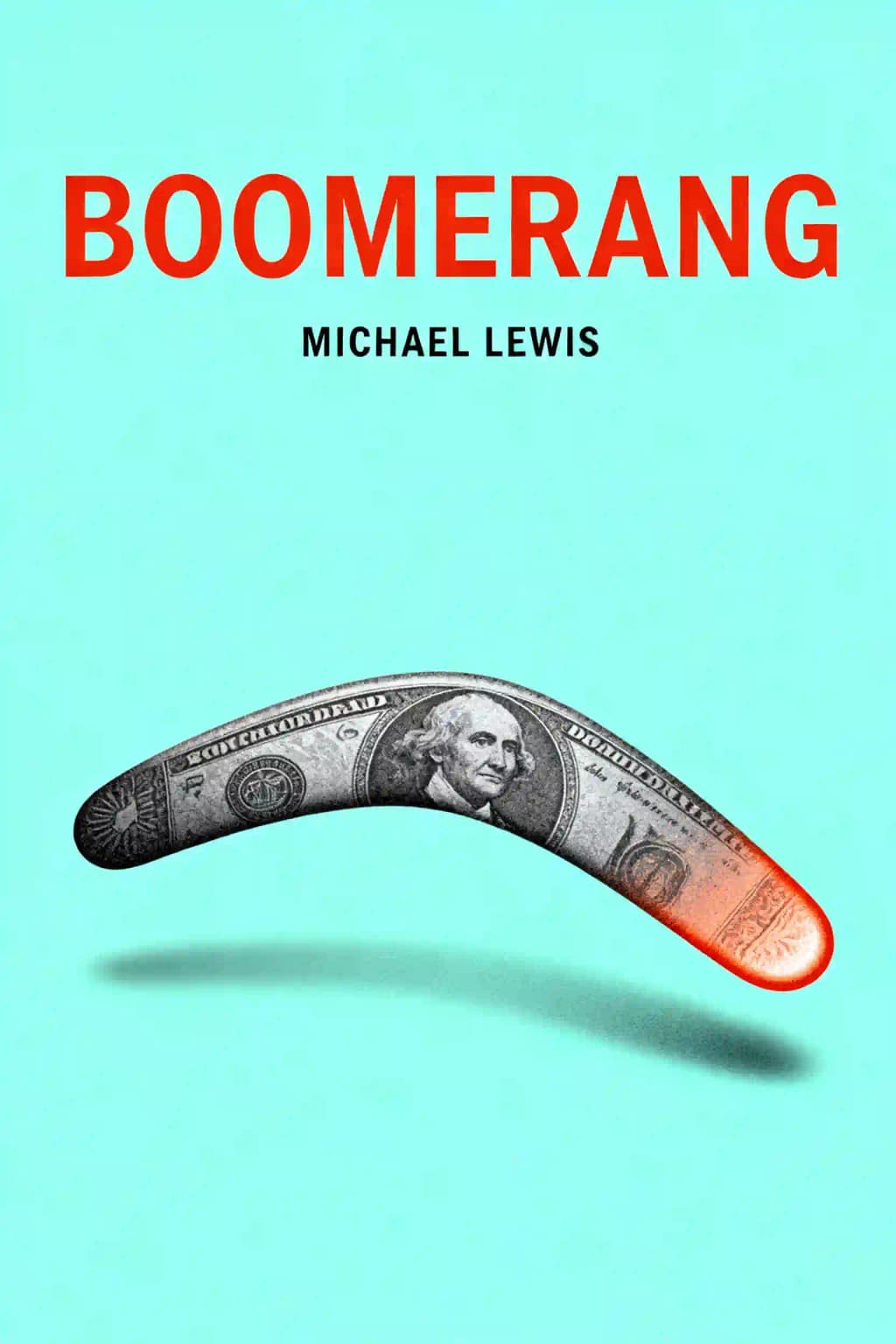
The Boomerang Effect of Financial Excess
The global financial crisis revealed a fundamental truth about human nature: when offered easy money, societies respond in ways that amplify their deepest cultural traits. Americans, driven by their cultural emphasis on individualism and material success, built increasingly oversized homes while turning a blind eye to predatory lending practices. Icelanders, with their Viking heritage of bold risk-taking, abandoned their thousand-year fishing tradition to remake themselves as global investment bankers. Germans doubled down on their reputation for order, becoming even more rigidly rule-focused in their financial dealings. The Irish struggled against their historical fatalism, embracing a property bubble with almost desperate optimism. Greeks transformed their government into a pinata stuffed with money, reflecting deep-rooted patterns of clientelism and institutional mistrust.
What Lewis masterfully demonstrates is how the global tsunami of cheap credit between 2002-2007 offered societies the chance to reveal hidden aspects of their national character. In Spain, the construction boom reflected centuries-old dreams of grandeur. In Iceland, three banks accumulated assets worth 850% of the country's GDP, embodying a national tendency toward dramatic overreach. The financial crisis wasn't just an economic phenomenon but a cultural one - a mirror reflecting each nation's values, priorities, and deeply embedded flaws.
The boomerang effect manifested with devastating precision. The very money thrown outward during the boom years came hurtling back in the form of sovereign debt crises, punishing austerity measures, and widespread social upheaval. Nations that had most enthusiastically embraced financial excess suffered the most severe consequences. Ireland's property values collapsed by more than 50%, while Greece's unemployment rate soared above 25%. The money that had seemed to offer freedom became the instrument of their bondage, with interest payments consuming ever-larger portions of national budgets.
Yet Lewis's narrative isn't entirely pessimistic. Through the stories of prescient individuals like Morgan Kelly in Ireland, who predicted the property crash with remarkable accuracy when no one would listen, or Arnold Schwarzenegger in California, who attempted structural reforms despite entrenched systemic resistance, we see the potential for change. The financial crisis stripped away comfortable illusions and forced societies to confront uncomfortable truths about themselves. In Iceland, this led to the prosecution of bankers and meaningful financial reforms. In Ireland, it prompted a painful but necessary reassessment of economic priorities.
Perhaps the most important lesson from "Boomerang" is that financial systems ultimately reflect human nature in all its complexity. The same ingenuity that creates prosperity can, without proper constraints and oversight, lead to catastrophic disaster. But human adaptability also offers hope - the capacity to learn from mistakes and build more sustainable systems. This is evident in the post-crisis reforms implemented across Europe and the United States, from stricter banking regulations to more transparent financial reporting requirements. As idiotic as optimism sometimes seems in the face of financial folly, it has a weird habit of paying off, particularly when coupled with hard-learned lessons and meaningful institutional change.