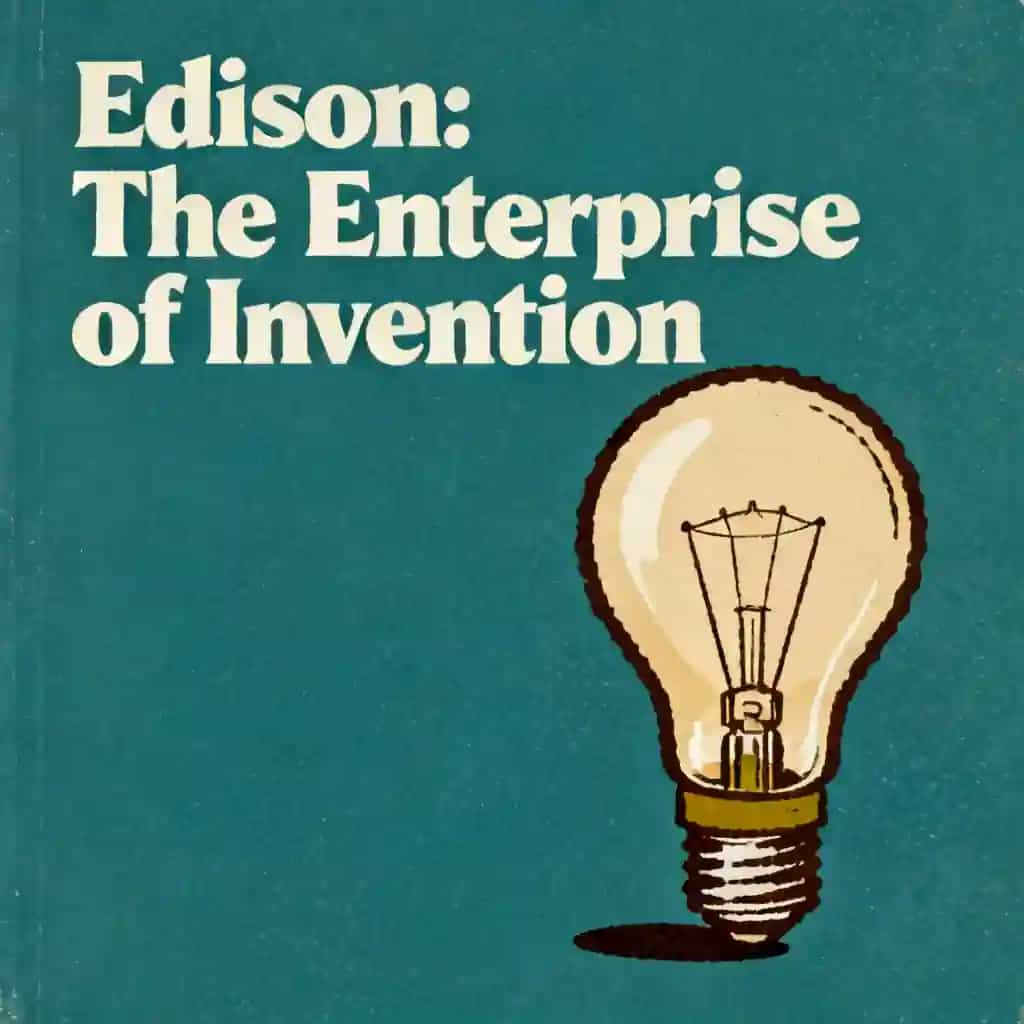
"Edison" by Edmund Morris unveils the complex genius behind 1,093 patents that power our modern world. A Pulitzer Prize finalist that captivated Walter Isaacson, this biography reignites debates about innovation ethics. What dark truths about America's greatest inventor remain hidden in plain sight?
Edmund Morris (1940–2019) was a Pulitzer Prize-winning biographer and author of Edison, specializing in crafting definitive portraits of transformative historical figures. Born in Kenya and educated in South Africa, Morris transitioned from advertising copywriter to master biographer.
He is best known for his acclaimed trilogy on Theodore Roosevelt—The Rise of Theodore Roosevelt (Pulitzer Prize and National Book Award), Theodore Rex, and Colonel Roosevelt—a 2,500-page achievement hailed for blending rigorous scholarship with narrative brilliance. His groundbreaking Dutch: A Memoir of Ronald Reagan, the only biography authorized by a sitting president, redefined presidential historiography through innovative storytelling.
Morris’s works explore themes of leadership, innovation, and legacy, reflecting his meticulous research and literary flair. A trusted voice in historical biography, his final book, Edison, dissects the inventor’s genius, cementing Morris’s reputation for resurrecting complex icons. His Roosevelt trilogy remains essential reading in U.S. history curricula, with The Rise of Theodore Roosevelt enduring as a 20th-century biographical classic.
Bedtime Biography: Edison chronicles Thomas Edison’s journey from a newsboy to America’s most prolific inventor, highlighting his relentless work ethic, curiosity, and impact on modern technology. Edmund Morris delves into Edison’s personal struggles, including his hearing loss, entrepreneurial ventures, and relationships, while emphasizing his 1,093 patents and innovations like the phonograph and electric light.
This book is ideal for history enthusiasts, innovators, and readers fascinated by biographical deep dives. Morris’s narrative appeals to those interested in Edison’s problem-solving mindset, his failures in mining and cement ventures, and how his inventions shaped 20th-century industrialization.
Yes—Morris’s seven years of research, access to Edison’s five-million-page archive, and engaging prose make this a definitive biography. It balances technical insights with humanizing anecdotes, such as Edison’s insomnia-driven work habits and strained family dynamics, offering a nuanced portrait of a complex genius.
Morris employs vivid storytelling, blending meticulous detail with narrative flair. He contextualizes Edison’s inventions within societal shifts, explores his rivalry with Nikola Tesla, and contrasts his obsessive focus with his emotional detachment from loved ones, creating a multidimensional portrayal.
The book highlights Edison’s phonograph, incandescent light bulb, and motion picture camera. It also examines lesser-known projects like his failed iron-ore mining venture and cement innovations, showcasing his iterative approach to problem-solving.
Edison’s progressive deafness, starting in adolescence, sharpened his focus on visual and tactile experimentation. Morris argues this “sensory isolation” fostered deep concentration, enabling breakthroughs like sound recording despite his disability.
Some readers may find Morris’s technical descriptions dense, particularly in sections detailing electrical engineering concepts. Additionally, the book prioritizes Edison’s professional achievements over his personal life, offering limited insight into his marriages and children.
Unlike purely technical accounts, Morris emphasizes Edison’s psychological drive and business acumen. The reverse chronological structure in later chapters distinguishes it from linear biographies, revealing how晚年 health struggles fueled his urgency to innovate.
Edison’s relentless experimentation (“1% inspiration, 99% perspiration”) underscores the value of iterative failure. His ventures into electric power distribution and battery storage also illustrate the importance of scalable infrastructure for technological adoption.
As AI and renewable energy dominate innovation, Edison’s systemic approach to R&D—merging invention with commercialization—offers a blueprint for tackling climate change and tech ethics. His adaptability mirrors today’s startup culture of pivoting amid disruption.
The book acknowledges Edison’s use of stray animals in electrocution experiments to discredit AC power. Morris frames this as part of his ruthless rivalry with George Westinghouse, revealing the dark side of his competitive drive.
Morris relied on the Edison National Historic Park’s five million documents, Rutgers University’s Edison Papers, and contemporaneous news articles. This exhaustive research debunks myths, such as Edison “stealing” ideas, by tracing his patent filings and lab notebooks.
通过作者的声音感受这本书
将知识转化为引人入胜、富含实例的见解
快速捕捉核心观点,高效学习
以有趣互动的方式享受这本书
My mother was the making of me.
Life is so short, I am going to hustle.
Persistent effort trumped natural talent.
I was never so taken aback in my life.
Edison is the perfect example of how one person's imagination can literally reshape civilization.
将《Edison》的核心观点拆解为易于理解的要点,了解创新团队如何创造、协作和成长。
通过生动的故事体验《Edison》,将创新经验转化为令人难忘且可应用的精彩时刻。
随时提问,选择你的学习方式,共创真正适合你的洞察。

"Instead of endless scrolling, I just hit play on BeFreed. It saves me so much time."
"I never knew where to start with nonfiction—BeFreed’s book lists turned into podcasts gave me a clear path."
"Perfect balance between learning and entertainment. Finished ‘Thinking, Fast and Slow’ on my commute this week."
"Crazy how much I learned while walking the dog. BeFreed = small habits → big gains."
"Reading used to feel like a chore. Now it’s just part of my lifestyle."
"Feels effortless compared to reading. I’ve finished 6 books this month already."
"BeFreed turned my guilty doomscrolling into something that feels productive and inspiring."
"BeFreed turned my commute into learning time. 20-min podcasts are perfect for finishing books I never had time for."
"BeFreed replaced my podcast queue. Imagine Spotify for books — that’s it. 🙌"
"It is great for me to learn something from the book without reading it."
"The themed book list podcasts help me connect ideas across authors—like a guided audio journey."
"Makes me feel smarter every time before going to work"

免费获取《Edison》摘要的 PDF 或 EPUB 版本。可打印或随时离线阅读。
In 1879, a scruffy inventor in a New Jersey laboratory carbonized a simple cotton thread, sealed it in a glass bulb, and watched it glow for thirteen hours straight. That moment didn't just birth the light bulb-it announced the arrival of a man who would reshape civilization itself. Thomas Edison wasn't born brilliant. He was kicked out of school after three months, labeled "addled" by a teacher who couldn't grasp his restless curiosity. Yet this supposedly slow child would go on to hold 1,093 patents and create industries that didn't exist before he imagined them. What made Edison extraordinary wasn't genius in the traditional sense-it was something far more accessible and, frankly, more inspiring: an almost superhuman capacity for work married to an unshakeable belief that problems were just puzzles waiting to be solved.
Young Al Edison didn't fit the mold. While other children memorized lessons, he conducted chemistry experiments in a train's baggage car - until he nearly burned it down with phosphorus. Most kids would have been chastened. Edison just moved his laboratory elsewhere. His mother Nancy saw what others missed. When teachers gave up on him, she gave him books - particularly Michael Faraday's work on electricity. By his teens, Edison was a telegraph operator, earning the nickname "Luny Edison" because he spent every cent on scientific equipment instead of food. At twenty-one, he declared: "I am now twenty-one. I may live to be fifty. Can I get as much done as Faraday did? I have got so much to do and life is so short, I am going to hustle." That urgency became his operating system. While others pondered, Edison experimented. His approach wasn't elegant or academic - it was relentless, systematic, and devastatingly effective.
Edison's greatest invention wasn't the light bulb or phonograph - it was the invention factory itself. In 1876, he established Menlo Park, the world's first industrial research laboratory, fundamentally changing how innovation worked. Before Edison, inventors toiled alone in workshops, guarding secrets. Edison assembled teams - chemists, physicists, craftsmen, mathematicians - and set them loose on problems together. The place ran on controlled chaos. When inspiration struck, work continued for days without pause. Edison would sleep on laboratory tables, wake up, and immediately resume experimenting. His assistant once found him unconscious after a seventy-two-hour marathon, surrounded by equipment. He valued skilled hands as much as trained minds. Charles Batchelor, his closest collaborator, was an English mechanic with extraordinary practical intelligence but zero formal scientific education. Within six years, Menlo Park generated over four hundred patents. That model - organized, collaborative, relentlessly experimental - became the blueprint for every corporate research lab that followed, from Bell Labs to Google X.
In July 1877, Edison noticed something odd while tinkering with telegraph technology: when recording tape moved quickly, the stylus made sounds resembling human speech. Most would have dismissed it as noise. Edison saw possibility. If telegraph signals could create indentations, why not sound waves? By December, he'd sketched a cylinder wrapped in tinfoil, a diaphragm, and a stylus. When machinist John Kruesi built it, Edison shouted "Mary had a little lamb" into the speaking tube, then cranked the handle. His own voice played back. Even Edison was stunned: "I was never so taken aback in my life." The phonograph exploded into public consciousness. President Hayes stayed up until 3 a.m. playing with it at a White House demonstration. For all of human history, sound had been ephemeral-a voice, once spoken, vanished forever. Edison made sound permanent. As one observer noted, "the voices of the dead could now be heard again." Edison thought it would be used for business dictation. He'd completely missed that he'd just created the entire recording industry, fundamentally changing how humans experience music and preserve culture.
When Edison announced in 1878 that he would create practical electric light, skeptics laughed. Arc lamps existed but were too bright for homes, and gas companies held enormous power. What separated Edison from other inventors was his understanding that the light bulb was just one piece of a larger puzzle. You needed generators, distribution networks, meters, safety systems-an entire infrastructure. While competitors focused on bulb design, Edison engineered a revolution. He tested thousands of filament materials with obsessive patience. In October 1879, carbonized cotton thread burned for over thirteen hours. By New Year's Eve, Menlo Park became the "Village of Light," illuminated by fifty lamps drawing thousands of visitors on special trains. The real magic came three years later. On September 4, 1882, Edison opened Pearl Street station in Manhattan-the world's first central power plant serving fifty-nine customers through underground cables. Edison had just obsoleted thousands of years of human history. Night and day, the ancient rhythm governing all human activity, suddenly became negotiable.
When photographer Eadweard Muybridge proposed combining sequential photographs with the phonograph in 1888, Edison envisioned something grander: a system that would "do for the Eye what the phonograph does for the Ear." By 1891, working with assistant William Dickson, he developed the Kinetograph (camera) and Kinetoscope (viewer). The first film, "Monkeyshines," showed a laboratory employee waving his arms-blurry, brief, but historic as America's first motion picture. Edison built the Black Maria, a bizarre tar-paper studio that rotated on tracks to follow the sun, producing vaudeville acts, boxing matches, and dancers. When the Kinetoscope debuted in 1894, people lined up to peer through peepholes at moving images, paying twenty-five cents for five short films. The attraction was irresistible-reality captured and replayed, time made repeatable. Edison initially resisted projection technology, preferring peepshow formats that required multiple machines. This miscalculation cost him market dominance when competitors developed successful projectors. Still, his systematic commercialization laid foundations for one of humanity's most influential industries-an art form that would shape culture, politics, and consciousness itself for generations.
At eighty, Edison pursued his final quest-finding a domestic rubber source to free America from foreign dependence. Partnering with Henry Ford and Harvey Firestone, he tested over seventeen thousand plant species, crossbreeding goldenrod to achieve twelve percent rubber content. He reviewed research from his deathbed until days before dying on October 18, 1931. President Hoover asked Americans to dim their lights for one minute in tribute-a moment when the nation Edison illuminated briefly returned to darkness. His legacy transcends 1,093 patents-it's his conviction that human ingenuity can overcome any obstacle through relentless persistence. His declaration that "genius is one percent inspiration and ninety-nine percent perspiration" democratized innovation itself-breakthrough ideas don't require supernatural brilliance, just superhuman effort. Nearly a century later, we still inhabit Edison's world. Every light switch, recording, and film traces back to his vision. But his deepest gift was proving the future isn't something that happens to us-it's something we build, one experiment at a time. His life whispers a radical truth: the obstacles that feel insurmountable today are just tomorrow's solved problems, waiting for someone stubborn enough to refuse to quit.