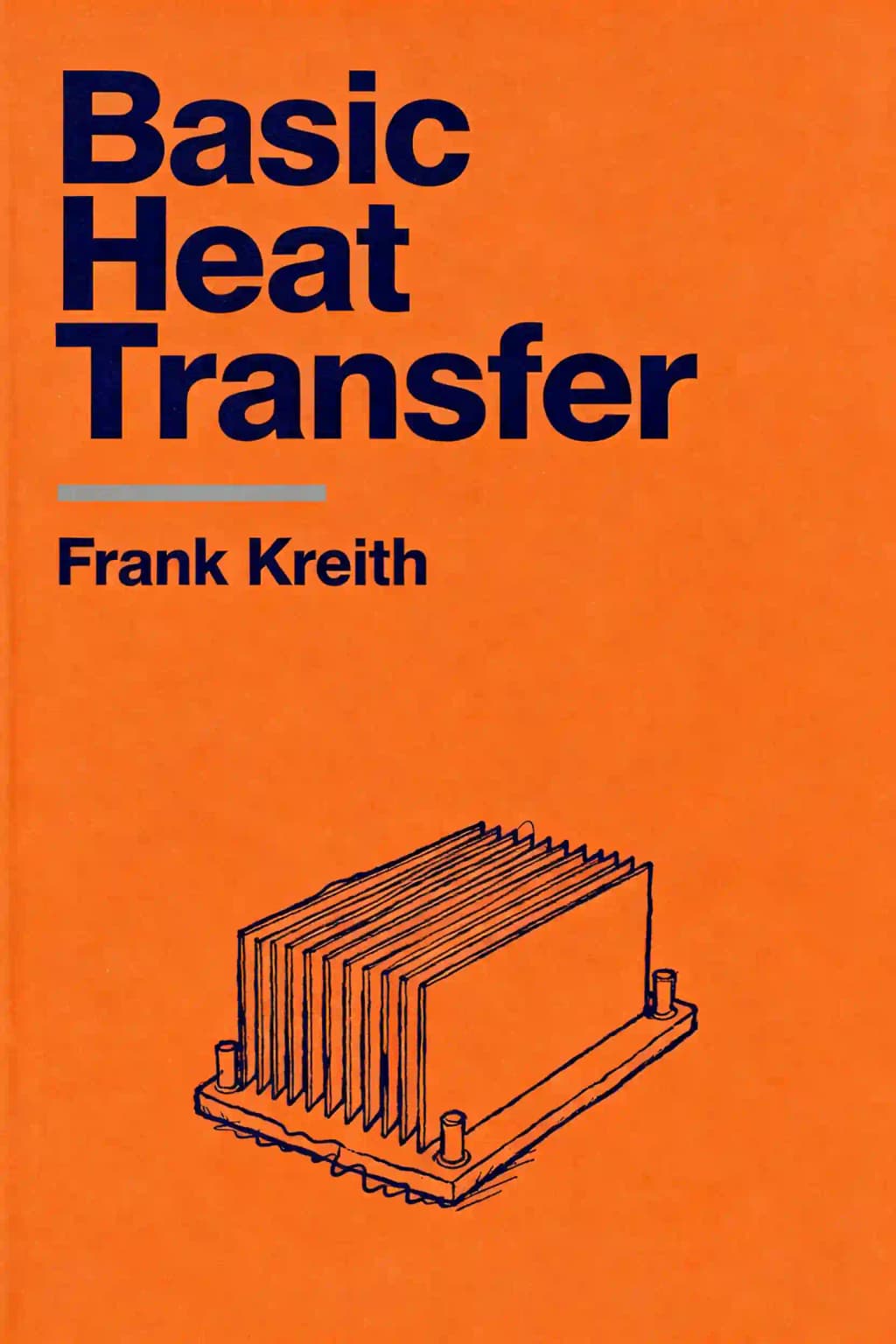
Master the invisible force that powers our world. "Basic Heat Transfer" by Frank Kreith, the cornerstone text that shaped generations of engineers, reveals thermal principles behind everything from spacecraft to your coffee mug. Required reading in elite engineering programs worldwide.
Frank Kreith, author of Basic Heat Transfer, was a pioneering mechanical engineer and renewable energy expert whose work shaped thermal science education and sustainable energy research.
A professor emeritus at the University of Colorado Boulder, Kreith combined academic rigor with real-world application, having contributed to rocket engine heat transfer at NASA’s Jet Propulsion Laboratory and led solar energy research at the National Renewable Energy Laboratory (NREL). His seminal textbook Principles of Heat Transfer became a cornerstone of engineering curricula, praised for bridging theoretical concepts with practical solutions for energy systems.
Kreith’s expertise extended beyond academia—he advised policymakers as a National Conference of State Legislatures Fellow and co-authored influential works on sustainable energy, including Principles of Sustainable Energy Systems. Honored with the ASME Frank Kreith Energy Award for lifelong contributions to renewable energy, his research remains foundational in engineering.
Kreith’s legacy endures through his mentorship of generations of engineers and his role in establishing the ASME Journal of Solar Energy Engineering, which he co-founded and edited.
Basic Heat Transfer by Frank Kreith provides a foundational exploration of heat transfer principles, including conduction, convection, and radiation. It emphasizes analytical problem-solving while integrating real-world applications in renewable energy, bioengineering, and materials processing. The book balances theoretical rigor with practical examples, making it a staple for understanding thermal systems.
This book is ideal for mechanical engineering students, early-career engineers, and professionals working with thermal systems like heat exchangers or insulation. Its clear explanations of core concepts also benefit interdisciplinary engineers in fields like energy systems or microelectronics.
Yes, it remains a respected resource for its structured approach to heat transfer fundamentals. Praised for its clarity and relevance, the book is widely used in academic courses and serves as a reference for solving real engineering challenges.
The book details three mechanisms:
Chapter 3 covers transient conduction using analytical methods like the lumped capacitance model and numerical solutions. It focuses on temperature distribution over time in materials, with examples ranging from industrial cooling to electronics thermal management.
Examples include designing thermal insulation, optimizing heat exchangers, and addressing challenges in renewable energy systems. Case studies span aerospace, microelectronics cooling, and energy-efficient building design.
While newer editions (like Principles of Heat Transfer) incorporate computational methods, Kreith’s original text excels in foundational theory and analytical problem-solving. It’s often paired with modern computational guides for comprehensive learning.
Key formulas include:
Yes, it explains heat exchanger types (e.g., shell-and-tube), the log mean temperature difference (LMTD) method, and effectiveness-NTU analysis. Applications include industrial process optimization and energy recovery systems.
Some readers note limited coverage of advanced computational tools (e.g., CFD) compared to modern texts. However, its focus on analytical methods remains valuable for building core problem-solving skills.
The book links heat transfer to the First Law of Thermodynamics, emphasizing energy conservation in systems like insulated pipes or radiative cooling setups. This integration clarifies real-world energy efficiency challenges.
Its principles underpin emerging technologies like battery thermal management for EVs and renewable energy storage. The analytical frameworks remain critical for sustainability-driven engineering innovations.
通过作者的声音感受这本书
将知识转化为引人入胜、富含实例的见解
快速捕捉核心观点,高效学习
以有趣互动的方式享受这本书
Heat transfer represents energy in transit due to temperature differences.
Radiation transmits energy through electromagnetic waves, requiring no medium at all.
Understanding these mechanisms isn't just academic-it's practical engineering.
Heat conduction represents nature's most intimate energy transfer mechanism.
By mastering these principles, we gain the ability to control thermal energy flows.
将《Basic heat transfer》的核心观点拆解为易于理解的要点,了解创新团队如何创造、协作和成长。
将《Basic heat transfer》提炼为快速记忆要点,突出坦诚、团队合作和创造力的关键原则。

通过生动的故事体验《Basic heat transfer》,将创新经验转化为令人难忘且可应用的精彩时刻。
随心提问,选择声音,共同创造真正与你产生共鸣的见解。

"Instead of endless scrolling, I just hit play on BeFreed. It saves me so much time."
"I never knew where to start with nonfiction—BeFreed’s book lists turned into podcasts gave me a clear path."
"Perfect balance between learning and entertainment. Finished ‘Thinking, Fast and Slow’ on my commute this week."
"Crazy how much I learned while walking the dog. BeFreed = small habits → big gains."
"Reading used to feel like a chore. Now it’s just part of my lifestyle."
"Feels effortless compared to reading. I’ve finished 6 books this month already."
"BeFreed turned my guilty doomscrolling into something that feels productive and inspiring."
"BeFreed turned my commute into learning time. 20-min podcasts are perfect for finishing books I never had time for."
"BeFreed replaced my podcast queue. Imagine Spotify for books — that’s it. 🙌"
"It is great for me to learn something from the book without reading it."
"The themed book list podcasts help me connect ideas across authors—like a guided audio journey."
"Makes me feel smarter every time before going to work"

免费获取《Basic heat transfer》摘要的 PDF 或 EPUB 版本。可打印或随时离线阅读。
Heat transfer shapes our world in ways we rarely notice yet cannot live without. From the warming sensation of sunlight on your skin to the cooling system preventing your smartphone from overheating, thermal energy's movement follows precise physical laws that engineers have harnessed to build our modern world. This invisible dance of energy occurs through three fundamental mechanisms that often work together: conduction, convection, and radiation. Understanding these principles isn't merely academic-it's the foundation for technologies that define contemporary life. When you feel the handle of a metal pot heating up as you cook, you're experiencing conduction. When warm air rises from a heater to circulate through your home, that's convection at work. And when you feel warmth from a campfire without touching the flames, you're sensing radiation. These processes follow mathematical patterns that allow us to predict and control thermal energy-cooling what needs cooling and heating what needs heating-a capability that underpins everything from climate control to computing.