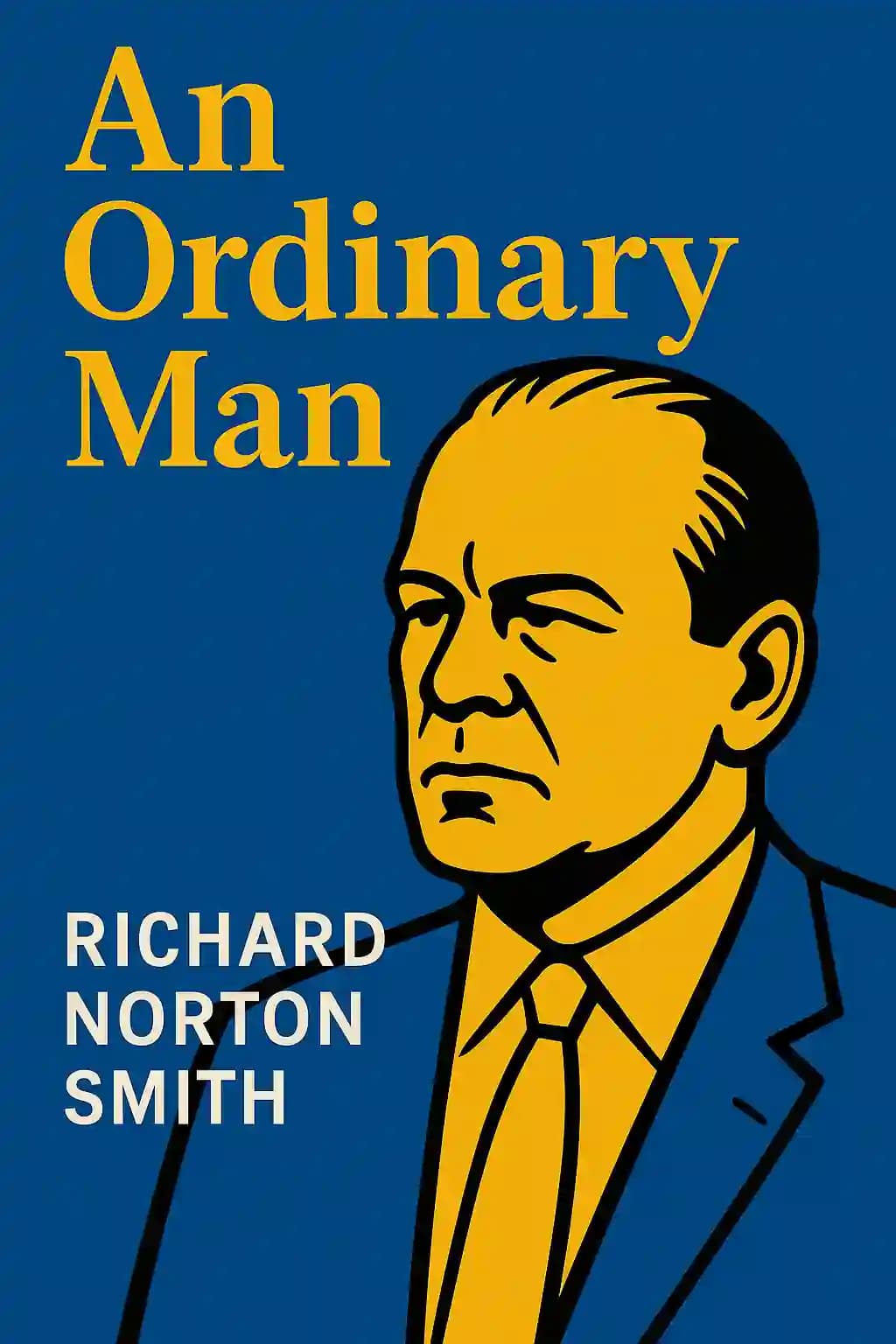
Beyond the "accidental president" caricature lies Gerald Ford's extraordinary leadership during America's constitutional crisis. This definitive biography, a Wall Street Journal Top 10 Book of 2023, reveals how an "ordinary man" with uncommon courage saved democracy when America needed it most.
Richard Norton Smith, acclaimed presidential historian and Pulitzer Prize finalist, explores the transformative legacy of Gerald R. Ford in An Ordinary Man: The Surprising Life and Historic Presidency of Gerald R. Ford. A Harvard-educated scholar and former director of multiple presidential libraries—including those of Herbert Hoover, Ronald Reagan, and Gerald Ford—Smith brings unparalleled expertise to this biography of the 38th president.
His works, such as The Colonel: The Life and Legend of Robert R. McCormick (winner of Harvard’s Goldsmith Prize) and On His Own Terms: A Life of Nelson Rockefeller, have established him as a leading authority on political leadership.
A frequent C-SPAN commentator and congressional speaker, Smith blends archival rigor with narrative flair to reframe Ford’s underrated presidency. His 14-year research odyssey for On His Own Terms exemplifies his commitment to depth, a hallmark mirrored in An Ordinary Man.
Smith’s insights, honed through decades curating presidential legacies, reveal Ford’s pivotal role in healing post-Watergate America. This latest work cements Smith’s reputation for revitalizing historical narratives, following his groundbreaking tenures at the Abraham Lincoln Presidential Library and Robert J. Dole Institute of Politics.
An Ordinary Man explores Gerald R. Ford’s journey from a modest Midwestern upbringing to the U.S. presidency, emphasizing his integrity, crisis management during Watergate, and efforts to restore national trust. The biography reveals Ford’s underrated leadership, pivotal decisions like Nixon’s pardon, and his commitment to bipartisanship.
History enthusiasts, political science students, and readers interested in post-Watergate governance will find value in this deep dive into Ford’s presidency. It’s also ideal for leadership scholars studying humility in crisis management.
Yes—Smith’s meticulous research and engaging narrative offer fresh insights into Ford’s legacy, balancing his achievements (economic stabilization, diplomatic strides) with critiques (e.g., handling of the Warren Commission). The book reshapes perceptions of Ford as a “transitional” leader.
Key themes include integrity over ambition, the restoration of public trust, and principled compromise. Ford’s Midwestern values, congressional pragmatism, and willingness to prioritize country over party recur throughout.
Ford is depicted as a consensus-builder who valued transparency and stability. His hands-on approach to Congress, willingness to work across aisles, and focus on healing post-Watergate divisions define his leadership.
Ford pardoned Nixon to halt national divisiveness and refocus on pressing issues like inflation and foreign policy. Smith argues this controversial decision, though politically costly, exemplified Ford’s belief in “merciful justice”.
The book counters the “accidental president” narrative by highlighting Ford’s strategic foresight, legislative acumen, and resilience during economic crises. It positions him as a proactive stabilizer, not a placeholder.
His Grand Rapids upbringing instilled humility, fiscal conservatism, and a service-oriented mindset. These values shaped his policy priorities (budget discipline, civil rights) and aversion to Washington elitism.
Smith’s focus on Ford’s character over political spectacle sets it apart. Unlike sensationalized accounts, it emphasizes quiet competence—making it a standout in leadership literature.
The book acknowledges criticism of Ford’s handling of the Warren Commission and economic policies but contextualizes these within era-specific challenges. Smith contrasts short-term disapproval with long-term historical reappraisal.
These lines underscore Ford’s belief in transparency and national unity post-Watergate.
In an era of political polarization, Ford’s emphasis on civility, institutional respect, and bipartisan problem-solving offers timely lessons. Smith frames his presidency as a model for bridging divides.
通过作者的声音感受这本书
将知识转化为引人入胜、富含实例的见解
快速捕捉核心观点,高效学习
以有趣互动的方式享受这本书
I'm a Ford, not a Lincoln.
Pragmatism over ideology feels increasingly like a lost art.
That one was for you.
He would always say, 'Calm down everybody. It'll turn out all right.'
Closer to death than any enemy attack.
将《Ordinary Man》的核心观点拆解为易于理解的要点,了解创新团队如何创造、协作和成长。
将《Ordinary Man》提炼为快速记忆要点,突出坦诚、团队合作和创造力的关键原则。

通过生动的故事体验《Ordinary Man》,将创新经验转化为令人难忘且可应用的精彩时刻。
随心提问,选择声音,共同创造真正与你产生共鸣的见解。

"Instead of endless scrolling, I just hit play on BeFreed. It saves me so much time."
"I never knew where to start with nonfiction—BeFreed’s book lists turned into podcasts gave me a clear path."
"Perfect balance between learning and entertainment. Finished ‘Thinking, Fast and Slow’ on my commute this week."
"Crazy how much I learned while walking the dog. BeFreed = small habits → big gains."
"Reading used to feel like a chore. Now it’s just part of my lifestyle."
"Feels effortless compared to reading. I’ve finished 6 books this month already."
"BeFreed turned my guilty doomscrolling into something that feels productive and inspiring."
"BeFreed turned my commute into learning time. 20-min podcasts are perfect for finishing books I never had time for."
"BeFreed replaced my podcast queue. Imagine Spotify for books — that’s it. 🙌"
"It is great for me to learn something from the book without reading it."
"The themed book list podcasts help me connect ideas across authors—like a guided audio journey."
"Makes me feel smarter every time before going to work"

免费获取《Ordinary Man》摘要的 PDF 或 EPUB 版本。可打印或随时离线阅读。
What does it take to lead a nation that never chose you? In August 1974, Gerald Ford became the only American president never elected to either the presidency or vice presidency. He inherited a country poisoned by political scandal, reeling from economic crisis, and watching its global influence crumble in real time. No inaugural parade, no electoral mandate, no honeymoon period-just the wreckage of Watergate and a nation's shattered faith in its institutions. Yet this unassuming former football player from Michigan would guide America through one of its darkest hours with a steady hand and moral clarity that cost him everything politically but earned him history's redemption. His story reveals a profound truth: sometimes the leaders we need aren't the ones we choose, and the decisions that define greatness are precisely those that destroy popularity.