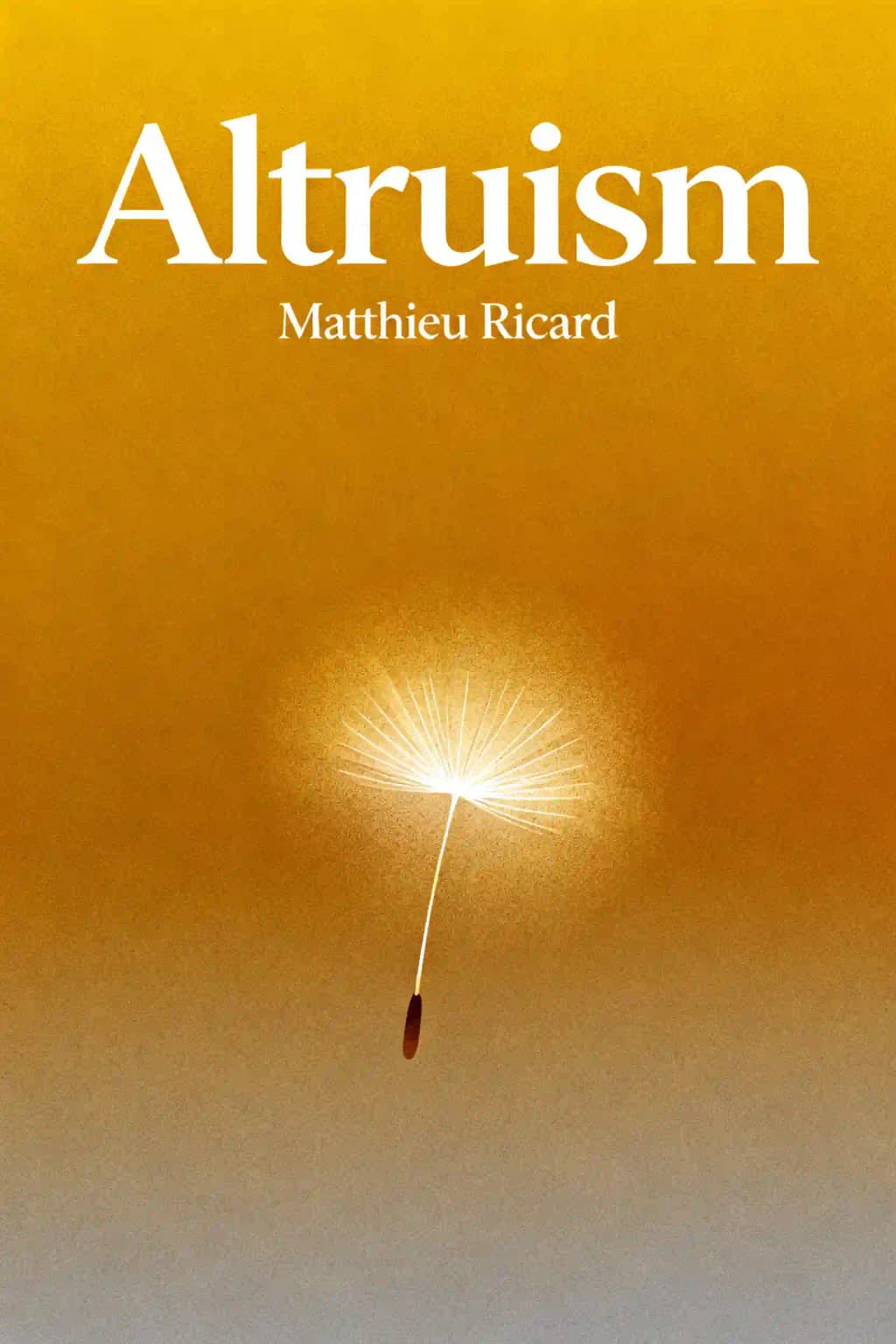
In "Altruism," Buddhist monk-scientist Matthieu Ricard reveals how compassion transforms both individuals and society. Endorsed by Arianna Huffington and Jane Goodall, this 849-page masterwork challenges our "selfish gene" assumption with compelling neuroscience. Can kindness actually solve our greatest global crises?
Matthieu Ricard, author of Altruism: The Power of Compassion to Change Yourself and the World, is a French-born Buddhist monk, bestselling writer, and influential advocate for integrating science with contemplative wisdom. A molecular biologist turned Himalayan monk, Ricard’s expertise spans neuroscience, ethics, and Buddhist philosophy, informed by over five decades of monastic life and collaborations with institutions like the Mind & Life Institute. His groundbreaking research on meditation’s impact on brain plasticity, conducted with neuroscientist Richard Davidson, underscores his unique authority on compassion and human flourishing.
Ricard’s prior works, including the international bestseller Happiness: A Guide to Developing Life’s Most Important Skill and The Monk and the Philosopher (coauthored with his father, Jean-François Revel), explore similar themes of wellbeing and existential purpose.
A prolific translator of Tibetan texts and photographer of Himalayan culture, he has also coauthored The Quantum and the Lotus with astrophysicist Trinh Xuan Thuan, bridging spiritual and scientific paradigms. Serving as the Dalai Lama’s French interpreter, Ricard’s insights have been featured in TED Talks, Spirituality & Health Magazine, and global forums on ethics and economics. Altruism, hailed as a “masterpiece” by critics, has been translated into 15 languages and emphasizes actionable strategies for cultivating empathy in modern society.
Altruism argues that genuine concern for others’ well-being is critical for solving 21st-century challenges like economic inequality, environmental crises, and personal fulfillment. Ricard blends neuroscience, philosophy, and real-world examples (e.g., humanitarian efforts in Nepal) to show how altruism can transform individuals and societies. The book synthesizes evidence from psychology, economics, and Buddhist ethics to advocate systemic change through compassion.
This book is ideal for readers interested in psychology, social justice, or global affairs, as well as leaders and policymakers seeking ethical frameworks. Economists like Amartya Sen and Joseph Stiglitz endorse its ideas, making it relevant for professionals in economics, sustainability, and nonprofit sectors. It’s also accessible to general audiences through gripping anecdotes, such as a man rescuing a child from a lion.
Yes—critics praise its “encyclopedic synthesis” of scientific research, historical examples, and actionable insights. Though lengthy (704 pages), its short chapters and narrative style make complex topics digestible. The Wall Street Journal calls it “immensely useful” for personal growth and societal reform. Ricard donates all proceeds to humanitarian projects, adding ethical value to the purchase.
Enlightened altruism combines individual compassion with systemic action, such as policy changes or nonprofit work. Ricard emphasizes that personal mindfulness practices (like meditation) must align with collective efforts—e.g., his NGO Karuna-Shechen builds schools and clinics in Nepal. This approach addresses root causes of suffering rather than symptoms.
Ricard argues altruism boosts economic resilience and employee satisfaction. Companies prioritizing ethical practices (e.g., fair wages, sustainability) often see long-term success. He cites studies showing that prosocial behavior reduces inequality, fostering trust and innovation. For example, “conscious capitalism” models align profit motives with social good.
Some reviewers note the book’s length (700+ pages) and dense academic references might overwhelm casual readers. Others argue Ricard underplays structural barriers to systemic change, such as political corruption or corporate greed. However, most praise its ambition and rigor.
While Happiness focuses on personal well-being through mindfulness, Altruism scales these ideas to societal transformation. Both emphasize compassion, but Altruism adds practical strategies for collective action—e.g., advocating for education initiatives or climate policies.
Persistent issues like climate change, AI ethics, and global inequality make Ricard’s arguments urgent. The book’s call for “a culture of altruism” aligns with 2025 trends in corporate social responsibility and mental health advocacy. It also addresses post-pandemic societal fragmentation.
A Buddhist monk and former geneticist, Ricard bridges science and spirituality. His NGO work in Nepal informs real-world examples, while collaborations with economists like George Soros ground the book in policy debates. This dual expertise lends credibility to his interdisciplinary approach.
Ricard rejects GDP-centric metrics, advocating instead for “Gross National Happiness” and sustainable development. True success, he argues, prioritizes human dignity and ecological balance over material growth. For example, Bhutan’s happiness index serves as a model.
通过作者的声音感受这本书
将知识转化为引人入胜、富含实例的见解
快速捕捉核心观点,高效学习
以有趣互动的方式享受这本书
Altruism isn't just a naive ideal but a practical solution.
Humans aren't solely selfish.
True compassion energizes rather than depletes.
Seeking your own joy often backfires.
Materialistic people report lower life satisfaction.
将《Altruism》的核心观点拆解为易于理解的要点,了解创新团队如何创造、协作和成长。
将《Altruism》提炼为快速记忆要点,突出坦诚、团队合作和创造力的关键原则。

通过生动的故事体验《Altruism》,将创新经验转化为令人难忘且可应用的精彩时刻。
随心提问,选择声音,共同创造真正与你产生共鸣的见解。

"Instead of endless scrolling, I just hit play on BeFreed. It saves me so much time."
"I never knew where to start with nonfiction—BeFreed’s book lists turned into podcasts gave me a clear path."
"Perfect balance between learning and entertainment. Finished ‘Thinking, Fast and Slow’ on my commute this week."
"Crazy how much I learned while walking the dog. BeFreed = small habits → big gains."
"Reading used to feel like a chore. Now it’s just part of my lifestyle."
"Feels effortless compared to reading. I’ve finished 6 books this month already."
"BeFreed turned my guilty doomscrolling into something that feels productive and inspiring."
"BeFreed turned my commute into learning time. 20-min podcasts are perfect for finishing books I never had time for."
"BeFreed replaced my podcast queue. Imagine Spotify for books — that’s it. 🙌"
"It is great for me to learn something from the book without reading it."
"The themed book list podcasts help me connect ideas across authors—like a guided audio journey."
"Makes me feel smarter every time before going to work"

免费获取《Altruism》摘要的 PDF 或 EPUB 版本。可打印或随时离线阅读。
Imagine a world where our deepest fulfillment comes not from pursuing our own happiness but from caring for others. This isn't just an idealistic vision-it's what rigorous science increasingly reveals about human nature. Matthieu Ricard, a molecular geneticist turned Buddhist monk, challenges our fundamental assumptions about selfishness and altruism. While philosophers like Hobbes and economists like Adam Smith portrayed humans as primarily self-interested, decades of research now paint a dramatically different picture. We are wired for connection and compassion from our earliest days. Toddlers spontaneously help strangers without prompting or rewards. Our bodies physically synchronize during moments of genuine connection, improving our cardiovascular, hormonal, and immune systems. When we witness others suffering, our brains activate as if we ourselves were in pain. This capacity for caring isn't a cultural invention but a biological inheritance-one that holds the key to both personal happiness and solving our greatest global challenges.