第 1 章
When Algorithms Meet Life's Messy Realities
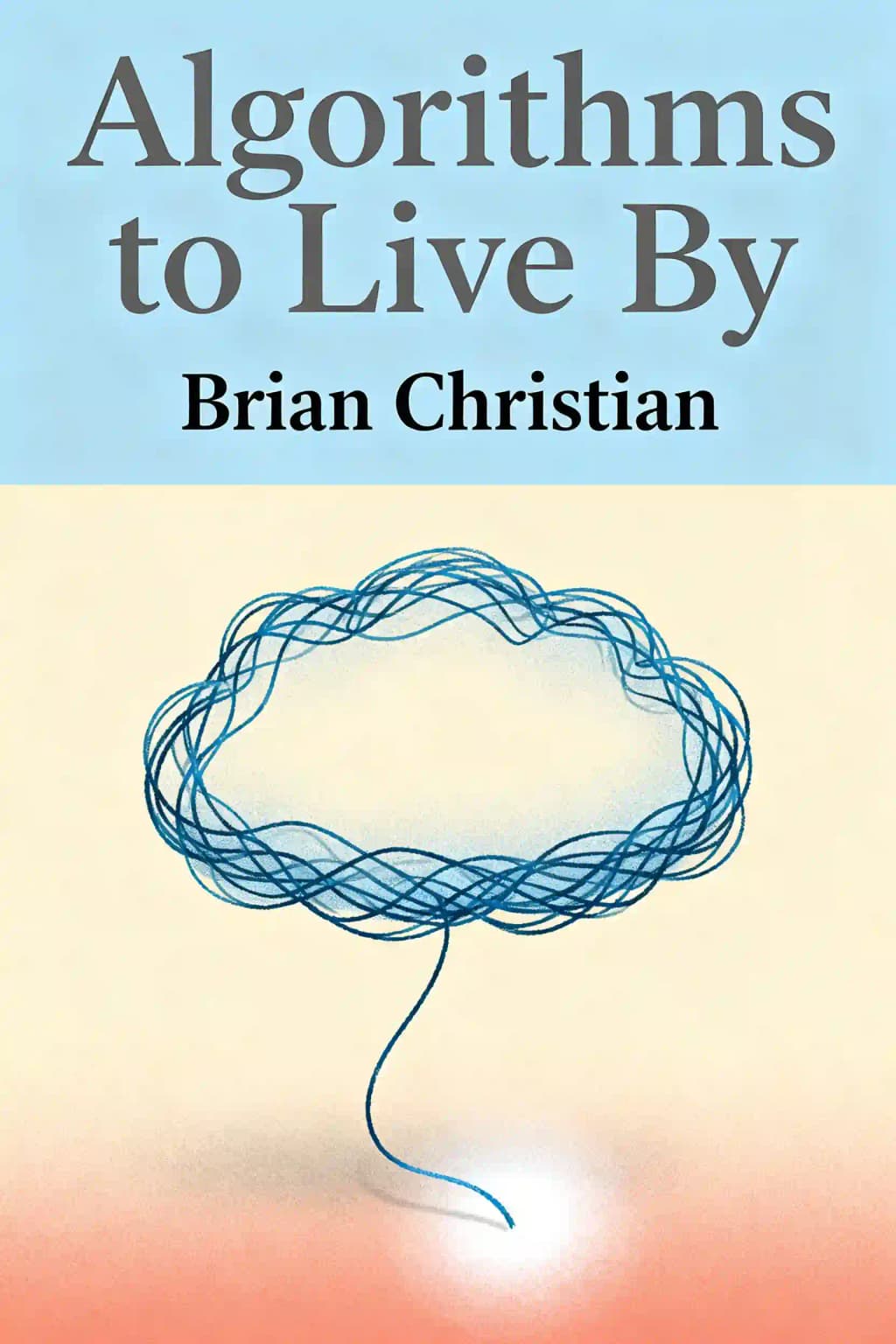
In the heart of San Francisco's competitive housing market, a counterintuitive strategy emerges: spend exactly 37% of your apartment search just gathering information, then immediately leap at the next option better than all you've seen. This isn't just real estate wisdom-it's mathematics at work in everyday life. "Algorithms to Live By," co-authored by Brian Christian and cognitive scientist Tom Griffiths, has become a cultural touchstone for those seeking clarity in life's chaotic decisions. Celebrated by tech leaders like Ev Williams (Twitter co-founder) and recommended in Bill Gates' reading list, this book bridges the gap between computer science and human decision-making. Since its 2016 publication, it has transformed how we think about ordinary choices-from organizing closets to finding love-by revealing the elegant mathematical frameworks beneath our messy human experiences.
第 2 章
The 37% Rule: When to Stop Looking and Commit
Imagine you're single and dating. How many people should you meet before deciding someone is "the one"? Or perhaps you're hunting for an apartment in a competitive market. When should you stop looking and make an offer? These scenarios exemplify what mathematicians call "optimal stopping problems"-knowing when to cease exploration and commit to a choice.
The solution, surprisingly elegant, is known as the 37% Rule. When facing sequential options with no chance to revisit passed opportunities, your best strategy is to spend the first 37% of your search (or time) just gathering information. During this phase, you reject everything. Then, you immediately accept the first option that exceeds all you've previously seen.
This approach emerged from the famous "Secretary Problem," where employers interview candidates one by one, making immediate hire-or-pass decisions. The problem captivated mathematicians like John Fox and Gerald Marnie in the 1950s, though its roots trace back to earlier puzzles like the "Game of Googol" and the "Cayley-Moser problem." The 37% solution provides your best chance-specifically a 37% probability-of selecting the absolute best candidate, regardless of whether you're choosing from 5 options or 5,000.
What makes this rule particularly fascinating is its application to romance. When mathematician Peter Backus calculated his chances of finding love in London, he applied similar principles to determine when to propose. The math suggests that if you expect to date from ages 18 to 40, your optimal strategy would be to date without serious commitment until age 26, then propose to the next person who's better than anyone you've dated before.
While the 37% Rule won't guarantee success, it offers the best mathematical odds in an uncertain world-a comforting thought when making life's most important decisions.
第 3 章
Full Information: Knowing When to Lower Your Standards
What happens when you have more information about your options? Let's say you're selling your house and have a sense of what offers might come in. This shifts us from the Look-Then-Leap Rule to what's called the Threshold Rule.
With full information about the distribution of possibilities, your chances of success jump from 37% to 58%. The key insight is that your threshold for acceptance should change over time. Early in your search, be highly selective. As opportunities dwindle, gradually lower your standards.
For example, if selling a house, you might initially reject offers below $300,000. But as weeks pass with few interested buyers, you might accept $290,000, then $280,000. The optimal strategy accounts for both the expected value of future offers and the cost of continued waiting.
This principle extends to job hunting, parking searches, and even knowing when to quit risky endeavors. Consider the tragic story of Russian oligarch Boris Berezovsky, a mathematician who understood optimal stopping theory yet failed to apply it to his own life. After amassing billions and challenging Putin's authority, he fled Russia but continued risky political maneuvers until losing everything-a poignant reminder that knowing when to walk away is as crucial as knowing when to pursue.
Studies suggest humans typically stop searching too early, settling for "good enough" rather than optimal outcomes. But the mathematics of optimal stopping reminds us of an uncomfortable truth: sometimes the best strategy still carries a high failure rate. Life offers no guarantees-only ways to maximize our chances in an uncertain world.
第 4 章
Explore or Exploit? The Balance Between Discovery and Reward
Should you try the new restaurant or return to your favorite? Visit a new vacation spot or revisit a beloved destination? This fundamental tension-between exploring new possibilities and exploiting known rewards-grows more complex with age and changing circumstances.
Computer scientists frame this as the "multi-armed bandit problem," imagining a gambler facing multiple slot machines with different payoff probabilities. The challenge: maximize total rewards without knowing which machine offers the best odds. This problem, foundational to mathematical psychology and machine learning, mirrors countless real-life scenarios.
The optimal strategy depends critically on your time horizon. With a long future ahead, exploration makes sense-the knowledge gained will benefit you for years. As time shortens, exploitation becomes more valuable. This explains why we become creatures of habit as we age-it's mathematically rational to rely on known pleasures when time feels limited.
Consider how Hollywood's increasing reliance on sequels and reboots might signal an industry perceiving a shortened future. When studios exploit proven franchises rather than exploring new stories, they're revealing a strategy optimized for short-term returns rather than long-term discovery.
Simple algorithms like "Win-Stay, Lose-Shift" prove surprisingly effective: stick with what works until it fails, then try something new. More sophisticated approaches like the Gittins Index and Upper Confidence Bound algorithms balance exploration and exploitation by factoring in both expected rewards and uncertainty.
These principles have revolutionized online experimentation through A/B testing and are reshaping clinical trials. Traditional medical studies often stick with fixed protocols even when early results suggest one treatment is superior. Newer "adaptive designs" shift patients toward promising treatments as evidence emerges-potentially saving lives while still gathering robust scientific data.
In our restless world where options constantly change, the explore/exploit dilemma never ends. We must continually balance the joy of discovery against the comfort of the familiar, guided by an awareness of our remaining time and the potential value of what remains undiscovered.
第 5 章
Sorting: The Fundamental Challenge of Organization
Every time you arrange your bookshelf, sort your email, or organize your closet, you're confronting one of computing's most fundamental challenges: sorting. This seemingly simple task-putting things in order-reveals profound insights about efficiency and tradeoffs.
Consider the humble task of matching socks after laundry. The naive approach-comparing each sock to every other sock-becomes painfully inefficient as the pile grows. Computer scientists measure this inefficiency using "Big-O notation," which describes how an algorithm's runtime grows with input size. The naive sock-matching method is "O(n2)"-quadratic time-meaning the work increases with the square of the number of items.
More sophisticated sorting algorithms break this quadratic barrier. Merge Sort, for instance, uses a "divide and conquer" approach, repeatedly splitting the problem into smaller parts before combining solutions. This reduces sorting time to O(n log n)-dramatically faster for large datasets. Some specialized sorting methods like Radix Sort can be even faster under certain conditions.
Sorting isn't just about efficiency-it's about robustness in the face of noise and uncertainty. When ranking sports teams, for instance, we can't directly compare every team against every other team. Instead, tournaments create a structured approach that approximates a full ranking while acknowledging inherent uncertainties.
Nature itself employs sorting algorithms. Chicken flocks establish "pecking orders" through direct confrontations, but not through exhaustive round-robin tournaments. Instead, chickens observe others' interactions and infer their relative standing-a more efficient approach that computer scientists have adapted into algorithms.
The principles of sorting extend beyond organizing physical objects or data. They help us understand how to structure competitions, establish social hierarchies, and even organize our thoughts. By recognizing the patterns and tradeoffs in sorting algorithms, we gain insight into the fundamental challenge of bringing order to chaos.
第 6 章
Caching: The Art of Forgetting
Imagine your closet is overflowing. Which items should you discard? This everyday problem mirrors one of computing's core challenges: managing limited storage space through effective "caching" strategies.
In computers, caching involves keeping frequently-needed data in fast, accessible memory while relegating less-used information to slower storage. The key question becomes: when space runs out, what should be removed?
The most effective approach, proven mathematically and practically, is surprisingly simple: discard the Least Recently Used (LRU) item. This principle works because temporal locality-the tendency for recently used items to be needed again soon-is a fundamental pattern in both computer operations and human activities.
Libraries demonstrate this principle beautifully. Traditional libraries shelve books by subject, but an LRU approach would place recently returned books in high-traffic areas before eventually returning them to their permanent locations. This seemingly chaotic system would actually optimize discovery by exposing patrons to what others are reading.
The internet itself relies on caching. Content Delivery Networks like Akamai maintain local copies of popular websites around the world, ensuring faster access by keeping information geographically close to users. This mirrors the memory hierarchy within computers, where speed correlates with proximity to the processor.
In our homes, LRU principles suggest keeping frequently used items in accessible locations while storing rarely-used ones in harder-to-reach spaces. The "Noguchi Filing System"-simply placing recently used documents at one end of a pile-creates a self-organizing structure that naturally prioritizes relevant information.
Even human memory appears optimized for LRU-like retrieval. Hermann Ebbinghaus's famous "forgetting curve" shows how memory decays over time, but cognitive scientists John Anderson and Lael Schooler discovered this curve closely matches statistical patterns in information relevance. Our memory systems aren't flawed-they're tuned to predict which information will be most valuable based on recency and frequency of use.
As we age and accumulate more experiences, memory retrieval naturally slows-not necessarily due to cognitive decline, but because we have larger "datasets" to search through. The challenge becomes one of organization rather than capacity, much like a computer with abundant but poorly managed storage.
第 7 章
Scheduling: Making Time for What Matters
We all face the daily puzzle of deciding what to do next. Should you tackle that big project or clear small tasks first? Computer scientists have been studying optimal scheduling for decades, and their insights can transform how we manage our time.
When tasks have deadlines, the optimal strategy is often straightforward: address them in order of due date (Earliest Due Date). But what if some tasks are more time-consuming than others? Moore's Algorithm offers a solution: start with the earliest due dates, but if you fall behind, drop the most time-consuming task to minimize the number of late items.
For tasks without strict deadlines, the Shortest Processing Time strategy proves surprisingly effective-tackle the quickest tasks first. This minimizes the average completion time across all tasks, rapidly shrinking your to-do list and providing psychological momentum.
When tasks vary in importance, the weighted shortest processing time approach becomes optimal: prioritize tasks by their importance divided by the time they'll take. This explains why we intuitively tackle important quick tasks before important lengthy ones-it's mathematically sound.
Scheduling becomes more complex when tasks depend on each other-what computer scientists call "precedence constraints." The Mars Pathfinder mission famously encountered a "priority inversion" problem when a low-priority task blocked a high-priority one, causing system resets. The solution involved "priority inheritance," temporarily elevating the blocking task's priority.
Preemption-the ability to pause tasks and switch-adds flexibility but comes with costs. Each "context switch" requires mental overhead to store your current state and recall the details of the new task. This explains why interruptions are so disruptive for complex work like programming or writing.
When overwhelmed by too many tasks, we risk "thrashing"-spending all our time switching contexts rather than making progress. The solution isn't always working harder; sometimes it's deliberately reducing the number of active projects or batching similar interruptions (like checking email) to minimize context switches.
These scheduling principles reveal that procrastination isn't always irrational-sometimes it's an optimal response to an incorrectly defined problem. By understanding the mathematical foundations of scheduling, we can make better decisions about how we allocate our most precious resource: time.
第 8 章
Bayes's Rule: Predicting in an Uncertain World
How do we make predictions when information is limited and uncertain? This question leads us to one of the most powerful ideas in statistics: Bayes's Rule, named after Reverend Thomas Bayes, whose groundbreaking paper was published posthumously in 1763.
Bayes's approach revolutionized prediction by providing a mathematical framework for updating beliefs based on new evidence. The formula combines prior beliefs with fresh data to form more accurate posterior beliefs-a process that mirrors how rational thinking should work.
Consider a medical test for a rare disease. If the test comes back positive, how worried should you be? Bayes's Rule tells us to consider both the test's accuracy and the disease's rarity. For very rare conditions, even accurate tests produce mostly false positives-a counterintuitive insight that has profound implications for medical screening programs.
The Copernican Principle, developed by physicist Richard Gott, offers a simple approach to prediction when little is known about a subject. It suggests that the future duration of something will likely mirror its past duration. If a Broadway show has run for one year, it will probably run for another year-no more, no less. While criticized for ignoring specific knowledge, this principle provides a reasonable starting point when information is scarce.
Different phenomena follow different statistical distributions, which dramatically affect predictions. Normal distributions (bell curves) cluster around average values, making mean-based predictions reasonable. Power-law distributions, with their "long tails" of extreme values, require multiplicative predictions-if a movie has grossed $10 million so far, expect it to reach $20 million total, not $10 million plus some fixed amount.
Remarkably, human intuition often aligns with these statistical principles. When asked to predict unknown quantities like ages or incomes based on limited samples, people naturally adjust their guesses based on the underlying distribution patterns-suggesting our brains have internalized sophisticated Bayesian reasoning.
Our predictions also reveal our worldview. The famous "marshmallow test," where children choose between one immediate treat or two delayed ones, isn't just about willpower-it reflects predictions about whether promises will be kept. Children from unstable environments rationally choose immediate rewards because their experience suggests future rewards may not materialize.
By understanding Bayesian reasoning, we gain insight not just into better predictions, but into how our experiences shape our expectations and decisions in an uncertain world.
第 9 章
Overfitting: When Thinking Less Leads to Better Decisions
Sometimes the path to better decisions involves thinking less, not more. This counterintuitive insight emerges from the problem of "overfitting"-when we build models so complex they capture noise rather than underlying patterns.
Consider a study on marriage satisfaction that analyzed couples' conversations. A complex model incorporating 16 factors perfectly explained past data but failed miserably at predicting future happiness. A simpler model using just one factor-whether conversations contained contempt-proved far more accurate for prediction. The complex model had "overfit" the data, mistaking random variations for meaningful patterns.
This phenomenon appears everywhere. Financial models with numerous parameters excel at "explaining" past market movements but often fail spectacularly at predicting future ones. Dietary studies identifying increasingly specific nutritional factors may miss broader patterns that actually determine health outcomes.
The risk of overfitting increases when data is limited or noisy-precisely the conditions we face in many life decisions. When uncertainty is high, simpler approaches often outperform complex ones. This explains why even Nobel Prize-winning economist Harry Markowitz used a simple 50/50 stock/bond allocation for his retirement rather than his own complex portfolio theory.
How can we avoid overfitting? Cross-validation offers one approach: test your model on data it hasn't seen during development. If performance drops significantly, you've likely overfit. Another technique, regularization, deliberately penalizes complexity to favor simpler explanations.
Evolution itself demonstrates a form of regularization through the slow pace of change. Organisms retain features that have proven robust across varied environments rather than rapidly adapting to every fluctuation. Cultural traditions similarly preserve practices that have worked across generations, providing stability against short-term disruptions.
The principle of "early stopping" in machine learning-halting the training process before it perfectly fits training data-mirrors how we might approach personal development. Rather than optimizing ourselves for current conditions that may soon change, we maintain some generality that serves us across varied circumstances.
When facing complex decisions with limited information, embracing simplicity isn't just easier-it's often more effective. By recognizing the dangers of overthinking, we can make more robust choices in an unpredictable world.
第 10 章
Relaxation: Finding Good Enough Solutions
Some problems are so complex that finding the perfect solution is practically impossible. Consider planning a trip to visit multiple cities-the infamous "traveling salesman problem." With just 10 cities, there are over 3 million possible routes. With 20 cities, more routes exist than atoms in the universe.
Computer scientists classify such problems as "NP-hard," meaning no efficient algorithm exists to solve them perfectly. Yet we face these challenges constantly-from organizing seating arrangements to scheduling complex projects.
The key insight: when perfect solutions are unattainable, "relaxation" techniques offer practical alternatives. These approaches simplify problems by temporarily ignoring or modifying constraints, solving the easier version, then adjusting toward feasibility.
For the traveling salesman problem, we might first find the "minimum spanning tree"-the shortest set of connections linking all cities without forming a complete loop. This provides a lower bound on the optimal solution's length and a starting point for building feasible routes.
"Continuous relaxation" transforms discrete problems (like assigning whole people to projects) into continuous ones (allowing fractional assignments). After solving the continuous version, we round to the nearest feasible solution. This approach powers algorithms that schedule sports leagues and assign medical residents to hospitals.
"Lagrangian relaxation" converts hard constraints into penalty terms in the objective function-like replacing speed limits with speeding tickets. This allows flexibility while still discouraging constraint violations, similar to how we balance rules and exceptions in daily life.
These techniques mirror how humans naturally approach complex problems-we simplify, approximate, and gradually refine rather than seeking perfection immediately. By embracing relaxation methods, we acknowledge that "good enough" solutions reached efficiently often serve us better than perfect solutions we can never attain.
The art lies in knowing which constraints can be temporarily relaxed without losing the problem's essence. This balance between pragmatism and idealism helps us navigate complexity in everything from daily schedules to major life decisions.
第 11 章
Randomness: The Unexpected Power of Chance
Counterintuitively, adding randomness to decision-making can sometimes lead to better outcomes than purely deterministic approaches. This insight has revolutionized computer science and offers surprising lessons for human decision-making.
The power of randomness emerges in sampling-using random subsets to understand larger wholes. In the 18th century, Georges-Louis Leclerc, Comte de Buffon, demonstrated how randomly dropping needles could estimate . This approach blossomed into the Monte Carlo method, developed at Los Alamos during the Manhattan Project, which uses random sampling to solve problems resistant to analytical solutions.
Randomized algorithms deliberately incorporate chance to solve problems more efficiently. The Miller-Rabin test for determining whether a number is prime uses random sampling to provide fast, reliable answers with near certainty-crucial for modern cryptography. These approaches trade absolute certainty for dramatic improvements in speed.
Beyond efficiency, randomness helps escape "local optima"-situations where incremental improvements lead to good but not great solutions. Imagine climbing a mountain in fog: moving consistently upward might lead to a minor peak rather than the highest summit. Occasionally taking random steps-even temporarily downhill-increases your chances of finding the true peak.
"Simulated annealing," inspired by metallurgy, gradually reduces randomness over time. Initially, the algorithm makes many random moves, allowing exploration of diverse possibilities. As it "cools," randomness decreases, focusing on refining promising solutions. This balance between exploration and refinement proves remarkably effective for complex optimization problems.
Randomness also plays a crucial role in creativity and evolution. Salvador Luria's breakthrough on bacterial mutation came through a chance observation that revealed bacteria develop resistance through random mutations rather than adaptive responses. This parallels how creative breakthroughs often emerge from unexpected connections rather than linear reasoning.
By embracing controlled randomness-knowing when to introduce chance into our decisions-we can overcome cognitive biases, escape ruts in our thinking, and discover solutions that deterministic approaches might never reveal. The strategic use of randomness isn't about abandoning reason but enhancing it with the power of exploration and serendipity.
第 12 章
Networking: Lessons from the Internet's Architecture
The internet-humanity's largest engineered system-offers profound lessons about communication, cooperation, and resilience. Its core principles extend far beyond technology into how we interact with each other.
Packet switching, the internet's foundational concept, breaks data into small chunks that find their own paths through the network. Unlike traditional circuit-switched systems (like old telephone networks) that establish dedicated connections, packet switching creates resilience through flexibility-if one path fails, packets route around the damage. This principle mirrors how resilient organizations and relationships adapt to changing circumstances rather than relying on rigid structures.
Acknowledgment protocols ensure reliability by confirming received messages. When a packet arrives, the recipient sends back confirmation; if no acknowledgment returns, the sender retransmits. This simple handshake creates reliability atop unreliable components-a principle that extends to human communication, where confirming understanding prevents cascading misinterpretations.
When network congestion occurs, exponential backoff provides an elegant solution: if your message doesn't get through, wait before trying again, doubling your waiting time with each attempt. This prevents congestion collapse where everyone continuously retransmits, making the problem worse. The principle applies equally to human interactions-when communication channels are overwhelmed, persistent badgering rarely helps.
Flow control mechanisms prevent faster senders from overwhelming slower receivers by dynamically adjusting transmission rates. In human conversation, we use similar "backchannels"-nods, "uh-huhs," and other signals that help speakers calibrate their pace and content.
Counterintuitively, large buffers designed to smooth traffic can actually worsen performance by introducing delays-a phenomenon called "bufferbloat." This reveals how well-intentioned attempts to eliminate small problems can sometimes create larger ones, a pattern seen in everything from helicopter parenting to economic interventions.
Perhaps most importantly, networking protocols demonstrate how complex, global behaviors can emerge from simple, local rules followed by independent agents. The internet has no central controller, yet it functions through cooperation among millions of devices following shared protocols. This decentralized resilience offers a model for human systems facing uncertainty and change-showing how local adaptations can create global robustness.