第 1 章
Unleashing Your Brain's Hidden Potential
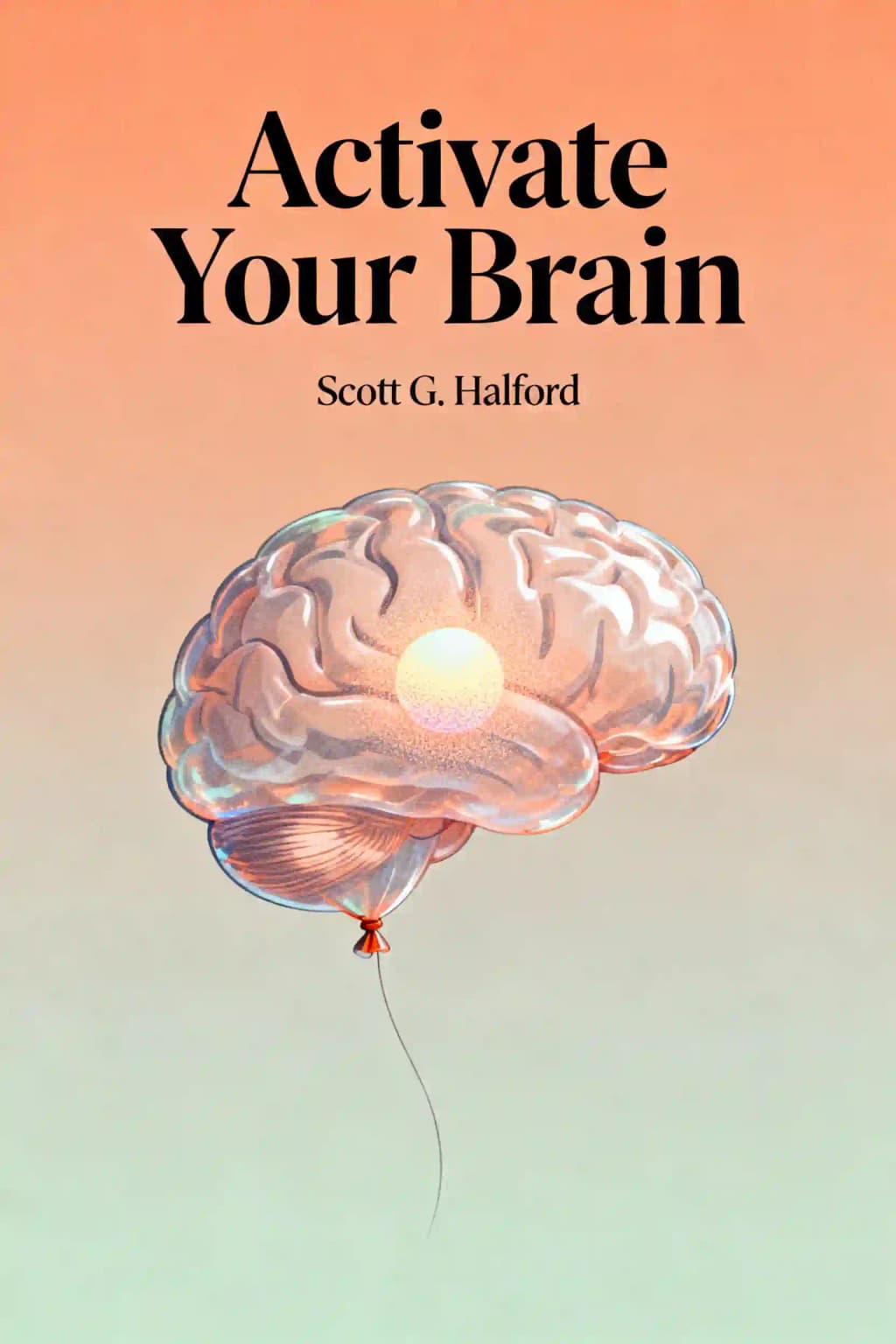
Ever found yourself staring at a screen at 3 AM, too exhausted to work but too anxious to sleep? You're not alone. In "Activate Your Brain," Scott G. Halford reveals how many of us have become stress junkies, victims of our own choices rather than masters of our mental capabilities. This groundbreaking work has become required reading in leadership programs at companies like Microsoft, Bank of America, and GE, where executives have embraced its practical approach to optimizing brain function. Oprah Winfrey featured Halford's techniques in O Magazine, calling them "game-changers for anyone feeling overwhelmed by modern life." What makes this book revolutionary isn't just its science-backed strategies, but how it transforms complex neuroscience into actionable daily habits that can dramatically improve your productivity, creativity, and wellbeing-all by making small, deliberate choices that align with how your brain naturally works.
第 2 章
The Three-Brain Symphony: Understanding Your Mental Architecture
Your brain isn't a single entity but three distinct systems working together-or sometimes against each other. The reptilian brain handles automatic functions like breathing and heart rate. The mammalian brain (limbic system) processes emotions and detects threats and rewards. The human brain (prefrontal cortex) enables reasoning, analysis, and emotional management.
This three-part system explains why we sometimes act against our better judgment. When your mammalian brain detects a threat-whether a charging bear or a critical email-it activates the "X system," an emotional, reflexive response that bypasses rational thought. Your prefrontal cortex houses the "C system," which can override emotional reactions when properly engaged.
Here's the challenge: scientists estimate we spend only 2-10% of our waking hours in the rational C system. The rest of the time, we're operating from our reactive X system. Even a 1-2% increase in C system engagement could dramatically improve your outcomes and creativity.
Think about the last time you snapped at someone and immediately regretted it. That was your X system taking control before your C system could intervene. With practice, you can create that crucial pause between stimulus and response, allowing your human brain to guide your reactions rather than being hijacked by your mammalian brain.
This understanding forms the foundation for everything else in the book. Success comes from managing the interplay between these systems-learning when to trust your quick emotional responses and when to engage your slower, more deliberate thinking. By recognizing which brain is currently "in charge," you gain the power to shift toward more productive states.
第 3 章
The Chemistry of Performance: Mastering Your Brain's Mood Molecules
Why do you excel one day yet struggle with identical challenges the next? The answer lies in your brain's neurochemistry-the complex balance of chemicals affecting how you function and respond to situations.
Your brain operates on a delicate balance of chemicals that require the "Goldilocks effect"-not too much, not too little, but just right. Four key neurochemicals drive your emotional states:
1. Adrenaline controls arousal levels-high levels trigger "fight, flight, or freeze" responses while low levels create calm states.
2. Cortisol maintains alertness and focus but becomes toxic when chronically elevated, leading to health problems including memory loss and premature aging.
3. Dopamine and norepinephrine generate pleasure, reward sensations, and engagement.
4. Oxytocin facilitates trust, bonding, and collaboration.
These chemicals create different emotional quadrants. Quadrants III and IV contain negative emotions produced by high cortisol, with intensity determined by adrenaline levels. Quadrants I and II house positive emotions, with quadrant I containing intense but fleeting experiences like elation, and quadrant II holding sustainable positive states like contentment and trust.
The brain's primary organizing principle is maximizing reward while minimizing danger, with significantly more neural architecture devoted to threat detection. This explains why negative experiences often overshadow positive ones. When adrenaline and cortisol combine, they create a threat response that magnifies perceived dangers and narrows attention, potentially causing "brain freeze" during important moments.
However, you're not helpless against these chemical fluctuations. Five simple activities can shift you from negative to positive states: adequate sleep, mindfulness practices, exercise, laughter, and experiencing significance through connectedness. Even more powerful is reframing how you perceive situations-the same activity feels entirely different when approached with positive intent rather than avoidance motivation.
Consider exercise: when you work out to avoid weight gain (avoidance), it feels burdensome. When you exercise to improve brain health (approach), it feels purposeful and rewarding. This simple mental shift transforms the same activity from a negative to a positive experience by changing the underlying neurochemistry.
第 4 章
The Social Brain: How Others Trigger Threat or Reward
Our brains constantly evaluate social interactions as either rewards or threats, processing these judgments several times per second unconsciously. This assessment determines whether we approach or avoid situations and people.
David Rock's SCARF model provides a framework for understanding what triggers threat or reward states in social situations:
Status: Your relative position compared to others affects your sense of safety. Higher status generally creates feelings of security, while lower status often triggers threat responses. Leaders can reduce status threats by giving recognition to team members and avoiding the need to be "the smartest person in the room."
Certainty: Our brains crave predictability. When we have certainty, we feel safe and can operate more creatively. Uncertainty triggers threat responses that make us revert to familiar behaviors while avoiding innovation. During organizational change-precisely when companies need fresh thinking-uncertainty makes these qualities harder to access. Leaders can increase certainty by using consistent meeting structures and clearly communicating what won't change during transitions.
Autonomy: We naturally desire the ability to make decisions. When this autonomy is threatened-when others make choices we believe should be ours-our threat response activates. Leaders can foster autonomy by describing options rather than prescribing specific paths.
Relatedness: Our need to belong is fundamental. Few things feel better than being welcomed into a group. Conversely, social rejection activates the same pain receptors as physical injuries. Even in modern workplaces, being excluded from meetings triggers a threat response. Leaders can foster relatedness by creating clear ground rules for team engagement and being accessible.
Fairness: Neuroscience reveals that fairness activates the brain's reward centers similarly to sex and chocolate. When relationships feel balanced, positive feelings emerge. Even small perceived imbalances can trigger negativity and relationship breakdown. To promote fairness, leaders should provide equal opportunities and distribute rewards based on transparent guidelines.
Understanding these five domains helps explain why certain interactions leave you feeling energized while others drain you. By recognizing when someone might be experiencing a SCARF threat, you can adjust your approach to create more reward states-benefiting both your relationships and outcomes.
第 5 章
Taking Control: The Foundation of Confidence and Success
Control is both biological and sociological, profoundly affecting our success. When we feel in control, we experience neurochemical pleasure, make better ethical choices, resist impulsive decisions, listen more attentively, and perform better professionally.
Our relationship with control exists on a spectrum between internal and external focus. Those with an internal locus of control believe they're responsible for their success and take proactive steps toward goals. Those with an external locus blame circumstances or others for failures. While both extremes have drawbacks, developing an internal focus generally leads to greater success.
Control has a dark side that emerges differently for each of us. An inner control freak lurks in all of us, typically emerging when trust is lacking. This explains why we dislike controlling people-their behavior signals they don't trust us. Paradoxically, giving up control is itself a form of control-managing our impulses to intervene.
Defining personal success increases our sense of control. Consider the parable of the fisherman and businessman: the fisherman already enjoys the simple life (fishing, napping with his wife, playing with grandchildren, enjoying evenings with friends) that the businessman suggests he could achieve after 20 years of building a fishing empire. Whether success means a simple daily catch or running a corporation, defining it clearly gives us control.
Well-placed control ultimately leads to confidence-the willingness to act without 100% certainty. Since life rarely offers guarantees, confidence enables us to try new things, accomplish goals, and feel good about achievements. Confidence emerges from feeling we have some control over circumstances or outcomes.
Three confidence killers to watch for: perfectionism (never acknowledging achievements), comparison (measuring ourselves against others), and "what-if" thinking (excessive worry about potential negative outcomes). To combat these killers, visualize worst-case scenarios, realistically assess their likelihood, and plan specific responses.
Two powerful confidence builders include:
1. Build and rely on intuition: Through experience and practice, your brain consolidates fragments of information into quick, confident decisions. This isn't universal but domain-specific-you become intuitive about areas where you've accumulated experience.
2. Try something new: Engaging in novel activities strengthens your brain and builds confidence by teaching you to be comfortable with discomfort. Each time you learn something new, you physically change your brain's structure, creating new neural connections.
The path to control and confidence starts with small steps: research a new topic every six months, embrace being a beginner without pressure to be perfect, and identify situations where you lack confidence, then visualize, plan and practice for them.
第 6 章
The Power of Focus: Managing Your Mental Energy
Willpower and focus represent critical inhibitory processes in our brain that require significant mental energy. Research like Walter Mischel's famous marshmallow tests demonstrated that children who could delay gratification developed better life outcomes including higher SAT scores and educational attainment.
Distractions devastate productivity-research shows even brief interruptions of 4.5 seconds triple error rates when returning to tasks. The modern workplace compounds this problem, with studies revealing we're interrupted approximately every three minutes. Most alarmingly, one hour of focused work equals about four hours of distracted time.
Multitasking actually trains your brain to be good at paying attention to distractions rather than focusing deeply. The brain performs best as a serial processor, and when we attempt to divide our attention, both quality and productivity suffer while anxiety increases.
Willpower is like a muscle that weakens without practice and becomes depleted throughout the day. As our brains tire, we become more easily distracted, requiring even more willpower to stay focused. Decision fatigue sets in later in the day, leading to less thorough thinking and more "rubberstamping." The most successful people recognize when their willpower is depleted and take breaks accordingly.
Mindfulness-being fully present-makes you a more effective leader who makes better decisions and works better with others. Research shows that practicing mindfulness for just 25 minutes daily for eight weeks can actually increase gray matter thickness, counteracting age-related atrophy.
An abundance mentality-believing "there is more where that came from"-contrasts with scarcity thinking, which assumes limited resources that must be competed for. Research from Harvard and Princeton shows that a scarcity mindset actually reduces cognitive capacity by overloading the brain with worries. Stanford researchers discovered that simply believing willpower is abundant rather than exhaustible improves performance on difficult memory tasks.
Practical steps to improve focus include:
• Do one thing at a time
• Turn off notifications on all devices
• Establish specific times to check email
• Work on difficult tasks when willpower is strongest (typically mornings)
• Practice doing things differently to strengthen willpower
• Maintain glucose levels with healthy complex carbohydrates
• When feeling overwhelmed, reframe with empowering statements like "This is when I'm at my best!"
第 7 章
Goal Achievement: How Your Brain Completes Tasks
Our brains are completion machines that reward us with dopamine when we finish tasks. Even the simple act of checking items off a to-do list provides neurochemical satisfaction. Success is essentially setting and achieving daily goals, with small achievements triggering nearly the same neurochemical reward as major ones.
Neuroscience reveals that asking "why" and "how" activates different neural circuits when pursuing goals. "Why" represents higher-order thinking about purpose, while "how" handles tactical execution. When stuck in project details, boosting motivation may require reconnecting with your purpose (why); when spinning your wheels despite clear purpose, focus on specific activating steps (how).
The ASTTARR system helps achieve goals by breaking them into manageable steps:
• Activate (start small, start now)
• See (visualize and write down the goal)
• Touch (do something related to the goal daily)
• Think (reflect on progress)
• Adjust (modify approach if needed)
• Reward (celebrate small wins)
• Repeat until completion
Research shows goals set more than ninety days out activate brain regions associated with unfamiliar people, making them harder to visualize and achieve. Breaking long-term objectives into smaller milestones creates regular dopamine rewards that keep us motivated.
When overwhelmed with competing tasks, even deliberately choosing to postpone a project helps manage anxiety. Researcher Malia Mason found that unfinished goals create mental loops that continuously pull at our attention until completed. To manage this mental tug-of-war, prioritize tasks using the 5 Ds:
• DO items you can complete today
• DELEGATE tasks others can handle
• DELAY items temporarily (but beware keeping them longer than 96 hours)
• DISCARD tasks you continually postpone
• DREAM by writing down one big life goal to prime your brain
According to Robert Cialdini's commitment and consistency theory, we're more likely to achieve goals that are public (shared with others), active (written down with detailed steps), and effortful (requiring accountability). The Hawthorne effect confirms we perform better when others are watching.
Setting clear parameters helps maintain sanity and control. Creating boundaries clarifies choices and makes decision-making easier. Sometimes growth requires letting go-simplifying allows the brain to function better and creates space for what truly matters.
第 8 章
Building Your Stamina: Sustaining Mental Energy
Like a blue spruce that appears healthy until suddenly dropping all its needles, our brains can function under stress until they don't anymore. Unrelenting stress without proper rest and refueling can literally shrink and age our brains. Stamina-defined as "the ability to sustain prolonged physical or mental effort"-is essential for achievement.
The brain can regenerate through neuroplasticity and neurogenesis when properly cared for through focus, rest, and exercise. Instead of exhausting ourselves and "catching up" on weekends, we can build daily practices that maintain energy and presence.
Our mindset about stress dramatically affects how it impacts us physiologically. A Yale study found that people primed with "stress is enhancing" messages reported better well-being and productivity, while also showing reduced cortisol levels compared to those primed with "stress is debilitating" messages. This reveals we can reframe stress positively, turning it from an energy-drainer into a stamina-builder.
What we put into our bodies directly impacts our brain's energy level, cell quality, and ability to manage stress. The brain's health depends on what enters through "the holes in your head"-what we see, hear, breathe, smell, eat and drink.
Proper hydration is crucial, as the brain is approximately 75% water, with dehydration significantly impairing memory and cognitive function. We need six to eight glasses of water daily, and feeling thirsty means we're already dehydrated. For brain fuel, complex carbohydrates from natural foods provide steady glucose, while simple carbs cause harmful blood sugar spikes and crashes.
Sleep isn't just recharging-it's when we consolidate learning and store information in memory. Adults need approximately four 90-minute REM cycles nightly, totaling 7-9 hours of sleep. Sleep deprivation causes numerous problems including brain decay, decreased memory and learning ability, weakened immune function, and impaired fat cell usage.
The time before bed is sacred-be deliberate about your inputs as they affect sleep quality. Writing in a gratitude journal or simply thinking positive thoughts primes your brain for pleasant rest. For problem-solving, write down questions before bed to potentially wake with solutions.
The human brain is like a Labrador retriever-eager to please and obey, but with limits. When pushed too hard without breaks, it eventually fails. If we want mental stamina, we must deliberately choose when to let our brains rest throughout the day through "awake rest," not just during sleep.
Implementing a 50/10 rule helps: limit meetings to fifty minutes, then use five minutes to document commitments and five minutes to prepare for the next meeting. This reflection time between work obligations improves stamina by allowing the brain to shift into awake-rest mode.
When our minds wander, we activate the default mode network (DMN)-a vast network of circuits that engages during daydreaming. This mental wandering, when positive rather than ruminating on worries, can improve innovative abilities and critical thinking. The brain often solves complex problems during these "incubation" periods, which explains why solutions suddenly appear while showering or driving.
Exercise is the single most powerful tool for brain health-nothing known benefits our brain more. It releases brain-derived neurotrophic factor (BDNF), which Dr. John Ratey calls "Miracle-Gro for the brain." BDNF helps our brain grow, slowing the 0.5 percent annual brain shrinkage after age forty.
第 9 章
Creating Significance Through Connection
Trust is consistently identified as the most crucial factor in any successful relationship-personal, political, or business. When trust is violated, the negative effects are profound; when present, the positive impact is equally significant.
Oxytocin serves as the primary brain hormone involved in trust formation. Neuroeconomist Paul Zak discovered through fMRI scans that we experience amygdala-based threat reactions when meeting strangers. When administered oxytocin through a nasal spray, test subjects showed almost no threat response. This explains why oxytocin increases during mate selection, creating that excited, bonding feeling.
Building trust requires deliberate effort but creates significant benefits as oxytocin increases and positive emotions spread contagiously. Trust develops through reliability, generosity, collaboration, positive relationships, laughter, physical touch, and following the trust equation: consistent behavior over time plus benevolence equals trust.
Research by psychologist Shelly Gable reveals that how we celebrate good times predicts relationship success better than how we handle difficulties. Her active-constructive responding (ACR) technique builds connections by responding enthusiastically to others' positive news with genuine interest and follow-up questions.
Of the four possible response types, only active-constructive responses (showing enthusiasm and asking questions) strengthen relationships. Passive-constructive responses (brief acknowledgment without follow-up), active-destructive responses (negative reactions or unwanted advice), and passive-destructive responses (ignoring the news entirely) all damage relationships to varying degrees.
When people object to ACR, they often cite being too tired or busy. This reflects a broader issue where we're least available to those most important to us because we haven't managed our energy effectively. Sometimes we must practice ACR even when we don't feel like it-we owe it to colleagues we respect and people we love.
第 10 章
Choose Your Best Self: Managing Ego for Maximum Impact
Like the judges on NBC's The Voice who deliver feedback with elegance and kindness, we can choose to be our best selves in each interaction by understanding and managing our ego. Though we often feel driven to bad behavior by situations and others, we do have a choice.
Understanding ego requires exploring both its strength and expression. The expression axis reflects how we behave in social situations-from less expressive (small) to more expressive (big). Neither style is inherently better, though each has strengths and weaknesses.
Ego strength goes beyond expression levels to what we believe about ourselves. A strong ego, like a physically strong person, doesn't need to hurt others to make its point. It doesn't demand to be right and seeks win-win outcomes. A weak ego, conversely, is fragile and unconfident-a bully willing to get hurt as long as others get hurt more.
The small, weak ego manifests as victims or as the unworthy. These individuals lack confidence, are often timid, shy, or passive-aggressive. The big, weak ego commands attention in negative ways-they're charming until disagreed with, abrasive, bold, manipulative, and aggressive.
Strong egos, whether big or small, make others feel good about themselves. They're genuinely interested in things and people beyond themselves. Their mantra is "I am no longer interested in being right; I am only interested in what works."
We choose which side of the chart we inhabit, acknowledging we all "pop over the line" occasionally but should apologize when we do. When feeling criticized or vulnerable, we risk crossing to the weak-ego side. Be aware of circumstances that trigger your weak ego and avoid them when possible.
第 11 章
Collaboration: Our Ultimate Survival Tool
Human survival has always depended on collaboration. Our ancestors needed to work together for hunting, childcare, and protection despite our physical weakness as a species. We're "smarter together," as groups consistently outperform individual geniuses on the same topics.
Psychologist Mihaly Csikszentmihalyi's concept of "flow" describes the euphoric state of performing practiced skills with lost time awareness. Charles Walker expanded this to include "interactive flow" (working collaboratively toward common goals), which produces greater joy and effectiveness than working independently.
Research identified three attributes predicting higher collective intelligence in teams: even distribution of turn-taking, social sensitivity (empathy and personal connection), and gender balance (60% women, 40% men). The good news is that turn-taking and social sensitivity can be taught, even in gender-imbalanced teams.
Effective collaboration requires finding workable ideas rather than being right. The author introduces a communication model that works even with weak egos, beginning with "Explore for Agreement"-finding common ground through curious questioning. Next comes "Detach from Being Right"-treating your idea as one of many possibilities. Finally, "Add or Modify"-presenting ideas as questions that build on others' thoughts.
Though science hasn't fully mapped the brain's capabilities, we already know enough to make meaningful changes. We don't need to wait for perfect scientific understanding to begin applying what we know. By understanding our biology, particularly our brain, we gain control to create significance rather than merely surviving threats. The journey starts with a simple directive: "Start small, start now. Activate."