The Single-Electron Memory Breakthrough: Fudan University Research
Explore the single-electron memory breakthrough by Fudan University. Learn how this semiconductor innovation published in Science could redefine data storage.
The Single-Electron Memory Breakthrough: Fudan University Researchのベスト引用
The 'Memory Wall' we’ve all been complaining about—the bottleneck that forces us to move AI to the cloud—is finally showing its first real cracks. If a single electron can hold a bit, the ceiling for what our devices can do just got a whole lot higher.
Generated by Aditya
Create a comprehensive educational lesson based on the attached article about Fudan University's single-electron memory breakthrough. Focus on the transition from 200,000 electrons to one bit per electron. Cover the science (electrons, thermal noise, quantum tunneling), the engineering (Guiyi 2D flash, graphene trap layer), and the manufacturing challenges (yield, CMOS integration). Explain the 'Memory Wall' and its impact on AI infrastructure (NVIDIA, Samsung, HBM). Use analogies like LEGO and airports to explain scaling. Strictly follow the source for geopolitical and economic claims, labeling facts vs. inferences. Address skepticism regarding lab-to-fab scaling. Original source: 'How many electrons does it actually take to remember a single one or a single zero?'


よくある質問
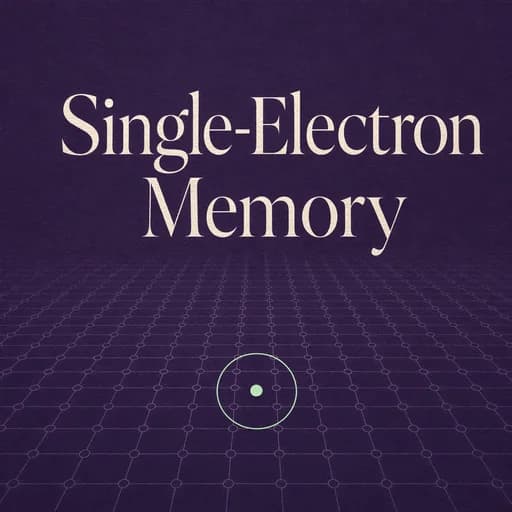
The single-electron memory breakthrough is a significant advancement in semiconductor innovation where researchers at Fudan University in Shanghai successfully stored a bit of data using just one electron. Published in the journal Science on July 16, 2026, this research challenges the traditional standard of using roughly 200,000 electrons to store a single bit. This discovery represents a major shift in electron-based computing and data storage technology.
Current smartphone memory, utilized by industry leaders like Samsung and SK Hynix, relies on massive overkill to ensure reliability. To store a single one or zero, modern devices must wrangle approximately 200,000 electrons into a reservoir to prevent the signal from being lost to heat and interference. In contrast, the Fudan University research proves that data can be reliably stored using a single electron, drastically reducing the resources required for memory.
Storing data with a single electron is considered a major achievement because it overcomes the 'noise' of heat and interference that typically swallows small signals. For forty years, using hundreds of thousands of electrons was the only way to guarantee data reliability. By proving they could 'hear the whisper' of a single electron, the Fudan University team has introduced a method that could revolutionize how chips are made and how data storage technology functions.
コロンビア大学卒業生がサンフランシスコで開発
"Instead of endless scrolling, I just hit play on BeFreed. It saves me so much time."


"I never knew where to start with nonfiction—BeFreed’s book lists turned into podcasts gave me a clear path."


"Perfect balance between learning and entertainment. Finished ‘Thinking, Fast and Slow’ on my commute this week."
"Crazy how much I learned while walking the dog. BeFreed = small habits → big gains."
"Reading used to feel like a chore. Now it’s just part of my lifestyle."

"Feels effortless compared to reading. I’ve finished 6 books this month already."
"BeFreed turned my guilty doomscrolling into something that feels productive and inspiring."

"BeFreed turned my commute into learning time. 20-min podcasts are perfect for finishing books I never had time for."
"BeFreed replaced my podcast queue. Imagine Spotify for books — that’s it. 🙌"

"It is great for me to learn something from the book without reading it."
"The themed book list podcasts help me connect ideas across authors—like a guided audio journey."
"Makes me feel smarter every time before going to work"
 Ask ChatGPT
 Ask Claude
コロンビア大学卒業生がサンフランシスコで開発
"Instead of endless scrolling, I just hit play on BeFreed. It saves me so much time."
"I never knew where to start with nonfiction—BeFreed’s book lists turned into podcasts gave me a clear path."
"Perfect balance between learning and entertainment. Finished ‘Thinking, Fast and Slow’ on my commute this week."
"Crazy how much I learned while walking the dog. BeFreed = small habits → big gains."
"Reading used to feel like a chore. Now it’s just part of my lifestyle."
"Feels effortless compared to reading. I’ve finished 6 books this month already."
"BeFreed turned my guilty doomscrolling into something that feels productive and inspiring."
"BeFreed turned my commute into learning time. 20-min podcasts are perfect for finishing books I never had time for."
"BeFreed replaced my podcast queue. Imagine Spotify for books — that’s it. 🙌"
"It is great for me to learn something from the book without reading it."
"The themed book list podcasts help me connect ideas across authors—like a guided audio journey."
"Makes me feel smarter every time before going to work"
"Instead of endless scrolling, I just hit play on BeFreed. It saves me so much time."
"I never knew where to start with nonfiction—BeFreed’s book lists turned into podcasts gave me a clear path."
"Perfect balance between learning and entertainment. Finished ‘Thinking, Fast and Slow’ on my commute this week."
"Crazy how much I learned while walking the dog. BeFreed = small habits → big gains."
"Reading used to feel like a chore. Now it’s just part of my lifestyle."
"Feels effortless compared to reading. I’ve finished 6 books this month already."
"BeFreed turned my guilty doomscrolling into something that feels productive and inspiring."
"BeFreed turned my commute into learning time. 20-min podcasts are perfect for finishing books I never had time for."
"BeFreed replaced my podcast queue. Imagine Spotify for books — that’s it. 🙌"
"It is great for me to learn something from the book without reading it."
"The themed book list podcasts help me connect ideas across authors—like a guided audio journey."
"Makes me feel smarter every time before going to work"
"Instead of endless scrolling, I just hit play on BeFreed. It saves me so much time."
"I never knew where to start with nonfiction—BeFreed’s book lists turned into podcasts gave me a clear path."
"Perfect balance between learning and entertainment. Finished ‘Thinking, Fast and Slow’ on my commute this week."
"Crazy how much I learned while walking the dog. BeFreed = small habits → big gains."
"Reading used to feel like a chore. Now it’s just part of my lifestyle."
"Feels effortless compared to reading. I’ve finished 6 books this month already."
"BeFreed turned my guilty doomscrolling into something that feels productive and inspiring."
"BeFreed turned my commute into learning time. 20-min podcasts are perfect for finishing books I never had time for."
"BeFreed replaced my podcast queue. Imagine Spotify for books — that’s it. 🙌"
"It is great for me to learn something from the book without reading it."
"The themed book list podcasts help me connect ideas across authors—like a guided audio journey."
"Makes me feel smarter every time before going to work"