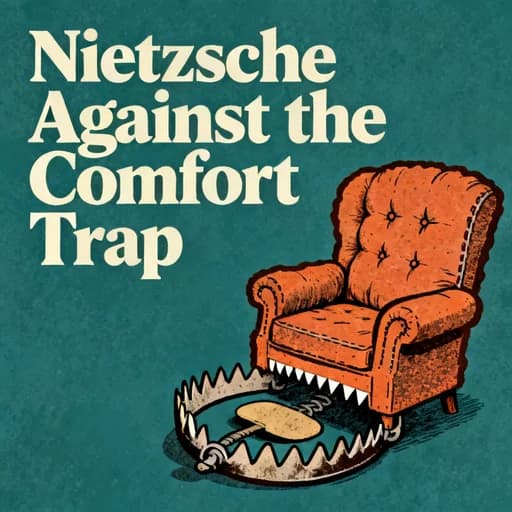
Nietzsche’s Cure for the Comfort Trap
Total security often leads to emptiness. Explore Nietzsche’s radical philosophy on why we must embrace suffering to find true growth and vitality.
Nietzsche’s Cure for the Comfort Trapのベスト引用
Suffering is not a bug in the system of life; it is a fundamental feature. When we try to cure it by creating a world of pure comfort, we accidentally cure ourselves of the very thing that drives growth, creativity, and greatness.
Generated with BeFreed
Nietzsche's Cure for a Comfortable Life






よくある質問
The Last Man is a prophetic figure Nietzsche used to describe a future type of human who prioritizes comfort, security, and health above all else. This individual is a "spiritual couch potato" who has no great longings or creative drive, seeking only "little pleasures" and the avoidance of any friction or suffering. Nietzsche feared this state because he believed that by "curing" ourselves of hardship, we accidentally eliminate the very challenges required for growth, creativity, and human greatness.
Nietzsche describes the evolution of human values through three stages: the camel, the lion, and the child. The camel is the disciplined spirit that carries the heavy weight of inherited societal values and traditions. The lion is the stage of rebellion that fights against these external "thou shalts" to create the freedom for new values. Finally, the child represents a "new beginning" and "innocence," where an individual moves beyond mere rebellion to actively create their own values and meaning through a "sacred Yes" to life.
Amor fati, or the "love of fate," is the radical affirmation of one's life exactly as it is, including all its suffering, regrets, and "horrible" moments. Rather than just tolerating necessity or wishing things were different, Nietzsche suggests we should want nothing to be changed—past, present, or future. It involves transforming the "it was" of the past into a "thus I willed it," effectively owning one's history and seeing every moment as a necessary part of the whole.
While modern wellness often focuses on "biohacking" and monitoring metrics to achieve a state of perfect comfort or longevity, Nietzsche’s "Great Health" is defined as "health for using." It is not about the absence of illness or the elimination of stress, but rather the possession of enough vitality and resilience to commit to demanding, risky projects. In this view, health is a tool to be spent on work, love, and service rather than a resource to be hoarded for the sake of a long, easy life.
"Instead of endless scrolling, I just hit play on BeFreed. It saves me so much time."


"I never knew where to start with nonfiction—BeFreed’s book lists turned into podcasts gave me a clear path."


"Perfect balance between learning and entertainment. Finished ‘Thinking, Fast and Slow’ on my commute this week."
"Crazy how much I learned while walking the dog. BeFreed = small habits → big gains."
"Reading used to feel like a chore. Now it’s just part of my lifestyle."

"Feels effortless compared to reading. I’ve finished 6 books this month already."
"BeFreed turned my guilty doomscrolling into something that feels productive and inspiring."

"BeFreed turned my commute into learning time. 20-min podcasts are perfect for finishing books I never had time for."
"BeFreed replaced my podcast queue. Imagine Spotify for books — that’s it. 🙌"

"It is great for me to learn something from the book without reading it."
"The themed book list podcasts help me connect ideas across authors—like a guided audio journey."
"Makes me feel smarter every time before going to work"
"Instead of endless scrolling, I just hit play on BeFreed. It saves me so much time."
"I never knew where to start with nonfiction—BeFreed’s book lists turned into podcasts gave me a clear path."
"Perfect balance between learning and entertainment. Finished ‘Thinking, Fast and Slow’ on my commute this week."
"Crazy how much I learned while walking the dog. BeFreed = small habits → big gains."
"Reading used to feel like a chore. Now it’s just part of my lifestyle."
"Feels effortless compared to reading. I’ve finished 6 books this month already."
"BeFreed turned my guilty doomscrolling into something that feels productive and inspiring."
"BeFreed turned my commute into learning time. 20-min podcasts are perfect for finishing books I never had time for."
"BeFreed replaced my podcast queue. Imagine Spotify for books — that’s it. 🙌"
"It is great for me to learn something from the book without reading it."
"The themed book list podcasts help me connect ideas across authors—like a guided audio journey."
"Makes me feel smarter every time before going to work"
"Instead of endless scrolling, I just hit play on BeFreed. It saves me so much time."
"I never knew where to start with nonfiction—BeFreed’s book lists turned into podcasts gave me a clear path."
"Perfect balance between learning and entertainment. Finished ‘Thinking, Fast and Slow’ on my commute this week."
"Crazy how much I learned while walking the dog. BeFreed = small habits → big gains."
"Reading used to feel like a chore. Now it’s just part of my lifestyle."
"Feels effortless compared to reading. I’ve finished 6 books this month already."
"BeFreed turned my guilty doomscrolling into something that feels productive and inspiring."
"BeFreed turned my commute into learning time. 20-min podcasts are perfect for finishing books I never had time for."
"BeFreed replaced my podcast queue. Imagine Spotify for books — that’s it. 🙌"
"It is great for me to learn something from the book without reading it."
"The themed book list podcasts help me connect ideas across authors—like a guided audio journey."
"Makes me feel smarter every time before going to work"
"Instead of endless scrolling, I just hit play on BeFreed. It saves me so much time."
"I never knew where to start with nonfiction—BeFreed’s book lists turned into podcasts gave me a clear path."
"Perfect balance between learning and entertainment. Finished ‘Thinking, Fast and Slow’ on my commute this week."
"Crazy how much I learned while walking the dog. BeFreed = small habits → big gains."
"Reading used to feel like a chore. Now it’s just part of my lifestyle."
"Feels effortless compared to reading. I’ve finished 6 books this month already."
"BeFreed turned my guilty doomscrolling into something that feels productive and inspiring."
"BeFreed turned my commute into learning time. 20-min podcasts are perfect for finishing books I never had time for."
"BeFreed replaced my podcast queue. Imagine Spotify for books — that’s it. 🙌"
"It is great for me to learn something from the book without reading it."
"The themed book list podcasts help me connect ideas across authors—like a guided audio journey."
"Makes me feel smarter every time before going to work"