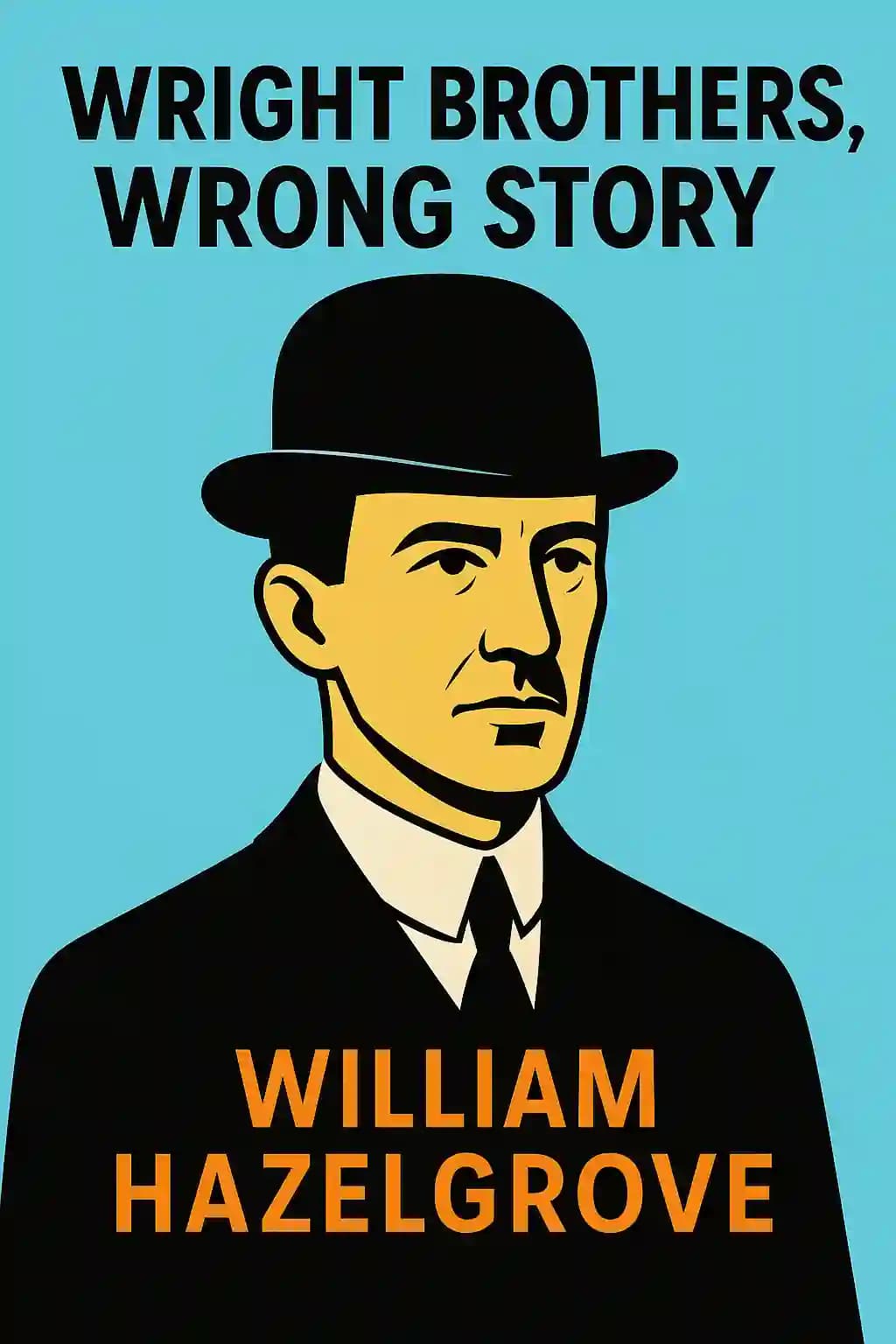
Wright brothers, wrong story
how Wilbur Wright solved the problem of manned flight
『Wright brothers, wrong story』の概要
History's greatest aviation myth unraveled: Wilbur Wright was the true genius behind flight, while Orville crafted their legacy after his brother's death. Hazelgrove's controversial research challenges everything we thought we knew - sparking fierce debates among historians about individual genius versus collaborative mythology.

『Wright brothers, wrong story』の主要テーマ
- historical revisionism
- sibling rivalry
- aviation pioneers
- intellectual isolation
- myth making
『Wright brothers, wrong story』の名言
Business felt like another prison.
Human flight is possible and practical.
An enthusiast, but not a crank.
The flying problem was left over to the 20th century.
『Wright brothers, wrong story』の登場人物
- Wilbur WrightThe visionary intellectual and primary innovator
- Orville WrightThe younger brother and skilled mechanic
- Octave ChanuteRenowned engineer and Wilbur's intellectual mentor
- Oliver Crook HaughNeighborhood bully who injured Wilbur in 1884
- Otto LilienthalGerman glider pioneer whose death inspired Wilbur
Wright brothers, wrong storyの要約をダウンロード
Wright brothers, wrong storyの要約をPDFまたはEPUBで無料でダウンロード。印刷やオフラインでいつでもお読みいただけます。
この本に関するよくある質問
Wright Brothers, Wrong Story reexamines aviation history, arguing that Wilbur Wright, not his brother Orville, was the true genius behind the first powered flight. William Hazelgrove challenges the traditional narrative, highlighting Wilbur’s technical brilliance and leadership while exploring the brothers' complex family dynamics and rivalry with contemporaries like Samuel Langley and Glenn Curtiss.
History enthusiasts, aviation buffs, and readers interested in biographical reinterpretations will find this book compelling. It appeals to those curious about early 20th-century innovation, patent battles, and the human stories behind historical milestones.
Yes, for its controversial thesis and deep dive into primary sources. While some criticize repetitive prose, the book offers fresh insights into the Wright brothers' lives, their feud with the Smithsonian, and the myth-making around their achievements.
Hazelgrove cites Wilbur’s detailed engineering notebooks, his leadership in patent disputes, and accounts of Orville’s mechanical execution of Wilbur’s designs. The book also analyzes the brothers’ correspondence and their later estrangement over credit for the invention.
It reveals their unconventional household, where neither brother married, and both lived with their father and sister Katharine. Hazelgrove explores how this insular environment fueled their collaboration and later conflicts.
Curtiss, a motorcycle innovator turned aviator, became their rival after modifying their patents. The book details his legal battles with the Wrights and the Smithsonian’s controversial support for Curtiss’s aerodrome.
Yes, it critiques the Smithsonian’s attempt to credit Samuel Langley’s failed aerodrome as the first viable aircraft, a move orchestrated to undermine the Wrights’ legacy. Hazelgrove exposes this institutional bias and its impact on historical narratives.
Critics note occasional factual errors and redundant passages. However, most agree the book’s research and challenge to the “lone inventor” myth outweigh these flaws.
Unlike traditional accounts, Hazelgrove’s work prioritizes Wilbur’s contributions and contextualizes the brothers’ achievements within early 20th-century technological rivalries. It contrasts with David McCullough’s The Wright Brothers, which portrays them as equal partners.
Orville is depicted as a skilled mechanic who executed Wilbur’s visions but struggled with credit-sharing after Wilbur’s death. The book suggests Orville’s later efforts to control their narrative obscured Wilbur’s centrality.
It underscores how historical narratives are shaped by bias and institutional power—a timely theme in an era of reevaluating legacy and credit in innovation. The book also resonates with debates over intellectual property in modern tech.
The author draws on the Wrights’ personal letters, patent documents, and court records, alongside newspapers and Smithsonian archives. Notable is his analysis of Wilbur’s technical journals, which reveal his problem-solving process.