第1章
A Haunting Tale of Isolation and Sisterhood
My name is Mary Katherine Blackwood. I am eighteen years old, and I live with my sister Constance. I dislike washing myself, and dogs, and noise. I like my sister Constance, Richard Plantagenet, and Amanita phalloides, the death-cup mushroom. Everyone else in my family is dead.
So begins Shirley Jackson's mesmerizing gothic masterpiece, "We Have Always Lived in the Castle," a chilling exploration of isolation, family secrets, and the destructive power of societal judgment. Published in 1962 as Jackson's final novel before her untimely death, this psychological thriller has captivated readers for generations with its unreliable narrator and atmospheric tension. Stephen King has cited it as a major influence, while contemporary authors like Neil Gaiman and Carmen Maria Machado have praised its perfect execution of subtle horror. The book experienced a significant resurgence following its 2018 film adaptation starring Taissa Farmiga and Alexandra Daddario, introducing Jackson's masterful storytelling to a new generation of readers fascinated by its exploration of feminine power, societal ostracism, and the creation of personal mythology.
第2章
The Blackwood Sisters and Their Isolated Existence
The Blackwoods were never much for restlessness. They always put things back where they belonged, their house built up with layers of Blackwood property weighing it down against the world. This weight of tradition and isolation forms the foundation of Mary Katherine "Merricat" Blackwood's existence alongside her older sister Constance. The sisters live in a grand old house on the outskirts of a small New England village, caring for their elderly Uncle Julian, the only other survivor of a family tragedy that occurred six years earlier.
Merricat, our eighteen-year-old narrator, ventures into the hostile village twice weekly for library books and groceries, since Constance never leaves their property and Uncle Julian cannot. These necessary excursions are fraught with danger as villagers openly despise the Blackwoods. Merricat approaches these trips like a dangerous board game, moving carefully from the library to the grocery store, avoiding eye contact, and enduring whispers and stares. In her mind, she wishes them all dead, imagining stepping over their bodies to help herself to the shelves.
The village's hatred manifests in cruel taunts. Children chant a disturbing rhyme: "Merricat, said Connie, would you like a cup of tea? Oh no, said Merricat, you'll poison me. Merricat, said Connie, would you like to go to sleep? Down in the boneyard ten feet deep!" Adults are equally cruel, making poisoning references and mocking the family's isolation. This hostility forces Merricat to retreat inside herself, walking rigidly past tormentors, wishing their tongues would burn and their throats would feel a torment hotter than a thousand fires.
The sisters' existence is defined by rigid routines and protective rituals. Tuesdays and Fridays are for village trips; Thursdays (Merricat's "most powerful day") for visiting the attic to dress in her dead family's clothes; Mondays for cleaning the house, carefully preserving everything exactly as it was. Their cellar is filled with preserved food-a legacy of Blackwood women through generations-jars of jam made by great-grandmothers, pickles from great-aunts, vegetables from grandmother, and even six jars of apple jelly from their mother. Constance's rows are the handsomest, shining among the others.
What emerges is a portrait of two women who have created a fragile sanctuary from a hostile world-a sanctuary about to be threatened by forces both external and internal.
第3章
The Shadow of Tragedy: Uncle Julian's Obsession
The Blackwood family history is dominated by a singular event-the arsenic poisoning that killed everyone except Constance, Merricat, and Uncle Julian six years earlier. Uncle Julian, partially paralyzed and mentally unstable from the poisoning, obsessively documents every detail of that fatal night, recounting the story to anyone who will listen.
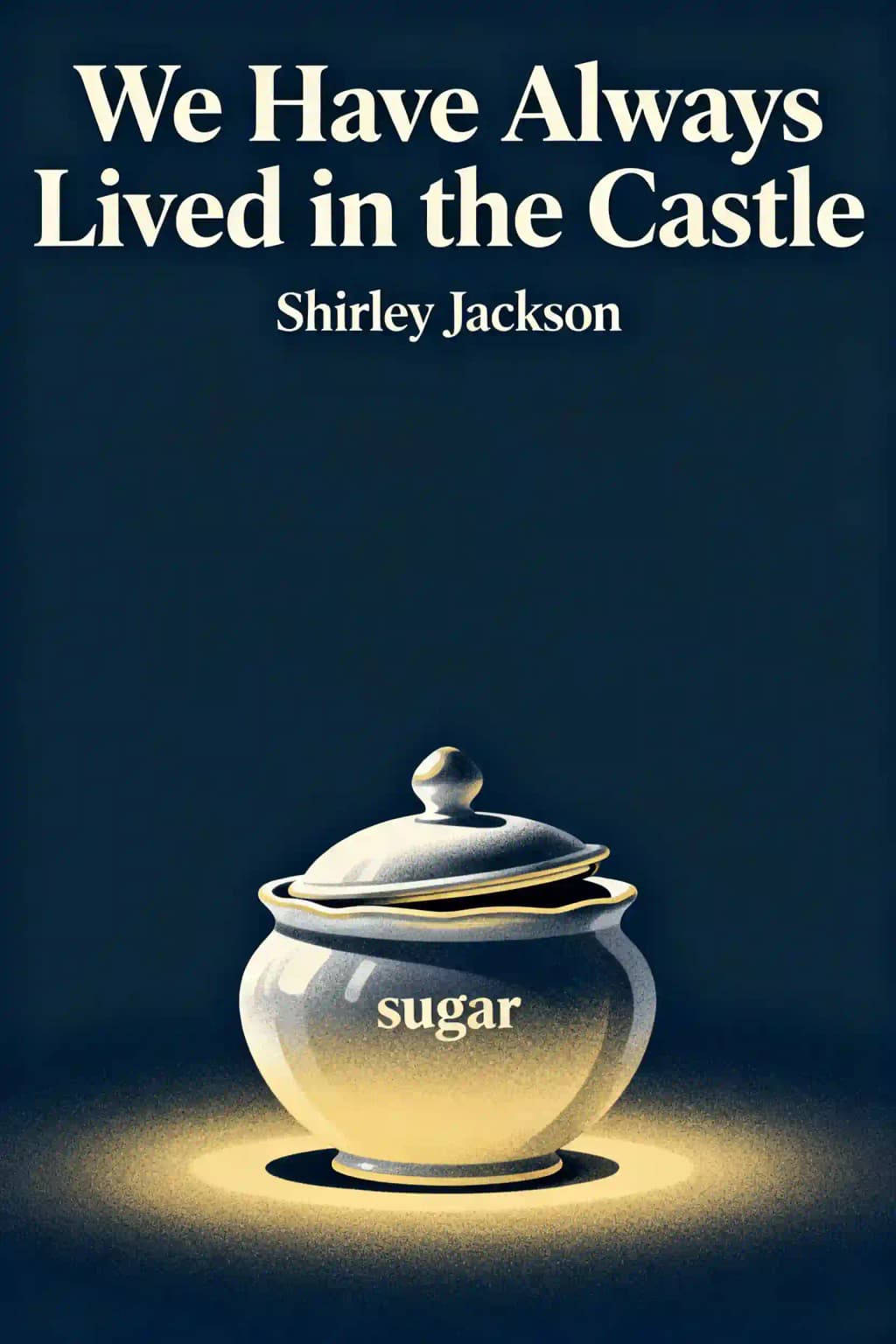
"We were, you understand, a family of great consequence," Uncle Julian tells Mrs. Wright, a fascinated visitor. He meticulously narrates how they were once "a large and happy family" with occasional disagreements. He describes his brother John sitting at the head of the table with "the decanter before him," taking pride in his family and position. Uncle Julian's sister-in-law was "a delicate woman" with "the exquisite line of the jawbone," and his nephew Thomas "used the most sugar." These details become significant when we learn the arsenic was in the sugar bowl.
The poisoning has become Uncle Julian's life's work-he's writing a book about it, collecting newspaper clippings, and interrogating Constance about minute details. "Everything revolves around Constance," he explains, noting the crucial detail that Constance washed the sugar bowl before police arrived-"a curious act" she explained by claiming "there was a spider in it." This detail had damned her in the eyes of the law, though she was ultimately acquitted.
What makes this obsession more disturbing is the family's casual attitude toward it. When visitors grow uncomfortable with Uncle Julian's morbid recollections, Constance and Merricat simply laugh about it after they leave. The poisoning has become normalized within their isolated world, a story told and retold until it has lost its horror-at least for them.
The family's relationship with poison extends beyond the tragedy. Constance tends a garden filled with deadly plants-hemlock, thornapple, baneberry, deadly nightshade, and mushrooms. Merricat casually recites the deadly properties of poisonous mushrooms, though Constance merely laughs it off as silliness. This casual familiarity with deadly substances creates an undercurrent of menace throughout their seemingly innocent domestic routines.
Through Uncle Julian's obsessive documentation, we gradually piece together the events of that fatal night, though the full truth remains tantalizingly out of reach-until Merricat finally reveals it.
第4章
Merricat's Magic: Protective Rituals and Hidden Treasures
Merricat's world operates according to magical thinking-a complex system of superstition, ritual, and sympathetic magic that she believes protects their isolated existence. Her narration reveals a mind that processes reality through symbolic associations rather than logic. "I like my sister Constance, Richard Plantagenet, and Amanita phalloides, the death-cup mushroom," she tells us, grouping her beloved sister with a long-dead English king and a deadly poison in a disturbing equivalence.
Her protective magic takes various forms. She buries treasured objects around their property-a doll beneath a rock, silver dollars by the creek, her father's watch. She nails her father's book to a tree as a talisman. When she senses change approaching, she chooses three magic words-"melody, Gloucester, and Pegasus"-keeping them secret and powerful. These rituals aren't random but form a coherent system in Merricat's mind, a way of controlling an unpredictable world.
"You bury food the way I bury treasure," she tells Constance, drawing a parallel between her sister's preservation of food and her own preservation of talismans. Both are attempts to stop time, to preserve something against decay and change. Merricat's buried treasures form a protective circle around their property, creating a magical boundary between their sanctuary and the hostile outside world.
When she discovers her father's notebook has fallen from the tree where she nailed it, she immediately senses disaster approaching. The nail had rusted away-a failure in her magical protection that allows the intrusion of their cousin Charles. "I had neglected to replace the fallen book, and our wall of safety had cracked," she laments.
Merricat also has secret hiding places throughout the property-a spot among the bushes where she listens to Jonas (her cat) tell stories, a creek shelter refreshed with clean grass and leaves. These physical spaces mirror her psychological retreats when confronted with threats. When villagers taunt her, she retreats inside herself; when Charles threatens her position in the house, she retreats to her hiding places.
Her magical thinking extends to time itself. Thursdays are her "most powerful day," while certain times are better for certain rituals. This temporal magic gives structure to her otherwise chaotic inner world, providing a framework for navigating a reality she finds threatening and unpredictable.
Through Merricat's rituals and magical thinking, Jackson creates one of literature's most distinctive narrative voices-childlike yet ancient, innocent yet calculating, vulnerable yet dangerous.
第5章
The Intruder: Charles Blackwood's Arrival
The fragile equilibrium of the Blackwood sisters' existence is shattered by the arrival of their cousin Charles Blackwood. His appearance is preceded by Merricat's premonitions of change-she notices Constance gazing beyond her garden toward the trees hiding the fence, or staring contemplatively down the driveway as if imagining what it would feel like to walk through the gates.
Charles immediately disrupts the sisters' carefully constructed routines. He sleeps in their father's room, sits in their father's chair at dinner, and begins wearing their father's clothes. "His big white face watching everyone eat," Merricat observes with disgust. This physical resemblance to their father is repeatedly emphasized-"I knew him at once; he looks like Father," Constance says admiringly, while Merricat sees only a threatening intrusion.
Charles's true motives quickly become apparent. He's interested in the family's money, questioning whether "crazy kid hasn't buried thousands of dollars all over, where we'll never find it." He takes Merricat's buried silver dollars to their father's safe and suggests selling family heirlooms. His presence begins to change Constance, who starts criticizing herself for "hiding" and letting Merricat "run wild," suggesting Uncle Julian belongs in a hospital.
The power struggle between Charles and Merricat forms the central conflict of the middle section. When Charles asks where "poor Cousin Mary" would go if Constance "turned her out," Merricat decides to politely ask him to leave. His response is ominous: he wonders who will still be there in a month-him or her. This direct threat escalates their silent war.
Merricat retaliates through her own form of domestic terrorism-stopping Charles's watch, transforming his room by replacing books and blankets with sticks, leaves, broken glass and metal, pouring water on the bed, and tearing down the curtains. "A demon-ghost would not easily find himself here," she thinks with satisfaction. Later, she knocks his burning pipe into a wastebasket full of newspapers, inadvertently starting the fire that will transform their lives.
Charles represents the intrusion of the outside world into the sisters' sanctuary. His materialistic values, his desire to "normalize" Constance by bringing her back into society, and his dismissal of their carefully constructed routines all threaten the delicate balance they've achieved. His resemblance to their father suggests he might recreate the patriarchal dynamics that ended in poisoning six years earlier.
Through Charles's character, Jackson explores how quickly protective isolation can be breached, and how vulnerable closed systems are to outside influence.
第6章
The Destruction of Paradise: Fire and Mob Violence
The fire that begins in Charles's room-Merricat's father's room-quickly spreads, forcing the sisters outside their protective sanctuary for the first time in years. This physical breach of their home parallels the emotional breach Charles has already created. As they watch from behind the vines on their porch, firemen trample through their home, dragging hoses and bringing filth into their sanctuary.
What begins as a rescue operation quickly transforms into something more sinister. The villagers gather outside, some laughing, some frightened. Charles's voice cuts through the chaos, repeatedly demanding "Get the safe in the study," revealing his true priorities. A woman's voice calls repeatedly, "Why not let it burn?" while Charles frantically shouts about saving the safe.
The scene escalates from destruction to deliberate desecration when Jim Donell, the fire chief, deliberately picks up a rock and smashes one of their mother's drawing room windows. This act of vandalism triggers a wave of destruction as villagers surge into the house, breaking possessions and chanting their cruel rhyme: "Merricat, said Constance, would you like a cup of tea?"
The mob surrounds Constance and Merricat, forming a cruel circle and blocking every attempt they make to reach the woods. This scene of collective violence reveals the true extent of the village's hatred-not just whispers and taunts, but a deep-seated desire to destroy the Blackwoods and everything they represent. Only the announcement of Uncle Julian's death temporarily breaks the mob's bloodlust, allowing the sisters to escape into the darkness of the trees.
The fire and mob violence represent the ultimate intrusion of the outside world into the Blackwood sanctuary. Their home is physically damaged, with the top floor "a nightmare of black and twisted wood," and their possessions deliberately destroyed. The kitchen table is overturned, chairs smashed, and the floor covered with broken dishes and food. Jars have been shattered against walls, silverware bent and scattered, and family tablecloths ripped and soiled. The sink is methodically filled with broken glass-evidence of calculated malice rather than random destruction.
Yet amid this devastation, one crucial area remains untouched-the cellar door remains closed, and all of Constance's preserves survive intact below. This preservation of their food supply becomes symbolic of their resilience and ability to survive despite external attacks.
The destruction of their home marks a turning point in the narrative-the sisters must now decide whether to rejoin society or retreat further into isolation.
第7章
The Revelation of Truth: Constance's Protection and Merricat's Guilt
In the aftermath of destruction, as the sisters salvage what remains of their home, the novel's central mystery unravels in a moment of quiet domesticity. Over a humble dinner of canned food in their damaged kitchen, Constance breaks years of careful silence. Her apology for the previous night's conversation - "I was wicked. I never should have reminded you of why they all died" - opens the door to a truth that has haunted their household for six years.
The revelation unfolds with devastating simplicity:
"I put it in the sugar," Merricat confesses.
"I know. I knew then. You never used sugar."
"No."
"So I put it in the sugar."
"Merricat," she says, "we'll never talk about it again. Never."
This exchange illuminates the dark foundation of their shared life: Merricat, at age twelve, poisoned their family with arsenic in the sugar bowl, while Constance, knowing the truth, chose to protect her sister by accepting society's condemnation. The significance of the sugar bowl, mentioned throughout the novel, takes on new meaning - Constance's careful washing of it wasn't an act of guilt but of protection, removing traces that could implicate her younger sister.
The revelation casts every aspect of their relationship in a new light. Constance's seemingly excessive indulgence of Merricat's peculiarities - the burial of objects, the naming of woods, the elaborate rituals - reveals itself as a complex dance of accommodation and containment. Her reluctance to leave the property or change their routine stems not just from agoraphobia but from an understanding of what Merricat is capable of when her world is threatened.
Merricat's survival that fatal night - she was "in disgrace" and confined to her room without dinner - takes on tragic irony. Her punishment became her salvation, while the family's ordinary gathering for dinner became their death sentence. Her intense hatred of Charles, previously attributed to jealousy, reveals deeper psychological wounds - he represents not just an intruder but a mirror of the patriarchal authority she violently rejected in killing her father.
The dynamics of their relationship become clearer: Constance's careful attention to Merricat's needs, her gentle redirections, her absolute refusal to contradict or challenge her sister - these aren't merely expressions of sisterly devotion but necessary strategies for maintaining peace with someone who solved family conflicts with murder. Their relationship exists in a precarious balance of profound love and unspoken fear, protection and potential threat.
Yet in the wake of this revelation, their bond doesn't fracture but somehow strengthens. Their exchange of "I love you, Constance" and "And I love you, my Merricat" carries new weight - it's an affirmation that their connection transcends conventional morality and survives even the acknowledgment of their darkest truths. Their love exists in a moral twilight zone, where protection of family supersedes all other ethical considerations.
This truth reshapes our understanding of their subsequent retreat into their damaged home, suggesting it's not just a rejection of society but a necessary containment, a way of protecting both themselves and the world from the consequences of their shared knowledge and capabilities.
第8章
Transformation: From House to Castle
In the novel's final section, the sisters adapt to their new reality, transforming their damaged home into a literal castle-a fortress against the world that tried to destroy them. Their house is now "turreted and open to the sky," with the top floor gone and the ground floor partially intact. Rather than leaving or rebuilding conventionally, they embrace this new form, closing off damaged rooms and creating new routines within their altered space.
"We had new landmarks in our damaged house-the broken stairway fragment, the boards across windows that we loved," Merricat explains. They close the shutters over the drawing room windows, where their mother's Dresden figurine now stands "small and courageous under her portrait in darkness." They barricade the dining room, filled with debris, closing those doors "forever." The kitchen windows are covered with cardboard so no one can see in. "Though the kitchen was now dark, it was safe," Merricat observes.
This physical transformation mirrors their psychological transformation. Rather than being defeated by the village's hatred and violence, they incorporate it into their identity, embracing their status as outcasts and turning it into power. Their damaged house becomes a visible symbol of their difference-a badge of honor rather than shame.
The villagers' perception of them also transforms. What began as hatred and mockery evolves into fearful respect. Children warn each other, "If you go on those steps, the ladies will get you." When a boy taunts them with the cruel rhyme, his parents leave eggs on the doorstep with a note reading, "He didn't mean it, please." The sisters have become legendary figures-witches or ghosts in the village imagination.
Most significantly, the villagers begin leaving food and gifts on their doorstep-a form of propitiation or tribute. "They leave food every day," Constance notes. "Sometime I would like to bake them a cake." This reversal of power dynamics is complete when Merricat observes, "Poor strangers. They have so much to be afraid of."
The novel ends with the sisters fully embracing their new existence. When Constance admits, "Well, I am afraid of spiders," Merricat promises, "Jonas and I will see to it that no spider ever comes near you. Oh, Constance, we are so happy." This declaration of happiness, coming after so much destruction and revelation, suggests they have found their true place-not in society, but in opposition to it, not in normality but in their own created reality.
The transformation of their house into a castle represents the ultimate triumph of their isolation-they have created a world entirely their own, impervious to outside judgment or interference.
第9章
Legacy of Fear: The Mythology of the Blackwood Sisters
The novel's conclusion reveals how the Blackwood sisters have transcended their status as victims to become figures of power in the village's collective imagination. What began as persecution has evolved into a complex relationship of fear, respect, and even reverence. The sisters have become mythological figures-witches or ghosts who must be appeased rather than attacked.
"I heard they see everything that goes on," villagers whisper. The strangers see only a ruined structure overgrown with vines, but they sense something more powerful behind the physical decay. Children are warned away from the property, and when one boy dares to taunt them, his family immediately seeks forgiveness through offerings.
This transformation represents a profound inversion of power. The sisters, once at the mercy of village cruelty, now hold psychological power over their tormentors. They have become the embodiment of the village's fears and superstitions-a living reminder of the violence the community perpetrated against them.
The offerings left on their doorstep-food and gifts-establish a new economic relationship. The sisters no longer need to venture into the hostile village for supplies; instead, the village comes to them, bearing tribute. This arrangement allows them to maintain their isolation while still receiving what they need to survive.
When Charles returns one final time with a photographer, boasting, "They've got money in there's never even been counted. They've got it buried all over," he represents the last gasp of the outside world's attempt to exploit them. His dramatic plea-"If you let me go this time, you'll never see me again"-is met with laughter from the sisters, who have transcended his power to hurt them.
The novel ends with the sisters fully embracing their mythological status. "Poor strangers," Merricat says. "They have so much to be afraid of." This statement reveals their complete psychological victory-they have transformed from the fearful to the feared, from the persecuted to the powerful.
In their final exchange, Constance admits to being afraid of spiders, and Merricat promises protection. This moment of vulnerability and care encapsulates their relationship-mutual protection against a hostile world. "Oh, Constance," Merricat concludes, "we are so happy." This declaration of happiness, coming after murder, fire, and destruction, suggests they have found their true place-not in society, but in opposition to it, not in normality but in their own created reality.
The Blackwood sisters have become living legends-a cautionary tale, a ghost story, a myth. Their legacy is fear, but also a strange kind of triumph-they have transformed persecution into power and isolation into strength. They have always lived in the castle, but now the castle lives in the village's imagination as well.