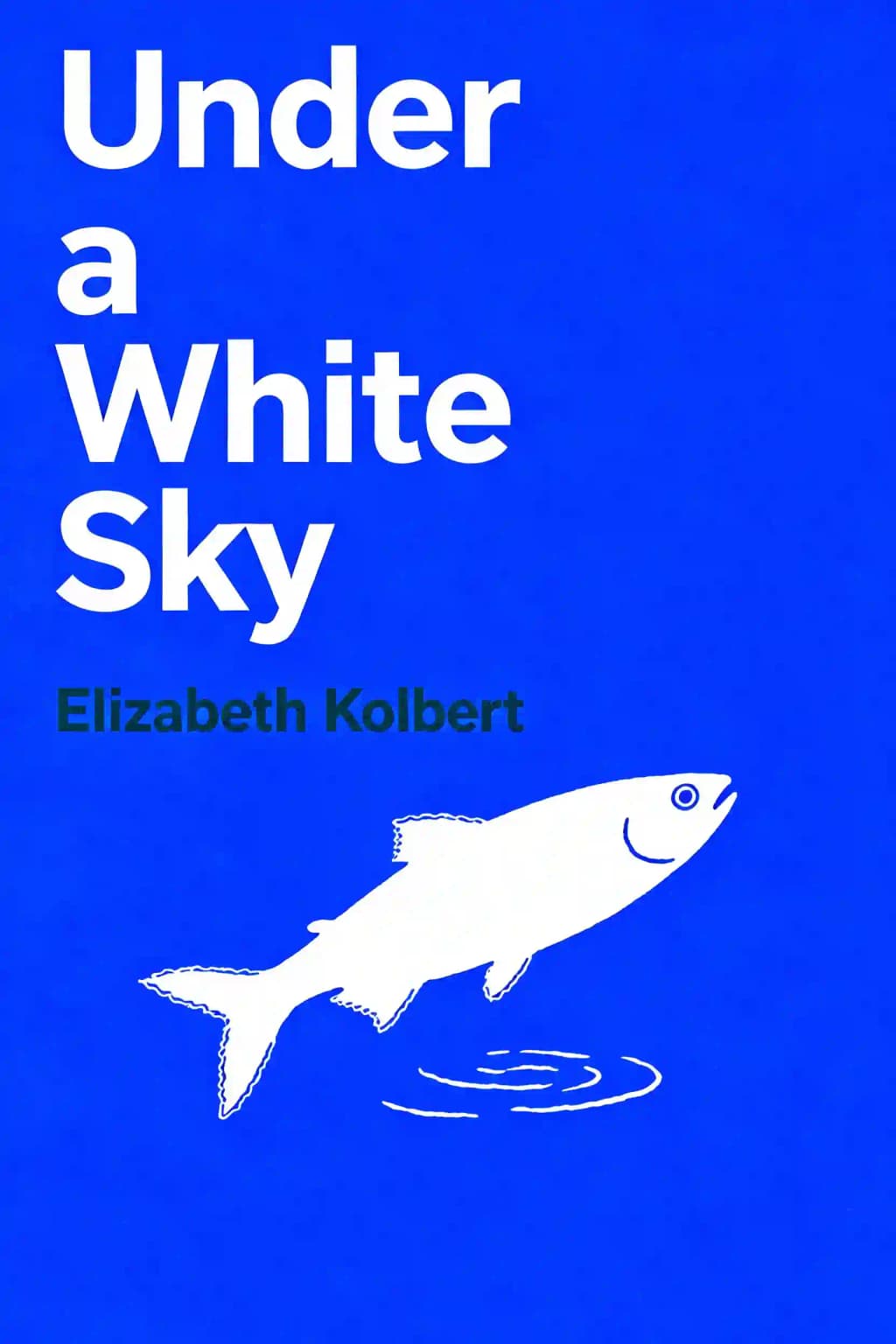
Elizabeth Kolbert's "Under a White Sky" explores humanity's paradoxical attempts to fix nature with technology. Endorsed by Bill Gates as "the most straightforward examination of humanity versus nature," this thought-provoking journey reveals our desperate technological gambles to save the very planet we've endangered.
Elizabeth Kolbert, Pulitzer Prize-winning author of Under a White Sky: The Nature of the Future, is a leading voice in environmental journalism and climate reporting. A staff writer for The New Yorker since 1999, Kolbert’s work explores humanity’s profound impact on the planet, blending scientific rigor with narrative-driven storytelling.
Her Pulitzer-winning book The Sixth Extinction: An Unnatural History (2014) cemented her reputation for examining biodiversity loss, while Field Notes from a Catastrophe (2006) established her early authority on climate crises. Under a White Sky continues this trajectory, investigating high-tech interventions to combat ecological collapse, from geoengineering to genetic rescue.
Kolbert’s career began at The New York Times, where she covered politics before shifting to environmental reporting. Her groundbreaking series “The Climate of Man” (2005) for The New Yorker earned the American Association for the Advancement of Science Award, foreshadowing her focus on anthropogenic climate disruption. Recognized with two National Magazine Awards and the Heinz Award for environmental achievement, her work has been translated into over 25 languages. Under a White Sky was named one of 2021’s 10 Best Books by The Washington Post, solidifying Kolbert’s role as a trusted chronicler of the Anthropocene.
Under a White Sky explores humanity’s attempts to solve environmental crises caused by previous interventions, like introducing invasive species or geoengineering. Elizabeth Kolbert examines projects such as electrified barriers to block Asian carp and CRISPR-modified cane toads, framing a paradox: technological fixes often spawn new problems. The book critiques the “control of the control of nature” in the Anthropocene era.
Environmental enthusiasts, policy makers, and fans of Kolbert’s prior work (The Sixth Extinction) will find this book essential. It appeals to readers interested in climate change solutions, geoengineering debates, and the ethical complexities of human-driven ecosystems. Critics note its relevance for those grappling with unintended consequences of technological fixes.
Yes—it’s a Pulitzer Prize-winning author’s critical examination of humanity’s fraught relationship with nature. Praised for its rigorous journalism and thought-provoking case studies, the book was shortlisted for the Wainwright Prize and named one of The Washington Post’s “10 Best Books of 2021”.
The “irony loop” refers to solutions creating new problems that demand further intervention. For example, introducing Asian carp to control weeds led to invasive fish threatening the Great Lakes, requiring electric barriers to contain them. Kolbert frames this as a hallmark of the Anthropocene.
Kolbert highlights the risks of over-reliance on technology, such as gene drives accidentally disrupting ecosystems or solar geoengineering causing unpredictable climate shifts. She questions whether we’re solving problems or compounding them, urging humility in innovation.
These lines capture the book’s central tension between human ingenuity and unintended consequences.
While The Sixth Extinction documented mass biodiversity loss, this book focuses on human responses to ecological crises. It shifts from diagnosing problems to analyzing high-stakes interventions, maintaining Kolbert’s signature blend of reporting and skepticism.
Some argue it leans too heavily on dystopian scenarios without endorsing concrete alternatives. Others note Kolbert’s neutrality—while she presents both sides of geoengineering debates, readers seeking clear answers may find the open-ended conclusions unsettling.
Through case studies like Louisiana’s flood-control systems and dying coral reefs, Kolbert demonstrates how well-intentioned efforts often backfire. She argues climate solutions must balance innovation with caution, as rapid fixes risk destabilizing delicate ecosystems.
As debates over carbon capture, AI-driven climate models, and CRISPR-based conservation intensify, Kolbert’s warnings about recursive problem-solving remain urgent. The book provides a framework for evaluating emerging technologies’ ethical and ecological trade-offs.
著者の声を通じて本を感じる
知識を魅力的で例が豊富な洞察に変換
キーアイデアを瞬時にキャプチャして素早く学習
楽しく魅力的な方法で本を楽しむ
they don't just invade ecosystems-"they conquer them."
retreat, though geophysically sensible, was politically impossible.
The boot-shaped state now has its sole, heel, and much of its instep in tatters.
The more water that's pumped, the faster the city sinks.
『Under a White Sky』の核心的なアイデアを分かりやすいポイントに分解し、革新的なチームがどのように創造、協力、成長するかを理解します。
『Under a White Sky』を素早い記憶のヒントに凝縮し、率直さ、チームワーク、創造的な回復力の主要原則を強調します。

鮮やかなストーリーテリングを通じて『Under a White Sky』を体験し、イノベーションのレッスンを記憶に残り、応用できる瞬間に変えます。
何でも質問し、声を選び、本当にあなたに響く洞察を一緒に作り出しましょう。

"Instead of endless scrolling, I just hit play on BeFreed. It saves me so much time."
"I never knew where to start with nonfiction—BeFreed’s book lists turned into podcasts gave me a clear path."
"Perfect balance between learning and entertainment. Finished ‘Thinking, Fast and Slow’ on my commute this week."
"Crazy how much I learned while walking the dog. BeFreed = small habits → big gains."
"Reading used to feel like a chore. Now it’s just part of my lifestyle."
"Feels effortless compared to reading. I’ve finished 6 books this month already."
"BeFreed turned my guilty doomscrolling into something that feels productive and inspiring."
"BeFreed turned my commute into learning time. 20-min podcasts are perfect for finishing books I never had time for."
"BeFreed replaced my podcast queue. Imagine Spotify for books — that’s it. 🙌"
"It is great for me to learn something from the book without reading it."
"The themed book list podcasts help me connect ideas across authors—like a guided audio journey."
"Makes me feel smarter every time before going to work"

Under a White Skyの要約をPDFまたはEPUBで無料でダウンロード。印刷やオフラインでいつでもお読みいただけます。
The Chicago River flows backward. Not metaphorically, but literally-engineers reversed an entire river's flow in the early 20th century, creating what was then the largest public works project in American history. They moved 43 million cubic yards of earth to flush Chicago's waste away from Lake Michigan and toward the Mississippi. It was a triumph of human ingenuity, a monument to our problem-solving prowess. It also unleashed a cascade of ecological chaos that we're still trying to contain with electric fish barriers, poison programs, and increasingly desperate interventions. This is the paradox at the heart of our environmental crisis: every solution seems to require another solution, and another, until we're left wondering whether we're fixing nature or simply replacing it with something else entirely.