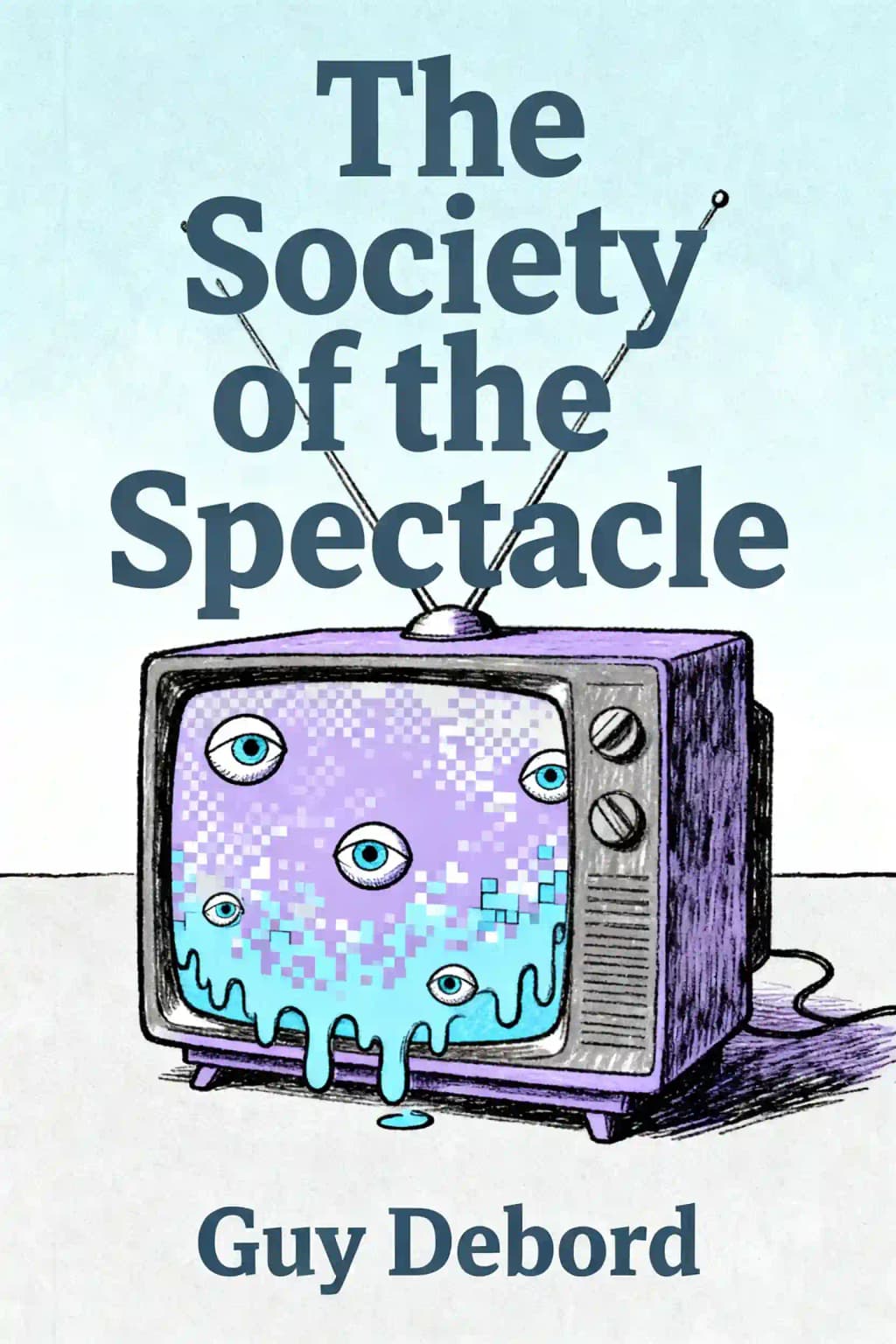
Guy Debord's revolutionary critique unmasks how media images dominate our reality. Fueling the 1968 Paris protests and influencing punk rock icons like The Sex Pistols, this prophetic text eerily predicted our Instagram-filtered lives decades before social media existed.
Guy Debord (1931–1994), author of The Society of the Spectacle, was a French Marxist philosopher, filmmaker, and revolutionary theorist who co-founded the avant-garde Situationist International movement.
His seminal 1967 work blends radical philosophy, cultural criticism, and Marxist analysis to dissect capitalism’s transformation of social life into commodified spectacles. As the intellectual architect of the May 1968 Paris uprising, Debord’s ideas about reclaiming authentic experience from mass media’s grip grew from his roots in Lettrist art experiments and his leadership of the Situationists’ anti-consumerist campaigns.
His later works, including Comments on the Society of the Spectacle and autobiographical Panegyric, further developed his critiques of modern alienation.
Translated into over twenty languages and cited in academic and activist circles worldwide, The Society of the Spectacle remains a foundational text for understanding media’s role in shaping contemporary reality. PM Press’s intellectual biography by Anselm Jappe underscores Debord’s enduring influence on critical theory and anti-capitalist thought.
The Society of the Spectacle (1967) critiques modern capitalism’s transformation of life into a mediated "spectacle," where images, commodities, and passive consumption replace authentic human experiences and relationships. Debord argues that this spectacle alienates individuals from collective action and creativity, perpetuating social control through mass media and consumer culture. The book blends Marxist theory with avant-garde philosophy to challenge viewers to reclaim agency through revolutionary praxis.
This book is essential for students of critical theory, Marxist philosophy, and political activism, as well as those interested in media studies, urban planning, or anti-consumerist movements. Its dense, aphoristic style appeals to readers seeking radical critiques of capitalism’s cultural and ideological dominance.
Yes—it remains a foundational text for understanding 20th-century critiques of media and consumerism, influencing movements from the 1968 Paris uprisings to modern digital culture analyses. While challenging, its insights into alienation and societal manipulation are still widely cited in academic and activist circles.
Key concepts include:
Debord argues consumer culture reduces human desires to commodity fetishism, where advertising and media spectacle dictate needs rather than fulfilling them. This creates passive "spectators" disconnected from authentic social interactions, perpetuating alienation and political apathy.
The spectacle is capitalism’s ultimate tool of control: a pervasive system where media, technology, and consumer goods dominate lived experience, replacing direct human connections with mediated representations. It masks societal inequalities by framing consumption as liberation.
Debord expands Marx’s critique of commodity fetishism, analyzing how capitalism’s cultural superstructure (media, art, urban design) enforces ideological compliance. Unlike traditional Marxism, he emphasizes revolutionary creativity over economistic solutions.
Its analysis of media saturation and social alienation directly applies to algorithmic curation, influencer culture, and the commodification of online identities. Critics argue modern platforms like social media exemplify Debord’s "spectacle" by monetizing attention and fragmenting collective action.
Some scholars argue Debord’s deterministic view underestimates individual agency, while others note his dense prose obscures practical solutions. Additionally, his romanticization of avant-garde art risks elitism, complicating mass mobilization efforts.
Unlike Adorno’s cultural pessimism or Foucault’s micro-power analyses, Debord prioritizes collective revolutionary action, blending Hegelian dialectics with Situationist art tactics. Its focus on lived experience contrasts with purely economic critiques like Marx’s Capital.
Yes—Debord directed a 1973 film of the same name, using détournement techniques to overlay revolutionary text over film clips and advertisements, visually enacting the book’s theories. This experimental approach mirrors his call to disrupt passive spectatorship.
著者の声を通じて本を感じる
知識を魅力的で例が豊富な洞察に変換
キーアイデアを瞬時にキャプチャして素早く学習
楽しく魅力的な方法で本を楽しむ
What appears is good, what is good appears.
The spectacle demands passive acceptance.
Having has been replaced by merely appearing.
The commodity has achieved the total occupation of social life.
All actual having must draw prestige from appearances.
『The society of the spectacle』の核心的なアイデアを分かりやすいポイントに分解し、革新的なチームがどのように創造、協力、成長するかを理解します。
『The society of the spectacle』を素早い記憶のヒントに凝縮し、率直さ、チームワーク、創造的な回復力の主要原則を強調します。

鮮やかなストーリーテリングを通じて『The society of the spectacle』を体験し、イノベーションのレッスンを記憶に残り、応用できる瞬間に変えます。
何でも質問し、声を選び、本当にあなたに響く洞察を一緒に作り出しましょう。

"Instead of endless scrolling, I just hit play on BeFreed. It saves me so much time."
"I never knew where to start with nonfiction—BeFreed’s book lists turned into podcasts gave me a clear path."
"Perfect balance between learning and entertainment. Finished ‘Thinking, Fast and Slow’ on my commute this week."
"Crazy how much I learned while walking the dog. BeFreed = small habits → big gains."
"Reading used to feel like a chore. Now it’s just part of my lifestyle."
"Feels effortless compared to reading. I’ve finished 6 books this month already."
"BeFreed turned my guilty doomscrolling into something that feels productive and inspiring."
"BeFreed turned my commute into learning time. 20-min podcasts are perfect for finishing books I never had time for."
"BeFreed replaced my podcast queue. Imagine Spotify for books — that’s it. 🙌"
"It is great for me to learn something from the book without reading it."
"The themed book list podcasts help me connect ideas across authors—like a guided audio journey."
"Makes me feel smarter every time before going to work"

The society of the spectacleの要約をPDFまたはEPUBで無料でダウンロード。印刷やオフラインでいつでもお読みいただけます。
In 1967, French philosopher Guy Debord published a slim volume that would become one of the most prescient critiques of modern society ever written. "The Society of the Spectacle" feels more relevant today than when it was written, dissecting how images mediate our social relationships in ways that have only intensified with time. What makes this text so compelling is its unflinching examination of how modern capitalism transforms authentic social life into a parade of representations-a world where having has been replaced by merely appearing, and where our relationships with each other are increasingly mediated through images we passively consume rather than experiences we actively create. From social media profiles to curated Instagram feeds, from celebrity worship to political theater, the spectacle has become the organizing principle of contemporary existence.