第1章
Farming Beyond the Harvest: The Hidden Business of Organic Success
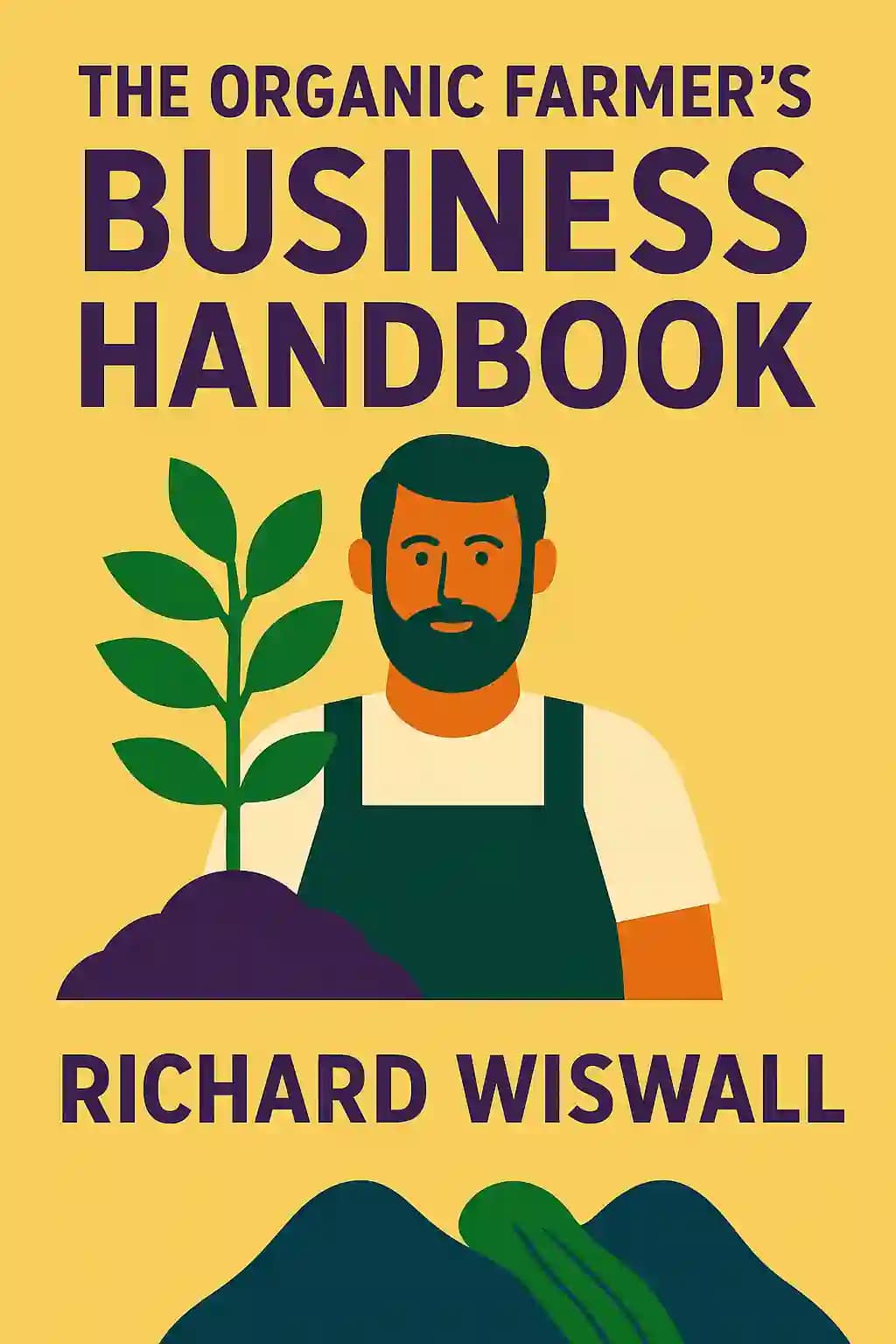
Imagine a vegetable farmer who makes more money than doctors or lawyers. Sounds impossible? This is exactly the paradigm shift Richard Wiswall presents in "The Organic Farmer's Business Handbook." While most farming conferences obsess over production techniques-the perfect compost recipe or ideal tomato variety-they rarely address what ultimately determines farm survival: profitability. Drawing from decades of experience running Cate Farm in Vermont, Wiswall challenges the "poor dumb farmer" stereotype with a revolutionary message: organic farms can thrive financially when farmers approach their work with business acumen. The book has become required reading in agricultural programs nationwide, praised by sustainable farming pioneers like Eliot Coleman, and has transformed countless struggling operations into profitable enterprises by shifting the focus from "farming harder" to "farming smarter."
第2章
True Sustainability: The Mile-High Fence and Solar Dollars
Picture a mile-high fence surrounding your farm with just one gate through which everything must pass. What enters? What leaves? This mental model helps visualize true sustainability. In an ideal system, like a simple dairy farm, the primary inputs are free-sunlight, rain, atmospheric nitrogen, and carbon dioxide-while outputs are primarily milk sold for money. Most organic vegetable farms, however, rely on numerous purchased inputs, making them less sustainable than we might imagine.
The key distinction lies in understanding different types of money: mineral dollars (from extracting finite resources like oil), paper dollars (from transactions where one party profits at another's expense), and solar dollars (generated through sustainable natural cycles). Solar dollars create true wealth by harnessing sunlight and natural processes, making them fundamentally different from other types. Unlike mineral dollars, solar dollars are infinitely renewable, and unlike paper dollars, they don't require someone to lose for another to gain.
Our mental frameworks-our paradigms-filter what we perceive as possible or impossible. The "poor dumb farmer" paradigm severely limits agricultural success. At a Holistic Management class that transformed my thinking, the presenter declared, "The biggest fallacy in farming is that there is no money in it" and "You plan for profit before anything else." These statements initially angered me but eventually shifted my perspective completely.
True happiness comes from pursuing what genuinely matters to you. Through exercises like deciding how to spend your last $100, writing your own obituary, or completing a Personal Values Worksheet, you can uncover your core values and create a personal goal statement that guides all future decisions. My own goal statement didn't specifically mention farming but emphasized economic security and time for family and friends-farming became the vehicle to achieve these deeper aims.
When your work aligns with your core values, even mundane tasks transform from frustrating chores into purposeful steps toward supporting family, enabling leisure time, planning for retirement, building community, and living intentionally. Keeping your goal statement visible helps maintain this perspective through farming's inevitable challenges.
第3章
Farm for Profit, Not Production: The Fundamental Equation
Moving beyond conceptual foundations to practical realities, the fundamental equation-Profit = Income - Expenses-becomes our guiding principle. Many farms generate impressive gross sales but negligible profits. Like a logger with a dull saw, farmers are often too busy working to sharpen their financial tools.
I resisted financial analysis for years, fearing I'd discover my decade of farming might be unprofitable. When I finally examined my numbers, I realized a critical insight: different crops have vastly different profitability profiles. Some generate substantial profit, others break even, and some actually lose money. The key to increasing overall farm profitability is determining which enterprises are most profitable, then emphasizing those while reducing or eliminating unprofitable ones.
Rather than passively accepting whatever profit remains at year-end, proactively set profit goals-whether $20,000, $50,000, or $80,000-then plan backward to achieve them. Using a five-year projection targeting $30,000 net profit from $60,000 gross sales, follow a four-part planning process:
1. Marketing Chart (showing accounts, products, and sales projections)
2. Production Plan (calculating beds needed based on projected yields)
3. Map (visual layout of fields and crops)
4. Seedling Calendar (scheduling transplant production)
This systematic approach prevents the costly mistake of growing unwanted crops that must be sold at fire-sale prices or tilled under. Remember, thoughtful planning maximizes efficiency in what can be a low-margin business.
第4章
Discovering Profit Centers: The Index of Profitability
Your farm's overall profitability represents the combined performance of many different enterprises. Understanding the profitability of individual crops is essential, as some make money while others lose it. With this knowledge, you can strategically increase overall farm profitability by focusing on your most profitable ventures.
Tracking income across different venues requires different approaches. Wholesale accounts use invoices that create an easy paper trail. For farmers' markets, record beginning and ending inventory on a clipboard. Farm stands require similar inventory tracking, while CSA shares need simple weekly records of what's included. Compile all sales data into a Sales Spreadsheet showing income by crop and by account.
While tracking direct expenses like seed purchases is straightforward through bills and receipts, labor costs-often the majority of production expenses-require additional documentation. Employee paychecks don't differentiate time spent on various crops, and owner labor isn't recorded at all.
The Crop Journal becomes one of the most important tools on your farm-a simple folder with alphabetized pages for each crop. All production activities are recorded contemporaneously, noting date, task, who performed it, and time spent. This captures labor inputs that would otherwise be impossible to allocate to specific crops. The journal also tracks production rates (like bunches harvested per hour) which helps with future planning and setting employee expectations.
With income tracked through sales records and expenses documented through bills and the Crop Journal, you can calculate profitability for each individual crop. When I first analyzed my carrots, I discovered potential net profits of $15,728 per acre-far exceeding my previous farm-wide average of $5,000 gross sales per acre.
A single sheet listing all crops by net return is "priceless" for farm management. This Index of Profitability drives decisions from planning through harvest, helping identify which crops deserve expansion and which need price adjustments or cost reductions. I challenge the common belief that farms must grow certain unprofitable "loss leaders" to attract customers. I don't grow sweet corn despite customer requests, instead directing them to neighboring farms while focusing on profitable crops.
第5章
Profit Time: Crop Enterprise Budgets That Transform Your Farm
Crop enterprise budgets allow you to analyze different crops side by side, revealing which are profitable and which may be losing money. These budgets break down the simple equation (Profit = Income - Expenses) for each crop, creating an Index of Profitability that serves as a primary management tool. While the first budget takes significant effort, subsequent ones become much easier to prepare.
When preparing budgets, count the farmer's field work hours as costs even though no paycheck is written-this prevents the common practice of farm businesses being subsidized through self-exploitation. All overhead costs must be allocated across crops based on acreage or sales percentages, including often-overlooked management and office time.
These analyses reveal surprising insights: weeding and harvesting constitute the largest production costs for most crops, while bed preparation and seeding play smaller roles. Vegetables I loved to grow became less appealing when I realized their minimal profit contribution, while unexpected "cash cows" emerged from comprehensive analysis.
Transplanting provides a jump on weeds, eliminating hand-weeding hours and enhancing mechanical weed control options, though hand transplanting remains more cost-effective than mechanical for plantings under 14 acre. Long-season crops with extended harvests like kale (potentially $20 in sales per plant) often yield more sales for the effort of soil preparation than short-season crops, though there are profitable exceptions in both categories.
The best numbers are your own-take charge and discover what profit centers are hiding on your farm. These revelations will transform not just what you grow, but how you grow it and where you focus your precious time and energy.
第6章
Marketing Strategies: Creating and Keeping Customers
Business guru Peter Drucker stated, "The purpose of business is to create and keep a customer." This underscores the marketplace's importance to business survival-without customers, there's no income and no business.
Successful businesses follow an ongoing practice of market analysis through the Marketing Circle concept, which asks four key questions: How will the market know I have what it needs? To whom will I market? Why will the market want my product? What will I market? The process begins with brainstorming marketing methods, identifying potential customers, assessing competition from the buyer's perspective, and determining which profitable products to sell.
Fear of rejection often prevents farmers from being exceptional salespeople. The reality of sales is getting many "no" responses for each "yes"-perhaps nine rejections for every acceptance or even twenty. The key is not taking rejection personally, separating marketplace rejection from personal rejection. Good salespeople have thick skin and understand that buyers simply may not need what's being offered.
Produce prices are defined by retail and wholesale markets, with price ranges reflecting the marketing costs involved. For example, wholesale lettuce prices range from $18/case (growers' co-op) to $28/case (local wholesale) to $48/case retail (farm stand, CSA, farmers' market). A farmer's job is to grow products for less than their selling price. When production costs are significantly below market price, farmers should pocket those profits rather than passing savings to buyers. Profit isn't a four-letter word-it's necessary to offset less fortunate production outcomes and compensate for risks taken.
Brand identity isn't just for multinational corporations-it's valuable for farms too. Creating a unified "look" through consistent color, lettering style, and artwork across farm materials weaves a thread of unified identity for your farm business.
When I first started farming, I hesitated to call myself "professional" despite apparent success because I realized how much I still didn't know. Being professional means competence in a specialty, but acting professionally is about reliability and respect. The five rules of doing business with serious buyers are simple: "Deliver in full, and on time" - repeated five times for emphasis.
Community-supported agriculture programs offer mutual benefits but require careful balance. With a typical $500/20-week share ($25/week), farmers must avoid both giving away too much produce and overwhelming members with excess food. If an oversupply causes a weekly share to reach $50 value instead of the expected $25, the farm effectively sells everything at half price while expenses remain the same. The solution is monitoring share value weekly to keep it close to what members have paid.
第7章
Effective Management: Conquering the Taxidermy Stare
Have you ever felt so overwhelmed with work that you became paralyzed? I call this the "taxidermy stare." Effective management means tackling the most important things first and following through to ensure completion.
Start by clearing your desk of papers. Handle each document once, making an immediate decision about where it belongs - file it, recycle it, or give it to someone else. Date every paper you handle. Use a filing system with manila folders and clear file names, organized by category or alphabetically.
As you process papers, add any required actions to a master to-do list. During off-season, I use a clipboard; in busy season, I post a large lecture pad on my office wall with categories like office, greenhouses, repairs, farmers' market, fieldwork, and long-term projects. The crucial next step is prioritizing tasks and assigning specific calendar time to complete them.
How do we decide which tasks deserve priority? Stephen Covey's Time Quadrant Matrix divides tasks into four areas: Quadrant I (urgent and important) includes crises like broken water lines; Quadrant III (urgent but unimportant) includes interruptions like salespeople; Quadrant IV (neither urgent nor important) represents procrastination activities like TV watching. The easily neglected Quadrant II contains important but non-urgent tasks like long-range planning, business analysis, and relationship maintenance. The key is spending time above the horizontal line of importance, especially making calendar time for the crucial Quadrant II activities.
Eugene O'Kelly's book "Chasing Daylight" offers a powerful insight after his terminal diagnosis: only worry about decisions you haven't made yet. Past decisions were made with information available at that time. Instead of regretting choices, make new decisions starting now. This perspective frees us from unproductive regret and focuses energy on present choices.
Adding employees doesn't reduce the farmer's workload hour-for-hour due to management responsibilities. I spend mornings planning daily tasks, supplies needed, and contingency plans. I provide employees with time estimates for tasks and clear daily work lists. The key to productive employees is mutual respect-view workers as assets, not liabilities to be minimized. Make work enjoyable by varying tasks, emphasizing each job's importance to farm success, and having crews tackle large projects together.
Farming with a spouse presents unique management challenges since you're together 24/7, unlike most couples who separate during workdays. My wife Sally and I discovered most conflicts arose when job boundaries were unclear or overlapping. We've established separate domains-she manages greenhouse production while I handle field crops-but still face decisions about shared resources. Regular scheduled meetings and designated private sanctuaries separate from work activities help maintain balance.
第8章
Office Paper Flows and Plugging Financial Leaks
Proper office procedures are as critical to farm success as marketing and production. Disorganized paperwork leads to financial leaks-I once discovered $800 in uncollected payments and math errors when I hired a bookkeeper to digitize my records.
Studies show 75% of business errors result from faulty procedures, not human error. Like airlines and hospitals that implement multiple checks to prevent catastrophic mistakes, farms need systems to catch oversights. Paper trails are essential-without invoices, sales revenue easily disappears. When I sell a $25 bag of carrots without documentation and payment is forgotten, that's equivalent to throwing cash away.
I believe in bundling office tasks for efficiency, just like I bundle farm tasks. Set a regular weekly time for desk work, such as Wednesday mornings. The simplest office setup uses two folders: one for paid bills (filed chronologically) and one for unpaid bills. When paying bills, process them all at once weekly rather than individually.
To increase efficiency and reduce errors, establish monthly billing accounts with businesses you regularly purchase from. Instead of writing checks for each small purchase, these businesses keep a tab that you pay monthly. This reduces the number of checks written and allows you to handle payments at your desk rather than while rushing through daily tasks.
Credit cards can increase efficiency but only if you don't overspend and pay balances in full monthly-otherwise interest becomes a major financial leak. Keep all credit card slips in a designated holder until the statement arrives, then staple corresponding slips to the statement before payment.
Designate your farm checkbook as the "mother checkbook" to track all farm transactions in one place. Don't limit yourself to just two lines in your checkbook register-use as many lines as needed to itemize different types of transactions. This makes year-end bookkeeping simpler and ensures you don't miss deductible expenses.
Financial leaks drain money from your farm business without you being aware. CSA programs risk giving away too much product for the money received; farmers' markets can leak money through "good weight" practices (rounding up weights in customers' favor); and invoiced sales pose the greatest risk through lost invoices, no invoices, or math errors. Using self-calculating digital scales at markets ensures fair trade and can quickly pay for themselves. For invoices, using triplicate forms provides backup copies, and double-checking math prevents costly errors.
第9章
Retirement on Your Farm: Financial Planning for Farmers
Money carries tremendous psychological weight in our society. We tend to elevate wealthy people and equate financial success with personal worth. In reality, financial net worth should not determine self-worth. As farmers and business owners, we must learn to disconnect our self-esteem from our financial status.
Retirement planning is part of a larger financial puzzle that includes saving, investing, business spending strategies, and tax management. As self-employed farmers without company retirement plans, we must take responsibility for our own financial destiny. While Social Security provides some income, it's inadequate alone. The goal is to retire on your farm, not by selling it, which requires strategic planning regardless of your current age.
To save money, you must spend less than you earn-there's no way around this fundamental equation. Your relationship with money affects your ability to save, and unconscious patterns can be changed. Remember that saving $1 is equivalent to earning $1.34 due to taxes, and saving can happen at any income level as long as basic needs are met.
Once you've saved money, investment options include cash (which loses value to inflation), land (not liquid but generally appreciates), collectibles, or stocks and bonds. Sound investing follows simple principles: make and follow a plan, buy quality investments, buy low and sell high, diversify, start early for long-term growth, and be tax-smart with IRAs.
Investing in your farm is always an option for money you've saved. When your farm generates profit, you can either save it or reinvest in farm items. By reinvesting profits in your farm, you reduce taxable income while increasing net worth through expanded assets. For example, if a farmer with $36,000 profit buys a $12,000 tractor before year-end, their taxable income drops to $24,000, saving $4,000 in taxes-essentially getting the tractor for only $8,000!
When planning for retirement, saving, investing, business spending tactics, and taxes must work together. Starting early is crucial-time is your biggest ally in investments. Even safe investments at 5% will yield $107,226 from an original $24,000 over thirty years. Maximize IRA contributions each year for tax-efficient investing, educate yourself, make a plan, and stick to it.
第10章
Production Efficiencies: Systems That Save Time and Money
While business aspects are crucial, production efficiencies directly impact profit by lowering expenses. Farming is a production business where farmers get paid by the piece, not by hourly wage, making efficiency crucial. Labor typically represents the largest expense, with weed control, harvesting, and pack-out being the most labor-intensive tasks.
Adopting standardized row spacing across the entire farm dramatically increases efficiency. I use raised beds spaced 6 feet on center, with three rows per bed spaced 14 inches apart. All tractors have identical wheel spacing. This universal system accommodates different crop sizes: small plants use all three rows, medium plants use the outer two rows, and large plants occupy only the middle row. The primary benefit is uniformity-all tractors can straddle every bed for planting, fertilizing, weeding, and harvesting.
While rototillers create clean, finely textured seedbeds quickly, continuous use has serious drawbacks. A better approach is combining a mini chisel pass with a rototiller run at slow RPM or faster tractor speed, creating a good seedbed with deeply loosened soil after just two passes.
Mechanical cultivation and flame weeding can dramatically reduce weed pressure and labor costs. Three essential cultivation tools are tine weeders, basket weeders, and sweeps. Using a two-pass offset method with basket weeders can reduce hand-weeding by 90%. Stale bed seeding-preparing beds and letting weeds germinate before killing them-provides additional weed control by eliminating the first flush of weeds before crop establishment.
Perfect seeding is crucial for crop profitability, maximizing yields without the expense of thinning. Careful calibration is essential-I test seeders on blankets or tarps, counting seeds per foot and adjusting until perfect. After seeding, I record the plate or hole size used on the seed bag and in my Crop Journal along with variety, company, date, bed footage, time spent, and seed quantity.
Though I own a two-row mechanical transplanter, I find hand transplanting more efficient for areas under 14 acre. Hand transplanting can achieve 900 plants per hour per person, while a tractor-mounted transplanter with three people can set 3,000 plants hourly but requires additional setup time and machinery costs.
Farming is essentially a business of "materials handling"-moving stuff efficiently from place to place. Smart materials flow saves countless steps over years of farming. For root crops, I use two essential harvest aids: a bedlifter that loosens soil under crops like carrots so they can be pulled without shovels, and a chain digger that lifts entire beds at once. We harvest into bushel baskets or poly-weave sacks, hire extra hands during busy times, and use a bucket brigade system for unloading.
第11章
The Business Plan: Your Farm's Roadmap to Success
Many farmers feel disconnected from business planning, seeing it as the domain of office-bound businesspeople rather than those who work the soil. But a business plan is actually a living document-a thoughtful representation of you, your farm, and your future. Think of it as a road map with your destination somewhere in the future. The plan is primarily for you, helping organize your thoughts and validate your direction. Writing it down makes your ideas more real and memorable.
The business plan doesn't need to be complicated. A basic structure includes: 1) Cover page with farm name and contact information; 2) Table of contents; 3) Executive summary (written last); 4) Descriptions of your farm and products; 5) Analyses including SWOT, management analysis, market analysis, and enterprise budgets; 6) Planning section with proposed strategies and implementation timelines; and 7) Financial forms including Profit and Loss statements, Balance Sheet, and Cash Flow Projections.
Financial statements speak clearly in the language of numbers. The Profit and Loss Statement lists all income and expenses for a specified time period, following the same format as your Chart of Accounts. Balance Sheets show what you own (assets), what you owe (liabilities), and your net worth at a specific moment in time. Comparing net worth from different years' Balance Sheets reveals whether you're gaining or losing financial ground.
Two basic accounting methods exist: cash and accrual. Cash accounting records transactions when money changes hands, while accrual accounting records transactions when they actually occur, using inventory to reflect expenditures. Accrual accounting provides a more accurate financial picture by accounting for timing differences between purchases and usage.
Cash Flow Projections map out future finances, showing how planned changes will affect profits. Unlike salaried workers, farmers face "lumpy" cash flows-investing heavily early in the season for returns months later. This creates a critical vulnerability: even profitable farms can fail due to cash flow problems if they can't pay immediate bills. Smart farmers secure necessary funds before they're needed, either through loans, lines of credit, or ideally, from previously saved profits.
With all components in place, write a concise summary to lead your business plan. Address the farm's purpose, crucial issues, and proposed operational changes. Include key financial data like current sales, income, and net worth, along with projections showing how these might evolve by implementing your strategies. Rather than shelving your completed plan, keep it vital by reviewing it semi-annually and updating it with new ideas. Planning is an ongoing process, not a one-time event.
第12章
Beyond Profit: Planning for Life's Bigger Picture
Death may be uncomfortable to discuss, but estate planning benefits those who will shoulder the burden after you're gone. Without proper planning, government regulations determine how your assets are distributed, potentially with larger tax implications. While many options exist from simple to complex, even basic estate planning typically involves three documents: a will directing asset distribution and appointing an executor; a durable power of attorney designating someone to handle your affairs if you become incapacitated; and a health care directive appointing someone to make medical decisions if you're unable.
While this book focuses on farm profitability, I never imagined becoming what might be called an "Uber Bean Counting Organic Farmer." Yet careful financial management provided the economic security I needed. Remember that while profits matter, they shouldn't overshadow what's truly important-family, friends, and pursuing a meaningful life. Return to the goal-setting exercises from chapter 1, envision your long-range plans, make prioritized to-do lists, schedule time for important tasks, and follow through.
Be the farmer you want to be. Create a farm that serves your deeper values rather than one that consumes your life. With thoughtful planning and business acumen, organic farming can provide not just a living but a life-one where you control your destiny rather than being controlled by financial pressures. The tools in this book aren't just about making money; they're about creating freedom to live according to your deepest values while stewarding the land for future generations.