第1章
The Perfect Crime: A Tale of Deception, Detection, and Deadly Secrets
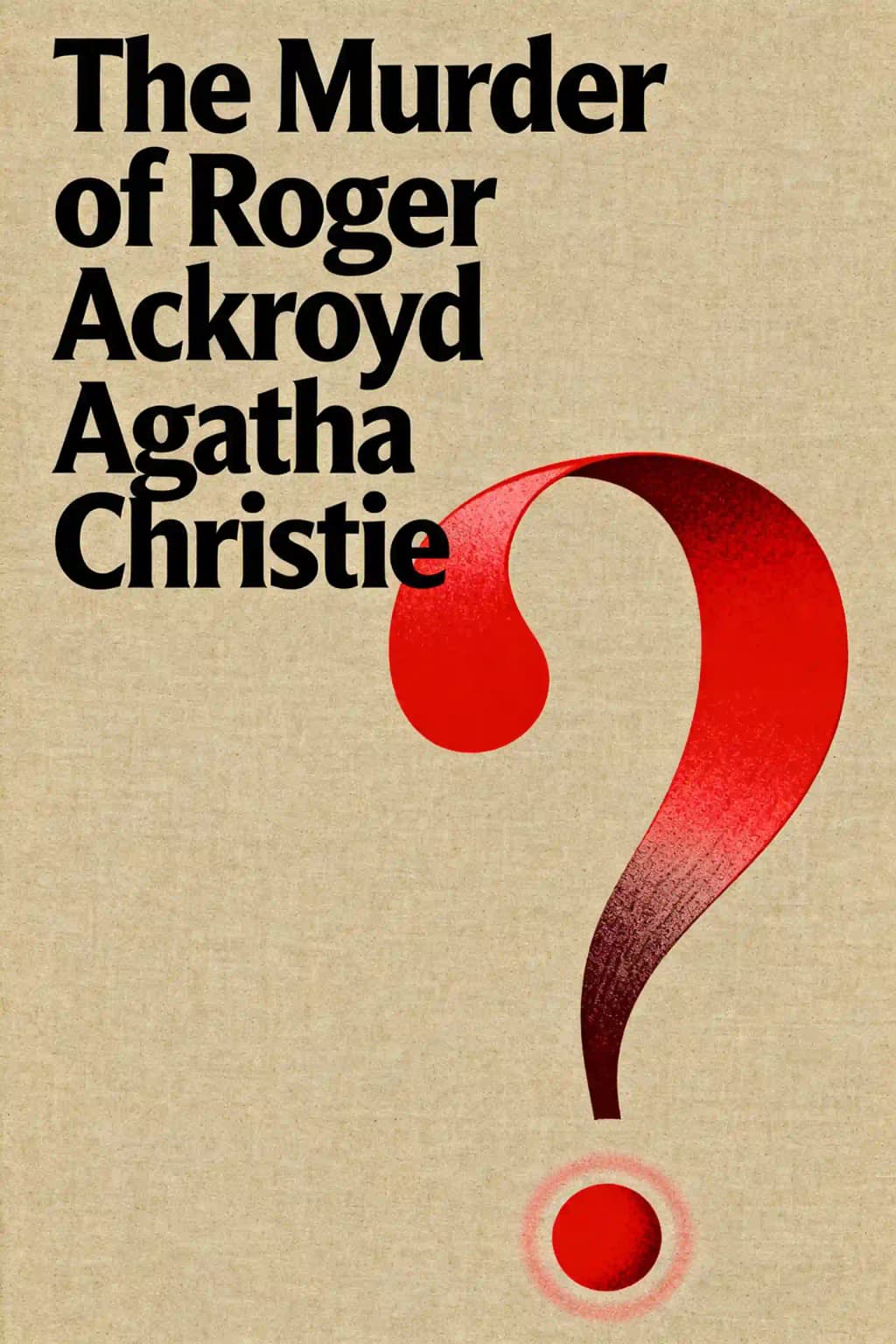
In 1926, Agatha Christie stunned the literary world with what many consider her greatest achievement - a murder mystery that broke all the rules. "The Murder of Roger Ackroyd" revolutionized detective fiction with its shocking twist ending, becoming an instant classic that has influenced generations of writers. The novel consistently ranks among the greatest mysteries ever written, with the British Crime Writers' Association naming it the best crime novel of all time in 2013. Even Stephen King called its conclusion "the most satisfying in mystery literature." Christie herself considered it among her personal favorites of her works. Nearly a century later, this masterpiece continues to captivate readers with its ingenious plot and brilliant narrative deception, demonstrating why Christie earned her title as the Queen of Crime.
第2章
A Doctor's Deadly Secret
Dr. James Sheppard seems the perfect narrator for a murder mystery - observant, intelligent, and privy to the intimate secrets of King's Abbot as the village doctor. When wealthy widow Mrs. Ferrars is found dead from an overdose of Veronal, Sheppard is called to the scene. His sister Caroline, the village's premier gossip, immediately declares it suicide motivated by remorse, reviving her theory that Mrs. Ferrars had poisoned her husband a year earlier. Though Sheppard dismisses this speculation publicly, he privately considers it might contain truth.
The plot thickens when Roger Ackroyd, a successful manufacturer and the village's most prominent citizen, invites Sheppard to dinner. Ackroyd appears unusually distressed, claiming his stepson Ralph is in London despite recent sightings in the village. That evening, after dinner, Ackroyd reveals a shocking truth: Mrs. Ferrars had indeed poisoned her husband, and she had confessed this to Ackroyd just before her death. More disturbing still, she had been blackmailed over this secret, driving her to suicide. Though she wouldn't name her blackmailer, something she said made Ackroyd suspect someone in his own household.
When a letter from Mrs. Ferrars arrives in the evening post, Ackroyd insists on reading it privately, refusing Sheppard's urgings to examine it immediately. The doctor leaves at 9:50 PM, encountering the suspicious butler Parker lurking outside the study door and later meeting a stranger asking directions to Fernly Park. At 10:15, Sheppard receives a telephone call supposedly from Parker, claiming Ackroyd has been murdered. Upon rushing to Fernly, he discovers Parker sent no such message. When they break into the locked study, they find Ackroyd dead in his armchair, stabbed from behind with a Tunisian dagger, the window open with clear footprints visible outside, and Mrs. Ferrars' blue envelope missing.
第3章
The Great Detective Returns
The day after the murder, Flora Ackroyd, Roger's niece, arrives at Dr. Sheppard's house in distress. She reveals that their mysterious new neighbor is none other than Hercule Poirot, the famous Belgian detective who has retired to King's Abbot. Despite his retirement, Flora is determined to enlist his help in solving her uncle's murder and clearing the name of her fiance Ralph Paton, who has mysteriously disappeared and become the prime suspect.
Poirot agrees to investigate but warns Flora: "I shall go through with it to the end. The good dog, he does not leave the scent!" When she insists she wants "all the truth," Poirot accepts the case, though his methods immediately prove unconventional. Rather than focusing solely on physical evidence as Inspector Raglan does, Poirot examines psychological details and inconsistencies in testimony.
The case against Ralph Paton seems overwhelming: his shoes match footprints on the windowsill, he was seen entering the grounds at 9:25 PM, he had financial motives, and he has disappeared completely. Yet Poirot remains unconvinced, suggesting that the abundance of evidence might actually indicate Ralph's innocence. "When the evidence shows one thing so clearly," he tells Sheppard, "I always ask myself if it could not be hiding something else."
As Poirot investigates, he discovers everyone at Fernly Park has something to hide. Mrs. Ackroyd searched Roger's desk for his will before his death. Flora stole forty pounds from her uncle. Geoffrey Raymond, Ackroyd's secretary, was deeply in debt and benefited from a legacy. Parker the butler eavesdropped hoping to profit from blackmail information. Even the parlourmaid Ursula Bourne has concealed her true identity and relationship to Ralph Paton.
第4章
Secrets Within Secrets
As Poirot delves deeper, the seemingly simple case reveals layers of deception. In the summerhouse, he discovers a scrap of starched cambric and a goose quill that proves to be a container for heroin. In the goldfish pond, he recovers a woman's wedding ring inscribed "From R., March 13th." Each clue points to hidden relationships and motives among the suspects.
The most startling revelation comes when Ursula Bourne, the parlourmaid, confesses she is secretly married to Ralph Paton. Their marriage explains the mysterious ring and their argument overheard in the woods. Ralph, financially dependent on his stepfather, had agreed to marry Flora for money while already married to Ursula. When Ackroyd announced the engagement publicly, Ursula confronted Ralph, then revealed their marriage to Ackroyd himself, resulting in her dismissal.
Meanwhile, the mysterious stranger seen near Fernly Park is identified as Charles Kent, a rough young man with a drug addiction. When questioned in Liverpool, Kent admits visiting Fernly that night but claims an alibi for the time of the murder. Poirot discovers Kent is the illegitimate son of Miss Russell, the housekeeper, who met him in the summerhouse to give him money before he departed.
As each suspect's secret is revealed, the timeline of the murder night becomes increasingly confused. Flora's admission that she never actually saw her uncle alive at 9:45 PM invalidates previous assumptions about when the murder occurred. Ralph's wife Ursula confirms meeting him in the summerhouse at 9:30 PM, but this provides no alibi for either of them during the critical time.
第5章
The Gathering of Suspects
In classic detective fashion, Poirot orchestrates an elaborate gathering of all suspects at his residence - a calculated move straight from the golden age of detective fiction. With his trademark dramatic flair and perfectly waxed mustaches twitching, he commands the room's attention as he methodically reveals the shocking truth about Ursula Bourne's identity as Ralph Paton's secret wife. The assembled group - including Major Blunt, Flora Ackroyd, Mrs. Cecil Ackroyd, and Dr. Sheppard - react with varying degrees of surprise and disbelief as Poirot hints mysteriously that he alone knows Ralph's current whereabouts.
The tension in the room becomes palpable as the suspects press Poirot for details. The detective, ever the master of suspense, maintains his enigmatic demeanor, insisting he knows every detail of the case while deliberately withholding specifics. His only cryptic response regarding Ralph's location is that he is "not far away" - a statement that sends ripples of unease through the gathered assembly.
The gathering reaches its dramatic crescendo when Ralph Paton himself materializes in the doorway, his appearance causing gasps of shock from the assembled group. Looking somewhat pale but composed, Ralph reveals he had been hiding in a small nursing home near Cranchester, secretly placed there by Dr. Sheppard who had been protecting him throughout the investigation. In careful detail, Ralph recounts his movements on the fateful night: departing from the summerhouse at precisely 9:45, spending hours wandering the dark country lanes in mental turmoil as he tried to decide his next move, and - most crucially - never encountering his stepfather either alive or dead.
Though Ralph's account leaves him without a verifiable alibi for the crucial time of the murder, Poirot's reaction is unexpected. Rather than expressing suspicion, he declares with evident satisfaction that this makes everything "very simple." The detective's eyes gleam with purpose as he announces that to exonerate Ralph, the true criminal must now step forward and confess.
The room falls into stunned silence as Poirot rises to his feet, his voice carrying unmistakable authority as he declares that Ackroyd's murderer is present among them. With calculated precision, he issues his final warning - by tomorrow, all evidence will be in Inspector Raglan's hands. The atmosphere grows thick with tension as each person present realizes that within 24 hours, someone's carefully constructed facade will crumble.
第6章
The Final Revelation
After everyone leaves, Poirot reveals to Dr. Sheppard his complete understanding of the case. The telephone call was arranged to ensure the murder was discovered that night rather than the following morning. The pulled-out chair was hiding something on the table by the window - a dictaphone that had played Ackroyd's voice at 9:30, creating the illusion he was still alive when he was already dead. The footprints were deliberately made using Ralph's shoes to cast suspicion on him.
Then comes Poirot's devastating conclusion: the murderer was someone who visited the Three Boars that day, knew about Ackroyd's dictaphone purchase, had mechanical knowledge, opportunity to take the dagger, carried a suitable receptacle like a black bag, and had the study to himself after the crime was discovered - "In fact-Dr. Sheppard!"
Poirot explains that Sheppard was Mrs. Ferrars' blackmailer, using his position as her doctor to discover she had poisoned her husband. When she committed suicide, Sheppard feared Ackroyd would learn his identity from her letter. He killed Ackroyd before he could read it, using the dictaphone to establish an alibi. The mysterious telephone call was arranged with an American liner's steward, confirmed by telegram.
Faced with exposure, Sheppard maintains his composure, thanking Poirot for an "interesting evening" before leaving. In the early morning hours, he completes his manuscript - ironically intended to document one of Poirot's failures - confessing everything. Throughout his narrative, he has been technically truthful while deliberately misleading the reader. His greatest fear has been his sister Caroline discovering the truth. Before taking a fatal dose of Veronal, he encloses his manuscript for Poirot, concluding with the wish that Hercule Poirot had never retired to grow vegetable marrows.
第7章
The Unreliable Narrator
Christie's masterstroke in "The Murder of Roger Ackroyd" is her use of the unreliable narrator - a technique that revolutionized detective fiction. Dr. Sheppard tells the story with apparent honesty, sharing his observations and thoughts while carefully concealing his own guilt. He writes truthfully about events but omits crucial information, creating a narrative that misleads without technically lying. His selective reporting becomes apparent only in retrospect, when readers discover how he artfully sidestepped describing his own criminal actions while maintaining a facade of complete disclosure.
This brilliant deception works because readers naturally trust a first-person narrator, especially one as seemingly rational and observant as Dr. Sheppard. His position as the village doctor gives him both respectability and access to private information, making him the perfect hidden villain. The narrator's professional status lends him credibility, while his role as Poirot's assistant further reinforces his trustworthiness. His detailed observations of other characters and apparent willingness to help solve the crime create a convincing smokescreen for his own involvement. When the truth is finally revealed, readers must reconsider everything they've read, seeing how skillfully they've been manipulated through carefully constructed scenes and strategic omissions.
Sheppard's motivation combines financial desperation with self-preservation. As Mrs. Ferrars' blackmailer, he extracted twenty thousand pounds from her, most of which he lost in speculation. When she committed suicide rather than continue paying, he faced exposure through her letter to Ackroyd. His murder of Ackroyd was calculated to prevent this revelation, using his medical knowledge and mechanical skills to create an elaborate alibi. The precision of his plan reveals both his intelligence and his cold-blooded nature - he times the murder perfectly, uses a dictaphone to establish false evidence, and manipulates his sister Caroline's routine to strengthen his alibi.
The narrative technique is particularly effective because Sheppard maintains his deception until the very end, even in his private journal entries. His clinical detachment and attention to detail serve both as character traits and narrative devices, allowing Christie to construct a mystery that plays fair with readers while still surprising them. The doctor's professional manner of recording events creates a sense of reliability that makes the ultimate revelation even more shocking. This innovative use of narrative perspective influenced countless subsequent mystery writers and demonstrated Christie's mastery of psychological manipulation in storytelling.
第8章
The Psychology of Murder
Throughout the novel, Christie explores the psychology of her characters with remarkable insight and nuance, demonstrating her deep understanding of human nature. Dr. Sheppard's seemingly detached narration masks a calculating mind willing to destroy lives for financial gain - a facade made more chilling by his matter-of-fact documentation of his own crimes. His relationship with his sister Caroline - whom he both loves and fears - adds complexity to his character, revealing how even murderers can maintain genuine emotional connections. His final concern is not remorse for his victims but fear that Caroline will learn the truth, showing how self-preservation dominates his moral compass even at the end.
The other characters reveal different psychological motivations that Christie carefully unfolds. Ralph Paton's financial dependence on his stepfather creates a web of compromising choices, including a secret marriage to a working-class girl and agreement to a loveless engagement with Flora. His actions demonstrate how financial pressure can trap individuals in increasingly desperate situations. Flora's theft of 20 from Ackroyd's bedroom shows how even seemingly honest people can be driven to dishonesty when faced with mounting debts and social expectations. Parker's eavropping habit reveals not just simple curiosity but opportunism born of social inequality - a butler seeking leverage in a household system that keeps him subordinate.
Poirot's psychological insight proves as important as physical evidence in solving the case, showcasing Christie's understanding that detective work is as much about understanding people as analyzing clues. He recognizes that people lie for various reasons - not only to conceal guilt but to protect others or hide embarrassing truths. His method involves carefully separating these different types of deception to uncover the one that matters. Through careful observation of body language, verbal slips, and behavioral patterns, Poirot builds a psychological profile of each suspect that proves crucial to identifying the killer.
The novel also explores how social class and financial pressure influence behavior and morality. The characters' actions are often driven by money - whether it's Dr. Sheppard's desire for financial security, Ralph's dependence on his stepfather's goodwill, or Flora's desperate attempt to cover gambling debts. Christie shows how these financial motivations intersect with psychological weaknesses and social expectations to create circumstances where murder becomes conceivable.
Through Dr. Sheppard's narrative, Christie presents a fascinating study of a sociopathic mind at work. His ability to maintain a facade of respectability while methodically planning and executing murder - and then chronicling it - reveals the frightening possibility that evil can exist behind the most conventional exterior. His psychological complexity serves as a reminder that murderers aren't always obvious villains but can be found in the most unexpected places.
第9章
The Village as Microcosm
King's Abbot serves as a microcosm of society, with its social hierarchies, hidden relationships, and web of secrets. Christie portrays the village as "rich in unmarried ladies and retired military officers" where gossip serves as the primary recreation. This seemingly peaceful setting conceals dark undercurrents - blackmail, drug addiction, illicit relationships, and ultimately murder. The village's surface tranquility masks a complex ecosystem of social obligations, unspoken rules, and carefully maintained appearances.
The social structure of the village plays a crucial role in the mystery. Roger Ackroyd represents the wealthy industrialist whose money gives him power but not security. His position at the top of the local hierarchy makes him both envied and isolated - his wealth cannot protect him from the consequences of his personal entanglements. Mrs. Ferrars embodies the vulnerable widow whose wealth makes her a target, highlighting how even privileged positions within the village come with their own dangers. Her story demonstrates how social status can become a gilded cage, trapping its occupants in webs of expectation and obligation.
The servants at Fernly Park - Parker, Miss Russell, and Ursula Bourne - represent different responses to their subordinate positions, from opportunism to dignified resistance. Parker's careful cultivation of a proper butler's demeanor masks his willingness to exploit his position for personal gain. Miss Russell maintains her dignity through competence and discretion, while Ursula Bourne's secret marriage reveals the constraints placed on servants' personal lives. Their varying approaches to navigating the social hierarchy provide insight into the complex power dynamics at play within the household.
Caroline Sheppard, though often played for comic relief with her insatiable curiosity and remarkable network of informants, demonstrates the power of gossip in maintaining social control. Her ability to uncover secrets makes her both feared and useful, even to Poirot himself who exploits her knowledge while pretending to humor her. Through her character, Christie illustrates how information functions as currency in village life, and how social surveillance operates through seemingly innocent channels. Caroline's extensive knowledge of village affairs reveals how personal secrets become communal property in such a close-knit environment, where privacy is often an illusion maintained only through collective agreement to preserve appearances.
The village's intricate social fabric serves as both backdrop and crucial element of the mystery, demonstrating how even the most ordinary-seeming community contains within itself the seeds of extraordinary crimes. The various social strata, from the wealthy inhabitants of Fernly Park to the humblest villagers, are bound together in a complex web of obligations, resentments, and secrets that ultimately proves deadly.
第10章
The Art of Detection
Christie uses "The Murder of Roger Ackroyd" to explore different approaches to detection, creating a masterful study in contrasting investigative methods. Inspector Raglan represents conventional police methods, focusing on physical evidence, timelines, and obvious motives. His approach - while methodical and professional - leads him to the wrong conclusion because he fails to question his fundamental assumptions. He follows standard procedures, interviewing suspects, establishing alibis, and checking physical evidence, but remains trapped by conventional thinking that prevents him from seeing the truth hiding in plain sight.
Dr. Sheppard, as both narrator and criminal, represents false detection - appearing to assist the investigation while subtly misdirecting it. His scientific training gives him the vocabulary and credibility to seem objective while actually manipulating perceptions. Through careful word choice and strategic omissions, he creates a facade of helpful participation while deliberately leading investigators astray. His medical background provides him with both the knowledge to commit murder and the professional authority to deflect suspicion. Sheppard demonstrates how expertise can be weaponized to create a perfect smokescreen of respectability.
Hercule Poirot embodies Christie's ideal detective - combining logical analysis with psychological insight and moral purpose. His methods seem eccentric but reveal a profound understanding of human nature. He notices what others overlook: the pushed-out chair, the burning fire, the significance of a quill, the peculiar placement of a telephone. Most importantly, he recognizes the significance of what is not said as much as what is. Poirot's strength lies in his ability to synthesize physical clues with psychological observations. He understands that every person's actions are driven by their character, their desires, and their fears. His seemingly random questions often reveal crucial insights into personalities and motivations.
Unlike Raglan's rigid methodology or Sheppard's deceptive approach, Poirot employs what he calls his "little gray cells" - combining rational deduction with intuitive understanding. He pays particular attention to domestic details others might dismiss: the arrangement of ornaments, the habits of servants, the daily routines of the household. His success comes from recognizing that murders are fundamentally human acts, and understanding the perpetrator requires understanding both the logical sequence of events and the psychological motivations behind them.
Through these three contrasting approaches, Christie demonstrates that effective detection requires more than just collecting evidence or following procedures - it demands an understanding of human psychology, an attention to subtle details, and the ability to see beyond surface appearances to underlying truths.
第11章
A Revolutionary Mystery
"The Murder of Roger Ackroyd" remains revolutionary nearly a century after its publication, fundamentally altering the landscape of detective fiction. Christie's bold narrative choice - making the narrator the murderer - challenged not just the conventions of detective fiction but readers' basic assumptions about storytelling itself. This masterful subversion proved that the genre could achieve sophisticated literary effects while maintaining its popular appeal. The novel's influence extends far beyond mystery writing, inspiring countless works across all genres that employ unreliable narrators and narrative deception, from psychological thrillers to literary fiction.
The book's enduring appeal lies in its perfect construction - a literary clockwork where every element serves multiple purposes. Each casual conversation contains hidden significance, every domestic detail conceals a potential clue, and even seemingly innocent observations become loaded with meaning upon rereading. Christie's genius was to play absolutely fair with readers while still managing to surprise them - all the clues are present, carefully distributed throughout the narrative, but cleverly disguised within the ordinary fabric of village life. The solution, when revealed, satisfies both logically and emotionally, leaving readers to marvel at how they missed what was hiding in plain sight.
Perhaps most remarkably, the novel succeeds on multiple levels simultaneously. As pure entertainment, it offers the intellectual pleasures of puzzle-solving and the emotional satisfaction of justice achieved. As literature, it explores deeper themes of deception, self-deception, and moral corruption in seemingly respectable society. Through Dr. Sheppard's carefully constructed persona - the seemingly reliable country doctor and trusted friend - Christie examines how evil can wear the mask of respectability. His chilling final confession ranks among literature's most memorable villainous revelations, made more powerful by our own complicity in believing his deceptions. His greatest crime may not be the murders he committed but his methodical betrayal of the reader's trust - a betrayal that forces us to question our own assumptions about truth, reliability, and the stories we choose to believe.
The novel's innovative structure also provides a masterclass in misdirection. Christie uses the conventions of detective fiction - the trusted Watson-like narrator, the careful accumulation of clues, the methodical investigation - to subvert those very conventions. This self-awareness elevates the book beyond mere puzzle-solving to become a commentary on the nature of narrative itself, anticipating postmodern literary techniques decades before they became commonplace.