第1章
Beyond Stocks and Bonds: The Little Book That Unlocks a World of Alternative Investments
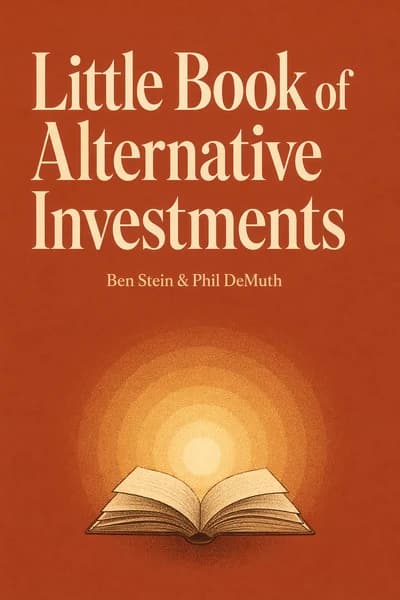
Imagine your investment portfolio as a romantic relationship. For decades, you've been in a committed marriage with the traditional 60/40 stock and bond allocation-reliable but increasingly predictable. Meanwhile, the wealthy investors you read about seem to be having all the fun with exotic alternatives that promise both excitement and stability. Ben Stein (yes, the monotone economics teacher from "Ferris Bueller's Day Off") and Phil DeMuth's "The Little Book of Alternative Investments" serves as your investment Kama Sutra, introducing you to options beyond your missionary-position portfolio. This Wall Street bestseller, beloved by financial advisors and individual investors alike, demystifies the secretive world of hedge funds, commodities, and other alternatives that were once exclusive to the ultra-wealthy. As markets have grown increasingly volatile in recent decades, Stein and DeMuth's practical approach to diversification has never been more relevant.
第2章
Rethinking What You Know About Investing
Before diving into exotic alternatives, we need to reconsider what we think we know about conventional investing. The colorful pie charts financial advisors love to show us are often misleading-despite their many slices, most portfolios effectively contain just two ingredients: stocks and bonds, typically in a 60/40 ratio. This combination balances the "caffeine" of stocks with the "port" of bonds in an elegant arrangement that has served investors reasonably well for decades. Consider the classic Vanguard balanced fund, which has delivered steady returns through multiple market cycles using this approach.
But there's a problem: most people are far more exposed to stock market risk than they realize. Your job security, your spouse's employment, your company stock options, your 401(k), and even your home value all deteriorate simultaneously during economic downturns. For example, during the 2008 financial crisis, many tech workers lost both their jobs and saw their stock portfolios crater by 50% or more. Real estate values in tech-heavy regions like San Francisco plummeted simultaneously, creating a perfect storm of correlated risks. You're effectively doubling down on the same economic factors that drive the stock market.
Rather than obsessing over returns, which are largely outside our control, we should focus on what we can manage: investment expenses, asset allocation, and risk management. Even small differences in fees compound dramatically - a 1% higher annual fee can reduce your retirement wealth by 20% over 30 years. One simple but powerful alternative investment is often overlooked: cash. Having sufficient cash reserves - typically 6-24 months of living expenses - provides a psychological security blanket that prevents panic selling during downturns. During the COVID-19 crash, investors with adequate cash reserves were able to stay invested or even buy more stocks at depressed prices.
When we analyze portfolios by risk exposure rather than dollars invested, the picture changes dramatically. Stocks, with their standard deviation of about 15%, are three times more volatile than bonds at 5%. This means a 60/40 portfolio is actually closer to 85/15 in terms of risk contribution. To truly balance these risks, you'd need a 25% stock, 75% bond portfolio-the inverse of the typical allocation. This creates a dilemma: lower equity allocation means lower expected returns. The solution? Either leverage (borrowing to amplify returns), using riskier bonds like high-yield corporate debt, or adding alternative assets with higher expected returns than bonds but low correlation to stocks. For instance, adding a 20% allocation to managed futures funds has historically improved risk-adjusted returns while providing valuable diversification during stock market crashes.
Consider also the role of international diversification - while global markets are increasingly correlated, exposure to different currencies and economic cycles can still provide meaningful diversification benefits. Emerging markets, in particular, often march to their own drummer, though they come with their own unique risks.
第3章
Optimizing Your Core Portfolio
Before exploring alternatives, ensure your conventional portfolio is optimized. Most investors follow ineffective strategies like stock picking without tracking performance against benchmarks. John Bogle's revolutionary insight was that passive index investing beats active management because managers, research, commissions, and taxes are expensive. Over 20 years, your chances of outperforming the market through active management versus using low-cost index funds are only about 15%.
However, academic research has identified persistent market anomalies that can enhance returns. Value stocks (companies trading at low multiples of their underlying economic value) have dramatically outperformed growth stocks-$1 invested in large U.S. value stocks in 1926 grew to $4,599 by 2010 versus just $1,647 for growth stocks. Similarly, small company stocks have outperformed large ones-$1 invested in small U.S. companies in 1926 grew to $13,666 versus $2,436 for large companies.
Low beta stocks (less volatile companies like utilities) perform better than expected on a risk-adjusted basis. Why do these anomalies persist? Human psychology. Investors remain overconfident, overpay for growth, prefer familiar large companies, and avoid boring businesses-creating enduring opportunities for disciplined investors.
To capture these anomalies, consider using fundamental-weighted index funds like the Powershares FTSE RAFI portfolios for U.S. and international markets. For low beta exposure, Berkshire Hathaway serves as a natural choice, supplemented with global sector funds in consumer staples, healthcare, and utilities.
For bonds, there are no exploitable anomalies, but investors face two compensated risks: term risk (longer-duration bonds pay more but face greater interest rate and inflation risk) and credit risk (lower-quality borrowers pay higher yields to compensate for default risk). For volatility reduction, consider short-duration, high-quality bonds, inflation-indexed bonds, and total bond market index funds for tax-sheltered accounts.
By combining value, small-cap, and low-beta stock tilts with a diversified bond approach, you can create a more efficient portfolio than the traditional 60/40 mix. While strategy can be controlled, outcomes remain uncertain-"luck is a terrible strategy."
第4章
The Collector's Dilemma: Beautiful Objects, Ugly Returns
During periods of economic uncertainty and market volatility, investors frequently seek refuge in tangible collectibles - from fine art and rare coins to vintage watches and first-edition books. While some dedicated collectors with deep expertise occasionally achieve impressive returns, particularly in niche markets they know intimately, the authors' advice remains crystal clear: "Collect for love, not for money." This wisdom stems from decades of observing how emotional attachment often clouds financial judgment.
The drawbacks of collectibles as investments are numerous and significant. Mass-marketed "limited editions" and items specifically promoted as collectibles rarely appreciate in value - think Beanie Babies, Franklin Mint commemoratives, or modern sports memorabilia. Collecting trends are notoriously fickle, with yesterday's must-haves becoming tomorrow's garage sale items. Markets for collectibles are highly illiquid, often requiring months or years to find suitable buyers. Values can fluctuate dramatically based on changing tastes, generational interests, and economic conditions. Most critically, collectibles tend to perform worst during economic downturns - precisely when investors might need to access their capital most urgently.
The pricing dynamics of collectibles create a persistent challenge. When buying, collectors invariably pay retail prices, regardless of dealers' claims about "wholesale" or "investment" opportunities. The selling experience is often disappointing - even well-maintained items rarely recover their purchase price after accounting for inflation, storage, insurance, and transaction costs. Auction houses typically claim 15-25% in commissions and fees, while finding qualified buyers requires extensive networking and patience. Popular television shows like PBS's Antiques Roadshow contribute to unrealistic expectations by quoting insurance replacement values rather than actual dealer buying prices, which can be 50-70% lower.
Using classic cars as a revealing case study, the authors methodically deconstruct the fantasy versus reality of collectible investments. Pricing mechanisms are notoriously subjective and unreliable, with identical models selling for vastly different prices based on subtle details or provenance. Restoration costs frequently exceed initial purchase prices - a complete engine rebuild alone can cost $20,000-$30,000. When adjusted for inflation, many "investment-grade" cars barely break even over decades of ownership. Beyond the financial considerations, classic cars present practical challenges: they typically handle poorly compared to modern vehicles, lack basic safety features like airbags and anti-lock brakes, and require specialized maintenance knowledge that's becoming increasingly scarce. Storage costs, insurance, and regular maintenance form a constant drain on returns.
As the authors pointedly conclude, "It is not easy to convert money into beauty and then back into money again." The transformation from financial asset to object of desire and back to financial asset is fraught with friction, emotion, and hidden costs that make collectibles a questionable choice for serious investors seeking reliable returns.
第5章
Alternative Investments to Avoid
Not all alternative investments deserve a place in your portfolio. The authors take a skeptical stance toward several options they consider unsuitable for most investors.
Private equity (encompassing venture capital and leveraged buyouts) locks up capital for years with wildly uneven returns. Research suggests venture capital actually delivers negative alpha with very high beta, meaning it underperforms the stock market while amplifying market risks. The real winners in private equity are the fund managers themselves, who collect lavish fees: 2% management fees annually, 20% of profits, plus additional charges. The authors suggest Berkshire Hathaway as their only recommended private equity play, citing Buffett's $100,000 salary to manage a $200 billion company.
Buy/write funds purchase a stock index like the S&P 500 and sell covered calls against it, generating income but limiting upside potential. The authors dismiss these strategies as unnecessarily complex and expensive, noting investors can achieve virtually identical results by simply putting half their money in an S&P 500 index fund and keeping the rest in T-bills.
Structured products combine notes with derivatives to create investments that promise attractive risk-return profiles but are designed primarily to generate profits for their creators. Despite marketing that emphasizes limited downside with market upside, these products suffer from illiquidity, credit risk, opacity, and high embedded fees.
Despite gold's allure as an inflation hedge and currency alternative, the authors express limited enthusiasm for it as a standalone investment. They prefer exposure through broader commodity indexes rather than direct investment, though they suggest SPDR Gold Trust ETF (GLD) for those who insist on owning it. As Buffett asked them: would you rather own all the gold in the world or all U.S. farmland, 10 Exxon Mobils, and a trillion dollars in cash?
第6章
Commodities: The Building Blocks of Diversification
On our hunt for alternatives to stocks and bonds, commodities represent our first meaningful stop. From agricultural products like wheat, corn, and soybeans to energy sources such as oil and natural gas, and precious and industrial metals including gold, silver, and copper, commodities encompass the physical goods that form the essential building blocks of our modern economy.
The modern commodities market traces back to 18th century Japan, where rice farmers developed futures contracts to protect themselves from price volatility. These contracts-specifying quantity, quality, delivery date, location and price-became tradable instruments, creating a standardized futures market that eliminated counterparty risk. This innovation spread globally, leading to established exchanges like the Chicago Board of Trade and the London Metal Exchange.
The futures market attracts three main categories of participants: speculators betting on price movements (like the Duke brothers in Trading Places), producers hedging their crops or mining output, and businesses securing predictable input costs for manufacturing. While individual investors might have hunches about commodity prices, it's crucial to remember you're trading against industry experts with deep specialized knowledge and often privileged information about supply chains and market conditions.
Unlike stocks or real estate, commodities aren't "earning assets"-they generate no income, dividends, or cash flows while you hold them. Their value comes purely from price appreciation driven by supply and demand dynamics. The bullish case rests largely on global development-"there is China"-as emerging economies require massive resources for industrialization. India, Southeast Asia, and Africa represent the next waves of resource-intensive development.
Even with modest expected returns, commodities earn their place in portfolios through three key benefits: diversification, inflation protection, and crisis performance. They generally have low correlations with stocks and bonds, serve as effective inflation hedges during periods of rising prices, and often perform well during market stress. From 1970-2004, broad commodity indices returned 4-6% above T-bills despite flat individual commodity prices, demonstrating the power of strategic rebalancing and roll yield.
For most investors, the best approach is through passive commodity index funds that provide broad exposure while minimizing trading costs and complexity. The PowerShares DB Commodity Index Tracking Fund (DBC) tracks 14 major commodities with T-bill collateral, offering exposure across energy, agriculture, and metals. Other popular options include the iPath Dow Jones-AIG Commodity Index ETN (DJP), which follows a production-weighted index, the Elements Rogers International Commodity ETN (RJI), designed by commodities guru Jim Rogers, and the DFA Commodity Strategy Portfolio (DCMSX), which employs a more sophisticated futures trading strategy. Each vehicle has distinct tax treatment and structural considerations that warrant careful evaluation.
When sizing commodity allocations, most experts recommend 5-15% of a diversified portfolio, with higher allocations potentially suitable for investors particularly concerned about inflation protection or seeking enhanced diversification benefits.
第7章
Real Estate: The Enduring Alternative
Real estate, once the primary wealth symbol for royalty and aristocrats, continues to serve as a cornerstone asset class for sophisticated modern investors. While residential property ownership (your primary home) functions more as consumption than pure investment, commercial real estate offers powerful portfolio diversification opportunities, primarily through REITs (Real Estate Investment Trusts) - a vehicle that democratizes access to large-scale property investments.
REITs are publicly traded companies that own, operate, and develop income-producing commercial properties across various sectors: office buildings, apartment complexes, shopping centers, healthcare facilities, data centers, and warehouses. To maintain REIT status, these entities must meet specific IRS requirements: invest at least 75% of total assets in real estate, derive 75% of gross income from real estate-related sources like rents or mortgage interest, and distribute a minimum of 90% of taxable income to shareholders as dividends annually. This structure ensures REITs remain focused on real estate operations while providing significant tax advantages.
The business model exemplifies elegant simplicity: as professional landlords, REITs collect rents from diverse tenant bases and distribute the majority to shareholders. This proposition has endured through centuries - the fundamental need for physical space, whether for living, working, or commerce, creates a perpetual demand that transcends economic cycles. Modern REITs have evolved to capture emerging real estate trends, including cell tower infrastructure, cold storage facilities, and specialized laboratory spaces.
REITs offer investors a compelling hybrid of investment characteristics: corporate equity structure for liquidity, inflation-hedging real assets as underlying collateral, bond-like predictable cash flows through contractual leases, and enhanced returns through prudent leverage (typically maintaining 40-50% debt-to-equity ratios). Their historical performance has been impressive, delivering average annual returns of 11.4% from 1990-2005. During the "lost decade" for broader equities (2000-2010), when the S&P 500 delivered negative returns, Vanguard's Real Estate Index fund generated a robust 10.3% annual return. While REITs experienced significant volatility during the 2008 financial crisis, dropping 38%, they've historically provided excellent protection during inflationary periods, particularly during the 1970s when real estate values and rents increased alongside rising prices.
For retail investors seeking exposure, low-cost index funds offer efficient access to the sector. Vanguard's MSCI REIT ETF (VNQ) provides broad domestic exposure with minimal expenses of 0.13% annually, while its international counterpart (VNQI) charges 0.35% for global diversification. Tax considerations are important: since approximately 60% of REIT dividends are taxed as ordinary income rather than qualifying for preferential dividend rates, these investments are particularly well-suited for tax-advantaged accounts like IRAs and 401(k)s. Modern portfolio theory suggests a REIT allocation of 5-15% can enhance risk-adjusted returns through decreased portfolio correlation with traditional stocks and bonds.
第8章
The World of Hedge Funds: Mystique and Reality
Hedge funds represent the ultimate alternative investments-sophisticated vehicles that aim to produce "absolute returns" disconnected from traditional markets. As Cliff Asness of AQR Capital describes them: "Hedge funds are investment pools that are relatively unconstrained in what they do. They are relatively unregulated, charge very high fees, won't necessarily return your money when you want it, and generally won't tell you what they do."
Modern hedge funds thrive on several key developments: the ability to short stocks, neutralizing market risk through long/short positions, leveraging trades, using computers to analyze massive data, accessing new futures and derivatives markets, and attracting brilliant minds to finance.
These funds exploit small market inefficiencies-the "sea shells left on the beach by the ocean of efficient markets." They capitalize on price anomalies, provide liquidity when others can't, take on arcane risks, and trade against institutions acting for policy reasons.
Despite their mystique, hedge funds have limitations. The infamous "2 & 20" fee structure (2% management fee plus 20% of profits) supports hedge fund managers' lavish lifestyles. Performance fees create perverse incentives-when below their hurdle rate near year-end, managers might take enormous risks with investors' money. High-water marks supposedly protect investors by requiring funds to recover previous losses before collecting performance fees, but managers can simply close underperforming funds and open new ones.
Since hedge fund reporting is voluntary, performance data suffers from survivorship and backfill bias. Ibbotson Associates research shows that from 1995-2009, hedge funds returned about 7.6% annually after fees, compared to 8% for the S&P 500. Critics also dispute claims of low correlation with traditional markets, showing hedge fund returns correlate positively with economic activity.
So why invest in hedge funds? During the 2008 crisis when the S&P 500 lost 37%, hedge funds were down only 15-19%-still painful, but significantly better. During the "lost decade" of 2000-2009 when stocks returned -1% annually, hedge funds delivered 4-7%. They represent a potential third leg of a stool supported by stocks and bonds, offering positive expected returns with moderate correlations to conventional investments.
第9章
Hedge Fund Strategies for Everyday Investors
The hedge fund industry has reached its "Model T moment," with strategies being mass-produced for everyday investors through mutual fund formats. These offer tremendous advantages: lower expenses, no performance fees, low minimums, simplified taxes, daily liquidity and pricing, transparency, SEC regulation, and less leverage.
Let's examine some key hedge fund strategies now available to ordinary investors:
Long/short equity funds simultaneously purchase securities they believe will rise while shorting others expected to fall. While long investing has limited downside and unlimited upside, short selling has limited upside and unlimited downside. These funds rely heavily on managers' stock-picking and market-timing skills.
Market neutral equity funds balance long and short positions to create portfolios uncorrelated with market performance. They practice "relative-value fundamental arbitrage"-finding correlated stock pairs and going long one while shorting the other (like buying Ford while shorting GM). The outcome is unrelated to broader market movements.
Global macro managers take a high-level view of the world economy, placing leveraged bets across equity markets, currencies, interest rates, and commodities worldwide when they spot imbalances. A popular strategy is the "carry trade"-borrowing in low-interest currencies to invest in higher-yielding assets elsewhere.
Managed futures funds actively trade futures markets across commodities, currencies, equities and fixed income globally. They employ trend-following systems that profit from investor psychology that creates momentum. They performed exceptionally well during market downturns, gaining 13-18% in 2008 when stocks fell 37%.
Event-driven managers capitalize on corporate events that create pricing opportunities. In merger arbitrage, they might buy shares of acquisition targets trading below the announced purchase price, betting the deal will close. The strategy also includes investing in distressed securities-typically bonds downgraded to junk status that institutional investors must sell regardless of price.
For investors lacking the resources to invest directly in hedge funds, hedge-fund-in-mutual-fund-wrappers offer an alternative approach. These vehicles attempt to deliver hedge fund performance through two different methods: Hedge Fund Replicants (mathematically replicating hedge fund index returns) and Hedge Fund Strategies (using actual hedge fund methodologies inside mutual funds).
第10章
Building Your Alternative Portfolio
Before diving into alternatives, investors should ensure their baseline portfolio is optimized by: diversifying globally with 30-60% invested abroad, using low-cost index funds, tilting toward historically outperforming factors (small company, value, low beta stocks), maintaining high-quality short-duration bonds, keeping adequate cash reserves, saving regularly for retirement, and having sufficient life insurance.
After diversifying into commodities and REITs, investors should allocate about 10% of their portfolio to hedge fund strategies. For a traditional 60/40 portfolio, this means 6% to alternatives, either taken entirely from equities (to lower risk) or split between stocks and bonds.
For beginners with as little as $6,000, the authors suggest equal allocations to three core strategies: Event-Driven (Merger Fund or Arbitrage Fund), Global Macro (Powershares DB G10 Currency Harvest Fund), and Managed Futures (Elements S&P Citi ETN), with each representing about 2% of the total portfolio.
For investors wanting specific fund recommendations across multiple hedge fund strategies, the authors provide detailed suggestions with confidence ratings. They recommend equal weighting across strategies rather than complex optimization.
The authors also propose a risk-balanced alternative that evenly distributes exposure across stocks, bonds, inflation-sensitive assets, and alternatives. This four-way risk-diversified portfolio allocates approximately 25% to each risk category. Using the Dow Jones Credit Suisse Hedge Fund Index as a proxy, they show how adding alternative investments can reduce volatility while maintaining reasonable returns.
The financial services industry has been slow to respond to the 2008 crisis, stuck in a cycle of selling stocks during good times and hiding during downturns. However, innovative minds have been developing better investment vehicles that systematically diversify risk beyond traditional stocks and bonds. These new alternative products actively manage key parameters like risk exposure, volatility, and correlation to equity markets.
Though more complex and expensive than traditional investments-contradicting the old "simpler is better" and "cheaper is better" mantras-these instruments help investors build wealth by preventing the destructive "buy high, sell low" behavior that occurs during market extremes. By moderating risk, they provide investors the peace of mind to stay invested through market cycles. The future of investing belongs not to flashy strategies but to steadier, more thoughtfully designed approaches that help ordinary investors weather market storms with confidence.