第1章
When Dreams Become Reality: A Journey Through Henrietta's Supernatural Landscape
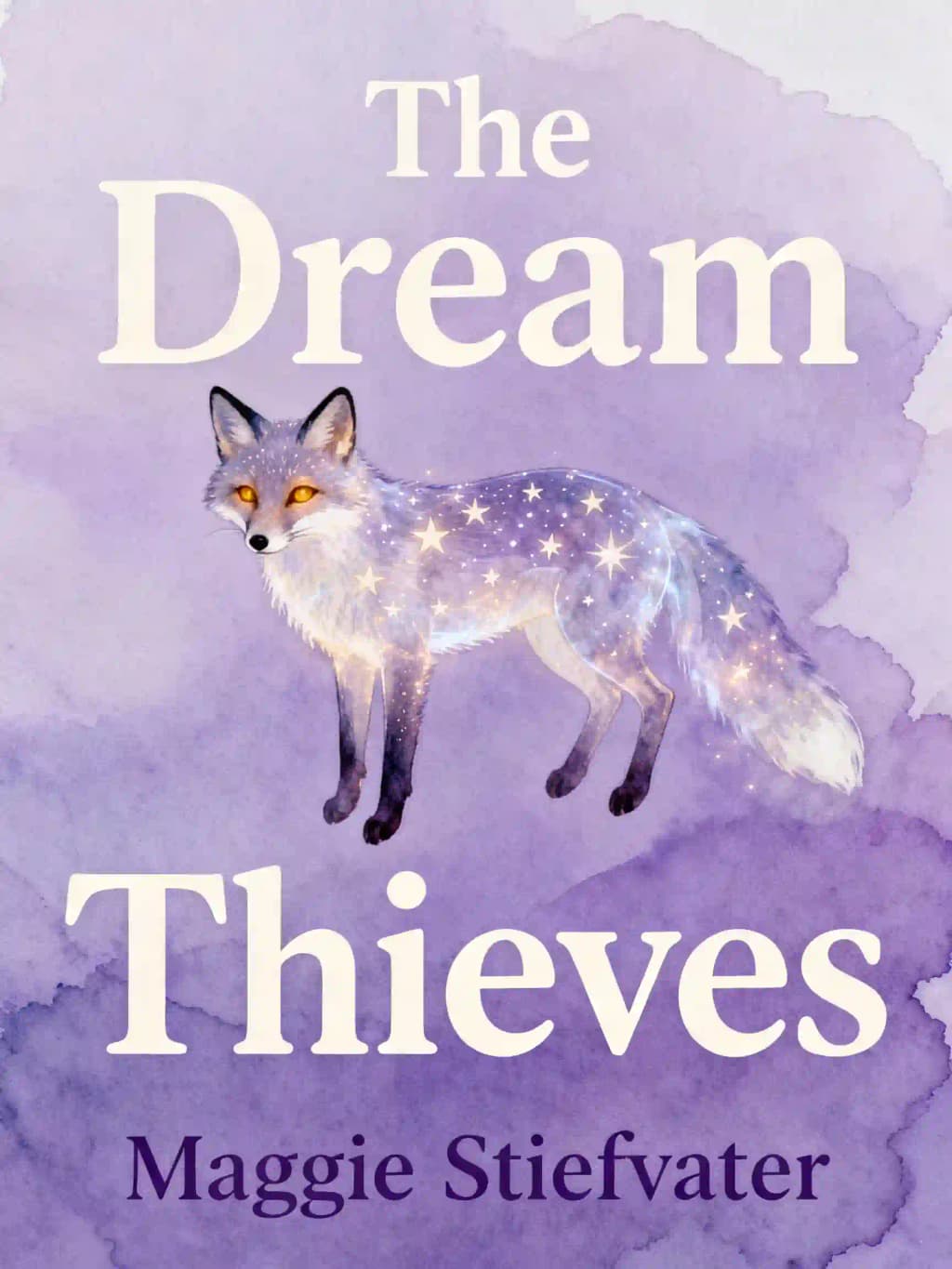
The Dream Thieves plunges readers into a world where the line between dreams and reality blurs dangerously. Maggie Stiefvater's second installment in The Raven Cycle series has captivated millions with its unique blend of supernatural elements and coming-of-age themes. Since its 2013 release, the book has developed a cult following, with celebrities like Emma Watson and Neil Gaiman citing it as a favorite. The novel's exploration of identity, power, and sacrifice resonates deeply with readers, earning it spots on numerous "Best YA Fantasy" lists and cementing Stiefvater's reputation as a master of atmospheric storytelling. What makes this story particularly compelling is how it transforms the familiar landscape of small-town America into something magical and dangerous-a place where dreams can literally come to life, with all the wonder and terror that implies.
第2章
The Secret Lives of the Lynch Family
Ronan Lynch carries three kinds of secrets: those shared between two people, those kept from oneself, and those completely hidden. His first secret involved his father, Niall Lynch-a charming, mysterious man who disappeared for months but returned with gifts and money. When young Ronan discovered a newspaper clipping confirming his father's story about an earthquake on his birth day, Niall revealed himself covered in blood and blue star-shaped petals that seemed to materialize from his mind. "I know where the money comes from," Ronan said. "Don't tell anyone," his father replied.
The most dangerous secret, however, is Ronan's ability to extract objects from his dreams. This power first manifested when he dreamed of his friend Gansey's car, held the keys in his dream, and woke to find them physically in his palm. This impossible ability shapes Ronan's entire identity-he is the Greywaren, a living artifact who can make dreams tangible.
The Lynch family home, known as the Barns, holds its own mysteries. When Ronan finally breaks the prohibition against visiting his childhood home, he discovers dozens of animals in suspended animation-breathing but unmoving. Most shockingly, his mother Aurora lies in the same state, revealing the devastating truth: she is another dream creation of his father's, not a real person at all.
The Lynch brothers represent different responses to their father's legacy. Declan, the oldest, maintains appearances and follows rules. Ronan rebels against constraints while secretly longing for his father's guidance. Matthew, the youngest, radiates innocent joy, unaware that his very existence may be another dream creation. Together, they navigate the dangerous aftermath of their father's death, with Ronan slowly realizing that his inheritance isn't just material wealth but the power to reshape reality itself.
第3章
The Quest for Glendower and the Ley Line
The search for the legendary Welsh king Owen Glendower drives the narrative forward. Buried somewhere along the Henrietta ley line, Glendower is said to grant a favor to whoever wakes him-a boon that might save Gansey from his prophesied death. The group initially found Cabeswater, a mystical forest along the ley line where trees speak Latin and time behaves strangely. But as the story progresses, Cabeswater mysteriously disappears, leaving only empty fields where ancient trees once stood.
The ley line itself becomes a character-a supernatural energy pathway that connects places of power across the landscape. Adam Parrish, in a desperate bid to help his friends, sacrifices himself to the line, becoming its human conduit. "I am Cabeswater's hands. I am Cabeswater's eyes," he realizes as he merges with its consciousness. This sacrifice fundamentally changes him, giving him access to the line's power but also making him vulnerable to its influence.
The group's search takes them to a man-made lake where they recover two impossible objects: an ancient shield boss with three ravens embossed on it (the coat of arms of Glendower's mythological father) and, bizarrely, a centuries-old wheel from Gansey's Camaro. This paradoxical discovery-a wheel simultaneously on Gansey's car and recovered from centuries underwater-unsettles their understanding of time and reality.
As Adam works with Persephone to repair the ley line's energy leaks, they discover that special stones act as conductors for the line's power, similar to those at Stonehenge. "In the past, priestesses would have maintained these lines," Persephone explains. When Adam wonders what the world would be like if all ley lines were repaired, she responds that it would be "a very different world with very different priorities"-suggesting the profound impact these supernatural energies once had on human civilization.
第4章
The Gray Man's Hunt for the Greywaren
The Gray Man-a hitman with a graduate degree and a published book on Anglo-Saxon verse-arrives in Henrietta hunting the Greywaren. His employer, Dr. Colin Greenmantle, believes it's an object that can extract things from dreams. The Gray Man's search leads him through Henrietta's strange landscape, where power surges, transformer fires, and mysteriously activated stadium lights suggest supernatural energy at work.
His investigation brings him to 300 Fox Way, home of Blue Sargent and her psychic relatives. There, he meets Maura Sargent and finds himself unexpectedly falling in love-"a sensation he compares to being stabbed with a screwdriver." This emotional connection complicates his mission, especially when he discovers the Greywaren isn't an object but a person: Ronan Lynch.
The Gray Man's past haunts him through his sociopathic brother, who "trapped animals and did things to them" during their childhood. When Greenmantle threatens to reveal the Gray Man's location to his brother unless he delivers the Greywaren by July 4th, the Gray Man faces an impossible choice between his mission and his newfound relationships.
In a pivotal confrontation, the Gray Man admits to killing Niall Lynch on Greenmantle's orders, triggering Ronan's fury. Despite this revelation, the Gray Man devises a plan to protect Ronan by telling his employer he's found the Greywaren but is keeping it for himself. "And then what happens?" Maura asks. "I run," he replies simply.
The Gray Man's character arc culminates when he chooses to face his brother rather than flee. At a truck stop parking lot, he confronts the man whose voice alone paralyzes him with memories of torture and abuse. Instead of succumbing to fear, he shoots his brother twice, leaving behind only a Post-it note before driving toward his new home in Henrietta-choosing love and belonging over his lifetime of running.
第5章
Dreams as Weapons: Ronan and Kavinsky's Dangerous Game
Joseph Kavinsky-a notorious Aglionby student known for drugs, street racing, and destruction-recognizes Ronan's ability because he shares it. "I know what you are," he tells Ronan, revealing dozens of white Mitsubishis he's pulled from dreams. Their shared power creates an immediate, dangerous connection between them.
Kavinsky offers to teach Ronan to control his abilities, showing him how to treat dreams as merely a means to an end-"to sneak in, grab what you want, and get out before the dream corrupts it." Under Kavinsky's tutelage, Ronan grows more skilled, learning to short-circuit the dream's "alarm system" and create increasingly complex objects.
Their relationship becomes a toxic battle of wills and desires. Kavinsky sees Ronan as a kindred spirit who could join him in nihilistic creation and destruction. "There's only with me or against me," he threatens when Ronan tries to leave. When Ronan refuses to join him, Kavinsky kidnaps Matthew to force Ronan's participation in his destructive Fourth of July spectacle.
The conflict culminates when both dreamers manifest nightmare creatures-Kavinsky's fire dragon versus Ronan's night horror-that battle above Henrietta's fairgrounds while fireworks explode around them. As the dragon destroys everything in its path, Kavinsky makes his final stand, putting on his white sunglasses as he faces his creation. "The world's a nightmare," he says before the dragon passes through him, killing him instantly.
This confrontation represents the fundamental difference between the two dreamers: Kavinsky uses his power for selfish destruction, while Ronan ultimately learns to work with Cabeswater as a partner rather than a thief. "The Greywaren is not just a dream thief," Adam tells him. "You're supposed to be Cabeswater's hands."
第6章
The Price of Magic: Sacrifice and Consequence
Throughout the novel, magic demands payment. When Adam sacrifices himself to the ley line to wake it, he experiences strange sensory distortions-"catching images" and feeling disconnected from his senses. He suffers episodes of "transient global amnesia" where he can't remember anything past the last minute, though he knows he's losing time. These episodes culminate when the Gansey family finds him walking along Interstate 395, fifteen miles from their D.C. home, with no memory of how he got there.
The psychic women of 300 Fox Way understand these costs. When Blue asks about her no-kissing curse-that if she kisses her true love, he will die-they offer no solutions, only acknowledgment of the burden. Similarly, when Ronan asks about his mother's dream-state, Calla explains that dream objects share the same life and soul as their dreamer-"like nail clippings"-and would stop functioning when the dreamer died.
Dreaming itself drains the ley line's energy, weakening Cabeswater. Each time Ronan or Kavinsky creates something from dreams, they siphon power from the supernatural current that sustains the magical forest. This realization leads to Adam's efforts to repair the line using stones as conductors, working frantically to restore the energy before Kavinsky's final dream-creation consumes it completely.
Even the Gray Man's skills come at a cost-his humanity gradually eroded by years of violence until meeting Maura reawakens his capacity for connection. When she touches his face and says, "I'm sorry no one saved you," she acknowledges the sacrifice his life has been.
The novel suggests that magic always requires something in exchange-whether energy, memory, safety, or love. As Maura warns about magical places: "They have rules we don't understand." The challenge for the characters is not avoiding payment but ensuring the price is one they choose consciously rather than one forced upon them.
第7章
Shifting Relationships and Hidden Desires
The relationships between the main characters evolve dramatically throughout the novel, weaving a complex tapestry of emotions, unspoken desires, and conflicting loyalties. Blue and Adam's romance, initially full of promise and tentative hope, begins to unravel in subtle ways. Their interactions become increasingly strained as Blue maintains her steadfast refusal to kiss him, offering no explanation for her reticence. The tension builds until, in a moment of raw honesty, she finally reveals the devastating truth of her curse - that kissing her true love will result in his death. But it's her following words that deliver the real blow: "it doesn't matter" because "it's not gonna be you," effectively ending any possibility of their romantic future.
Meanwhile, Blue's feelings for Gansey develop with an inevitability that terrifies her, especially given her knowledge of his impending death within the year. Their connection manifests in small, intimate moments: sharing jokes only they understand, late-night phone calls where silence speaks louder than words, and stolen glances during group meetings. One particularly poignant moment occurs when they stand together overlooking Henrietta, the town's lights scattered like fallen stars against the backdrop of night-black mountains. Unlike her calculated interactions with Adam, Blue's relationship with Gansey feels organic and natural-"a foregone conclusion rather than playacting." This natural chemistry only makes her prophesied role in his death more tragic.
Ronan's character development reveals layers of complexity and hidden desires that he struggles to acknowledge. His dreams increasingly feature Adam - sometimes in danger, sometimes simply present, always significant. His complicated relationship with Kavinsky crackles with dangerous energy, mixing attraction, repulsion, and recognition of their similar abilities. When Kavinsky attempts to forge a connection by suggesting they're kindred spirits - dreamers too wild for the real world - Ronan forcefully rejects this parallel, insisting there's more to life than "sex and drugs and cars." This rejection represents Ronan's broader struggle to reconcile his wild nature with his desire for meaningful connections.
Gansey remains the gravitational center of the group, though his carefully maintained facade occasionally shows cracks. His greatest fear isn't death or failure, but rather becoming irrelevant to those he loves. This vulnerability becomes starkly apparent during a heated confrontation with Adam, who strikes at Gansey's core insecurity by declaring, "I got into Aglionby without you. I got Blue without you. I woke the ley line without you." Gansey's uncharacteristic silence in response reveals the depth of his fear of redundancy in his friends' lives.
These evolving relationships create an intricate web of loyalties, jealousies, and unspoken feelings that both strengthen and complicate the group's quest. Each character must navigate not only their supernatural challenges but also the equally daunting terrain of their emotional connections. Their individual growth becomes inseparable from their relationships with each other, suggesting that understanding the human heart might be as mysterious as understanding the magical forces they encounter.
第8章
The Power of Names and Language
Language holds supernatural power throughout the novel, functioning as both a key to magical realms and a reflection of identity. In Cabeswater, the ancient trees speak Latin, their whispered words carrying both warnings and wisdom. Understanding their speech isn't merely about translation-it's about connecting with the forest's consciousness. The trees communicate through fragments of prophecy, weather patterns, and riddles that require both linguistic knowledge and intuitive understanding to decipher.
Ronan's puzzle box serves as a metaphor for the interconnectedness of human communication across time. Its ability to translate between Latin, Greek, Sanskrit, Coptic, and one mysterious unidentifiable language suggests that all magical languages share a common root. The box doesn't simply convert words; it reveals the underlying patterns that connect ancient systems of meaning, suggesting that magic itself might be a kind of universal language.
Names carry particular significance, operating as both identifiers and sources of power. When Orphan Girl instructs Ronan to "call it by name" during his attempt to dream the Camaro, it represents a fundamental shift in his approach to dream objects. Instead of trying to forcefully extract the car from his dreams, he learns to establish a relationship with it through naming-a act of respect rather than dominance. This mirrors ancient magical traditions where knowing something's true name grants power over it.
The Gray Man's relationship with names illustrates their role in identity and power. His refusal to use his birth name represents more than anonymity-it's a rejection of his past self. When Greenmantle weaponizes his birth name-Dean Allen-it becomes an act of violence, stripping away the protective layers of his chosen identity. This reveals how names can be both shields and weapons in the wrong hands.
Gansey's multiple names demonstrate how identity shifts across different contexts. As Richard Campbell Gansey III, he embodies centuries of family legacy and social expectation. As simply Gansey, he exists in the space he's created with his friends, where he can be authentic. The nickname Dick, used by those who see only his surface, represents misunderstanding and social distance.
Latin phrases weave through the narrative like musical motifs, each carrying layers of meaning. When Adam declares "Scio quid hoc est" in Ronan's dream, the Latin adds gravity to his understanding, suggesting knowledge that transcends modern language. The haunting chant "Rex Corvus, parate Regis Corvi" during the power outage connects their present quest to ancient cycles of power and prophecy, suggesting that their story is part of a much larger magical tradition.
The novel ultimately presents language as a form of magic itself-a tool for transformation and understanding. As characters master various forms of communication, from ancient Latin to the language of dreams, they gain agency within their magical world. This mastery transforms them from observers into active participants in the supernatural landscape, demonstrating that true power comes not from controlling magic, but from learning to speak its language.
第9章
The Inheritance of Fathers: Legacy and Identity
Fathers cast long shadows throughout the novel, their influence extending far beyond physical presence or absence. Ronan struggles with Niall Lynch's complicated legacy-the magical abilities he inherited, the dream-created family members he left behind, and the enemies his actions attracted. When Ronan finally dreams of his father, Niall appears as "a forest fire, a rising sea, a car crash" with "planets inside him"-larger than life even in death. This metaphorical description captures both the awe and terror of Niall's influence, suggesting how parental power can be simultaneously creative and destructive. The magical objects scattered throughout the Barns serve as physical reminders of Niall's dreams, each one carrying both wonder and potential danger.
Adam's relationship with his abusive father forms the core of his character development. His "binary" anger-inherited from his father-threatens to consume him when triggered, manifesting in clenched fists and racing thoughts that mirror his father's violent tendencies. During a pivotal moment at Cabeswater, Adam analyzes this rage, recognizing it as his father's legacy within him. He sees how the patterns of abuse threaten to repeat themselves in his own behavior, particularly in moments of stress or confrontation. His journey involves breaking this inheritance by choosing a different path, ultimately becoming the hands of Cabeswater rather than repeating his father's violence. This transformation requires conscious effort to recognize and redirect his inherited responses.
Gansey's father, though physically present, remains emotionally distant-a different kind of absence. Richard Campbell Gansey II appears briefly during the D.C. political event, but their interaction reveals little connection beyond social pleasantries and shared names. Their conversations focus on surface-level topics, avoiding any meaningful exchange. Gansey has effectively chosen a different father figure in Glendower, the sleeping king whose favor might save him from death. This spiritual adoption reflects how children sometimes seek alternative parental figures to fulfill unmet emotional needs.
The Gray Man's relationship with his brother served as a twisted father figure, systematically shaping him into a weapon through psychological and physical abuse. "I'm sorry no one saved you," Maura tells him, acknowledging how this relationship formed his identity as a killer. Their dynamic demonstrates how early authority figures can normalize violence and create deep-seated patterns of behavior that require tremendous effort to overcome.
Through these varied father-son relationships, the novel explores how we inherit not just physical traits or possessions from our fathers, but patterns of behavior, emotional responses, and ways of moving through the world. Each character carries their father's influence differently: Ronan through his magical abilities and responsibility to his created family, Adam through his struggle with inherited anger, Gansey through his search for alternative guidance, and the Gray Man through his professional violence. The characters' growth depends on recognizing these inheritances and choosing which to honor and which to reject-creating identities that incorporate their pasts without being limited by them. This process of selective inheritance becomes central to their individual journeys toward self-definition.
第10章
The Convergence of Magic and Reality
As the novel concludes, the boundaries between magic and reality blur completely, creating a rich tapestry where the supernatural and mundane interweave seamlessly. Ronan's dream-created Camaro serves as a perfect example - not only is it indistinguishable from the original, but it even carries the same scratch on the driver's door and the lingering scent of leather and gasoline that characterized the first car. This precise replication demonstrates how dream objects have evolved from crude approximations to perfect manifestations of reality.
Adam's connection to Cabeswater transforms his perception of the ordinary world. Through his sacrifice, he begins to see the ley line's energy as golden threads weaving through everyday scenes - threading through traffic lights, pulsing beneath parking lots, and spiraling around trees in the local park. Even mundane moments like waiting at a stoplight become infused with magical awareness as he feels the earth's energy humming beneath the asphalt.
The practical approach to magic displayed by Blue's family at 300 Fox Way further emphasizes this convergence. Maura reads tarot cards while stirring soup, Calla discusses prophetic dreams while filing her nails, and Persephone teaches psychic techniques between bites of toast. Their casual integration of the supernatural into daily life suggests that magic isn't just possible - it's practical, useful, and utterly normal.
This convergence reaches its emotional peak when Aurora Lynch awakens in Cabeswater. Her emergence from dreams into reality is marked by subtle details - the way her dress ripples like water, how flowers bloom wherever her feet touch the ground, and the ravens that circle overhead responding to her presence. Her simple acknowledgment "Flowers and ravens" carries deep significance, accepting both her dream nature and her real connection to her sons. Cabeswater itself adapts to accommodate her, creating a perpetual spring in the section where she resides, demonstrating how magical spaces can bend to accommodate dream things.
The discovery of the new cave entrance "where a pool once existed" expands the physical manifestation of this merger. The entrance appears as both ancient and newly formed, with moss-covered stones that seem to shift positions when viewed from different angles. Adam's practical concern about safety measures reflects how the group has matured in their approach to magical phenomena - no longer recklessly charging forward but learning to navigate this merged world responsibly.
The novel's conclusion with Maura's disappearance masterfully ties together these themes. Her note, "Glendower is underground. So am I," suggests that the quest for the Welsh king has become more than a treasure hunt - it's now a journey through layers of reality where historical figures, family mysteries, and magical forces converge. This development implies that the boundaries between past and present, magic and reality, are as permeable as those between dreams and waking life.
Through these developments, The Dream Thieves presents magic not as an escape from reality but as a deeper layer of it, accessible to those who learn to perceive differently. The characters' journey becomes one of integration rather than separation, suggesting that the extraordinary exists not in some distant realm but in the shadows and spaces of everyday life, waiting to be recognized by those who have learned to see with both their eyes and their hearts.