第1章
The AI Revolution: Transforming Business with Intelligence
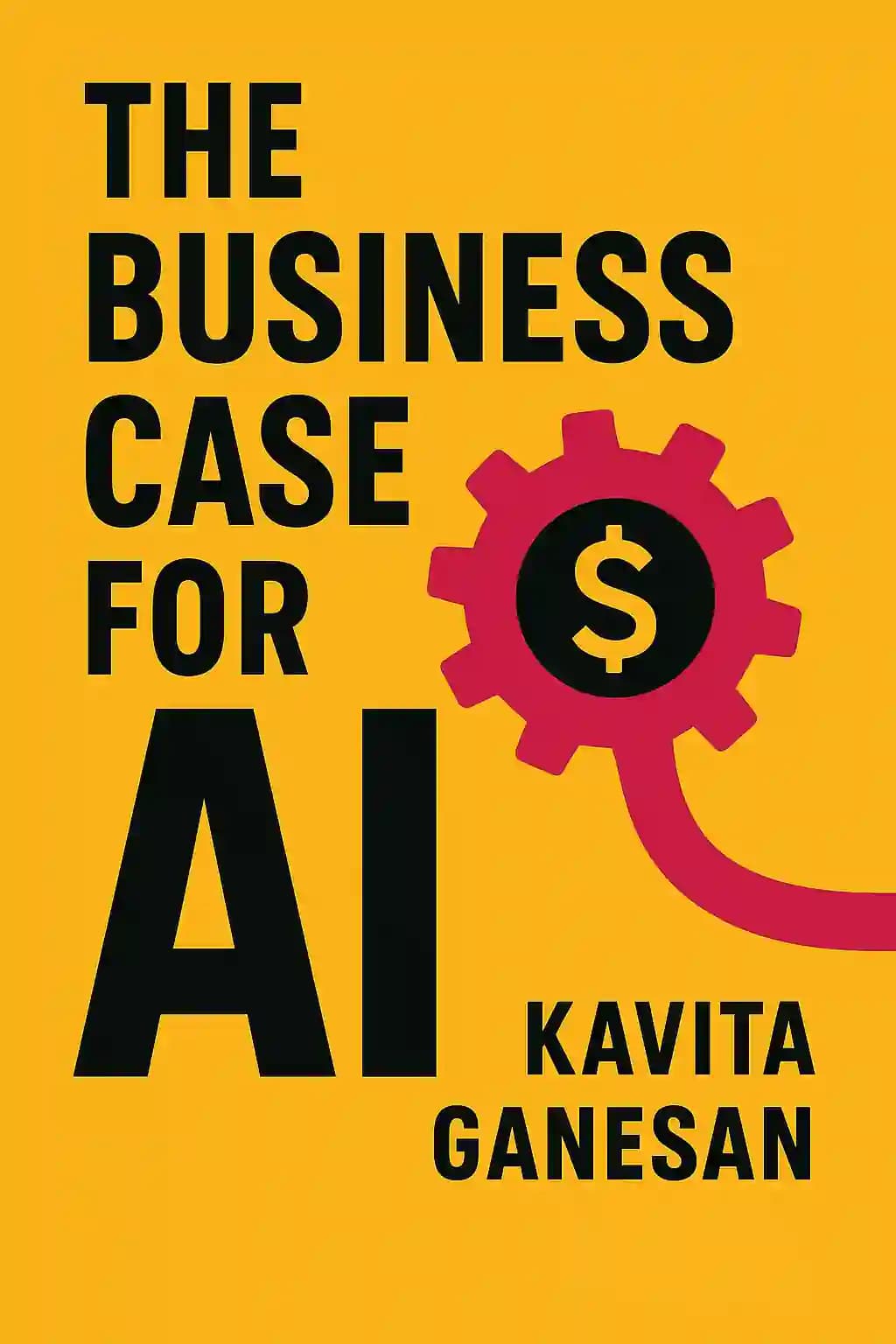
In a world where technological adaptation is increasingly essential for business survival, AI has emerged as both a beacon of hope and a source of intimidation. Yet the hype and misinformation surrounding artificial intelligence often lead to confusion and failed initiatives. Kavita Ganesan's "The Business Case for AI" cuts through this noise with a refreshing directive that might surprise you: sometimes, you should stop using AI. As counterintuitive as it sounds, Ganesan argues that AI isn't always the answer-especially when problems could be solved more efficiently through better software engineering or even manual processes. This practical perspective comes from her extensive experience as an AI practitioner since 2005, where she's observed firsthand the disconnect between leadership understanding and implementation reality. The book has garnered praise from tech leaders across industries for its no-nonsense approach to AI implementation, with Forbes recognizing it as essential reading for executives navigating digital transformation. Unlike futuristic AI manifestos that dominate bestseller lists, Ganesan's work focuses on immediate, practical applications that deliver measurable business value-making it the rare AI book that prioritizes results over technological fascination.
第2章
Demystifying AI: From Academic Concept to Business Tool
Artificial intelligence isn't the intimidating, humanity-destroying force often portrayed in science fiction. At its core, AI represents systems that mimic human decision-making to complete specific tasks as well as or better than humans. Today's business AI is "narrow" rather than general-it excels at particular functions while lacking the broad capabilities of human intelligence.
AI emerged as an academic discipline at the 1956 Dartmouth Conference but only became widely practical for business around 2011. This shift occurred thanks to four key developments: big data availability, cheaper computing power, advanced machine learning techniques, and cloud infrastructure that eliminated the need for expensive in-house supercomputers.
The most relevant AI technologies for businesses include machine learning, deep learning, computer vision, robotics, and natural language processing. Machine learning serves as the primary driver due to its versatility with different data types and minimal need for human supervision. It enables computers to learn patterns from data with limited human intervention, allowing them to make decisions when encountering similar situations in the future.
While machine learning algorithms learn from data, they can't independently determine which attributes (features) to use for optimal learning. This requires a data scientist to perform feature engineering-discovering the best combination of features for prediction. Deep learning, a subset of machine learning, uses neural networks to simulate how the human brain works, automatically discovering which features matter most without human engineering.
Computer vision enables machines to "see" by extracting information from images and video, while natural language processing helps computers understand textual data-critical for businesses since 80-90% of organizational data is unstructured, with text forming the majority. These capabilities help businesses organize documents, understand customer sentiment, extract key information from large text volumes, and provide 24/7 customer service through virtual assistants.
It's important to distinguish between AI and simpler automation. Robotic Process Automation (RPA) focuses on automating digital tasks previously done by humans, like data entry. While some RPA applications use AI (known as intelligent automation), many don't require AI at all. In practice, many business problems require hybrid solutions combining multiple AI techniques with human-curated rules to deliver seamless experiences.
第3章
Five Crucial Tips for AI Success in Business
To maximize AI success, leaders must avoid pursuing "AI for AI's sake"-a common phenomenon driven by executive pressure, funding opportunities, and marketing goals that often leads to expensive, fruitless experiments. Instead, follow these five essential tips:
First, understand AI. Without sufficient understanding, leaders limit their chances of success-explaining Gartner's prediction that 85% of AI projects "will not deliver." While implementation-level knowledge isn't necessary, understanding business aspects of AI is crucial for making better vendor selections, hiring decisions, and maximizing investments.
Second, address foundational gaps. Unlike tech giants like Meta and Google that are inherently AI-driven, most organizations have foundational gaps to address before implementing AI. For example, if necessary data isn't being collected, the first step is establishing data collection and storage systems rather than immediately hiring data scientists.
Third, be clear on ROI. AI's return on investment often manifests as benefits rather than immediate financial gains. While augmenting customer service with AI might eventually reduce costs, the immediate benefit is increased agent productivity. Leaders should focus on what pain points AI will address, what benefits will result, and what advantages AI offers over simpler approaches.
Fourth, consider budget. Implementing AI requires significant investment in training executives, upskilling employees, hiring specialists, and establishing data infrastructure. Without adequate budget, organizations risk cutting corners that harm customer experience, such as relying on public datasets instead of collecting quality data.
Finally, be committed. AI initiatives demand long-term commitment as they don't yield quick results. The process involves acquiring data, developing and testing models, and operationalizing them with ongoing maintenance. Models need periodic retraining as they become stale, and may require rebuilding as regulations change. For quick, cost-effective solutions, organizations should start with simple software automation or manual processes, replacing them with AI later when there's clear benefit.
第4章
Dispelling Common AI Myths
AI is surrounded by misconceptions that distort expectations and understanding. Let's examine five common myths to help distinguish between hype and reality.
Myth #1: We'll all lose our jobs to AI. This fear is only partially true. Current AI remains one-dimensional, lacking human common sense, adaptability, and emotional intelligence. Historically, technology creates more jobs than it destroys by increasing productivity and demand. Like the Industrial Revolution's impact on weaving, AI will transform job roles rather than eliminate them entirely. Customer service operators, for instance, won't disappear but will handle more complex issues while AI manages routine requests.
Myth #2: AI is 99.99% accurate. AI systems make mistakes regularly-even a 95% accurate model fails 5% of the time on familiar data and more frequently on new data. These errors can have serious consequences in critical applications like healthcare. In high-stakes situations involving safety or livelihood, AI should serve as a "second opinion" rather than the sole decision-maker. Since AI learns from inherently incomplete data, some inaccuracy is inevitable.
Myth #3: AI means instant, incredible results. Despite predictions from major companies about self-driving cars being mainstream by 2020, the technology remains limited to small-scale pilots. More ambitious AI visions require greater time and risk to yield meaningful results, with some ideas remaining unrealizable until supporting technologies emerge. AI demands long-term commitment and adaptability rather than delivering immediate perfection.
Myth #4: Computer algorithms are less biased than humans. Algorithms can encode and amplify human bias rather than eliminate it. The COMPAS criminal risk assessment tool demonstrates this problem-a ProPublica investigation found it incorrectly flagged Black defendants as high-risk at much higher rates than White defendants. AI bias stems from training data that contains historical discrimination patterns or lacks representation of certain groups. While bias can be minimized through careful planning, it requires joint responsibility between leaders, domain experts, and developers.
Myth #5: Sophistication is superior. Overly complex AI solutions often fail to deliver practical value. The best AI approaches aren't the most sophisticated or talked-about, but those that solve business problems within practical constraints. Leaders should focus on communicating business needs, constraints, expected inputs/outputs, response times, integration requirements, and budget limitations rather than specific techniques.
第5章
Transforming Business Processes with AI
Inefficiencies plague every business, but AI can help eliminate them while improving productivity. The airline industry demonstrates this potential-despite only 5% of flight delays being weather-related, AI solutions now help carriers like Air France analyze billions of data points to optimize fuel consumption, saving millions while reducing emissions.
Customer service presents ideal AI opportunities due to abundant training data and clear efficiency needs. Virtual AI assistants like those used by power company Exelon can handle straightforward customer inquiries 24/7 across multiple channels, significantly reducing workload for human agents. For complex issues, AI can improve productivity through intelligent routing and solution suggestion-telecommunications company MetTel's Next Best Action system analyzes service tickets, predicting the correct next step 75% of the time.
In human resources, AI can't replace professionals but can multiply their efficiency through strategic automation. In recruitment, AI can rapidly evaluate millions of candidates against hundreds of data points-Vodafone uses AI to screen call center applicants through video interviews, halving candidate vetting time. For retention, personalized learning systems can recommend targeted development opportunities based on career goals and industry trends.
Sales productivity can dramatically improve by automating administrative tasks that consume 63% of representatives' time. AI can intelligently populate databases with complete information, merge multiple sources, eliminate duplicates, and rank prospects by relevance. AI assistants can engage prospects at scale-as demonstrated by Terrapinn, whose AI assistant contacted 3,500-4,000 leads, generating over 1,000 qualified opportunities in 2019.
Marketers can leverage AI to enable micro-segmentation and precise customer targeting. Personalized recommendation engines, responsible for one-third of Amazon's revenue, can be applied beyond products to suggest content, connections, or tutorials. AI excels at churn prediction, identifying customers likely to leave and enabling targeted retention offers-as demonstrated by a Southeast Asian telecom provider saving $10 million monthly through AI-driven churn reduction.
AI transforms IT operations from reactive to predictive by identifying patterns that precede infrastructure failures. Event noise reduction is another critical application, as demonstrated by Fannie Mae, which used AI operations to group related alerts and surface underlying issues among their 20,000 monthly incidents, reducing incidents by 35% and slashing resolution time by 25-75%.
In manufacturing, AI enables intelligent automation of tedious, detail-oriented tasks. For quality control, AI analyzes sensor data and camera feeds to detect microscopic defects invisible to the human eye. Seagate implemented deep learning for real-time image analysis of silicon wafers during hard disk production, identifying tiny defects early and reducing manufacturing time by 10% with up to 300% ROI.
第6章
Enhancing Decision-Making with Intelligent Data Analytics
While businesses generate vast amounts of data daily-from sales figures to customer interactions-most rely on simple data analytics (SDA) that merely summarizes straightforward metrics like monthly recurring revenue. However, 80% of enterprise data is unstructured, requiring intelligent data analytics (IDA) that leverages AI to extract deeper insights.
Ocean Spray revolutionized their product development by using natural language processing to analyze thousands of online conversations about cranberry juice, discovering unexpected customer behaviors-like women using it as a nonalcoholic cocktail substitute-that traditional market research missed. This "listening at scale" approach revealed hidden product opportunities, leading to successful new beverage lines like Ocean Spray Mocktails.
Companies can improve customer experience by aggregating disparate data sources-support emails, social media, call transcripts-to perform customer-driven improvements based on comprehensive insights rather than scattered feedback. A Canadian hospital improved patient experience by using NLP and machine learning to analyze hundreds of web comments, revealing recent negative experiences stemming primarily from nursing staff interactions and emergency room wait times.
While companies typically rely on structured rating scales from employee surveys, the open-ended responses often reveal the "why" behind ratings and surface unknown issues. When analyzing 42,000 responses to "How can we make this a better place to work?", NLP standardization revealed that while pay was the major complaint in big cities, safety concerns dominated in smaller company locations-insights impossible to glean from ratings alone.
Search logs contain valuable user behavior data, including keywords used, results displayed, clicks, and query reformulations. This information helps diagnose search problems, understand visitor intent, improve search quality, and inform content strategy. Since search logs are unstructured or semi-structured, intelligent data analytics is needed to connect multiple data sources and use NLP to recognize synonymous keywords before extracting meaningful insights.
Incident and defect reports in manufacturing, transportation, and healthcare contain valuable but complex semi-structured data that traditionally requires manual analysis. IDA can automate this process by clustering related issues to identify problem patterns and their prevalence. For example, in cancer radiation therapy, machine learning can group treatment errors into clusters like "wrong patient positioning" or "human error," while NLP can drill deeper to reveal specific causes.
第7章
Understanding the Machine Learning Development Lifecycle
The machine learning development lifecycle combines data science, software engineering, and creative problem-solving-often misunderstood by management who may not grasp the infrastructure and resources needed. This cycle follows six distinct phases:
Problem Definition and Planning is the most critical yet often most neglected phase. It involves breaking larger business problems into manageable subproblems to identify which truly require AI solutions. Proper framing ensures measurable outcomes by answering what pain points the AI solves, which metrics it impacts, how it integrates with existing systems, and whether sufficient data exists.
Data Acquisition and Preparation involves determining if you have the right data in sufficient volume, addressing any gaps before development begins. Though positioned as the second phase, data acquisition and preparation remain critical throughout the entire lifecycle-from initial exploration to post-deployment fine-tuning and performance measurement.
Model Development is the process of training computers to complete specific tasks by feeding them hundreds or thousands of examples. This highly iterative process involves continuous evaluation, tuning, and experimentation. Despite the rise of AutoML tools making development seem simple, substantial AI expertise remains essential for effective models.
Post-Development Testing involves testing models with real data in real-life situations before full deployment. Often overlooked but absolutely necessary, PDT reveals performance issues not visible during development. Testing helps measure impact on business metrics and enables comparison with existing solutions.
Model Deployment means formally integrating a model into production systems after successful development and testing. Models process new data either in real-time (for time-sensitive applications like fraud detection) or batch mode (when delays are acceptable, like product recommendations). Deployment planning should start early in Phase 1, not when development nears completion.
Monitoring and Feedback is essential as model performance can degrade over time due to changing user behaviors or data issues. Many companies take a dangerous "set-and-forget" approach, only addressing models when problems arise. Effective monitoring includes collecting user feedback and tracking usage patterns to diagnose issues early.
第8章
Preparing Your Organization for AI Success
The five pillars of AI preparation-Budget, Culture, Infrastructure, Data, and Skills (B-CIDS)-provide a framework for becoming "AI-ready," meaning you can take AI from conception to implementation with minimal friction, repeatedly.
Data readiness is critical as machine learning algorithms are data-hungry. Organizations must examine their data infrastructure by asking: Are you storing data? Are you warehousing data? Are you logging? Have you digitized paper documents? Companies generate structured data (like customer records), unstructured data (emails, call transcripts), and semi-structured data daily, but many fail to store it all.
Cultural readiness involves creating mindset shifts crucial for embracing AI. This includes establishing AI literacy across the organization, making leadership data-savvy, being ready to experiment and brace for uncertainties, building cross-functional teams, creating an ethics and accountability committee, and keeping an open mind about AI's potential.
Skills readiness requires specialized training for different stakeholders. Executives need education on AI in a business context to envision benefits and align initiatives with long-term goals. Product managers and innovation leaders need expertise to recognize opportunities organically. Technical employees can be retrained to execute data strategies and AI initiatives, leveraging their familiarity with company infrastructure and processes.
Infrastructure readiness includes specialized software tooling, computation power, hardware, and personnel to support the data-hungry, computationally expensive ML development lifecycle. Cloud computing services now allow companies to rent computing infrastructure, scaling resources up or down as needed. Machine Learning as a Service (MLaaS) platforms provide convenient environments to build, deploy, and manage ML models with out-of-the-box tools.
Budget readiness acknowledges the significant investment required across multiple areas: data warehousing costs, AI development and implementation costs, AI infrastructure costs, and training costs. While this represents an ongoing investment, it's one of the best long-term investments medium-to-large organizations can make.
Rather than waiting until all five pillars are perfected, the Jumpstart AI approach enables strategic experimentation while addressing readiness gaps through short-term strides. This four-step method involves identifying AI readiness gaps, finding high-impact AI initiatives, developing a short-term AI strategy, and tracking progress to adjust and iterate.
第9章
From Opportunity Identification to Implementation
Finding AI opportunities requires aligning initiatives with genuine business needs rather than pursuing technically interesting but commercially irrelevant projects. The HI-AI Discovery Framework helps leaders identify the most promising AI opportunities through four steps, providing a structured approach to evaluation and implementation.
Step 1 determines whether you have a potential AI initiative (PAI) by examining if your problem makes AI sense, business sense, and has basic implementation building blocks. This involves determining your current problem's starting point and asking qualifying questions about decision-making complexity, workload volume, and data availability. For example, if a manufacturing company faces quality control issues, they should assess whether they have sufficient historical defect data, clear decision criteria, and enough volume to justify AI implementation. Key qualifying questions include: "Do we process hundreds or thousands of similar decisions monthly?" and "Is our historical data digitized and accessible?"
Step 2 involves framing potential AI initiatives by documenting them clearly to ensure their benefits and impact are measurable. This includes describing the pain point, project description, potential benefits, expected Return on AI Investment (ROAI), and data/feasibility notes. For instance, a customer service AI initiative might document current response times, customer satisfaction scores, and projected improvements in these metrics. The framing should include specific KPIs, such as "reduce response time by 40%" or "increase first-contact resolution by 25%."
Step 3 uses expert verification to identify red flags, assess feasibility, reframe problems, suggest alternative solutions, and provide implementation timelines. This verification prevents wasting resources on non-viable projects. Experts should evaluate technical requirements, data quality, integration challenges, and regulatory compliance. They might identify issues like data privacy concerns in healthcare applications or scalability limitations in proposed solutions.
Step 4 applies the I2R2 scoring method to prioritize PAIs by evaluating four key questions: Is the initiative implementation-ready? What's the estimated impact size? Is the ROAI clear? What's the risk if this initiative fails? Each question is scored on a scale, creating a comprehensive evaluation framework. For example, a high-impact, low-risk project with clear ROAI and strong implementation readiness would score highly and receive priority.
Once opportunities are identified, organizations must decide whether to build AI solutions in-house or purchase them from vendors. The "buy" approach involves purchasing prepackaged AI solutions that come either built into larger software platforms or as targeted solutions for specific problems. For example, a company might choose to implement an off-the-shelf AI-powered CRM system rather than building one from scratch. The custom-build strategy begins with creating a Minimum Viable Product (MVP) that can be tested, evaluated, and iteratively improved. This approach might be preferred for unique business processes or when competitive advantage is crucial.
Success measurement is critical for AI initiatives but often misunderstood. True AI success rests on three pillars: Model Success (acceptable AI performance), Business Success (meeting organizational objectives), and User Success (user satisfaction with the solution). Model Success might be measured by prediction accuracy or processing speed, Business Success by ROI or operational improvements, and User Success through adoption rates and user feedback. For instance, an AI-powered recruitment tool must not only accurately screen candidates (Model Success) but also improve hiring quality (Business Success) while being embraced by HR staff (User Success). All three pillars must be strong for an initiative to truly succeed, and regular monitoring of these metrics enables continuous improvement and adjustment of the AI solution.
第10章
Taking Action: Start Small, Start Now
Dell's technical support success story exemplifies how AI can deliver concrete business results when implemented strategically. Their homegrown AI tool helped 3,000 support agents reduce call times by 10% while improving service accuracy. By predicting the best troubleshooting steps, the tool allowed agents to skip diagnosis 25% of the time and go straight to solutions. The system analyzed millions of historical support cases to identify patterns and recommend the most effective solutions, ultimately saving Dell an estimated $20 million annually in support costs.
Dell didn't transform overnight-they started small, focusing on specific areas in customer service that could benefit from AI. They began with a prototype in their North American support centers, carefully measuring results before expanding globally. Their journey illustrates how becoming AI-ready requires systematic planning and execution, with each success building momentum for the next initiative.
To implement AI effectively, organizations must first define clear, measurable goals and thoroughly assess their current situation. If your company is data-ready but not AI-ready, use the Jumpstart AI approach to identify and address readiness gaps. This includes evaluating data quality, technical infrastructure, and team capabilities. If your company is AI-ready but seeing no value, revisit initiative framing and success measurements to determine which initiatives to keep, improve, or abandon. Consider factors like ROI, strategic alignment, and operational impact. Regardless of your starting point, begin with small, manageable projects that can demonstrate quick wins.
The COVID-19 pandemic starkly revealed that organizations can't rely solely on human workforce-a hybrid approach combining human expertise with AI capabilities is essential. While AI is often portrayed as futuristic technology, it's already solving critical business problems today, from supply chain optimization to customer experience enhancement. Building the foundation for AI takes time-cultural shifts, employee training, opportunity identification-potentially years. Organizations must develop new skillsets, establish governance frameworks, and create processes for AI development and deployment. The longer you wait, the harder it becomes to catch up when it matters, as competitors gain experience and market advantage.
By following this book's guidelines, organizations can become more productive, make better decisions, and gain competitive advantage. Success stories from companies like Dell, IBM, and Microsoft demonstrate that systematic AI implementation leads to measurable improvements in efficiency, customer satisfaction, and bottom-line results. The key is to start now, start small, and build systematically toward an AI-ready organization that can repeatedly implement successful AI initiatives that deliver measurable business value. This includes creating cross-functional teams, establishing clear metrics for success, and maintaining a balanced approach between innovation and practical implementation.