第1章
When Chance Meets Skill: The Psychology of Poker and Life
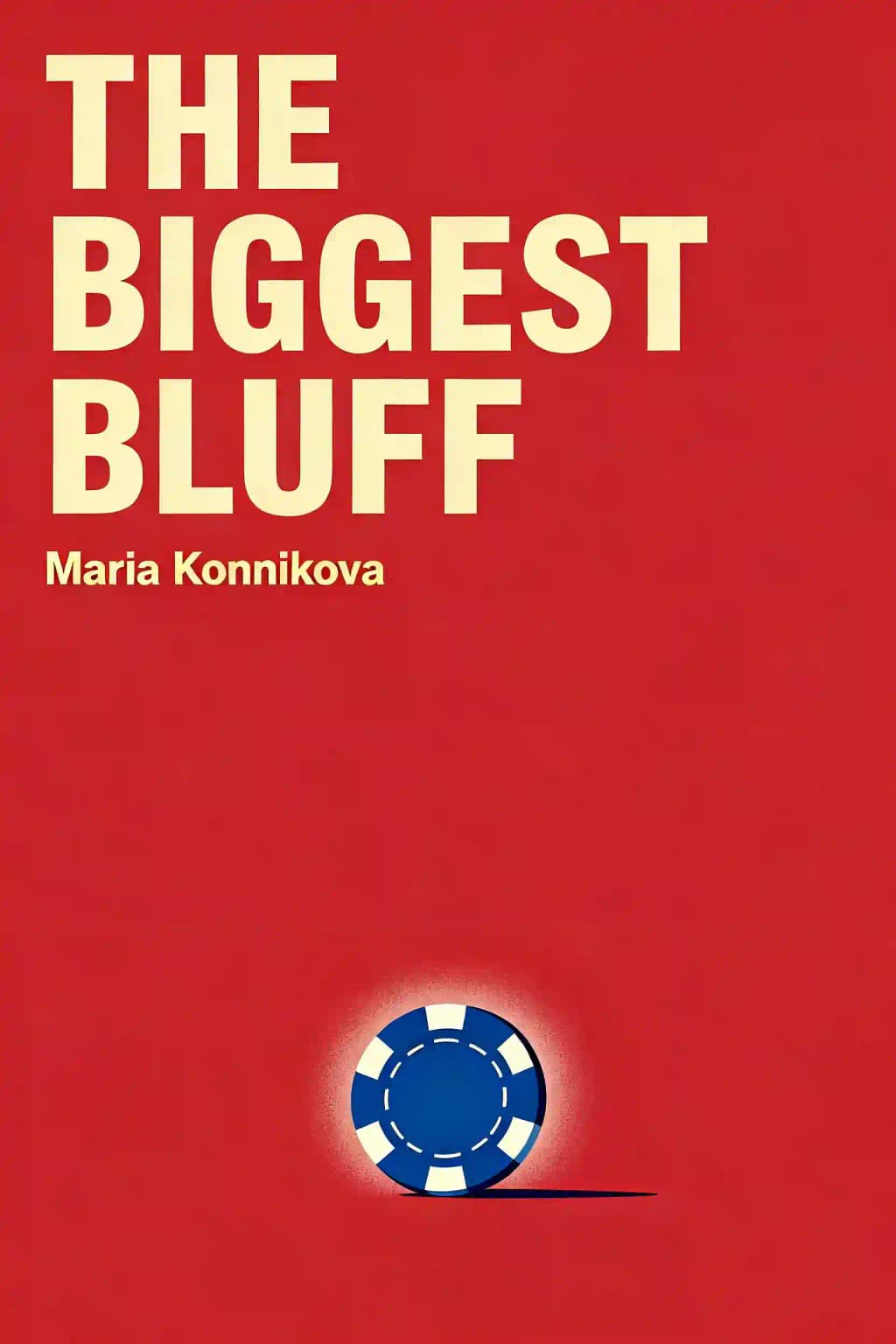
In 2017, I found myself huddled on a bathroom floor in Las Vegas, violently ill during poker's most prestigious tournament-the $10,000 World Series of Poker Main Event. Despite meticulous preparation-preventive medicine, yoga, meditation, proper sleep-here I was, learning poker's harshest lesson: some things remain stubbornly outside your control. This moment epitomizes Maria Konnikova's journey from complete poker novice to international champion in just one year. A New Yorker writer with a PhD in psychology, Konnikova's experiment became a sensation in both poker and literary circles, with her book landing on Bill Gates' recommended reading list and earning praise from poker legends and psychologists alike. Her quest wasn't just about mastering cards but understanding the delicate balance between skill and chance that defines both poker and life itself.
第2章
The Quest for Control in an Uncertain World
The struggle between luck and control has fascinated me for years. From my parents' fortunate escape from the Soviet Union to my academic achievements in America, I've wondered how much of life is skill versus chance. During my doctoral research at Columbia, I studied this question by having participants play a simulated stock market game with real money. The results were striking: intelligent people consistently overestimated their control over events, ignoring feedback and doubling down on losing strategies.
This reflects our fundamental struggle to grasp probabilities. Our brains process personal experiences, not abstract statistics-what psychologists call the description-experience gap. Personal experience trumps statistical reality every time. We only buy flood insurance after experiencing a hurricane; we ignore climate data when purchasing beachfront property. Our experiences teach us, but they don't teach us poorly.
2015 brought this reality home when a series of misfortunes hit my family: my mother lost her longtime job and faced age discrimination; my grandmother died from a fall; my husband's startup failed; and I developed a mysterious autoimmune condition. These events forced me to confront the role of chance in life. Some find comfort in pure statistics-the "one chance in a million" happens regularly among billions of people. Others imbue chance with meaning as luck, fate or karma.
In my search for understanding, I discovered John von Neumann's game theory, inspired by poker-the perfect balance between skill and chance. Unlike chess (pure skill) or roulette (pure chance), poker mirrors life's blend of control and randomness. I chose to learn No Limit Texas Hold'em specifically because its incomplete information and unlimited betting create the closest simulation to real-life decision making, where we must make choices with limited knowledge and can always risk everything on a single decision.
第3章
Finding a Mentor in Poker's Silent Assassin
Nearly a year before my bathroom floor episode, I nervously prepared to meet Erik Seidel-a quiet, reserved poker legend with multiple World Series bracelets and tens of millions in winnings. Unlike showboating professionals, he plays with deliberation and precision. I'd studied him carefully, knowing I was about to propose a year-long commitment-a "marriage" of sorts.
Erik stands out not just for his poker accolades but for his longevity and psychological approach in a game increasingly dominated by math and game theory. In the bombastic poker world, he's atypical-cultured, curious, with boundless enthusiasm for life. He loves music, theater, comedy, and culinary adventures. His life motto seems to be: life is too short for complacency. His advice to aspiring players? "Pay attention."
I first saw Erik in the movie Rounders, which featured his famous 1988 WSOP final table against Johnny Chan. Now I was here to convince this legend to teach me-a complete poker novice-how to play at championship level. Through poker, I hoped to learn about decision-making and taming luck itself.
When I mentioned my psychology background, Erik became interested, noting that psychology is "the most fascinating part of the game." He was particularly intrigued by my language abilities, comparing poker games to different languages requiring mastery. Erik saw value in my psychological approach versus the math-heavy strategies of other players, believing that "self-control is huge in the game." Our partnership formed around testing whether psychology and people-reading could triumph over mathematical approaches at the poker table-with the World Series Main Event as the ultimate test.
第4章
Poker: Not Just Gambling, But a Laboratory for Decision-Making
My grandmother's horror at my poker ambitions reflects society's deep misconceptions about the game. While many equate poker with gambling, I find myself repeatedly explaining that poker is fundamentally a game of skill. Unlike casino games where you must have the best hand to win, in poker you can win with the worst hand and lose with the best. This distinction is crucial. When economist Ingo Fiedler analyzed hundreds of thousands of online hands, he found the best hand won only 12% of the time, with less than a third of hands even reaching showdown. Economists Levitt and Miles discovered professionals at the 2010 WSOP earned a 30% return while amateurs lost 15%-a skill difference far exceeding what's observed in financial markets.
Betting, rather than undermining poker's legitimacy, actually enhances its value as a learning tool. As Kant observed, betting forces us to quantify our certainty-"the offer of a bet startles him, and makes him pause." We learn to properly calibrate probabilities because real money is at stake. This explains why certain professionals (contingency lawyers, meteorologists, horse-race handicappers) develop superior probabilistic thinking-they face immediate feedback on their estimates.
The game's history stretches back to Girolamo Cardano, a 16th-century gambler who pioneered probability theory while rejecting the divination methods of his day. He wrote the first known book on probability, winning back money he'd lost to marked cards through mathematical approaches. Cardano also described primero, possibly the earliest form of poker, which evolved through Europe as primiera, la prime, pochen (German for "to bluff"), and poque before reaching America in 1803 as poker.
Despite his mathematical insights, Cardano acknowledged that probability knowledge helps understanding but not necessarily practical play-unless one cheats. Poker teaches that certainty doesn't exist; you must act with incomplete information.
第5章
Learning the Hard Way: Failure as the Ultimate Teacher
Maria begins her poker journey with early morning lessons from Erik Seidel on the Upper West Side. Their meetings start with bagels and discussions of her progress, which has been largely theoretical so far.
Maria immerses herself in Dan Harrington's poker books, studying them meticulously before her walking lessons with Erik. These walks become their primary teaching method-Erik pacing quickly along the Hudson while Maria juggles books, notes, and recording devices, trying to keep up both physically and intellectually.
Their discussions cover poker fundamentals: starting hand selection, position importance, and player styles. When Maria asks why she shouldn't just play hyper-aggressively to be unpredictable, Erik explains that while aggression can work short-term, the most successful players balance solid fundamentals with strategic aggression.
Dan Harrington later emphasizes that Maria's greatest challenge will be conquering herself. "You will never learn how to play good poker if you get lucky," he tells her. Failure provides the objectivity needed to evaluate one's thinking process properly. Dan reveals he quit poker after winning $1.63 million because he recognized his declining abilities against strengthening competition-demonstrating the objectivity he preaches.
Erik confirms Dan's wisdom, sharing how his own career survived the 1987 Wall Street crash because he didn't take failure personally but instead studied harder. "When things go wrong, other people see it as unfairness," Erik explains, while successful players treat triumph and disaster equally, avoiding the delusions that derail poker careers.
When I try to tell Erik about my unfortunate tournament exit, he immediately cuts me off: "Do you have a question about how you played the hand?" When I admit I don't, he refuses to hear my story, explaining that bad beat stories are "a really bad mental habit" that won't improve my game-like "dumping garbage on someone else's lawn." Erik insists I focus on process, not luck. This lesson extends beyond poker: how we frame experiences affects our thinking and emotional state. The language we use becomes our mental habits, determining how we learn and grow.
第6章
The Military Strategy of Poker: Terrain, Position, and Planning
In New Jersey, I can legally play online poker while looking across the Hudson at Manhattan, where it would be criminal. I choose a dachshund puppy avatar and the name "thepsychchic"-deliberately ambiguous and feminine, knowing men play differently against women. In one of my first hands, I raise with jack-ten offsuit from early position, getting multiple callers. The flop gives me a straight draw but comes all spades. I bet half-pot, one player calls, then another raises big, forcing me to fold.
Erik reviews my play, pointing out multiple errors: playing jack-ten from early position, betting when I should have checked, and most crucially, lacking clear reasoning for my decisions. He emphasizes developing a methodical thought process for every action despite time pressure. This becomes my epiphany-poker requires military-like strategic thinking, evaluating position, board texture, and opponents before each decision.
I'm learning that poker is like a military campaign where terrain matters greatly. Different board textures demand different strategies, just as battles in mountains versus plains require distinct approaches. Dynamic boards need careful planning; static ones allow more shortsighted play. My half-pot bet sizing showed my inexperience-I wasn't considering what I was trying to accomplish and whether I could achieve it more efficiently.
Erik teaches me that "not playing scared" doesn't mean blind aggression but making decisions free from fear, whether passive or aggressive. Many players perform worse on livestreams because they worry about appearances rather than optimal play. Unlike them, Erik is like a dragonfly-the animal kingdom's most successful hunter with a 95% kill rate-quietly observing, predicting opponents' moves, and adapting accordingly. His legendary call with jack-high against Urbanovich demonstrated this perfectly: combining general knowledge of heads-up play with specific observations of his opponent's patterns.
Erik sees poker not as war but as jazz-responding fluidly to what others are doing rather than imposing a rigid style. My job now is simply to gain experience, make mistakes, and learn what plays are possible versus what's crazy.
第7章
The Meritocracy of the Poker Table
The high-roller poker room represents America's closest approximation to a true meritocracy. Here, Ivy League graduates sit alongside players from impoverished backgrounds, rural West Virginia, and tiny villages in Belarus. Unlike traditional careers with gatekeepers, poker welcomes anyone who can afford the buy-in and play well, regardless of education, connections, or social skills. Even physical disabilities don't prevent participation-many players started from hospital beds when other activities were impossible.
While not perfect (stability and early support still matter), poker offers a rare opportunity for skill to transcend background. The concentration of talent is palpable, from Doug Polk in his #BAZAM tank top to Daniel Negreanu chattering away, from Harry Potter lookalike Ike Haxton to pink-haired Justin Bonomo.
Erik emphasizes that focus is richly rewarded at the poker table. "Pay close attention," he advises, explaining that patterns in betting and tells become visible only through sustained attention. Ironically, even top players miss crucial information because they're distracted by their phones-"it's really kind of insane," Erik notes.
This echoes W.H. Auden's quote I used in my first book: "Choice of attention-to pay attention to this and ignore that-is to the inner life what choice of action is to the outer." Erik directs me to observe Andrew "LuckyChewy" Lichtenberger, who embodies perfect focus with his poised posture, quiet hands, and intense gaze absorbing the entire room. While most players fiddle with phones or chat, Chewy remains completely present, his chip stack tripling over two hours.
Meeting with Chewy at Starbucks, I discover his focus isn't natural but cultivated through yoga, kung fu, and tai chi qigong. "Tai chi means energy movement, and qigong means energy pulsation," he explains, describing how each movement flows from the previous one without preset plans. He views poker similarly-"a flow of energy, where whoever can apply the right amount of pressure and allow the right amount of retreat will win."
第8章
The Detective Work of Reading People
Meeting Phil Galfond shatters my expectations. Instead of the swashbuckling bro I anticipated (famous for connecting two East Village apartments with a custom slide), I find an affable, mild-mannered man in a gray t-shirt who speaks with a voice "ready-made for narrating soothing nature documentaries." Despite being one of poker's elite players and owner of training site Run It Once, Phil offers his help with genuine enthusiasm.
His approach to teaching poker resonates perfectly with my background: "Poker is storytelling," he explains-a narrative puzzle where my job is to assemble the pieces. Phil warns against taking shortcuts despite my Main Event timeline, explaining I could learn through rote memorization (the quickest path to competency) or develop deeper understanding. As a detective and storyteller in poker, I must decipher what opponents' actions mean and don't mean while constructing my own coherent narrative.
"The times I have my largest advantages are when they think the story they're telling makes sense-and I know that it doesn't," Phil reveals. His challenge to me: never take any action without asking why, and always seek to understand opponents' motivations rather than judging their plays.
When strangers discover I play poker, they inevitably ask if I count cards (confusing poker with blackjack) or if I can spot tells. As a psychologist who's studied deception, surely I can read souls? My Monte Carlo experience taught me otherwise. I remember feeling triumphant after making day two in my first major tournament, only to badly misread a new player at my table. Seeing his tattooed biceps and shaved head, I immediately stereotyped him as an aggressive maniac. When he raised repeatedly, I three-bet with ace-queen, then shoved all-in against his four-bet, convinced he was bullying me. He snap-called with pocket queens, and I only survived by hitting a miracle ace on the board.
"What were you thinking?" whispered an Irish player next to me. "That's one of the tightest players on the circuit. When he re-raises you, you fold pocket jacks!"
This was my wake-up call: I was far too confident about things I thought I knew. I wasn't reading tells; I was acting on implicit biases. The math was becoming the easy part-it was adjusting to humans that proved harder.
第9章
Managing Emotions: The True Secret to Poker Success
In poker, "tilt" describes when emotions affect decision-making-not just anger but any emotion unrelated to rational choice. Contrary to popular belief, emotions aren't inherently bad for decisions. Neuroscientist Antonio Damasio found that people with brain lesions preventing emotional experiences often make poor gambling decisions. Social psychologists Norbert Schwarz and Gerald Clore demonstrated that emotions should be integral to decisions rather than incidental. Their research showed that people report higher life satisfaction on sunny days than rainy ones-unless their attention is drawn to the weather. Similarly, stock market returns correlate with cloud cover and sports outcomes. The key is recognizing when emotions are influencing us inappropriately and learning to dismiss them as sources of information.
While subtle emotions can be managed by simply recognizing their irrelevance to decision-making, powerful emotions like anger or jubilation are harder to control even when identified. Anticipating emotional responses before they occur is more effective than trying to control them after they arise. Walter Mischel, despite studying self-control, couldn't keep chocolate in his house knowing he'd eat it. Similarly, poker pro Gus Hansen once folded ace-king against an all-in bet-not because it was mathematically correct, but because he anticipated how losing would affect his subsequent play. As Jared Tendler explains, tilt makes you revert to your worst self, reversing progress in your game like an inchworm moving backward. "The only thing you can truly expect is your worst," he says. "Everything else is earned every single day."
Working with Jared, I uncovered deeper emotional issues affecting my play. Persistent impostor syndrome stemmed from a kindergarten experience where my identity was questioned. I struggled with anxiety about letting down backers and myself-"beaten dog syndrome"-fearing future self-criticism so much I couldn't make aggressive plays. We addressed these through visualization, finding my optimal stress level, and practicing embodied cognition-physically projecting confidence to create inner feeling.
第10章
The Triumph: From Novice to Champion
Sitting at my first major final table, I'm surrounded by poker legends: Chris Moorman, Harrison Gimbel with his Triple Crown, and chess grandmaster Loek van Wely. With the second-largest chip stack but feeling like an impostor, I'm grateful when Erik unexpectedly appears to offer support. His advice is simple: "Don't be a fish." But when dealt pocket aces early on, I play them poorly against van Wely's flopped straight, losing a third of my stack. Erik texts me to reset mentally and take it "one hand at a time." I adopt Anne Lamott's "bird by bird" approach, playing patiently despite my dwindling chips.
When Moorman busts in eighth place, I gain confidence. Another pair of aces helps me eliminate the Brazilian player in seventh place. Later, careful observation of "Aggro Oldie's" betting patterns allows me to make a crucial call with bottom pair, winning against his bluff with ace-high. Despite fluctuating chip counts and growing fatigue, I eliminate another player with queens against jacks, bringing us down to five players.
After a break to refuel, I return with renewed focus. When Grandmaster raises from the small blind, I push all-in with pocket sevens, only to face his pocket aces. Miraculously, I hit a straight to survive. Soon after, I eliminate the Grandmaster in fourth place. Heads-up against Alexander Ziskin, a Chicago pro, I face a tournament-defining moment when I call his all-in with just ace-king high against his flush draw. The river brings a king, sealing my victory and the $84,600 prize. I've become the 2018 PCA National champion, just one year after learning poker.
My victory catapults me into unexpected fame. The poker world embraces my story-from novice to champion in just a year. Interview requests pour in from global media outlets like The Times of London, Le Monde, and Newsweek. I make the cover of Bluff Europe, and German Glamour does a photoshoot. PokerStars offers me formal sponsorship as a team pro, opening new possibilities: more travel, higher buy-ins, and financial cushion.
第11章
The Biggest Bluff: Skill Can Never Be Enough
My hearing goes first, then my eyesight. I grab the bathroom counter to avoid falling, thinking I'm having a stroke or aneurysm. Fighting to stay conscious, I manage to call for my husband. "Something very bad is happening," I tell him. Earlier that day, I'd been playing in the World Series of Poker after a late night and migraine. Now I sit blind on our couch, waiting twenty terrifying minutes for my vision to return. My pupils dilate to the size of my corneas as I schedule emergency brain scans.
The tests come back inconclusive-likely a severe migraine combined with a vasovagal event from playing too long on an empty stomach. Throughout this frightening episode, I remain surprisingly calm-a different me than two years prior. Poker has taught me to embrace uncertainty, to control what I can and accept what I can't. As Richard Dawkins writes, we've won "the impossible, improbable lottery of birth," yet we're "nothing more than interpreters of static." We can't control outcomes, only our reactions.
The biggest bluff? That skill alone can ever be enough. It's the useful delusion that pushes us forward when luck turns against us. Poker hasn't made me millions, but it's given me something far more valuable: decision-making ability, emotional strength, and self-knowledge that will serve me long after my winnings run dry. As Erik tells me while walking in Riverside Park, "This game is just too damn interesting. It's such a beautiful game." And it truly is.
In Macau, luck is worshipped openly. The casino floors teem with people screaming at baccarat tables (proper etiquette demands it), wearing red (the lucky color), obsessing over lucky numbers (especially eight), and displaying status symbols like long pinky nails. Even rational poker pros like Ike Haxton admit to cultivating superstitions-carrying lucky dollar bills or wearing specific shirts for certain tournaments-as a way to cope with luck's overwhelming presence in their lives.
I question the wisdom of attaching mental well-being to random objects, pointing to research showing how "lucky" seats make Italian students overconfident and how belief can manifest physically through placebo and nocebo effects. People can literally scare themselves sick or even to death through belief alone. Superstitions create false attributions that impede learning and create vulnerability when lucky charms are lost.
While I reject superstition, I've come to appreciate belief's broader power. Recent research suggests the "hot hand" isn't always fallacious-confidence can translate to improved execution in human performance. A 2018 Nature study found evidence of hot streaks in artistic, film and scientific careers that emerge randomly but have self-reinforcing effects while they last. In poker, perceived confidence often makes opponents fold more often, creating a self-fulfilling prophecy.
Ultimately, poker taught me that the biggest bluff isn't that skill can conquer chance, but that we have the courage to play at all, knowing that chance will always have the final say. And yet we must play as if skill matters completely-because that's the only way to improve our odds in both cards and life.