第1章
Unleashing Your Potential: The Roadmap to an Extraordinary Life
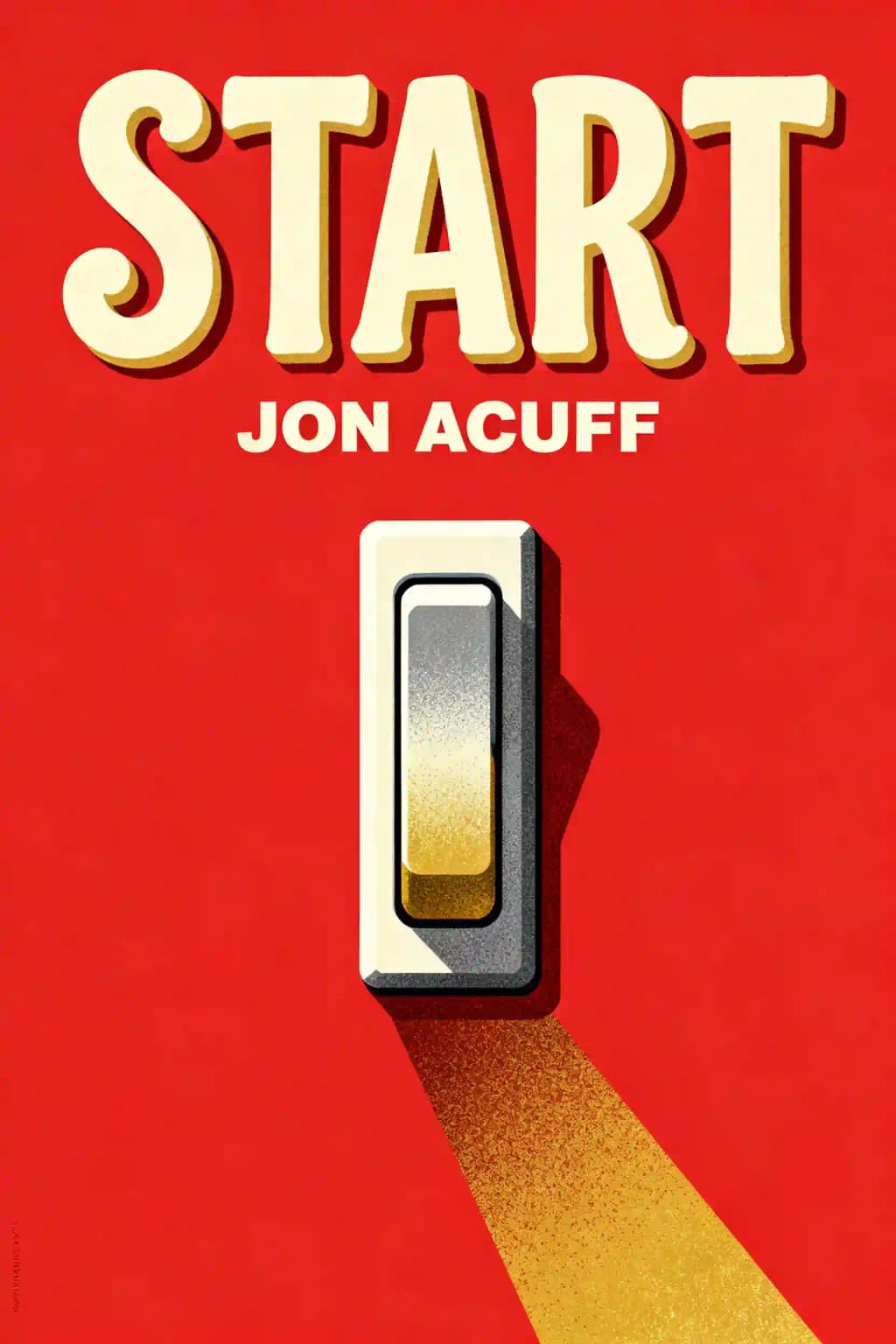
Ever wondered why Korean Air's first-class seats are periwinkle blue cocoons of luxury while coach seats are brown-the color of disappointment? This visual metaphor from Jon Acuff's "Start" perfectly captures the stark contrast between the roads to awesome and average that we all face. The book has become a cultural phenomenon, with celebrities like Tim Ferriss and Michael Hyatt citing it as essential reading for anyone feeling stuck. Since its 2013 release, "Start" has sold over half a million copies and launched Acuff into the speaking stratosphere, where he regularly addresses Fortune 500 companies and has been featured on CNN, Fox News, and in Fast Company. What makes this book so magnetic? Perhaps it's the universal truth it addresses: we all know where we want to go, but most of us have no idea where to start.
第2章
The Crossroads: Where Average Meets Awesome
The opportunity to reach awesome has never been greater. Three forces have created a perfect storm of possibility: retirement is essentially dead (with people in their 50s starting over as entrepreneurs), hope has become our driving force (younger generations want meaning now, not eventually), and anyone can play (technology has democratized access to opportunity). These forces have radically shortened the path to reaching our dreams.
Remember when you were a child? Like Acuff's six-year-old daughter who confidently compared her imagination to Roald Dahl's, we all once believed anything was possible. Then somewhere along the way, we lost that confidence-perhaps when someone important told us our dreams weren't realistic, or when our analytical left brain overpowered our creative right brain.
The good news? We can recover those childlike notions of grandeur while applying adult skills. Age is no longer the primary factor determining where you are on your journey. Whether you're 22, 33, 45, or 52-it's time to start.
Fear argues both contradictory sides: "Don't chase your dream at all" and "If you chase your dream, you have to do it all at once." Both statements are lies. As you stand with one foot on the road to average and one foot on the road to awesome, there's a simple trick to kill these concerns: just start. The starting line is the only line you completely control. The finish? That's months or years away, influenced by countless people and experiences you can't predict.
第3章
The Courage to Begin: Small Steps Toward Big Dreams
The path to awesome often looks radically different by the time we reach the end than what we initially imagined. When Acuff appeared on national news discussing companies that were hiring, he realized how different his career path was from what he'd planned. When he started blogging, he never imagined speaking to 80,000 people or writing four books. The best things in his life weren't planned-they were surprises that came after taking that first step across the starting line.
Many of us over-structure our lives like Acuff once over-practiced his speeches-memorizing every word and gesture until they lacked passion. His mentor explained, "Your speeches are so over-structured that you're not leaving any space for something new to happen in the moment." The same principle applies to life-average is popular because it's familiar and predictable, while awesome requires embracing uncertainty. When we squeeze our lives too tightly, we eliminate room for the surprises that define the road to awesome.
Taking the first step toward awesome requires embracing tension-being both realistic about your present while dreaming about your future. Acuff learned this the hard way when he started an ad agency without necessary skills or time, costing him $2,310 when a client's refund check bounced. His mistake wasn't dreaming big, but failing to be brutally realistic about his present circumstances. Had he been honest, he would've started smaller with a beta project.
Being brutally realistic about your current circumstances is critical to your success. Ignoring reality, like pretending student loans don't exist while dreaming, turns your present into a prison rather than a platform. The world's definition of dreaming often encourages abandoning commitments with empty sayings like "follow your dreams and the universe will open doors." But you don't have to choose between abandoning commitments to dream or resigning yourself to an average life. There's a third way to honor commitments while completely changing your life.
第4章
Discovering Purpose: The Journey, Not the Destination
Rather than offering a neat formula for finding your purpose with motivational platitudes, Acuff discovered something more honest: he didn't find his purpose in some dramatic moment. Standing at a Vietnamese kindergarten built with $60,000 raised through his blog readers, he wondered, "How did I get here?" The truth was, he didn't know. He hadn't mapped out this path with perfect clarity-he simply lived with purpose along the way.
Most of us believe dangerous lies about purpose: that everyone else knows theirs, that we only get one, that we should know it by age 22, that it instantly changes everything, and that we must know the finish line before starting. These misconceptions paralyze us. The truth is that purpose isn't a final destination-it's a way of living. Trying to "find your purpose" puts tremendous pressure on you, becomes an idol, and stops you from taking action. Instead, living with purpose allows you to start today, start where you are, and pursue what matters to you without being locked into one path forever.
The wall of purpose seems insurmountable-1,000 feet tall and stretching for miles. But here's the secret: the door in that wall is already unlocked. You don't need a special key, just turn the knob and walk through. Purpose rarely greets you at your doorstep; it finds you when you're already in motion. Purpose is attracted to momentum, often surprising you mid-stride. So start moving-the door has always been open.
We all want shortcuts to success, hoping to leap straight from starting to harvesting rewards. But the path to awesome doesn't work that way. Even Gwyneth Paltrow couldn't skip the Learning and Editing stages when transitioning from acting to music, despite her fame and $900,000 recording deal. Each new pursuit requires going through all stages, regardless of past success in other areas. You can't skip destinations, but you can accelerate your journey through four methods: starting earlier, standing on the shoulders of giants, working harder and smarter, and occasionally harvesting someone else's fields through opportunities they provide.
第5章
Confronting the Voices: Overcoming Fear and Doubt
Stories without dragons are boring-heroes need villains to overcome. The dragon on your path to awesome is the forest of voices that keeps most people stuck in average. These voices of fear and doubt only get loud when you do work that matters. Acuff's friend Al Andrews, who runs Porter's Call counseling for musicians, helped him realize that no one has positive internal voices. The voices aren't friends looking out for us-they're foes.
When Acuff tracked his own voices, he discovered one constantly asking "Are you happy enough?" which spirals into demands for perfection. These voices convey three primary messages: 1) "Who are you to do that?"-questioning your qualifications; 2) "You're too late"-using distorted views of time to either delay or destroy you with regret; and 3) "It has to be perfect"-a schizophrenic argument that nothing will work while simultaneously demanding perfection.
Fear and doubt are like muscles that grow stronger with use. If you don't deal with them, they'll only get louder. Beat them by documenting them (writing them down exposes their absurdity) and sharing them with others (community is what fear fears most). At their best, these voices can serve as a compass pointing to what matters most. As Steven Pressfield notes, fear can "point to true North... that calling or action it most wants to stop us from doing."
As you start your journey, pushing through purpose, rejecting entitlement, and fighting back against fear, the map to awesome will gradually become clearer. The path won't be easy, but it will become increasingly rewarding as you persist.
第6章
The Learning Stage: Making Time for What Matters
The road to awesome won't cost money, but it demands the most expensive currency there is: time. Every step from Learning to Guiding requires deposits of this precious resource. Rather than waiting for more time to appear, you must launch a rescue mission of your current days.
When Acuff realized time was the fuel for his journey, he initially tried to go from zero to 1,000 mph overnight with an elaborate system called SWORD (Serve, Worship, Order, Rest, Dance). He tracked every minute obsessively until he burned out after a month. What he learned was that change must be simple-especially new change. We don't need to rescue our entire year at once. All we need is thirty minutes in our week-this simple sacrifice was the most important thing he did to change his career. Without those thirty minutes, he never would have written four books or moved to Nashville for his dream job.
You're too busy to be awesome right now. When we focus on our dreams at the wrong times, it can hurt our relationships-like when Acuff's wife cried after he spent four hours writing during a holiday when she expected family time. The solution? Be selfish at the right time. At 5:00 a.m., nobody expects anything from you. Your spouse won't complain, your kids won't ask to play, and your boss won't demand your attention. You can also rescue thirty minutes during lunch or late at night. If your dream isn't worth thirty minutes, you either have the wrong dream or you're just pretending. Nobody gets up early or stays up late on the road to average.
Many claim to be "night owls," but research suggests willpower favors the morning. In a famous 1996 study by Roy Baumeister, participants who had to resist chocolate cookies and eat radishes gave up on a subsequent puzzle in about 8 minutes, while those who ate cookies persisted for 19 minutes. Willpower is finite-we have a limited daily supply. This explains why tasks skipped in the morning rarely happen after work, and why executives make poor decisions at night after a day of depleting their willpower reserves.
You rescued thirty minutes. You put your television and video watching on a diet. You are starting to hustle and making time for learning. But the truth is, you're going to be really busy. The five-step secret to getting it all done is simple: 1) Admit you can't possibly get it all done. 2) Give yourself grace to accept that as reality, not failure. 3) Do the things you can with your full attention. 4) Celebrate what happens in Step 3 instead of obsessing over what you didn't get to. 5) Repeat as necessary.
第7章
Finding Your True North: Clarity Through Self-Discovery
Just beyond the forest of voices lies a metaphorical plane crash that can bring clarity. Acuff always wanted to survive a plane crash-not the gruesome kind, but one where he'd save people, slide down the inflatable exit, and gain a new perspective on life. Since actual crashes are statistically improbable, he created a mental one by asking: "If I died today, what would I regret not being able to do?" His honest list: 1) Write a book, 2) Love my wife, 3) Play with my kids. The follow-up question hit harder: "Are those the things I'm spending time doing right now?"
This wasn't an immediate life-changer, but rather an invitation to be more awesome more often. Most people die with regrets-as nurse Bronnie Ware discovered, the number one being "I wish I'd had the courage to live a life true to myself." Don't wait for a real brush with death to gain this clarity.
Learning about who we are is rarely easy, but you've been leaving yourself clues about what you truly love all along-a gingerbread trail leading to your definition of awesome. As Acuff's mother-in-law wisely noted when people asked how he suddenly started writing so much: "That's the wrong question. The real question is, 'How did he not do it before?'" The thousands of words now going into blogs and books had always been inside him, previously scribbled on Post-it notes and envelopes-tweets before Twitter existed.
If you struggle with the plane crash questions, try asking instead: "What can I not stop doing?" What passion or activity has survived for years in your life? We're horrible at seeing the potential of our own dreams, but they're there in the shadows, waiting for us to admit they matter.
When a 42-year-old pastor asked Acuff whether he should take three months off to write a book or write a page daily, Acuff reminded him he had 42 years of research on himself. As a storyteller who'd been preaching for twelve years, his solution was simple: get his sermons transcribed. You need to be a student of you. Don't approach the road to awesome as if you've never been awesome before. Study your past successes-how you stuck to that diet, what skills shone at work. Most self-help books presume a one-size-fits-all approach, but you might be a bird reading instructions for fish.
第8章
The Editing Stage: Sculpting Your Path Through Subtraction
You won't know exactly when you've entered the land of Editing-there's no checklist or precise boundary. The stages of the journey overlap like colors in a rainbow rather than distinct paint samples. The key difference is mathematical: Learning is about addition while Editing is about subtraction. In Editing, you'll determine which of your many discoveries will continue with you and which you'll leave behind for others. Like Michelangelo selecting the perfect marble block and then chiseling away everything that isn't David, you'll remove what doesn't belong to reveal your true path.
When faced with the Editing stage, we often overcomplicate simple solutions because we're afraid of change. Like Acuff's friend Tim who blamed his iPhone for missing breakfast meetings rather than buying a $10 alarm clock, we create a fog of complexity to avoid making decisions. We retreat to familiar comfort rather than edit our lives. Unlike physical hoarders whose collections create visible, stinking piles, our emotional hoarding of unused dreams creates hidden piles we don't have to confront.
When facing life choices, most people ask practical questions about money, market needs, and experience, but fail to ask the most important question: "What gives me the most joy?" Many feel guilty prioritizing joy, as if it's selfish or impractical. But joy isn't selfish-true joy leads to selflessness. Money isn't a calling but a consequence. The bakery owners Acuff met had analyzed every practical aspect of relocating their business to Idaho but never considered what would bring them joy. Finding your awesome means discovering what genuinely lights you up inside, not just chasing job titles or results.
A father and son building Frisbee golf course signs for an Eagle Scout project demonstrated choosing passion over convention. "This sure beats building another park bench," the father remarked. Too often, people believe making a difference requires miserable sacrifice, like the boy who painted fire hydrants for his badge. As you edit your life, don't fall for the lie that changing the world must be a chore. Be brave enough to pursue what genuinely excites you rather than what seems appropriately difficult or serious.
第9章
Beyond Job Titles: Finding Your Core Essence
When someone challenged Acuff about who would collect trash if everyone found their dream job, he realized the person was confusing awesome with job titles. Awesome is your core essence, not your occupation. An Apple customer service representative taught him this when she explained she loved her seemingly difficult job because it fulfilled her passions for helping people and learning new things. Once Acuff discovered his own passion for sharing ideas, countless career paths opened up. Most people get it backward-they hunt for perfect jobs without first understanding what they truly love. Don't just search for impressive titles; find your awesome first, then apply it anywhere.
People challenge Acuff: "What if my dream is winning a Grammy but I can't sing?" The truth is, you can't be anything you want, but you can be something better-the best version of yourself. External validation like Grammy awards are just scoreboard results, not your awesome. Your awesome might be expressing your natural singing talent more today than yesterday. The band Seryn demonstrated this by playing with the same unbridled passion in a living room for 80 people as they did for 13,000 in an arena. They played to the size of their hearts, not their audience. Awesome doesn't let crowds determine performance quality.
In the diamond mine of Editing, we must decide what in our life is a diamond and what's a rock. This decision changes how we interact with everything. Scientists call this "value attribution"-the value we place on things guides our perception. The Washington Post proved this when they placed Joshua Bell, one of the world's greatest violinists, in a subway station. Despite his extraordinary talent and $3.5 million Stradivarius, only 7 out of 1,000 commuters stopped to listen. The rest had already assigned "street music" value to what they heard.
Our calendars reveal our true diamonds-where we spend our time shows what we truly value, regardless of our stated intentions. If we don't like what we find, we must edit our calendars deliberately to protect what matters most. Time is the only honest indication of what matters to us, while intentions are ambitious liars. By examining where your time actually goes, you can see whether your stated priorities match your lived reality.
第10章
The Mastering Stage: Putting in the Work
The road to awesome always involves a fight. A dream you don't have to fight for isn't a dream-it's a nap. When Acuff wanted to name his book "Quitter," Dave Ramsey pushed back, thinking it was too negative. Despite his nervousness confronting him, Acuff fought for the title he believed in. Ramsey's pushback actually helped him define his dream and crystallize his vision. That's how the road to awesome works-you'll get your hands dirty, step into the fray, and throw some elbows. Awesome is not a casual affair.
When Acuff decided to become a public speaker in 2008, he faced the classic experience catch-22: he needed experience to get booked, but couldn't get booked without experience. His solution was speaking at a local church's rehab program-not the glamorous audience most aspiring speakers dream of. But it was perfect: he could share hope with people who truly needed it, they wouldn't let him phone it in, and he faced zero competition. Years later, someone approached him saying, "I heard you the first time you spoke. I was in rehab, and that meant a lot to me." Want to master something? Find your version of rehab-somewhere you can practice being awesome.
If you're not trying to be a public speaker, your "rehab" might look different. The three best ways to get experience are: volunteer, take a part-time job, or be led. Volunteering doesn't slow you down-it speeds you up by providing invaluable education without risking your future. The new definition of volunteering is "any activity that lets you trade time for expertise." Taking a part-time job in your dream field allows you to get paid to learn your future business. Being led by someone experienced provides wisdom that can catapult you ahead in mastering your craft.
During a difficult speech at a music festival where teenagers clearly wanted the rapper Lecrae instead of him, Acuff realized something simple: he was doing a rep. Mastery comes through repetition-doing the work over and over. Whether building friendships or pursuing dreams, it's not about home-run moments but consistent practice. That's why he wrote millions of words on his blog, spoke six times a week to different audiences, and had twenty-six 1099s in one year while working full-time. What looks like genius is usually just hard work, like Mozart whose hands were deformed by age 28 from endless practice and composition.
Not everything you enjoy needs to be mastered. Just as Acuff will happily never participate in a triathlon despite enjoying running, you'll have activities that are simply hobbies. In the land of Mastering, ask yourself: "Do I care enough about this to do the reps, volunteer, or get a part-time job?" Recognizing when something is just a hobby isn't failure-it's success. It frees you from guilt and allows you to focus on the things that truly define your awesome.
第11章
The Harvesting Stage: Reaping What You've Sown
Just inside Harvesting's border lies a dangerous exit that can undo all your progress. The secret to success is surprisingly simple: don't be a jerk. Kindness creates opportunity, while talent with a bad attitude eventually loses to mediocrity with a good attitude. Another exit to avoid is fame-even small amounts can create a divide between who you really are and the public persona you maintain. And don't mistake Harvesting for retirement or coasting-that's like lying down near the marathon's finish line.
The secret to being an awesome public speaker, booking more gigs, and succeeding in almost anything is shockingly simple: don't be a jerk. Acuff discovered this backstage at speaking events when clients would thank him not for his content but "for being so nice." Many speakers and musicians create such a low bar of kindness that simply being decent stands out. They berate staff, refuse Q&As, and hide from attendees. People don't like working with jerks, don't listen to them, and don't want them to win-as NFL star Terrell Owens learned when his bad attitude eventually overshadowed his remarkable talent.
Andy Warhol's prediction that "everyone will be world-famous for fifteen minutes" has proven prophetic in the internet age. Even with niche passions, you'll gain some degree of fame when you master and harvest your skills. The danger comes when fans build expectations of who you are, and you begin playing up to that image. This creates an exhausting divide between your true self and your public persona. You start maintaining a facade rather than continuing toward awesome. Fame can be wonderful if used well, but don't let it become your exit back to average.
Don't confuse Harvesting with retirement, vacation, or the end of your journey. Ask any farmer-harvest season isn't easy. Stopping now would be like napping fifty feet from the marathon finish line.
The entitlement ladder in Harvesting is dangerous because you don't realize you're climbing it until you fall off. In 2011, after Dave Ramsey hired Acuff with the challenge to "be awesome," he ironically got lazy. He began coasting, believing he was too important for certain responsibilities, thinking "I'm an author" who shouldn't sully his hands with mundane tasks. This entitlement cost him dearly-he neglected his 10,000-member Facebook group for Stuff Christians Like, and when Facebook migrated it, only 23 people remained-a devastating 99% loss.
第12章
The Guiding Stage: Sharing Your Journey with Others
Every great story follows four parts: innocence, innocence lost, coping with the loss, and resolution. But unlike movies where credits roll and stories end, our lives continue beyond resolution. If we're not careful, we get stuck in the land of Guiding, believing one trip down the road to awesome was enough. Fear and doubt refuse to give us a free pass in any land, especially the last one.
In 2009, Acuff's blog readers raised $60,000 for two kindergartens in Vietnam, with the first $30,000 coming in just eighteen hours. It made for a great headline, but three years later, he'd turned that headline into an epitaph. He got comfortable telling the story, perfecting his dramatic pauses and jokes, until it became firmly ingrained in his identity. When his wife and he wanted to do another project, he proposed raising just $25,000-not because that's what was needed, but because he was afraid of failing to match their previous success. His wife saw through it immediately: "I dare you to lose some face." He was basing a hospital project in Vietnam on protecting his ego. He got stuck in Guiding because fear and doubt convinced him not to risk his successful identity by starting something new.
Comedian John Crist explained that bombing on stage doesn't devastate him because he performs multiple shows each night. "If I fail during the 7:00 p.m. show, I only have to carry it for an hour until the 8:00 p.m. show." By shortening his starting cycle, failures don't have time to define him. Similarly with success, if you don't start again and head back to Learning with a fresh project, yesterday's successes will define your identity. You'll protect them rather than celebrate them. Fear and doubt are brilliantly consistent-if you fail, they say "See, average is where you belong." If you succeed, they whisper "Don't leave. What if this was just lucky? What if your next adventure fails?" The true tragedy of a "one-hit wonder" isn't limited popularity-it's succeeding once and never trying again.
Dave Ramsey, on the eve of launching his first book in seven years, wasn't focused on logistics but on how to serve people better: "How do I make sure that the woman in Ohio, who just lost her house and is in tears, knows that we're here to help her?" The secret is that helping others better their lives is more fulfilling than obsessing about your own. Awesome always goes viral. Joy is contagious. When you find something you love, you naturally want to help others find their passion too. "Helped people help people."
第13章
The Continuous Journey: Starting Again and Again
In the land of Guiding, you have just two essential tasks: find someone to guide, and take another part of your life back to the start of the journey. The first is relatively simple-the challenge is deciding whom to guide from among those who notice your non-average life. The second is your invitation to the fountain of youth. Science confirms that continuing to learn keeps you young-neuroscientists have shown that synaptic connections can grow throughout life, and "learning allows us to transcend our genes." The alternative is stagnation, like Brent's grandfather who declined rapidly after retiring at 77 because "he couldn't find the next thing to start." The road to awesome isn't a straight line but a circle you can travel with any aspect of life-marriages, companies, families. Whatever you choose to make more awesome, the time has come to start again.
The best measure of effective guiding is observing how others run alongside you. Like David Rudisha's record-setting 800-meter Olympic race that elevated everyone else's performance-where seven of eight runners set personal bests and the fifth-place finisher ran a time that would have won gold in nearly every previous Olympics-your pursuit of awesome becomes infectious. You pull others forward like "a speedboat leading seven water-skiers." Despite feeling unqualified, guiding gives you the chance to change the world. Pursuing your dreams isn't selfish; wasting your talents is. As Steven Pressfield argues, not giving your gift to the world hurts everyone: "You hurt your children. You hurt me. You hurt the planet." Your contribution matters.
The fear of success is far more surprising and insidious than the fear of failure. As Sigmund Freud noted in his 1915 essay "Those Wrecked by Success," some people fall apart "precisely when a deeply-rooted and long-cherished wish has come to fulfillment." Philadelphia therapist Elissa Sklaroff explains that success-fearing people are running from having to change their secret self-image as undeserving or unsuccessful. For thirty years, Acuff was comfortable being a mess-up-failure became his identity, average his address. When success came, it felt ill-fitting and terrifying. Sometimes we fear success because if one area gets awesome, it forces us to confront the areas we're truly afraid of.
In the land of Harvesting, there's room to explore who you are and who you were meant to be. Don't run from it-lean in and know that your adventure in awesome is just beginning. The road to awesome isn't a straight line but a circle you can travel with any aspect of life. Whatever you choose to make more awesome, the time has come to start again.