第1章
Tales from the Mist: Stephen King's Nightmarish Anthology
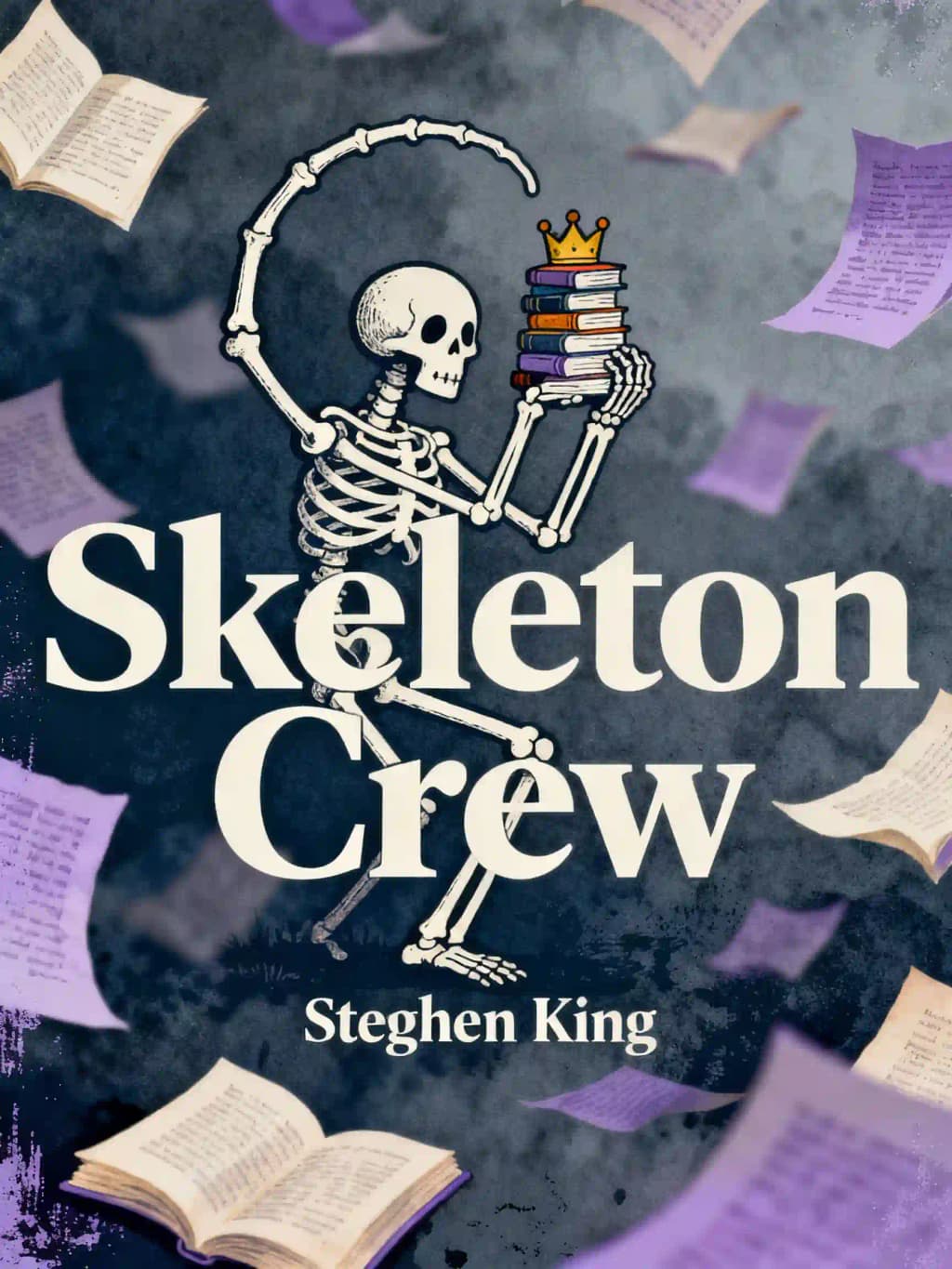
In the pantheon of horror literature, few collections have maintained such a powerful grip on readers' imaginations as Stephen King's "Skeleton Crew." Published in 1985 during King's creative peak, this anthology of 22 short stories has been hailed by critics as one of his finest works, showcasing his remarkable versatility in crafting tales of psychological terror, cosmic horror, and supernatural dread. The collection, which includes the novella "The Mist," later adapted into a controversial film by Frank Darabont, remains a favorite among King's "Constant Readers" and continues to influence horror writers today. Even celebrities like filmmaker Guillermo del Toro and author Neil Gaiman have cited specific stories from this collection as inspirations for their own work. What makes these tales so enduring is King's uncanny ability to find horror in the mundane-transforming everyday objects like toy monkeys, milk trucks, and word processors into vessels of unspeakable terror.
第2章
Into the Mist: A Community Trapped by Cosmic Horror
The collection's centerpiece, "The Mist," begins with an ordinary scene: a father and son shopping at a local supermarket following a violent thunderstorm. What starts as a routine errand quickly transforms into a nightmare when an unnatural fog engulfs the small Maine town, bringing with it creatures from another dimension. The horror unfolds gradually-first with distant screams, then with the appearance of tentacled monstrosities that snatch people from the parking lot.
What makes "The Mist" so effective is how it traps its characters in a pressure cooker of fear and uncertainty. The supermarket becomes a microcosm of society under extreme duress. As the situation deteriorates, we witness the fragmentation of social order: some band together pragmatically, others retreat into denial, and a growing faction rallies around Mrs. Carmody, a religious zealot who interprets the mist as divine punishment requiring blood sacrifice.
The protagonist, David, watches in horror as Mrs. Carmody's influence grows. "That crazy cunt. That witch," another character describes her, recognizing the dangerous power she wields over the increasingly desperate survivors. King masterfully portrays how quickly civilization's veneer can crack under pressure, revealing our most primal instincts-both noble and monstrous.
The creatures themselves represent cosmic horror at its finest-tentacled abominations, prehistoric-looking flying creatures, and enormous beasts that shake the building as they pass. When a small expedition ventures to the pharmacy next door, they encounter spider-like creatures that spin webs capable of slicing through human flesh. These entities aren't simply monsters; they're utterly alien, suggesting a universe indifferent to human existence.
In the story's devastating conclusion, David escapes with his son and a small group of survivors, only to discover the mist extends far beyond their town. Driving through the apocalyptic landscape, he clings to a faint radio transmission suggesting survivors in Hartford. "Tonight, I'll kiss my son and whisper two words in his ear against the dreams that may come: Hartford and hope," he writes, leaving us with the barest glimmer of possibility amid overwhelming despair.
第3章
Consuming the Self: The Horrific Journey of "Survivor Type"
Perhaps the most disturbing entry in the collection is "Survivor Type," presented as the diary of Richard Pine (formerly Richard Pinzetti), a disgraced surgeon stranded on a tiny deserted island after a shipwreck. The story begins with Pine's clinical observation: "These are the facts, as I have committed them to this paper with my surgical pencil. A number two pencil, of course. And I wonder how much longer I can keep my mind." This opening perfectly sets up the methodical descent into madness that follows.
Pine's background-growing up in Little Italy, putting himself through medical school through questionable means, and eventually losing his license for selling prescription drugs-establishes him as morally compromised from the start. Yet there's something admirable about his initial determination to survive. When his lifeboat sinks, he kills a seagull with a rock and forces himself to eat it raw, fighting back nausea. "Physician, heal thyself," he thinks grimly.
As days pass without food, Pine's situation becomes increasingly desperate. After breaking his ankle while trying to signal a plane, he makes a fateful decision: "I'm going to amputate my foot." What follows is one of King's most shocking sequences, as Pine uses heroin from his smuggled stash as anesthetic and performs the operation on himself. The true horror comes afterward, when starvation drives him to eat his own amputated foot.
The genius of "Survivor Type" lies in its inexorable logic-each decision Pine makes seems rational given his circumstances, yet leads him further into unimaginable territory. His diary entries grow shorter and more disjointed as he continues to amputate and consume parts of himself: "I am a monster now, a freak... nothing left below the groin... I drag myself around like a crab." By the final entry, his mind has completely fractured: "lady fingers they taste just like lady fingers," he writes, suggesting he's begun eating his own hands.
The story forces us to confront uncomfortable questions: How far would we go to survive? At what point does survival lose its meaning? Pine's mantra-"I will survive"-becomes increasingly hollow as he sacrifices his humanity piece by piece. It's a masterclass in body horror that lingers long after reading.
第4章
Technological Terrors: "The Jaunt" and "Word Processor of the Gods"
King has always excelled at finding horror in modern technology, and two stories in "Skeleton Crew" showcase this talent brilliantly. "The Jaunt" begins innocuously, with a father explaining teleportation technology to his children before their first trip to Mars. The story's genius lies in its worldbuilding-King creates a believable future where "jaunting" has revolutionized transportation and solved energy crises, all while maintaining one crucial rule: travelers must be unconscious during transit.
As the father explains the history of jaunting, we learn why this rule exists. The inventor, Victor Carune, discovered that while objects could be safely teleported instantaneously, conscious creatures experienced something horrifying during the process. Mice emerged catatonic before dying. One researcher sent his wife through with no destination programmed, trapping her consciousness forever. A death row inmate who volunteered to jaunt while conscious emerged with snow-white hair, muttering "It's eternity in there" before dying.
The story builds to a chilling climax when the son, Ricky, holds his breath instead of inhaling the anesthetic gas. When the family arrives on Mars, he emerges with white hair and ancient eyes, cackling maniacally: "Longer than you think, Dad! I saw! I saw!" before clawing out his own eyes. The horror comes from the implication that while the body travels instantaneously, the mind experiences subjective eons alone with its thoughts-a fate worse than death.
"Word Processor of the Gods" explores similar technological territory with a more intimate focus. Richard Hagstrom receives a homemade word processor built by his recently deceased nephew Jon. After discovering the machine can alter reality through its DELETE, INSERT, and EXECUTE functions, Richard begins rewriting his unhappy life-first by deleting his alcoholic brother's photograph, then creating gold coins, and finally erasing his ungrateful son and bitter wife to replace them with the family he always wanted.
The story works on multiple levels. On the surface, it's a modern take on the "three wishes" fable, complete with the machine's inevitable breakdown adding urgency to Richard's choices. On a deeper level, it explores the fantasy of rewriting one's life-the ultimate power of creation and destruction. When Richard types "MY SON IS SETH ROBERT HAGSTROM" and presses DELETE, erasing his son from existence, we're simultaneously horrified by the act and sympathetic to his desire for a better family. The story asks: If we could erase our mistakes and rewrite our lives, would we still be ourselves? And what responsibility do we bear for the reality we create?
第5章
Cursed Objects: "The Monkey" and "The Reach"
King has always had a knack for transforming innocent objects into vessels of horror, and "The Monkey" exemplifies this talent. The story follows Hal Shelburn's lifelong battle with a toy monkey with brass cymbals that brings death whenever it clashes them together. As a child, Hal witnessed his dog's horrific death after the monkey's cymbals jangled from the attic. Years later, when his sons discover the toy in his parents' attic, deaths begin again-a neighbor drowns, a friend dies in a car crash.
What makes the monkey truly terrifying is its seeming sentience-it resists Hal's attempts to muffle or destroy it, and seems to beckon him to wind it up against his will. The monkey represents the random cruelty of fate, striking down loved ones without reason or mercy. When Hal finally decides to sink it in Crystal Lake, the monkey's cymbals begin beating inside the flight bag as he rows to the deepest part, and the boat starts breaking apart around him as if under attack.
The story's ending is deliberately ambiguous. Though Hal believes he's rid himself of the curse, a newspaper clipping reports hundreds of dead fish mysteriously floating in Crystal Lake, suggesting the monkey's evil influence continues. This uncertainty-the sense that evil can never be truly vanquished-pervades many of King's most effective stories.
"The Reach," which closes the collection, takes a more subtle approach to horror. The story follows 95-year-old Stella Flanders, who has never left Goat Island despite the narrow stretch of water (the Reach) separating it from the mainland. As winter brings record cold, freezing the Reach solid, Stella begins seeing her dead husband Bill beckoning her to cross.
The horror here is existential rather than supernatural-Stella's impending death from stomach cancer, which she keeps secret from her family. When she finally decides to answer Bill's call, she dresses warmly and sets out across the frozen water. The weather turns into a whiteout, and as she struggles forward, more dead islanders emerge from the snow to join her. They form a circle around Stella as they reach the mainland shore, and she accepts her death, joining them in song.
The story's power comes from its gentle approach to mortality. The Reach becomes a metaphor for the passage from life to death-a journey we all must make alone, yet perhaps not without guides. When Stella's son later finds her frozen body wearing not his cap but one belonging to his long-dead father, we're left wondering about the boundary between the living and the dead. On quiet nights, he contemplates "whether the dead sing" and "whether they love us," concluding that "it often seems to him that they do both."
第6章
Madness and Paranoia: "Gramma" and "The Ballad of the Flexible Bullet"
King's exploration of mental deterioration reaches its peak in two stories that blur the line between supernatural horror and psychological breakdown. "Gramma" places eleven-year-old George alone in a house with his bedridden grandmother while his mother rushes to the hospital where his brother has been injured. Though initially brave, George becomes increasingly terrified as he recalls disturbing family secrets-Gramma was kicked out of church and fired from teaching over mysterious books that somehow allowed her to have children despite medical impossibility.
When Gramma dies during his watch, George experiences a moment of adult comprehension-she had been a witch with occult powers. But the true horror comes when he attempts to cover her face and her hand suddenly clutches his wrist. As he tries to escape, he hears her voice calling him back for a hug, and his feet obey against his will. The story takes a disturbing turn when George's aunt calls with a warning, instructing him to command Gramma to lie down "in the name of Hastur." Before he can complete the incantation, Gramma tears away the phone and attacks him.
The final twist reveals that Gramma's power has transferred to George through her death. When his mother returns, she finds him seemingly normal but discovers a piece of his torn shirt in Gramma's hand. As George lies in bed, "a horrible grin" surfaces on his face-Gramma's power now lives in him, and he particularly looks forward to when his brother returns from the hospital, imagining what he'll do when they're alone at night.
"The Ballad of the Flexible Bullet" approaches madness from a different angle, examining how delusions can spread from person to person. The story centers on a correspondence between an editor and a paranoid writer named Reg Thorpe, who believes in "Fornits"-luck-elves that live in typewriters and help with creativity. Thorpe's paranoia escalates dramatically-he believes mailmen are CIA, neighbors are spies, and electrical devices are monitoring his thoughts.
The true horror emerges when the editor begins sharing Thorpe's delusions, unplugging electrical devices in his own home and experiencing what he calls "the irrational subconscious" with "a revolver loaded with flexible bullets." When Thorpe receives news that his story will be rejected due to the magazine discontinuing fiction, he purchases a gun and ultimately commits suicide after shooting his wife and others.
The story's power comes from its examination of the contagious nature of madness-how easily rational people can slip into paranoid thinking when primed by someone they respect. The "flexible bullet" becomes a metaphor for ideas that penetrate our defenses and lodge in our minds, warping our perception of reality. As the editor reflects at the story's end, we all contain "a small padded room" inside us where irrationality lurks, waiting for the right trigger.
第7章
Everyday Horrors: "The Raft" and "Mrs. Todd's Shortcut"
Some of King's most effective stories find terror in seemingly ordinary situations. "The Raft" follows four college students who swim to a wooden platform in the middle of a deserted lake, only to become trapped by a mysterious black substance floating on the water's surface. What begins as a carefree autumn swim turns into a nightmare of isolation and predation.
The black thing-described as a perfect circle that maintains its shape except when conforming to the raft's edges-initially appears harmless. But when Rachel kneels to examine the swirling colors within it and touches it with her finger, the substance instantly surges up her arm, dissolving her skin beneath it before consuming her entirely. The remaining students watch in horror as it grows larger after feeding.
The genius of "The Raft" lies in its simplicity-four people trapped in plain sight with no hope of rescue until hunting season months later. One by one, they succumb to the creature: Deke's leg is pulled through an impossibly narrow crack in the boards, shattering bones as he's gradually consumed; LaVerne's hair dips into the water during a moment of intimacy with Randy, leading to her gruesome death. Finally, Randy, delirious from exhaustion after standing for days to avoid the creature sliding under the raft, surrenders to its hypnotic colors, asking "Do you love?" before allowing himself to be mesmerized.
The story works as both body horror and existential terror-the black substance represents death's patient inevitability, consuming each victim in turn while the survivors watch helplessly. The lake's isolation magnifies their plight; no one knows they're there, and no one will miss them for weeks. It's a perfect microcosm of human vulnerability in an indifferent universe.
"Mrs. Todd's Shortcut" takes a more subtle approach to horror, following the strange case of Ophelia Todd, a woman obsessed with finding increasingly shorter routes between Castle Rock and Bangor. The narrator, Homer, recounts how 'Phelia's shortcuts became progressively more bizarre-roads that shouldn't exist, impossible geography, and strange creatures glimpsed through the trees. Eventually, she reveals that in "those other places," she isn't Worth Todd's childless wife or failed poet, but her true self-"Diana," as Homer called her.
The story suggests that 'Phelia has found passages to another dimension where time moves differently-she grows younger with each journey while her husband ages normally. After she disappears with her car, Homer eventually joins her, transformed into a younger version of himself. The narrator watches as Homer and a woman with long red hair and a "shining forehead" drive away together.
Though less overtly horrific than other stories in the collection, "Mrs. Todd's Shortcut" explores the uncanny-the sense that reality is thinner in certain places, allowing passage to somewhere else. The horror lies in the choice between normal life and something "terrible but no longer deadly" beyond our world. As the narrator reflects, though he doesn't necessarily wish to be where they are, he still wishes he "was a smoking man"-suggesting a desire for the excuse to pull over and perhaps find one of those shortcuts himself.
第8章
The Darkness Within: "The Man Who Would Not Shake Hands" and "Cain Rose Up"
King's exploration of human darkness reaches its peak in two stories that examine how ordinary people become monsters. "The Man Who Would Not Shake Hands" tells the tale of Henry Brower, who refuses all physical contact after being cursed by a holy man in Bombay. When Brower accidentally shakes hands with another man during a card game, the victim dies of a heart attack the next day. Even a dog that Brower touches dies shortly afterward.
We learn that while working in India, Brower had carelessly left his motorcar's switch on. A local boy, son of a holy man, had climbed in, accidentally started the vehicle, and died in the crash. The boy's father cursed Brower: anything he touched with his hands would die. The story ends with Brower found dead in a flophouse, "sittin bolt upright in his brown suit" with "his left hand holding his right wrist"-essentially shaking his own hand in death, fulfilling the curse.
The story works as both supernatural horror and psychological study. Whether the curse is real or psychosomatic becomes almost irrelevant-Brower's belief in it shapes his reality, driving him to increasingly desperate isolation. His final act-shaking his own hand-suggests either suicide or the curse's completion of its cycle, bringing a tragic symmetry to his fate.
"Cain Rose Up" takes a more direct approach to human darkness, following a disturbed college student named Garrish who returns from his final exam feeling disconnected from reality. After brief interactions with his dormmates, he retrieves a hidden rifle and begins shooting people at random from his window. When a neighbor pounds on his door concerned about the gunshots, Garrish continues his rampage, justifying his actions with a twisted biblical reference about Cain and Abel.
Written years before school shootings became a tragic reality in American life, the story is disturbingly prescient. King offers no supernatural explanation for Garrish's actions-just the chilling banality of his thought process as he methodically selects victims. The biblical reference in the title suggests that such violence is as old as humanity itself, an inherent potential within us all. The story ends with Garrish taking aim at another victim, muttering "Good God, let's eat" as he pulls the trigger again-a disturbing non sequitur that emphasizes his complete break from reality.
第9章
The Lingering Nightmare: King's Enduring Legacy
"Skeleton Crew" remains one of Stephen King's most powerful collections because it demonstrates his remarkable range-from cosmic horror to psychological terror, from supernatural threats to human monsters. What unifies these diverse stories is King's deep understanding of fear itself-not just what scares us, but why. From the otherworldly mist that conceals prehistoric horrors to the mundane terror of a word processor with reality-altering powers, King proves that fear can lurk in both the extraordinary and the everyday.
In his afterword, King reveals that money isn't why he writes, though he admits being "bowled over" by payments ranging from $40 for "The Reaper's Image" to $2,000 for "Word Processor of the Gods." These early payments, while modest by today's standards, marked important milestones in his career. Instead, he writes because "not writing is suicide"-a compulsion to exorcise the nightmares that haunt him. This personal necessity translates into stories that feel urgent and authentic, tapping into universal fears while remaining deeply human. The raw honesty of his creative drive bleeds through every page, making even the most fantastic scenarios feel grounded in emotional truth.
King compares short stories to "quick kisses in the dark from a stranger"-briefer than the long affair of a novel, but with their own sweet attraction. This metaphor perfectly captures the appeal of "Skeleton Crew"-each story delivers a jolt of terror before releasing us, but the cumulative effect lingers long after we close the book. Stories like "The Jaunt" and "The Raft" demonstrate this perfectly, delivering their horrific payoffs with precision timing that leaves readers gasping.
As we journey through these tales of cosmic horror, technological terror, cursed objects, and human darkness, we're reminded of our fundamental vulnerability-to forces beyond our comprehension, to our own darkest impulses, and to the fragility of the reality we take for granted. The collection explores themes of isolation, addiction, grief, and the price of survival, often through seemingly ordinary characters thrust into extraordinary circumstances. Yet within this bleak landscape, King offers moments of connection and resilience-characters who face unimaginable horrors with courage, sacrifice, and occasionally, transcendence. Mrs. Todd's shortcut through dimensions, while terrifying, also suggests the possibility of escape from life's mundane constraints.
Perhaps that's why these stories continue to resonate decades after their publication. In a world increasingly filled with real horrors-from pandemic fears to technological anxieties-King's fictional nightmares offer a controlled space to confront our fears-and sometimes, to find unexpected beauty in the darkness. His stories serve as a mirror to society's evolving fears while remaining timeless in their exploration of human nature. The collection demonstrates King's masterful ability to blend the supernatural with the psychological, creating stories that are both terrifying and deeply moving. As King himself writes in his closing words to readers: "We're going into dark places, but I know the way. Just hold tight to my arm. And if I should kiss you in the dark, it's only because you are my love."