第1章
The Art of Reading Like a Writer: A Master Class in Literary Craftsmanship
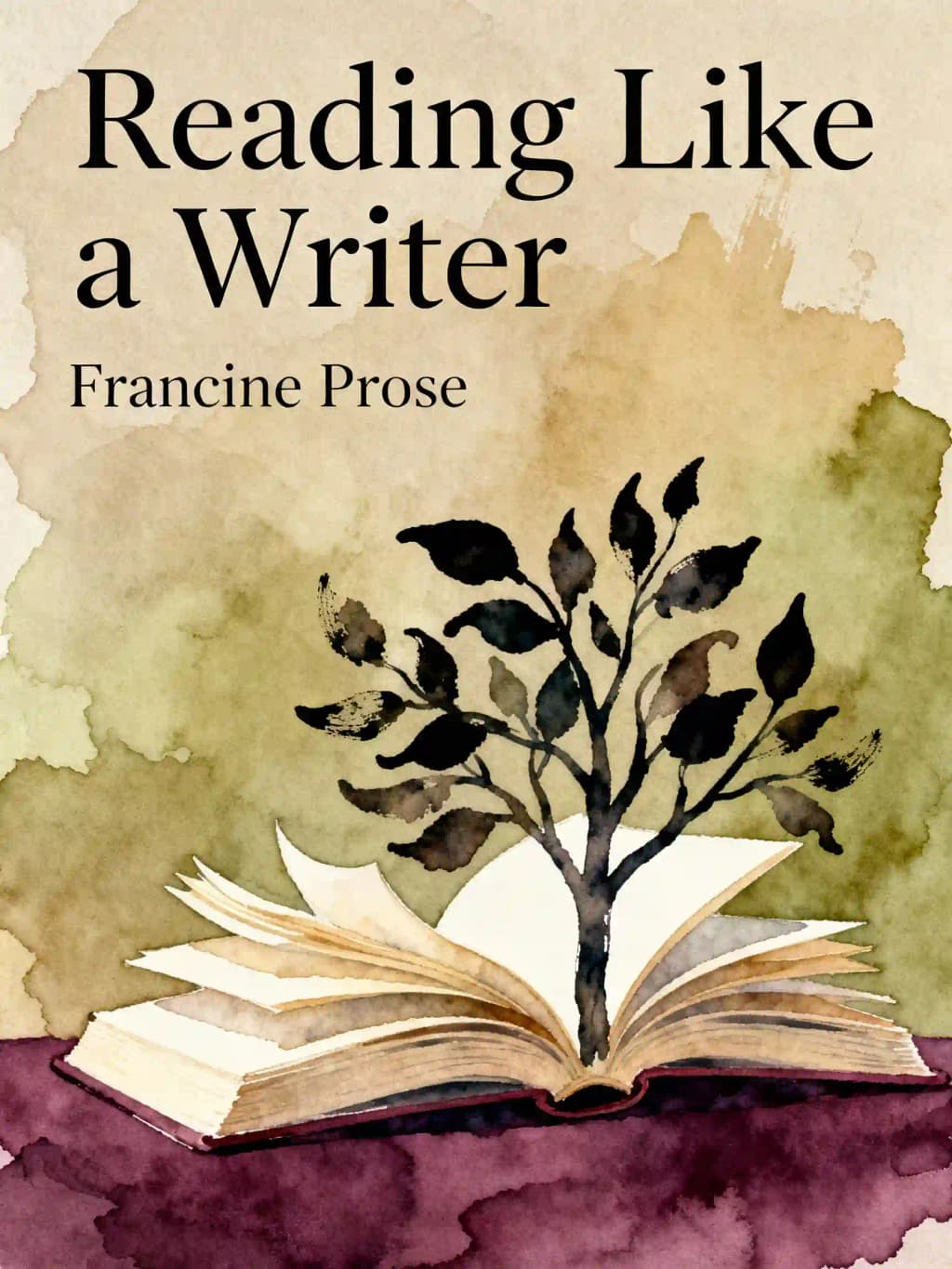
Have you ever wondered why some books captivate you completely while others leave you cold? When Francine Prose's "Reading Like a Writer" was published in 2006, it quickly became a literary sensation, with writers from Stephen King to Zadie Smith praising its insights. This guide to attentive reading has since become required reading in creative writing programs nationwide, selling over half a million copies. What makes this book so special is Prose's ability to demystify the craft of writing by teaching us to read with a writer's eye. Drawing from her twenty years of teaching experience at prestigious institutions like Harvard and Columbia, Prose offers a master class in literary appreciation that transforms how we engage with texts. As The New York Times noted, it's "less like a writing manual than a guided tour through the narrow corridors of the writer's craft, corridors that can seem unnecessarily winding until you realize their sinuous and surprising beauty."
第2章
The Writer as Reader: Learning Through Literary Osmosis
Can creative writing be taught? This question has haunted writing instructors for generations. While Prose acknowledges that workshops can help writers edit their work and find community, she discovered that she learned to write not through formal instruction but through the act of writing itself and by reading the masters with intense attention.
Like all serious writers, Prose absorbed technique through a kind of literary osmosis, studying the works she loved most with analytical precision. She read with heightened consciousness of style, diction, sentence structure, and how writers created characters and employed dialogue. This approach treats writing as a word-by-word process-putting "every word on trial for its life," as she memorably phrases it.
This isn't casual reading. It's an active engagement with text that transforms beloved books into both sources of pleasure and personal textbooks in the art of fiction. When we read this way, we begin to notice the countless small decisions that make great writing feel inevitable and effortless.
The practice of close reading has deep roots in literary education. In high school, Prose's English teacher assigned students to trace references to blindness in Oedipus Rex and King Lear. What initially seemed like a mechanical exercise became a thrilling treasure hunt, revealing patterns and meanings that casual reading would miss. This approach proved practical-like sight-reading for a musician-developing skills that would serve her throughout her career.
What's remarkable is how this kind of attentive reading transcends time and cultural differences. When Prose taught Heinrich von Kleist's "The Marquise of O-" to her Mormon undergraduate students in Utah, she worried the tormented German writer's novella about a respectable widow mysteriously pregnant might alienate them. Instead, she found her students animatedly debating the Marquise's choices and family dynamics as if discussing real neighbors. Almost two centuries after Kleist's death, twenty young Americans had entered completely into the world he created through words, demonstrating how reading can bring us together across vast divides.
第3章
Words: The Building Blocks of Literary Magic
When we read like writers, we begin to appreciate that language is the writer's medium just as notes are for composers or paint for painters. Every page was once blank, and every word reflects countless deliberations. All elements of good writing depend on choosing one word over another.
To truly understand this, we must slow down and read every word, asking what information each word choice conveys. Flannery O'Connor's opening paragraph of "A Good Man Is Hard to Find" demonstrates this richness beautifully. The first sentence-"The grandmother didn't want to go to Florida"-establishes her resistance, while calling her "the grandmother" rather than using her name gives her an archetypal role. Word choices like "connections" instead of "relatives" reveal her faded gentility, and "seizing" rather than "taking" shows her fierceness.
Katherine Mansfield's "The Daughters of the Late Colonel" shows the power of what's left unsaid. The opening sentence "The week after was one of the busiest weeks of their lives" omits what comes after "after," revealing the sisters' inability to acknowledge their father's death. Her style uses participles-"thinking, wondering, deciding"-that exhaust into ellipses, mirroring the sisters' mental state.
Alice Munro writes with Shaker-like simplicity, where every word feels inevitable despite the careful craft behind it. In "Dulse," she efficiently establishes her protagonist's entire life in plain language: "She was forty-five, and had been divorced for nine years." This contradicts the common advice to "show, not tell"-sometimes telling is more effective when done with energetic, specific language.
Reading "carnivorously" means approaching texts not to steal or borrow, but to admire, absorb and learn from what each author does particularly well. When facing writing challenges-like depicting a room full of talking characters or crafting a convincing lie-writers can turn to masters like Tolstoy, Gaddis, or Tolstaya for technical assistance. This approach rewards close reading with the excitement of experiencing the artist's hand and mind, similar to viewing a masterpiece painting both from afar and up close to see the brushstrokes.
第4章
Sentences: The Architecture of Meaning
For many writers, crafting great sentences matters more than plot, though few would admit this to publishers. Discussing sentences with another writer creates an intimate connection-like mathematicians bonding over an elegant theorem. Beautiful sentences transcend time and genre, appearing in plays, novels, or journalism. What makes a beautiful sentence? Like poetry, it's something you feel physically-when you're conscious of sentences as deserving deep respect and attention, you're already advancing as a writer.
Samuel Johnson's 134-word opening to "The Life of Savage" exemplifies clarity despite its length, turning a cliche about wealth and happiness into a philosophical exploration through measured, musical prose that reveals a lively mind at work. Philip Roth's paragraph from "American Pastoral" demonstrates extraordinary versatility-shifting between sentence fragments, declarative statements, and rhetorical questions that build to profound wisdom. Virginia Woolf's astonishing 181-word opener to "On Being Ill" remains perfectly comprehensible despite its length, demonstrating how grammar serves clarity rather than constraining it.
Many beginning writers mistakenly believe grammar is irrelevant to great literature, but mastering grammatical logic mysteriously enhances thought itself. Grammar functions like etiquette-the writer hosts the reader and follows conventions to ensure comfort. The crucial difference between learning from style manuals versus literature is that manuals teach what not to do, while great writing provides positive models.
Rhythm matters nearly as much in prose as in poetry. Reading work aloud reveals sentences that need smoothing. The most celebrated literary passages move us through cadences that reinforce and transcend their content, affecting us like music in ways words alone cannot explain. Tim O'Brien's "The Things They Carried" creates its haunting, dirge-like power through repetition and rhythmic listing of objects that function as mini-biographies.
Hemingway famously advised writing "one true sentence" when stuck-"the truest sentence that you know"-then proceeding from there. Though he never clearly defined what makes a sentence "true" in fiction, perhaps he was confusing truth with beauty, a concept equally difficult to define. What matters is that Hemingway cared deeply about sentences, used them as sustenance and focus, and told his publishers and readers they mattered.
第5章
Paragraphs: The Breathing Space of Prose
Paragraphs offer writers a powerful tool for shifting rhythm and perspective. In Isaac Babel's view, paragraphs should be broken "only for the effect on the reader," not according to rigid rules. A new paragraph allows you to "quietly change the rhythm" and can illuminate "the same landscape from a different aspect."
To understand how paragraphs work, we must examine them in practice rather than theory. Looking at Babel's fiction reveals his masterful paragraph construction, particularly in stories like "Crossing into Poland" and "My First Goose." Both stories begin with paragraphs that build toward disquieting conclusions, creating a literary respiration where readers inhale at the beginning and catch their breath at the end.
In "Crossing into Poland," Babel moves from straightforward narration to the haunting phrase "upon the bones of peasants," elevating the text from mere reportage to literature. Similarly, in "My First Goose," the opening paragraph captures a disturbing erotic fascination with a military commander's appearance, building toward the unsettling image of legs "like girls sheathed to the neck in shining riding boots"-an image that will resurface at the story's conclusion.
While school instruction often emphasizes beginning paragraphs with "topic sentences," Strunk and White offer more nuanced guidance. They suggest starting paragraphs with sentences that indicate the topic or aid transition, but warn against making any device a mannerism. In animated narrative, paragraphs may be short without topic sentences, with breaks serving as rhetorical pauses that emphasize action details. They conclude that paragraphing requires "a good eye as well as a logical mind," noting that breaking long paragraphs makes text less intimidating to readers, though firing off too many short paragraphs can be distracting.
While Strunk and White's advice is worth taking seriously, we can be grateful for writers who break these sensible rules. Samuel Beckett and Jose Saramago constructed extremely long paragraphs, while Garcia Marquez's first paragraph in "One Hundred Years of Solitude" runs for a page and a half. Most style guides caution against one-sentence paragraphs, which can feel like a punch. Overused, they become an annoying tic or lazy attempt to inject false importance. The one-sentence paragraph should be used sparingly, reserved for sentences with enough resonance to justify this attention-grabbing device.
Paragraph shifts often represent changes in point of view or perspective shifts like cinematic camera angle changes. Jonathan Franzen's paragraph from "The Corrections" begins in omniscient third person before veering into a character's subjective view, transforming a simple description of an elderly couple into a loaded family relationship summary. Denis Johnson's "Angels" masterfully uses paragraph breaks to enhance both clarity and psychological disorientation.
第6章
Narration: Finding the Right Voice
The challenge of narration often centers not on who is telling the story but on who is listening. For novice writers, the question of audience can be more vexing than voice. Using framed stories-narratives told by one character to another-can solve this problem by establishing clear contexts for storytelling.
Wuthering Heights exemplifies the nested narrative structure, with Mr. Lockwood as the outside frame and Nelly Dean serving as the primary narrator. Though deeply involved in events, Nelly maintains enough distance to credibly report the gothic happenings while grounding them in everyday reality. Her relatively organized mind helps explain complex genealogies and time skips. Despite this ornate structure, the novel feels natural as character personalities emerge through consistent diction.
Short anecdotes within larger narratives change pace while revealing character through content, telling style, and apparent purpose. Richard Price's Freedomland includes a mother's story about her daughter Brenda-who may have killed her own child-showing how interpolated narratives illuminate character through what they choose to share. The anecdote about Brenda as a child who remembered her parents crying over "September Song" and later gifted her mother the same song after her father's death reveals Brenda's sympathetic, generous nature, making a case for her innocence.
Writers often struggle with finding the best narrative approach. Though writing students are typically instructed to choose a point of view and stick with it, skilled writers frequently break this rule. Beyond the standard first and third person options, narrative voice creates urgency through establishing contact with specific listeners.
First-person narratives are endlessly variable, with skilled writers establishing narrator personality within paragraphs while persuading readers to stay with that voice for hundreds of pages. Nabokov's Humbert Humbert emerges immediately as a brilliant, self-dramatizing lunatic genius, while Peter Taylor's Phillip Carver reveals his insecurity through repeated assertions of "certainty." Even omniscient narrators have distinctive personalities-Deborah Eisenberg's narrator in "A Cautionary Tale" reveals complex moral sensibilities in a single long sentence about friendship, while Jane Bowles employs a voice suggesting an educated but neurotic child.
第7章
Character: Bringing People to Life on the Page
Character development emerges not necessarily through physical description but through action, moral choices, and the ways characters respond to extraordinary circumstances. Skilled writers can make characters feel so real that readers discuss them as if they were neighbors whose behavior requires interpretation and judgment. This verisimilitude comes from carefully crafted moments that reveal personality through decisions, dialogue, and reactions to events rather than mere physical attributes.
Kleist creates characters without physical description-we never learn how the Marquise looks, what people wear, or what rooms contain. Instead, he establishes character through moral qualities and actions, describing people as "impetuous, wrongheaded, overly emotional, but essentially good at heart" before setting them loose "like windup toys" through his fast-paced narrative. This technique forces readers to focus on the essential nature of characters rather than superficial details, creating deeper psychological portraits that resonate beyond the page.
Kleist masterfully creates character through what he doesn't show. The phrase "a little while after" between the Marquise fainting and recovering represents one of literature's most brilliant "fades to black," concealing yet implying what transpired between her and Count F-. The Marquise's character emerges through her innocent confusion about her pregnancy and the Count's dying words about "Julietta"-the first time we learn her name. These strategic omissions create tension and intrigue while revealing character through reaction rather than direct exposition.
Even disparate writers share the skill of creating minor characters with just a few strokes. Austen dispatches Mr. and Mrs. John Dashwood in Sense and Sensibility with devastating efficiency, describing him as "not ill-disposed" but "rather cold hearted, and rather selfish"-adjectives far more damning than the negated one. She creates the impression of fairness while actually condemning him, noting he might have been "more amiable" with a better wife. This technique of understated criticism through seemingly balanced observation becomes one of Austen's signature methods for character revelation.
Austen defines characters through contrast, particularly in establishing the Dashwood sisters. Elinor, "the creature of sense," possesses "strength of understanding, and coolness of judgment" despite being only nineteen. Though affectionate with "strong feelings," she "knew how to govern them"-unlike her mother and sister. Marianne, "everything but prudent," has abilities "quite equal to Elinor's" but is "eager in everything" with sorrows and joys having "no moderation." This pairing demonstrates how contrasting personalities can illuminate each other's traits while creating dramatic tension that drives the narrative forward.
The most memorable characters often emerge through their relationships with others, their responses to moral dilemmas, and the small details that hint at larger truths about their nature. Writers like Kleist and Austen show that effective characterization depends not on exhaustive description but on strategic revelation of key moments and choices that allow readers to construct complete personalities from carefully selected details. Through this approach, characters become more than mere constructs on the page - they become living, breathing entities that persist in readers' imaginations long after the story ends.
第8章
Dialogue: The Music of Human Interaction
Conventional writing advice often suggests that fictional dialogue should be an "improved" version of real speech-cleaned up, economical, and free of repetitions and hesitations. Yet this approach produces dialogue less interesting than what we overhear in daily life. Poor dialogue typically operates on only one level, particularly when used merely for exposition, creating stiff conversations where characters exchange information solely for the reader's benefit.
Henry Green's novels demonstrate dialogue's remarkable potential, simultaneously providing text and subtext while revealing characters' emotions, manipulations, and concealed intentions. His dialogue shows people interacting with remarkable accuracy, fully inhabiting characters from the inside so that every line expresses their circumstances and emotional state.
Green's dialogue masterfully captures the complex dynamics between characters. When Kate awakens after calling out "Paddy" in her sleep, Edith teases her while removing herself from Albert, who turns away "facing Ireland." Their exchange reveals the subtle power dynamics-Kate's embarrassment at her unconscious revelation, her counterattack about Edith and Albert being "in each other's arms," and Albert's sharp denial ("We wasn't").
The novel's dialogue brilliantly portrays human interaction-how Albert's confession of family worries meets with Edith's partial attention, how she offers practical reassurance while maintaining emotional distance, and how physical proximity creates tension. Green captures the reality of inattention in conversation, allowing Albert to repeat himself as people do in life, rather than following the fictional convention where characters perfectly listen and respond.
Sam Pollit in Christina Stead's "The Man Who Loved Children" delivers extended monologues that reveal his charming yet megalomaniacal personality. He transforms trivial matters into prolonged disquisitions, as when he rhapsodizes about "Sunday-Funday" coming "from Peking, the Himalayas... over the pond pine ragged in the peat" to find "Gulliver Sam's Lilliputian Pollitry." His casual discussion with his daughter about murder being potentially "beautiful" as "self-sacrifice" escalates to disturbing eugenic fantasies about "picking out the unfit and putting them painlessly into the lethal chamber."
第9章
Details and Gestures: The Small Moments That Reveal Everything
A transformative workshop at Esalen Institute demonstrates the extraordinary power of well-chosen details in storytelling. During a session, a one-legged skiing champion crafts an elaborate gothic tale about losing her leg to a seemingly innocuous cat bite that turned catastrophically gangrenous. Despite the tale's outlandish nature, the entire class believes her story completely, swayed by one masterfully chosen detail: her precise description of her parents' contrasting dietary habits - her father's devotion to health food versus her mother's secret candy drawer. This single authentic-feeling detail anchors the entire narrative in reality.
Details serve as the bedrock of persuasion - skilled liars and accomplished writers alike understand that "the single priceless detail" creates a bridge of trust between storyteller and audience. In Kafka's "Metamorphosis," readers accept the fantastical premise of Gregor Samsa's transformation into a giant insect partly because of the expertly chosen detail of the framed magazine picture of a lady in furs hanging in his bedroom. This mundane object, described with such precision, grounds the supernatural elements in familiar reality.
Great writers construct their fictional worlds through a careful curation of specific, resonant details. Even Samuel Beckett, often viewed as minimalist and unconcerned with naturalistic detail, understood deeply that "in the particular is contained the universal." This philosophy manifests in works like "Molloy," where the protagonist's sixteen sucking stones, meticulously rotated between his pockets, and his peculiar arrangement of bicycle-attached crutches become powerful metaphors for the human condition while remaining concrete, specific objects.
Chekhov, master of the telling detail, filled his notebooks with precise observations that capture entire worlds in single images: "A bedroom. The light of the moon shines so brightly through the window that even the buttons on his night shirt are visible." In his correspondence with aspiring writers, he consistently emphasized economy and relevance in descriptions, urging them to "seize upon the little particulars" that create vivid mental pictures. His example of "a little glowing starpoint flashed from the neck of a broken bottle" to evoke a moonlit night demonstrates how a single, perfectly chosen detail can illuminate an entire scene.
Similarly, carefully selected gestures function as windows into characters' innermost beings. Henry James demonstrates this masterfully in "The Portrait of a Lady," where Isabel's discovery of her husband's relationship with Madame Merle unfolds entirely through observed posture and positioning - no dialogue necessary. In Chekhov's "The Bishop," a mother's nervous, repetitive handling of drinking glasses becomes a profound commentary on class anxiety and the complex dynamics between a successful son and his humble parent. James Joyce's "The Dead" reaches its emotional crescendo through Gabriel's seemingly minor gesture of awkwardly giving a coin to Lily, a moment that perfectly encapsulates his patronizing attitude, acute class consciousness, and defensive vanity. These small physical actions reveal more about character than pages of exposition ever could.
第10章
The Courage to Read and Write
While writing may seem safer than fighting fires or performing surgery, it requires genuine courage to face the fear of writing badly, revealing something hidden, losing others' good opinion, or discovering unwanted truths about oneself. Literature provides endless courage and confirmation through brave, original works written without regard for their strangeness or risk.
Reading can give writers courage not just to resist cultural pressures, but also to endure the difficult process of writing itself. Isaac Babel described revision as hard labor: "I work like a pack mule, but it's my own choice." He meticulously examined every sentence, cutting unnecessary words, ensuring metaphors were fresh, removing excess adverbs, and striving for clear, hard lines. Despite working under Stalin's regime-which eventually led to his arrest and execution-Babel maintained his artistic standards, showing that true art requires freedom of imagination.
Writers' biographies and letters can provide inspiration during difficult writing periods. Tolstoy destroyed printer's plates of "Anna Karenina" for last-minute revisions. Flaubert's correspondence reveals his agonizing struggle with "Madame Bovary," feeling "as dreary as a corpse" and that writing was like "playing the piano with leaden balls attached to his fingers."
Reading can even offer courage when writing itself seems frivolous compared to world suffering. Zbigniew Herbert's poem "Five Men," about an execution, confronts this dilemma directly. After describing the brutal scene in vivid sensory detail, the poem questions writing "unimportant poems on flowers" in the face of such horror, yet concludes one can still "offer to the betrayed world a rose."
In the late 1980s, Prose endured miserable weekly bus commutes to teach at a college. The New Rochelle Trailways Station was a depressing place-stale air, unfriendly people, and the Challenger disaster repeatedly playing on TV. Her salvation came through reading Chekhov's short stories during these journeys. His profound, beautiful tales transported her beyond her surroundings, offering both distraction and deep comfort. Through his vision, she began to see that nothing was wasted-even her dreary bus station experiences might someday serve her work. Reading Chekhov brought her "as close to happiness as I knew I was likely to come," revealing that books remain our best way of carrying great art's consolations with us.
Ultimately, if we want to write, it makes sense to read-and to read like a writer. By doing so, we join a conversation that has continued across centuries, learning from masters who faced the same blank page and somehow found the courage to fill it with words that continue to move us today.




![[b6e42e78-29d6-4f27-8d8a-93e6264f8416:c0000] Contrarian_Codex_newsletter_112_1.pdf p1-1](/_next/image?url=https%3A%2F%2Fd1y2du6z1jfm9e.cloudfront.net%2Fassets%2Fpodcast%2Fblue.png&w=1024&q=50)
![[b6e42e78-29d6-4f27-8d8a-93e6264f8416:c0001] Contrarian_Codex_newsletter_112_1.pdf p1-1](/_next/image?url=https%3A%2F%2Fd1y2du6z1jfm9e.cloudfront.net%2Fassets%2Fpodcast%2Fyellow.png&w=1024&q=50)
![[b6e42e78-29d6-4f27-8d8a-93e6264f8416:c0002] Contrarian_Codex_newsletter_112_1.pdf p1-1](/_next/image?url=https%3A%2F%2Fd1y2du6z1jfm9e.cloudfront.net%2Fassets%2Fpodcast%2Fgreen.png&w=1024&q=50)