第1章
The Illusion of Character: When Good People Do Bad Things
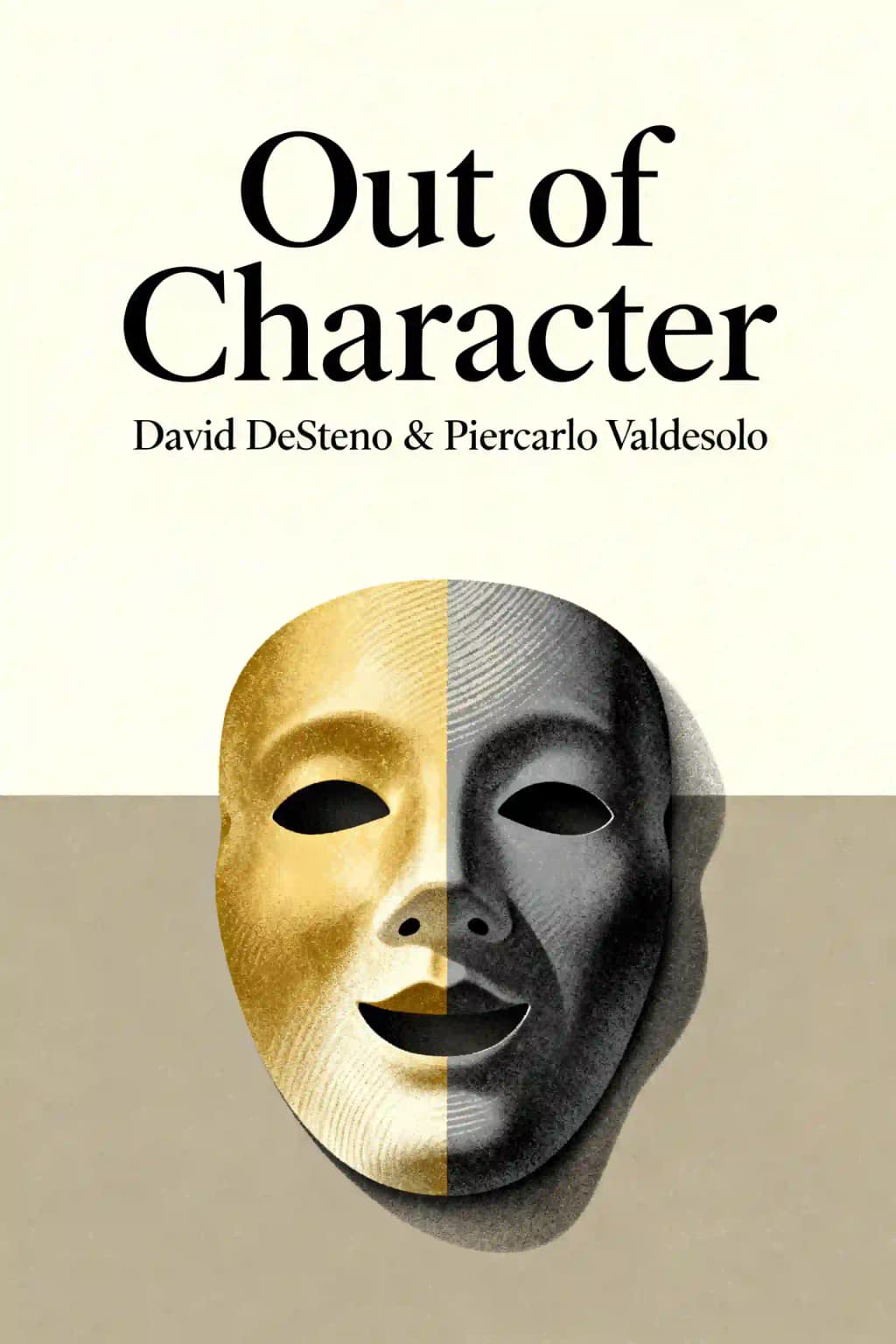
Have you ever wondered how a respected governor, devoted husband, and father could suddenly abandon his responsibilities to pursue an extramarital affair? Or how soldiers who exchange Christmas gifts with enemy troops can resume killing each other the very next day? The shocking transformation of Mark Sanford-from Eagle Scout and fiscally responsible governor living by biblical principles to a man who abandoned his post and family for an Argentinian mistress-forces us to question everything we thought we knew about character. "Out of Character" by David DeSteno challenges our fundamental assumptions about human nature, revealing that our moral compass isn't fixed but fluctuates constantly based on subtle environmental and psychological cues. The book has garnered praise from behavioral economists and psychologists alike, with Daniel Gilbert calling it "a fascinating and important examination of the forces that shape our moral decisions." Its insights have influenced fields from business ethics to criminal justice, showing that the potential for both virtue and vice exists within all of us.
第2章
The Myth of Fixed Character
The traditional view of character-that it's formed early in life and remains stable throughout-simply doesn't hold up under scientific scrutiny. We typically imagine character as permanent marks impressed on coins, guiding actions consistently throughout life. But if character is truly stable, how could someone like Mark Sanford deceive everyone for so long? Society applies a curious double standard: a single moral failing can permanently taint someone's character, while good deeds from those deemed "bad" rarely redeem them. This tendency to accentuate the negative is deeply ingrained in human psychology-like how a single fly ruins soup, but soup cannot improve a bowl of flies.
The problem isn't our judgment but our flawed understanding of what character truly is. Acting "out of character" isn't rare-it's commonplace. In every one of us lurks the potential to lie, cheat, and sin, regardless of how good we believe ourselves to be. Most people envision character as the familiar cartoon image of an angel and devil sitting on our shoulders, each whispering conflicting advice. We assume our character is determined by which voice we habitually favor. This view feels logical but isn't supported by data.
Character isn't fixed but fluctuating-more like a scale constantly seeking balance between competing psychological mechanisms. Unlike the angel-devil metaphor, these dueling forces aren't simply good and bad; it's never certain which voice to trust; and the battle between them isn't fair, as external forces can easily tip the scale without our awareness. A more accurate metaphor is Aesop's ant and grasshopper. The grasshopper represents mental systems focused on immediate rewards and short-term pleasure, while the ant embodies systems concerned with long-term outcomes. Neither is inherently virtuous or sinful-both serve our interests but in different timeframes.
Evolution programmed us to want certain things in the short term (fatty foods, sex, power) because they potentially increase evolutionary fitness, while also valuing long-term stable relationships crucial for human well-being. The challenge lies in balancing these competing systems, which is why character isn't decided by a simple one-off choice but emerges from this complex internal struggle.
第3章
The Science Behind Our Moral Hypocrisy
Hypocrisy isn't merely violating your own moral beliefs-it's shifting those beliefs to suit your momentary needs and desires. Consider high-profile cases like Eliot Spitzer's prostitution scandal, Rush Limbaugh's drug abuse while condemning addicts, and William Bennett's gambling addiction while preaching self-restraint. These aren't isolated moral lapses by uniquely flawed individuals; the potential for hypocrisy lurks in all of us.
In our laboratory experiments, we created situations to test moral hypocrisy. Participants could either assign themselves an easy 10-minute task or difficult 45-minute task, with the unassigned task going to the next participant. Though given a coin-flipper for fairness, 92% simply took the easy task. When asked to rate their own fairness, these participants judged themselves moderately-not completely fair but not terribly unfair either. However, when different participants observed someone else making the identical self-serving choice, they harshly condemned it as completely unfair and immoral.
This stark difference reveals how our moral judgments shift depending on whether we're judging ourselves or others. When our short-term interests are at stake, we unconsciously adjust our beliefs about right and wrong, rationalizing our actions without even realizing we're doing it. Our experiment showed that when we prevented rationalization by having participants memorize digit strings while making judgments, the hypocrisy vanished-people judged their own unfair actions just as harshly as others'. This proves we do intuitively feel screwing others over is wrong, but our minds excel at squashing these feelings with reasoned excuses when it serves our interests.
Our ethics and morality aren't fixed-they're surprisingly elastic and changeable. Research shows our morals are often shaped more by emotional responses than rational ones. Consider the example of siblings Julie and Mark having protected, consensual sex once while on vacation-most people immediately feel this is wrong but struggle to articulate why when all potential harms are ruled out. This gut revulsion serves an evolutionary purpose, protecting our species from the genetic risks of inbreeding long before modern contraception existed.
Our moral judgments are shockingly vulnerable to manipulation through seemingly irrelevant emotional triggers. Simply sitting in a messy room with stained chairs and dirty tissues causes people to judge moral transgressions more harshly than those in clean environments. Conversely, physical cleanliness can alleviate moral guilt-the "Macbeth effect." College student "Sam" unconsciously used frequent hand-washing to assuage guilt about his promiscuous behavior, allowing him to maintain his self-image as a "nice guy" while engaging in one-night stands.
第4章
The Eternal Battle Between Love and Lust
Conventional wisdom says love involves searching for one's soul mate-a notion dating back to Plato's Symposium, which describes humans as once being two-headed, four-limbed beings split by the gods, forever seeking their other half. Art, literature, and movies perpetuate this tale of finding the one person who "completes us." But this simplistic notion of "one true love" is scientifically wrong. Whom we love isn't determined by fate or divine intervention. Like many choices shaping our character, the decision between love and lust reflects a battle between long-term and short-term interests constantly waging within us.
One-night stands perfectly illustrate this battle. What makes one person catch your eye in a crowded bar? Why does something about a particular stranger get your pulse racing? And what determines whether a hookup becomes the topic of a wedding toast or an embarrassing memory? These outcomes aren't arbitrary. Our minds are attuned to subconscious physical cues that have evolved to direct us toward desirable mates.
Physical attraction fundamentally shapes relationship beginnings. There's widespread agreement across cultures about who is attractive, and these judgments appear biologically determined. Even infants show preferences for faces adults rate as attractive, suggesting concepts of beauty emerge automatically and early. Judgments of attraction are partly rooted in automatic, intuitive cues about potential partners' health and evolutionary fitness-their ability to produce healthy offspring.
Our evolutionary urges drive us toward genetically fit partners through subtle cues we often don't consciously register. Bilateral symmetry-how perfectly our features mirror each other across our body's midline-signals genetic health and reproductive success. Studies consistently show we find more symmetrical people more attractive. When women are ovulating, these preferences intensify-they can even detect symmetry through smell alone, as demonstrated in Thornhill and Gangestad's "dirty t-shirt" experiment where ovulating women preferred the scent of symmetrical men.
While immediate attraction sparked John and Amelia Rocchio's relationship, it was love, not lust, that sustained their connection for eighty-two years as those physical features inevitably aged. Hormone levels significantly influence our mating behaviors. Studies show men with higher testosterone levels expend more effort finding mates and competing with rivals, while lower testosterone correlates with monogamy. When men enter committed relationships, their testosterone often decreases. Similarly, women's interest in casual encounters varies with their ovulatory cycle-during fertile periods, they feel greater attraction to "manly" men outside their relationships.
Love serves an evolutionary purpose by binding us to partners, increasing devotion and compelling us to prioritize another's well-being. The battle between lust and love-between one-night stands and lifelong commitment-continues throughout our lives, with jealousy serving as a powerful tool our inner "ant" uses to protect long-term relationships.
第5章
Pride: The Double-Edged Sword
Pride has a universally bad reputation across religions and cultures. In Christian theology, it's considered the deadliest of the seven deadly sins; in Buddhism, one of the ten fetters preventing enlightenment; and similarly condemned in the Torah and Tao Te Ching. Even modern English thesauruses list mostly negative synonyms for pride: arrogance, conceitedness, being full of oneself. Yet this universal condemnation seems contradictory-pride can motivate excellence while hubris repels us. The resolution lies in understanding that pride isn't a fixed personality trait but emerges moment by moment from the battle between our short-term and long-term interests.
Pride often drives our perseverance through challenges and obstacles. While we might think pride comes from satisfying self-set goals, it actually stems primarily from external social factors. The universal quest for social status requires hard work-developing athletic skills, earning top grades, gaining promotions-creating tension between our inner "grasshopper" seeking immediate pleasure and our "ant" recognizing that long-term rewards come to experts and leaders.
Lisa Williams' experiment on pride and perseverance yielded unmistakable results: participants who received acclaim for their visuospatial abilities persevered significantly longer on tedious tasks than those who received neutral feedback or none at all. The more pride they felt, the longer they worked. This demonstrates that pride and perseverance aren't inherently tied to the nature of a task or its inherent value-even for skills as arbitrary as "visuospatial cognition." Simply marking an ability as socially important by having someone care about and praise performance instantly generated pride and motivation.
Pride manifests in universal physical expressions-straighter posture, elevated head, expanded chest-that function as status signals across cultures. Jessica Tracy's research documented these markers, showing their recognition from Canadian college students to isolated West African ethnic groups. These expressions are so innate that even congenitally blind Paralympic athletes who couldn't have learned them through observation display identical pride gestures upon winning.
When pride-induced individuals took charge of group tasks, they monopolized the puzzle for 20-25% longer than teammates. This dominance had a surprising effect: rather than resenting these self-appointed leaders, group members actually liked them more. The proud participants were perceived as having higher status and greater leadership qualities, and were significantly more likable than those who didn't demonstrate pride. This effect wasn't simply because proud people did more work-a confederate who contributed little wasn't disliked for it. Pride functions efficiently in social groups-it motivates individuals to work harder while signaling to others that they're worthy of being followed, even when their pride isn't actually justified by superior abilities.
第6章
The Fluid Nature of Compassion
The winter of 1914 revealed a puzzling aspect of human nature. British and German soldiers, engaged in brutal trench warfare, suddenly laid down their weapons on Christmas Eve to exchange gifts and play soccer. This temporary compassion vanished as quickly as it appeared, with the soldiers returning to killing each other days later. This striking example illustrates how our capacity for both cruelty and compassion can flip with surprising ease, challenging our notion of fixed character traits.
What determines whether we show compassion or cruelty? A key factor is perceived similarity. We instinctively feel more compassion toward those we see as "like us." This explains battlefield dynamics, where enemies in different uniforms seem alien until humanizing moments reveal commonalities. The same mechanism worked in the Ivory Coast, where warring factions united temporarily over World Cup soccer, and after disasters like 9/11 when people briefly set aside differences.
This "like us/not like us" distinction has evolutionary roots. Robert Trivers' theory of reciprocal altruism explains that helping strangers can be adaptive if they might reciprocate later. But with limited resources, we need mechanisms to choose who deserves our compassion. Similarity serves as this selective cue, signaling who might reciprocate our kindness. Crucially, these similarity judgments are highly flexible and context-dependent, explaining how enemies can transform into friends and back again so rapidly.
We form impressions of others with remarkable speed and surprising accuracy. Jeremy Bailenson's research suggests we favor those who physically resemble us. In a clever experiment during the 2006 Florida gubernatorial race, researchers showed participants either unaltered photos of candidates or photos subtly morphed with the participant's own face (60% candidate, 40% participant). Consistently, people preferred whichever candidate had been made to look more like themselves, rating them as more honest, moral, and kind-regardless of political positions. This preference emerged despite participants being unaware of the manipulation, suggesting our judgments of character are profoundly influenced by unconscious perceptions of similarity.
In another experiment, researchers created arbitrary similarity between strangers based on whether they "overestimated" or "underestimated" trivial facts like the number of black bears in Massachusetts forests. Participants then witnessed a confederate unfairly assign a difficult task to another person. The results were striking: 58% of participants helped the victim when they believed they shared the same meaningless "estimator type," compared to just 16% when told they were different types. This manufactured compassion demonstrates how easily our moral character can fluctuate based on perceived similarity, even when that similarity is completely arbitrary and meaningless.
第7章
The Golden Rule's Surprising Elasticity
The Golden Rule-treating others as we wish to be treated-forms the foundation of human social exchange. This principle was powerfully illustrated when Mohammad Sohail, a convenience store owner, showed mercy to a would-be robber by giving him $40 and food instead of shooting him. Months later, the reformed man returned $50 with a note explaining how this act of kindness had transformed his life.
Though fairness often appears to be a strategic decision-we reciprocate to maintain relationships-people frequently act fairly even when there's no clear benefit, like tipping waitstaff in cities they'll never visit again. These behaviors defy pure rational self-interest. The reformed thief who repaid Sohail with interest had no logical reason to return the money-he couldn't be tracked down and clearly needed funds himself. This illustrates that the mechanisms shaping our character aren't always rational.
Gratitude appears to be the psychological mechanism behind our universal desire for fairness, driving us to reciprocate kindness even when there's no rational benefit. In our experiment, participants completed grueling word problems until their computers seemingly crashed, erasing their work. When our confederate "Allison" helped fix the computer, participants reported feeling intensely grateful. Later, when Allison asked them to complete additional tedious problems, they not only agreed more frequently but worked 50% longer than those whose computers hadn't crashed.
Most surprisingly, this gratitude effect transferred even when a complete stranger (not Allison) requested help. The more grateful participants felt toward Allison, the more time they spent helping the stranger. This demonstrates how gratitude can be misdirected-our intuitive systems know we should repay kindness, but don't always check who we're repaying. When we reminded participants about Allison's help before they encountered the stranger, they no longer showed this effect. This simple reminder brought their rational systems back into play, correcting the intuitive impulse to help anyone when feeling grateful.
Despite our assumptions about honor students being honest achievers, surveys reveal that 80 percent of top academic performers admit to cheating. When asked why, students claimed it was simply what successful people did-honesty wouldn't be enough. This demonstrates how external factors, particularly others' behavior, influence our decisions about fairness and honesty. Anonymity powerfully enables self-serving behavior. Chen-Bo Zhong's research showed that simply dimming the lights in a room increased cheating on math problems by almost $2 per person. The mere perception of being less visible-whether through darkness or facial obscurity-makes us more likely to act dishonestly. Our adherence to fairness principles is remarkably elastic, influenced by subtle environmental cues and others' behaviors.
第8章
The Hidden Forces Behind Our Decisions
Risk assessment is deeply influenced by our competing mental systems rather than pure rationality. Our inability to accurately weigh short-term rewards against long-term risks explains many seemingly irrational behaviors. When emotions run high, our rational assessment systems often shut down. Peter Ditto's experiments demonstrated this powerfully: participants were far more likely to take gambling risks when freshly baked cookies were physically present, their aroma filling the room, compared to when cookies were merely mentioned as a potential reward. Similarly with sexual attraction-men consistently underestimate STD risks from attractive women. The more appealing and immediate the reward, the more we instinctively ignore potential dangers, allowing our inner "grasshopper" to override logical decision-making.
Our emotional states profoundly influence risk assessment, even when those emotions are completely unrelated to the decision at hand. Research shows that people feeling sad overestimate the likelihood of tragic events, while angry people overestimate infuriating ones. This emotional bias in risk assessment isn't necessarily irrational from an evolutionary perspective-it's often better to be safe than sorry. Our past experiences similarly shape risk perception, with painful experiences making us overly cautious and missed opportunities making us more willing to gamble.
Our cultural admiration for risk-takers explains why we celebrate heroes who defy the odds. The 2010 NCAA tournament's Butler Bulldogs captivated the nation as underdogs against Duke, with people caring less about the outcome than their improbable journey. This same psychological bias for beating odds drives Wall Street traders, whose brains show intense pleasure during high-risk decisions-the worse the odds, the greater the pleasure. While we condemn reckless bankers, we celebrate unlikely winners like Seabiscuit, revealing the similar psychological mechanisms behind both behaviors.
In the Iowa Gambling Task, players initially choose cards randomly but eventually gravitate toward safer decks with smaller but more consistent payoffs. Remarkably, skin sensors reveal players experience anxiety when reaching for risky decks around the tenth draw-long before conscious awareness. This demonstrates how our "ant" mind works as a silent statistician, calculating long-term probabilities below consciousness. While the "grasshopper" mind seeks immediate rewards, the ant focuses on probability over possibility. Though the ant eventually prevails in controlled experiments, real-world decisions often require additional help to overcome the grasshopper's immediate impulses.
第9章
Finding Your True Character
Character exists, but not as we typically conceive it. The mistakes we make in classifying someone's "true colors" parallel our misunderstanding of actual colors. While we perceive colors as distinct categories with clear boundaries, science shows they're simply variations along a light wavelength continuum. Just as we can't precisely determine where orange becomes red, we can't definitively categorize someone as purely honest or dishonest. Similarly, we mentally categorize character traits as distinct entities (noble, sleazy, trustworthy), then become confused when people act "out of character." In reality, character varies along a continuum between our competing psychological needs-the metaphorical ant and grasshopper, where the ant represents our future-focused, disciplined side and the grasshopper embodies our present-focused, pleasure-seeking nature.
Once you recognize character's flexibility stems from competing psychological mechanisms, you can develop strategies beyond mere willpower to influence your behavior. This might involve environmental design, like removing temptations or creating accountability structures, rather than relying solely on self-control. Success requires accurately assessing contexts-knowing when to trust intuition versus reason while remaining vigilant about subtle cues like anger, smells, laughter, or synchronous movement that might unconsciously push you in unwanted directions. For instance, studies show that people make more aggressive decisions in rooms with unpleasant odors and demonstrate increased generosity when exposed to the sound of children laughing. Understanding how morality, jealousy, bigotry and other character traits function helps defend against forces that might co-opt your decisions.
Evidence supports this approach: Yale's RULER program, which teaches children to recognize and manage their emotions rather than simply instructing them on "good behavior," produced students who performed better academically and demonstrated more desirable social behaviors than peers taught character development through traditional methods. The program's success stems from teaching emotional intelligence skills like recognizing triggers, understanding impulses, and developing coping strategies. Similarly, research shows that recognizing biases in emotional intuitions correlates with greater life satisfaction, workplace advancement and leadership potential-confirming that character, like any skill, can be learned with the right tools. Studies of successful executives reveal that those who actively work on understanding their emotional patterns make better decisions and build stronger relationships.
Though temperament, culture and environment may position people to more frequently occupy certain spots along this spectrum, context constantly shifts where we land. A normally honest person might lie to protect someone's feelings, while a typically selfish individual might show unexpected generosity in a crisis. There are no firm character boundaries, only a sliding scale between vice and virtue that can shift rapidly. Recognizing this thin line between cowards and heroes, bigots and the tolerant, saints and sinners helps us better understand those occasions when we or others act "out of character." The challenge lies in finding your personal balance point between short-term desires and long-term social needs-a perfect balance that, like the "golden mean" in mathematics, can be approached but never definitively calculated because it shifts with each new situation. This understanding allows us to work on character development not as a fixed destination but as an ongoing process of calibration and adjustment.




![[7db1fdd0-1099-4ec6-ad34-336671b38df6:c0000] The Laws of Human Nature.pdf p1-1](/_next/image?url=https%3A%2F%2Fd1y2du6z1jfm9e.cloudfront.net%2Fassets%2Fpodcast%2Fgreen.png&w=1024&q=50)
![[7db1fdd0-1099-4ec6-ad34-336671b38df6:c0001] The Laws of Human Nature.pdf p1-1](/_next/image?url=https%3A%2F%2Fd1y2du6z1jfm9e.cloudfront.net%2Fassets%2Fpodcast%2Fblue.png&w=1024&q=50)