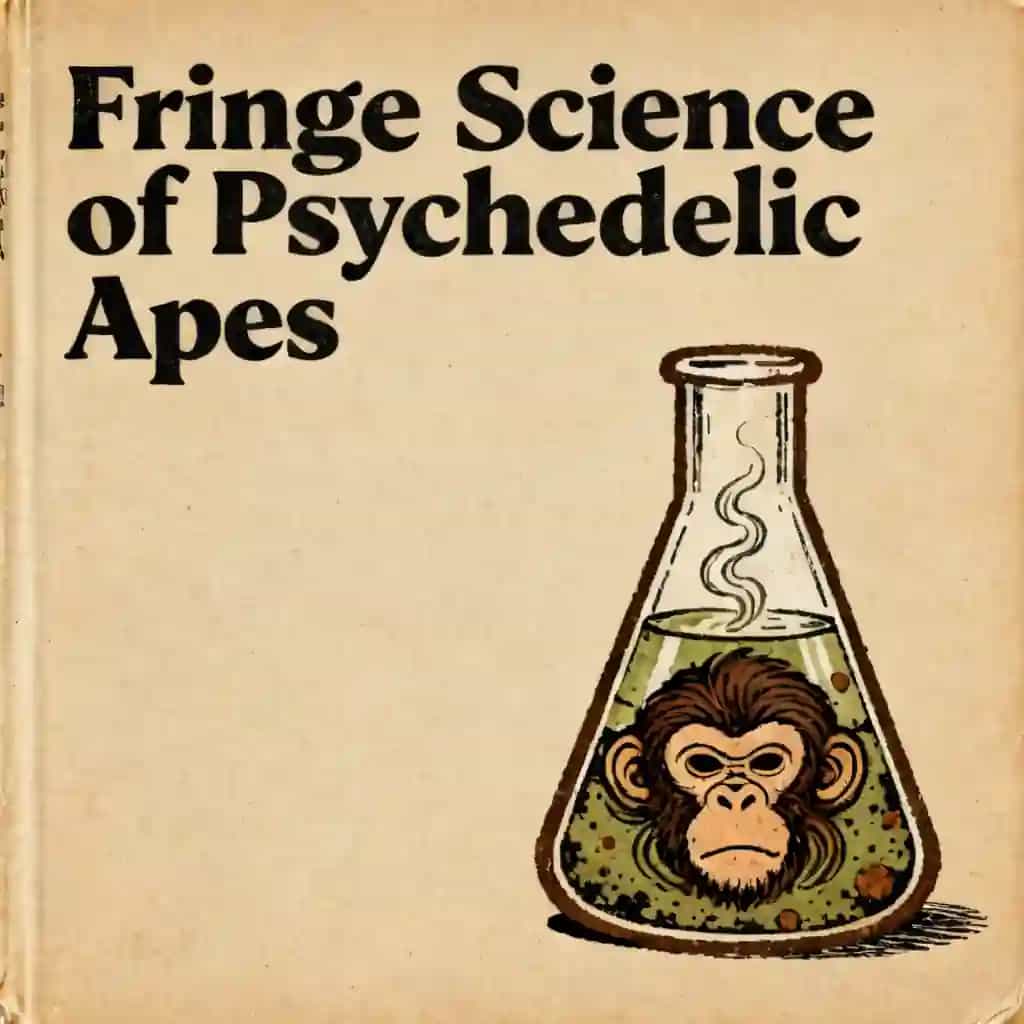
Where does science end and pseudoscience begin? Princeton historian Gordin's fascinating exploration challenges Karl Popper's falsifiability criterion and reveals how fringe ideas shape mainstream thought. Essential reading in an era where climate denial and anti-vaccination movements blur scientific boundaries.
Michael D. Gordin, author of On the Fringe: Where Science Meets Pseudoscience, is a Rosengarten Professor of Modern and Contemporary History at Princeton University. He is a leading authority on the historical interplay between legitimate science and marginalized knowledge systems.
A Harvard-trained historian of science specializing in Russian history and nuclear weapons, Gordin explores how pseudoscience emerges and evolves alongside mainstream scientific paradigms. His acclaimed works include A Well-Ordered Thing (a cultural biography of Dmitrii Mendeleev) and Five Days in August (on the nuclear bombing of Japan), both praised for blending rigorous scholarship with accessible narratives.
A Guggenheim Fellow and member of Germany’s National Academy of Sciences, Gordin has contributed to The Los Angeles Review of Books and appeared on Carnegie Council podcasts. On the Fringe was named a top science book of 2021 by Science News and translated into German, cementing its role in debates about scientific legitimacy.
On the Fringe examines the blurred line between science and pseudoscience, analyzing historical cases like Soviet-era technologies, astrology, and eugenics. Gordin argues that terms like "pseudoscience" lack fixed definitions and are shaped by cultural and political contexts. The book explores how once-respected fields become marginalized and how ideology influences scientific legitimacy.
This book is ideal for readers interested in the history of science, Cold War politics, or the sociology of knowledge. Academics, students, and enthusiasts of science communication will appreciate Gordin’s analysis of how societal forces categorize ideas as "mainstream" or "fringe".
Yes. Gordin’s nuanced exploration challenges assumptions about scientific legitimacy, offering fresh perspectives on historical and modern debates. Its accessible style balances scholarly rigor with engaging case studies, making it valuable for general readers and experts alike.
Gordin discusses vestigial sciences (e.g., astrology), hyperpoliticized projects (Nazi “German science”), and counterestablishment movements (creationism). He also examines Soviet biological weapons programs and the ideological suppression of genetics under Stalin.
The book rejects a universal definition, instead showing how pseudoscience is a fluid label applied to ideas contradicting dominant paradigms. Gordin emphasizes that disciplines like alchemy were once mainstream, while others gain pseudoscientific labels due to political or social pressures.
Vestigial sciences are fields like astrology or phrenology that lost scientific credibility but persist culturally. Gordin highlights how these were once integral to academic study, demonstrating how scientific validity shifts over time.
The book details Soviet achievements in the space race and bioweapons, framed as tools of political ambition. Gordin also analyzes the collapse of USSR scientific institutions and their global impact, emphasizing how state ideology shaped research priorities.
Some reviewers note limited depth on modern pseudoscience (e.g., climate denial) and uneven coverage of topics like ESP. However, these gaps don’t diminish the book’s core analysis of historical cases.
Unlike works focusing on debunking pseudoscience, Gordin’s historical approach reveals how societal power structures define scientific legitimacy. This contrasts with method-centric critiques, offering a unique lens on science’s cultural dimensions.
While focused on historical cases, Gordin’s framework applies to modern issues like anti-vax movements or AI hype. The book underscores how labeling ideas as “pseudoscience” often reflects power dynamics rather than objective truth.
Gordin’s expertise in Soviet history and nuclear science informs his analysis of state-driven research. His prior work on Russian science and Cold War politics enriches the book’s exploration of ideology’s role in shaping scientific discourse.
著者の声を通じて本を感じる
知識を魅力的で例が豊富な洞察に変換
キーアイデアを瞬時にキャプチャして素早く学習
楽しく魅力的な方法で本を楽しむ
Today's pseudoscience might become tomorrow's breakthrough.
Boundaries aren't fixed barriers but dynamic interfaces.
Science is a human endeavor, subject to social forces.
Science's legitimacy is negotiated through social processes.
Peer review reflects existing power structures.
『On the Fringe』の核心的なアイデアを分かりやすいポイントに分解し、革新的なチームがどのように創造、協力、成長するかを理解します。
鮮やかなストーリーテリングを通じて『On the Fringe』を体験し、イノベーションのレッスンを記憶に残り、応用できる瞬間に変えます。
何でも質問し、学習スタイルを選び、自分に本当に響くインサイトを一緒に作れます。

"Instead of endless scrolling, I just hit play on BeFreed. It saves me so much time."
"I never knew where to start with nonfiction—BeFreed’s book lists turned into podcasts gave me a clear path."
"Perfect balance between learning and entertainment. Finished ‘Thinking, Fast and Slow’ on my commute this week."
"Crazy how much I learned while walking the dog. BeFreed = small habits → big gains."
"Reading used to feel like a chore. Now it’s just part of my lifestyle."
"Feels effortless compared to reading. I’ve finished 6 books this month already."
"BeFreed turned my guilty doomscrolling into something that feels productive and inspiring."
"BeFreed turned my commute into learning time. 20-min podcasts are perfect for finishing books I never had time for."
"BeFreed replaced my podcast queue. Imagine Spotify for books — that’s it. 🙌"
"It is great for me to learn something from the book without reading it."
"The themed book list podcasts help me connect ideas across authors—like a guided audio journey."
"Makes me feel smarter every time before going to work"

On the Fringeの要約をPDFまたはEPUBで無料でダウンロード。印刷やオフラインでいつでもお読みいただけます。
The Earth's continents drift across the planet's surface like massive ships on an invisible ocean. Today, this fact appears in every elementary school textbook. Yet in 1912, when Alfred Wegener proposed this idea, geologists dismissed him as a crackpot. His theory remained scientific heresy for half a century before becoming geology's cornerstone. This transformation reveals something unsettling: the boundary between legitimate science and fringe nonsense isn't a fixed wall but a permeable membrane, constantly shifting as knowledge evolves. What we mock today might revolutionize tomorrow-or remain forever exiled to pseudoscience's graveyard. Understanding how these boundaries form and shift offers a compass for navigating our information-saturated world, where distinguishing breakthrough from bunk has never been more crucial or more difficult.
Scientific legitimacy is negotiated through peer review, institutional validation, and cultural acceptance-a spectrum where ideas move from fringe to foundational truth. Wegener's continental drift theory exemplifies this. Without explaining how continents could move through solid ocean floor, geologists dismissed it as lunacy. By the 1960s, seafloor spreading and plate tectonics transformed it into accepted science-requiring a fundamental reconceptualization of Earth's structure. Barry Marshall and Robin Warren's bacterial ulcer theory and Stanley Prusiner's prions faced similar resistance before revolutionizing their fields. These cases reveal that legitimacy operates through both empirical evidence and social processes. Scientific communities initially lack frameworks to accommodate paradigm-shifting insights. Only when supporting evidence accumulates and theoretical mechanisms emerge do ideas cross into mainstream acceptance-often requiring generational change as younger scientists prove more receptive to revolutionary paradigms.
Scientific authority emerges through social processes-institutions, credentials, networks-not just accuracy. Barbara McClintock's "jumping genes" research was dismissed in the 1950s despite rigorous methodology because it contradicted molecular biology's central dogma. She received her Nobel Prize thirty years later. Institutional affiliation profoundly shapes credibility. Harvard or MIT research receives more attention than identical work from regional universities, creating a Matthew effect where recognition flows to established figures. This affects citations, media coverage, funding, and speaking invitations. Publication venues function as gatekeepers. Appearing in *Nature* or *Science* confers immediate credibility, while less prestigious journals leave findings overlooked. Peer review reflects existing power structures, with established researchers determining which questions merit investigation. Impact factors and citation metrics reinforce these hierarchies, pressuring researchers toward "fashionable" topics over unconventional inquiry. Scientific language itself marks boundaries. Mastery of specialized terminology, citation practices, and methodological conventions signals belonging. Researchers from non-English speaking countries or outside traditional academia find themselves marginalized regardless of merit. Understanding these social dimensions doesn't invalidate science's achievements-it explains why consensus sometimes resists novel ideas before eventually incorporating them.
How do ideas move from scientific periphery to center? This journey requires more than evidence-it demands strategic positioning, institutional support, and effective responses to criticism. Institutional champions prove crucial. When established scientists advocate controversial ideas, they lend credibility that overcomes resistance. Luis Alvarez, a Nobel Prize-winning physicist, championed the asteroid impact theory of dinosaur extinction, helping it gain traction despite initial skepticism from paleontologists. Connecting fringe ideas to established research offers another pathway. Successful boundary-crossers frame their work as extensions solving recognized problems, not revolutionary challenges. Quantum mechanics gained acceptance partly by solving specific atomic spectroscopy problems that classical physics couldn't explain. Responding effectively to criticism proves essential. Theories that gain acceptance typically evolve in response to legitimate concerns, improving rigor and explanatory power. Epigenetics moved from margins to mainstream by developing precise molecular mechanisms and meeting skeptics' demands for rigorous evidence. Timing and scientific context matter tremendously. Continental drift's acceptance coincided with ocean floor mapping technologies revealing seafloor spreading-a mechanism making continental movement plausible. Successful boundary-crossing requires translating insights into terms recognizable to established disciplines.
Some theories remain permanently excluded from science due to specific pseudoscientific characteristics that distinguish them from legitimate fringe ideas. Immunity to falsification marks persistent pseudoscience. Legitimate theories specify conditions proving them wrong. Pseudoscientific claims use protective mechanisms impervious to contrary evidence. When contradictory data emerges, proponents add auxiliary hypotheses explaining away inconsistencies rather than reconsidering core premises. Astrology exemplifies this-despite controlled studies finding no correlation between celestial positions and personality traits, astrologers add complications when confronted with negative evidence: perhaps the birth minute was recorded incorrectly, or additional celestial influences weren't accounted for. Disconnection from evolving scientific knowledge represents another characteristic. Legitimate fringe theories engage with mainstream developments, incorporating new findings and responding to methodological standards. Perpetually fringe theories remain frozen, referencing outdated concepts and ignoring advances in related fields. Most tellingly, persistent pseudoscience displays extraordinary claims coupled with ordinary evidence. Revolutionary scientific theories make dramatic claims but provide correspondingly powerful evidence. Pseudoscientific theories promise to overturn fundamental principles based on limited, anecdotal, or methodologically flawed evidence-explaining why some fringe theories gain acceptance while others remain permanently marginalized.
How should we approach the boundary between mainstream and fringe science today? Social media has democratized information while enabling rapid misinformation spread. Navigating this requires balancing openness to unorthodox ideas with justified skepticism. The COVID-19 pandemic illustrates these stakes. Early on, the laboratory leak hypothesis was dismissed as conspiracy theory, yet later warranted serious investigation. This shows how premature dismissal can impede legitimate inquiry. Conversely, unfounded claims-from miracle cures to microchip vaccines-spread rapidly, causing real harm. Several principles guide thoughtful navigation. First, distinguish between heterodox theories from those engaged with relevant scientific fields versus claims from those operating entirely outside established methods. Second, examine whether proponents respond substantively to criticisms or dismiss them as conspiracy evidence. Valuable fringe theories typically evolve through legitimate criticism. Third, consider whether claims make testable predictions or remain immune to falsification-theories specifying no disproof conditions represent pseudoscience. Fourth, assess whether proponents acknowledge tentative claims or present absolute certainties despite limited evidence. Finally, examine whether fringe theories address genuine explanatory gaps or simply reject established knowledge without superior alternatives.
Science generates reliable knowledge through human beings embedded in historical, social, and cultural contexts. Understanding this human dimension reveals how knowledge develops through complex social processes. Continental drift illustrates these dynamics. Wegener faced resistance not just from insufficient evidence but because, as an astronomer and meteorologist, he challenged geologists' professional identities by transgressing disciplinary boundaries. Plate tectonics' acceptance required new evidence plus shifts in disciplinary cultures around emerging geophysics. Scientific controversies involve professional rivalries, institutional politics, and struggles for recognition. When Prusiner proposed that proteins alone could transmit disease, he challenged central dogmas and faced fierce resistance. His vindication revealed how progress depends on distinctly human qualities like persistence despite criticism. Science's social dimensions - peer review, replication, critical evaluation - help communities identify errors and build reliable knowledge. Yet these same elements explain why communities sometimes resist valuable innovations or perpetuate limiting biases. The boundary between legitimate science and fringe speculation shifts with each generation's discoveries. Yesterday's heresy becomes today's textbook truth. Approach bold claims with curiosity tempered by skepticism. Demand evidence but remain open to surprise. Question authority while respecting expertise. The next great scientific revolution might be brewing right now at the margins.