第1章
The Transformative Power of Leading Change
In today's rapidly evolving business landscape, John P. Kotter's "Leading Change" stands as a timeless beacon for organizations navigating the turbulent waters of transformation. First published in 1996 and still dominating bestseller lists decades later, this revolutionary work has become the go-to playbook for executives worldwide. When Satya Nadella took the helm at Microsoft in 2014, he famously distributed copies to his entire leadership team, crediting the book's framework as instrumental in Microsoft's remarkable turnaround. The Harvard Business Review ranks it among the most influential business books ever written, with over 1 million copies sold across 150+ languages. What makes Kotter's work so enduring? Unlike theoretical approaches to change management, Kotter distilled fifteen years of observing actual transformations into a practical, sequential process that addresses both the rational and emotional dimensions of change. As disruption accelerates across industries, the ability to implement meaningful organizational change has become not just advantageous but existential.
第2章
The Change Problem: Why Transformations Fail
The business landscape is littered with the remains of failed change initiatives. Despite good intentions and significant resources, approximately 70% of organizational transformations fall short of their objectives. Why do so many well-planned change efforts collapse? The answer lies in a predictable set of errors that organizations repeatedly make.
The most fundamental mistake is allowing too much complacency to persist. Consider the global pharmaceutical company that, despite declining performance, bad press, and customer complaints, continued business as usual. Management meetings skirted real problems, energy levels remained low, and while people acknowledged issues existed, they deflected personal responsibility. In this quicksand of complacency, change initiatives die quickly.
This complacency persists for multiple reasons: the absence of visible crisis, physical surroundings that signal success (like luxurious offices), low performance standards, narrow functional structures, internal planning systems designed for easy goal achievement, feedback systems that shield employees from external stakeholders, cultures that discourage bearers of bad news, human denial tendencies, and senior management's "happy talk" that creates false security.
The second critical error involves failing to build a sufficiently powerful guiding coalition. Major change requires a committed team with formal authority, expertise, credibility, and leadership capacity. Individual leaders alone, no matter how competent, lack the assets needed to overcome tradition and inertia. One quality improvement director named Claire discovered this when her task force, lacking key line managers, became slow, political, and ultimately ineffective.
Other common errors include underestimating vision's importance (substituting detailed plans for clear direction), undercommunicating by factors of 10-100 (holding just a few meetings about the vision while thousands of communications are needed), permitting obstacles to block progress (like "The Rock," an executive who paid lip service to change while refusing to adapt), failing to create short-term wins (losing momentum when no progress is visible within 6-18 months), declaring victory prematurely (celebrating after the first major improvement), and neglecting to anchor changes in the corporate culture (allowing old traditions to reassert themselves).
These errors aren't inevitable. With awareness and skill, organizations can avoid them by understanding why resistance occurs and implementing the multistage process that overcomes destructive inertia through genuine leadership rather than mere management.
第3章
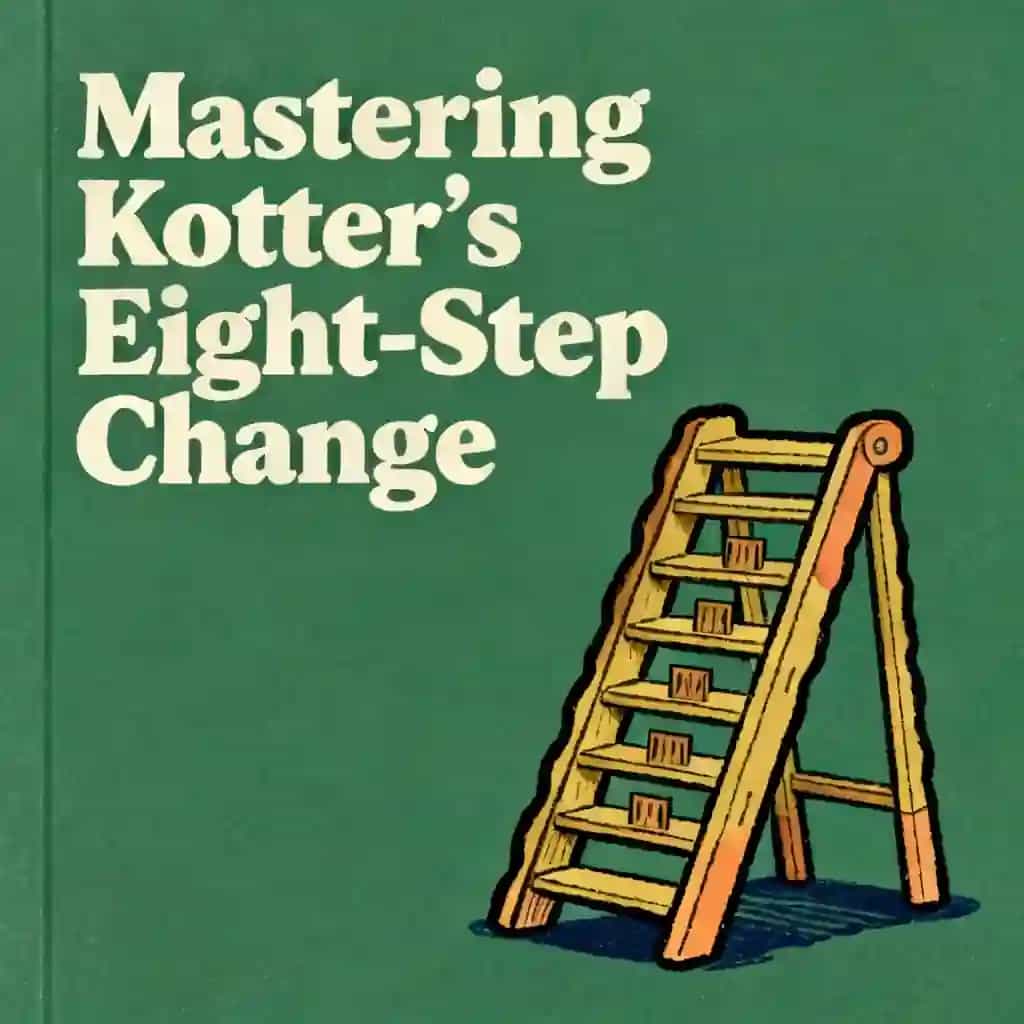
The Eight-Stage Process: A Roadmap for Transformation
Successful organizational change follows a clear sequence that respects both the rational and emotional dimensions of transformation. This eight-stage process provides a comprehensive roadmap that addresses the fundamental reasons why change efforts typically fail.
The journey begins with establishing a genuine sense of urgency. Without this critical foundation, change initiatives inevitably stall as people find countless ways to withhold cooperation from efforts they consider unnecessary. Creating urgency requires bold leadership actions: cleaning up balance sheets to show losses, selling luxurious headquarters, setting seemingly impossible targets, or hiring consultants to force honest discussions. While visible crises effectively catch attention, waiting for fires is dangerous in a fast-moving world. Smart leaders often create "artificial crises" rather than waiting for real ones, accepting unrealistic projections to demonstrate inevitable failures or cleaning up balance sheets to show losses.
The second stage involves creating a powerful guiding coalition with the right composition, trust level, and shared objective. This coalition must combine four essential characteristics: position power (enough key players to prevent blocking), expertise (diverse viewpoints for informed decisions), credibility (respected voices to ensure pronouncements are taken seriously), and leadership (proven change-drivers). The coalition must exclude those with overwhelming egos or "snake-like" qualities that destroy trust, while sometimes incorporating "reluctant players" whose power or respect makes them too important to ignore.
With this foundation in place, the third stage focuses on developing a vision and strategy that clarify direction, motivate people despite personal costs, and coordinate diverse activities efficiently. An effective vision paints a picture of the future that appeals to all stakeholders, stretches resources and capabilities without seeming impossible, provides focused guidance while allowing flexibility, and can be communicated within five minutes. The vision creation process engages both analytical thinking and deep personal values work, making it challenging for executives trained primarily as managers rather than leaders.
These first three stages prepare the organization to begin actual implementation through the remaining five steps: communicating the change vision broadly, empowering employees by removing barriers, generating short-term wins to build momentum, consolidating gains to produce more change, and finally anchoring new approaches in the corporate culture. This comprehensive sequence respects the complex, interdependent nature of organizational systems while addressing both structural and human dimensions of transformation.
第4章
Communication: The Lifeblood of Change
A vision's power remains dormant until most stakeholders share a common understanding of its goals and direction. Yet communication failures occur even when executives believe they've made substantial efforts. In one organization, managers devoted time at meetings, published articles, and produced videos, yet employees barely remembered the vision amid information overload. In another, complex, jargon-filled statements were communicated frequently but remained incomprehensible.
The challenge of effective communication is often underestimated. After spending hundreds of hours developing a vision, executives expect others to grasp it quickly, overlooking the intellectual and emotional processing required. Employees naturally question what the vision means for them personally, whether sacrifices will be required, and if they can trust the message. The sheer scale of communicating to thousands of employees can seem financially prohibitive, leading to inadequate efforts.
Successful vision communication follows clear principles. First, keep it simple - jargon-free, direct messaging reaches large groups more effectively than complicated communication. Technical language and MBA-speak create confusion and alienation, while elegant simplicity facilitates understanding. Second, use metaphors, analogies, and examples that communicate complex ideas quickly. A company describing itself as "less like an elephant and more like a customer-friendly Tyrannosaurus rex" conveys more in sixteen words than pages of explanation about balancing scale with speed.
Third, utilize multiple channels - large meetings, memos, newspapers, posters, and informal conversations. When the same message comes from six different directions, it's more likely to be heard and remembered on both intellectual and emotional levels. Fourth, repeat, repeat, repeat - single announcements rarely penetrate consciousness in our cluttered mental environment. Successful transformations involve tens of thousands of communications as managers integrate vision messaging into daily activities.
Perhaps most importantly, leaders must "walk the talk." Behavior communicates vision more powerfully than words. When top leadership embodies the change vision - like a CEO personally responding to customer complaints within 48 hours - employees grasp the message clearly. Nothing undermines vision communication more than inconsistent behavior from key players. When apparent contradictions exist between the vision and organizational practices, they must be addressed honestly rather than ignored.
Finally, effective vision communication must be two-way, not a one-way broadcast. When feedback channels remain closed, critical errors in the vision may go uncorrected until it's too late. Even well-educated people only truly buy into change after wrestling with it through questions and challenges - the same process the guiding coalition went through initially. Small moments of dialogue - five minutes in meetings, hallway conversations - can accumulate into thousands of valuable hours of engagement that strengthen both the vision itself and commitment to implementation.
第5章
Empowerment: Removing Barriers to Action
Major internal transformation rarely happens unless many people assist, yet employees won't help if they feel powerless. While completing the first four transformation stages already does much to empower people, the purpose of stage five is systematically removing barriers that prevent employees from implementing the change vision. Four obstacles are particularly important: structures, skills, systems, and supervisors.
Organizational structure often disempowers employees trying to implement a new vision. In one Australian financial services firm, despite successfully communicating a customer-focused vision, strong functional silos made delivering new products nearly impossible as they required seamless cooperation across four different departments. Middle managers, especially those with decades invested in the traditional structure, resisted reorganization despite mounting evidence it was necessary. The result: employees became frustrated and gave up trying to implement the vision. When structural barriers aren't removed promptly, employees may sour on the entire transformation effort.
Training deficiencies create another significant barrier. After decades of being conditioned not to accept responsibility, many employees won't simply embrace empowerment - some won't believe it, others will see it as exploitation, and many will doubt their capabilities. New experiences are needed to erase these beliefs. While not all organizations need massive training investments during change, the right educational experiences are essential. Training becomes counterproductive if it feels like "shut up and do it this way" rather than supportive of new responsibilities.
Even with strong vision communication, restructuring, and training, change efforts often stall because organizational systems remain misaligned with the new direction. In one case, a frustrated manager couldn't understand why employees resisted despite extensive communication and reorganization efforts. Investigation revealed that HR systems contradicted the vision: performance evaluations ignored customer focus (central to the vision), compensation rewarded avoiding mistakes rather than creating change, promotion decisions had limited connection to transformation goals, and recruiting systems remained outdated. While early in transformation you can't fix every inconsistency due to time and resource constraints, major systemic barriers must be addressed directly.
Perhaps the most challenging barrier involves supervisors who maintain command-and-control styles. Middle managers like "Frank" systematically disempower employees with phrases like "We've tried that before," "You need more analysis," and "Check with me first." Such managers aren't necessarily bad people - they've developed deeply ingrained habits reinforced by past success. Organizations often avoid confronting these blockers due to guilt (especially if they're friends or mentors), political considerations, or their strong short-term results. However, honest dialogue usually proves most effective: clearly explaining the industry situation, vision, needed assistance, and timeframe, then asking how to help them contribute. Executives frequently regret not addressing these blockers earlier, as their continued presence discourages other employees and prevents building momentum.
第6章
Generating Momentum Through Short-Term Wins
Major organizational transformations require credibility-building short-term wins to sustain momentum. In one cautionary example, a charismatic division president led an exciting three-year change initiative with bold vision, strategic shifts toward becoming a global powerhouse, and extensive communication. Despite launching new products, implementing training programs, reorganizing departments, and making a major acquisition, the transformation collapsed when he was fired in year four. His critical mistake: insufficient attention to short-term results.
Without demonstrable performance improvements, stakeholders grow increasingly skeptical. While zealous believers might stay committed regardless of results, most people need convincing evidence that change efforts are paying off. Skeptics demand even higher standards of proof that changes work without endangering the organization. Running transformation efforts without attention to short-term wins is extremely risky.
Effective short-term wins must be visible, unambiguous, and clearly connected to the change effort. Examples include predicted cost reductions materializing on schedule, cycle time improvements, or positive external recognition. Small companies typically need wins within six months, while larger organizations require them within eighteen months. This means transformation efforts must operate in multiple stages simultaneously, producing results while still establishing urgency and vision.
These wins serve six critical functions: they provide evidence that sacrifices are worthwhile, reward change agents with needed recognition, help refine vision and strategies through concrete feedback, undermine cynics by demonstrating progress, keep senior leaders supportive with evidence of success, and build momentum by converting fence-sitters into active supporters.
Successful transformations don't leave short-term wins to chance. Rather than hoping that "with a little luck" improvements might materialize, effective guiding coalitions deliberately plan and execute for visible results. Organizations fail to produce these wins for three reasons: they're overwhelmed by the change process, they mistakenly believe the short-term must be sacrificed for long-term transformation, or they lack sufficient management capability and commitment on the guiding coalition.
The pressure to produce short-term wins helps maintain urgency when people naturally begin to let up a year or two into a transformation. Without this pressure, minor tasks that once took a month suddenly require three times longer. Effective leaders link this pressure to urgency through constant vision communication, giving meaning to hardships and reminding tired employees why their continued effort matters.
This need for short-term wins highlights a crucial principle: transformation requires both leadership and management. While leadership establishes direction and vision, management's systematic approach to targeting objectives, budgeting, planning, organizing and controlling is essential for delivering concrete results that sustain transformation momentum.
第7章
Sustaining Transformation: The Challenge of Consolidation
Major change initiatives can easily stall before completion. At one company, an annual management meeting turned into an excessive celebration of early wins, with congratulatory speeches, awards, and entertainment signaling "mission accomplished" when much work remained. The implicit message received was that the difficult work was behind them, causing a dozen change initiatives to slow or halt entirely. Celebrating wins prematurely can be lethal when it destroys the sense of urgency required to complete transformation.
Resistance to change never fully disappears - it merely goes underground, waiting for an opportunity to resurface. Self-centered managers, narrowly focused engineers, and skeptical executives don't convert or leave; they wait for chances to reassert themselves. Sometimes resisters even orchestrate celebrations to create complacency. The cardinal rule of transformation is clear: whenever you let up before the job is done, critical momentum is lost and regression follows. Three years of work can unravel with remarkable speed, and rebuilding that momentum becomes exponentially harder.
Modern organizations consist of highly interdependent parts, with connections between departments growing tighter as competitive pressures eliminate buffers like large inventories. These growing interconnections significantly complicate transformation efforts, as changing one element affects many others - like trying to rearrange furniture in a room where everything is connected by ropes and cables. Most of our personal experience with change involves simple, independent systems - like moving a chair to a better position. Few of us have learned how to introduce major change in highly interdependent systems where changing one element requires changing nearly everything.
In such environments, transformation requires building capacity first: assessing urgency levels, creating a guiding coalition, clarifying vision, and addressing obstacles before implementation. While this methodical approach takes longer than simply ordering changes, it's the only effective path in complex, interconnected organizations. The process unfolds through multiple projects, with the first performance improvements typically appearing before the halfway point. In successful transformations, the guiding coalition uses these early wins to accelerate momentum, tackling bigger projects like restructuring, reengineering, and strategic planning overhauls.
As transformation progresses, people begin questioning whether all organizational interdependencies are truly necessary. These inquiries often emerge from frustration with the difficulty of changing highly interconnected systems. When properly channeled, such questioning can be extremely valuable, as many interdependencies exist merely as historical artifacts rather than current necessities. While purging unnecessary connections creates more work initially, it ultimately makes both the current transformation and all future change efforts significantly easier.
Because changing anything significant in highly interdependent systems often means changing nearly everything, business transformation becomes a massive exercise spanning years, not months. At the extreme, this stage can stretch over a decade with hundreds or thousands of people leading dozens of change projects. This is where leadership proves invaluable - outstanding leaders think long-term, staying the course to accomplish psychologically important objectives.
第8章
Anchoring Change in Culture: The Final Challenge
An aerospace division achieved impressive results after years of transformation work - innovative products, 62% revenue growth, and 76% net income increase over five years. When the division GM retired, everyone believed the changes were complete. Yet within two years, new product introduction and market success plummeted. The problem? The changes were never firmly anchored in the division's culture.
Culture exerts powerful influence on behavior for three primary reasons: 1) Individuals are selected and indoctrinated thoroughly, often hiring for cultural compatibility without explicit acknowledgment; 2) Culture operates through hundreds or thousands of people reinforcing the same norms; and 3) Most cultural influence happens without conscious intent, making it difficult to challenge or discuss. Culture consists of norms of behavior (common ways of acting that persist through teaching new members) and shared values (important concerns that shape group behavior over time). These elements operate largely outside awareness - like fish in water - as employees are socialized through promotions, sanctions, and daily reinforcement.
When a company's core culture isn't incompatible with new vision, the challenge becomes grafting new practices onto old roots while eliminating inconsistent elements. One industrial equipment manufacturer with a century-old "customer-first" culture had codified this value into six three-inch procedure manuals. When changing market conditions required more flexible approaches, their CEO ceremoniously acknowledged these manuals' historical importance while explaining why new practices better served their core customer-first value. Through a respectful "eulogy" for the old ways, he connected new practices to enduring values, helping employees emotionally transition from rigid procedures to more responsive customer service approaches.
When new practices fundamentally conflict with existing culture, the challenge becomes far greater. A company founded in 1928 had developed a deeply risk-averse culture shaped by the Great Depression. When market changes required more risk-taking approaches in the late 1980s, management took six critical steps: 1) Continuously demonstrating how performance improvements linked to new practices; 2) Acknowledging the historical value of old culture while explaining its current limitations; 3) Offering attractive early retirement while retaining those embracing new approaches; 4) Ensuring new hires weren't screened using old cultural criteria; 5) Avoiding promoting anyone who didn't genuinely appreciate new practices; and 6) Selecting CEO candidates without Depression-era values.
Despite popular theories suggesting culture change should be the first step in transformation, experience shows the opposite is true. Culture cannot be directly manipulated - it changes only after you've successfully altered people's actions, after new behaviors produce benefits over time, and after people see the connection between actions and improved performance. The difficulty of cultural change explains why transformation requires eight stages rather than just two or three, why it takes so much time, and why it demands leadership from many people.
第9章
Leadership and Lifelong Learning: The Path Forward
The key to creating successful twenty-first-century organizations is leadership - not just at the top with a capital "L," but throughout the enterprise with a lowercase "l." Future employees will need more knowledge about leadership and management than their predecessors, as these skills are essential for building dynamic, adaptive enterprises. This challenges traditional notions of leadership as a divine gift granted to few at birth, a model that ignores the power of lifelong learning.
The story of "Manny" illustrates leadership development through lifelong learning. At forty, he appeared to be a cautious, somewhat political manager with no exceptional qualities. Nine years later, he had developed remarkable depth and sophistication, eventually running a $600 million profit business through major transformation. Similarly, Japanese industrialist Konosuke Matsushita wasn't described as brilliant or charismatic early in life but grew into an entrepreneur in his twenties, a business leader in his thirties and forties, and a major organizational transformer in his fifties.
A twenty-year study of Harvard Business School graduates revealed that competitive drive and lifelong learning gave people an edge in challenging economic environments. These factors created strong "competitive capacity" - competitive drive fueled lifelong learning, which increased skills and knowledge, especially leadership abilities, enabling people to handle increasingly difficult global business conditions. Marcel DePaul exemplifies this pattern - from an unremarkable staff officer at thirty-five to a wealthy company founder described as "visionary" and "charismatic" twelve years later. His success came not from luck but from using difficulties as opportunities for learning and growth, reflecting on experiences, confronting mistakes, maintaining humility, and continuously testing new ideas despite discomfort or risk.
Small differences in learning rates create enormous capability gaps over time. Consider twin sisters at age thirty with identical skills: Fran grows her capabilities by 6% annually while Janice grows at just 1%. By age fifty, Fran will have 321 units of career-related capability compared to Janice's mere 122. This compounding effect creates vastly different outcomes despite starting from the same place. While such differences might matter less in stable times, our volatile twenty-first century makes this growth differential critical.
The habits of successful lifelong learners are surprisingly simple yet powerful. They take risks, pushing beyond comfort zones and trying new ideas. They practice humble self-reflection, honestly examining both successes and failures without defensiveness. They actively solicit opinions from others, believing they can learn from anyone. They listen carefully with genuine openness. These habits bring short-term pain through failure and negative feedback, which is why most people avoid them. The best lifelong learners overcome this natural tendency because they're driven by high standards, ambitious goals, and a genuine sense of mission that helps them endure the discomfort associated with growth.
Traditional career paths are becoming obsolete. Successful twenty-first-century careers will be more dynamic with less linear movement up a single hierarchy. While initially uncomfortable, this volatility offers significant benefits: people who master changing career paths become more comfortable with change generally, develop greater leadership potential, and can better help their organizations transform while minimizing the painful effects of change. Those who learn to cope with change, develop leadership potential, and help transform their organizations will fare better despite the risks - and typically find greater purpose and fulfillment along the way.