第1章
The Astonishing Machine Between Your Ears
Have you ever stopped to consider that the most complex object in the known universe sits right between your ears? This seemingly unimpressive 1.4-kilogram pinkish blob-once thought merely to cool blood-contains a staggering 86 billion neurons forming trillions of connections. It's what allows you to read these words, remember your first kiss, plan your future, and experience the full spectrum of human consciousness. "How Your Brain Works" by New Scientist has become a cornerstone text for understanding our most mysterious organ, praised by neuroscientists and casual readers alike for its accessible approach to complex concepts. Even tech mogul Elon Musk referenced it when discussing his Neuralink project, noting how it shaped his understanding of neural interfaces. The book's cultural impact extends beyond science circles-it's frequently cited in discussions about artificial intelligence, as developers attempt to mimic the brain's remarkable efficiency and adaptability. What makes this exploration particularly valuable is how it transforms neuroscience from an abstract academic pursuit into a practical guide for understanding ourselves.
第2章
The Remarkable Evolution of Our Thinking Machine
Our brains evolved from simple nerve clusters in ancient invertebrates to the most complex structure in the known universe. This remarkable journey began about 2.5 million years ago when our ancestors diverged dramatically from other apes. A fascinating genetic mutation weakened our jaw muscles, allowing skulls to expand without being constrained by powerful biting forces. Simultaneously, tool development enabled meat consumption, providing rich nutrients that fueled further brain growth.
Harvard primatologist Richard Wrangham suggests another critical factor: cooking. By making food more digestible, cooking allowed more efficient nutrient extraction while shrinking our digestive systems, freeing resources for brain development. This created a virtuous cycle-better nutrition supported larger brains, which developed better tools and cooking techniques, which improved nutrition further.
Our increasingly complex social lives likely drove expansion of the frontal neocortex. Robin Dunbar demonstrated strong relationships between primate group size, social interactions, and brain region size. The modern human brain emerged in Africa around 200,000 years ago through this interplay of diet, culture, technology, social relationships, and genes.
Interestingly, our brains may have reached maximum size. Evidence suggests a 3-4% shrinkage over the past 10,000 years-perhaps because bigger brains became disadvantageous for childbirth or too energy-demanding, already consuming 20% of our food intake despite being only 2% of our body weight.
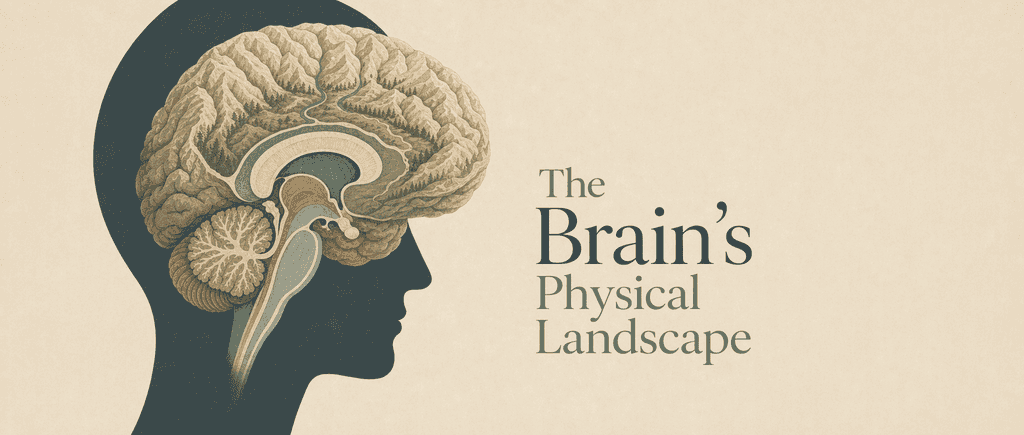
The brain organizes into three primary regions with distinct functions. The hindbrain (evolutionarily oldest) controls automatic functions like breathing and heart rate through structures including the medulla oblongata, pons, and cerebellum. The midbrain coordinates physical actions and contains the substantia nigra, which produces dopamine-essential for movement and functioning as the "reward" neurotransmitter. The forebrain (most recently evolved) enables uniquely human capabilities through structures including the thalamus, hypothalamus, amygdala, hippocampus, and cerebral cortex-the wrinkled outer layer that enables planning, language, and creative intelligence.
This single sheet of tissue, folded to cover 1.6 square meters, contains four lobes with specialized functions: frontal (thinking, planning, personality), occipital and temporal (visual and auditory processing), and parietal (attention and sensory integration). The body is mapped multiple times across the cortex, with disproportionate representation-hands and lips receive more brain tissue than the torso or legs, reflecting their importance for human functioning.
第3章
The Mathematics Behind Your Thoughts
Modern neuroscience is shifting from studying isolated brain regions to understanding how neural networks create experiences greater than the sum of their parts. The brain's nerve fibers follow a "small-world network" structure, where any two regions connect through relatively few steps-similar to the "six degrees of separation" in human societies. Only about 1 in 25 nerve fibers connect distant regions, while the rest join nearby neurons, balancing communication efficiency with biological cost.
These long-range connections form a "rich club" backbone connecting twelve principal brain regions, critical for information integration. Disruption to this network may contribute to conditions like schizophrenia.
The brain maintains a delicate balance between order and chaos-what scientists call a "critical point" or "edge of chaos" state. Neural avalanches-temporary bursts of activity-follow mathematical power laws similar to earthquakes and forest fires, where larger events occur less frequently according to strict ratios. This critical state gives the brain maximum flexibility, speeding up signal transmission and allowing quick coordination when facing changing situations.
Your wandering mind reflects a neural battleground where thoughts compete for dominance, much like predators and prey in nature. Mikhail Rabinovich and Gilles Laurent discovered that neuronal activation fluctuates in waves rather than simply habituating after detecting stimuli. These patterns mirror mathematical equations describing predator-prey interactions. In the brain, cognitive patterns briefly gain supremacy before fading, allowing others to emerge-explaining our constantly shifting thoughts.
The brain excels at prediction, from anticipating words in conversation to judging traffic gaps. Bayesian statistics offers a mathematical framework explaining how the brain calculates probabilities based on prior knowledge while constantly updating with new data. Karl Friston extended this concept with his "free energy principle," describing how the brain minimizes prediction errors. This elegant theory has successfully modeled visual processing, eye movements, and limb control-potentially becoming neuroscience's E=mc2.
These insights raise profound philosophical questions. Neurophilosopher Patricia Churchland addresses the existential implications of reducing human experience to neural activity. She compares this revelation to discovering Earth orbits the Sun-ideas that challenged fundamental worldviews. While many find it unsettling to consider consciousness, decisions, and emotions as merely physical brain functions, Churchland remains unfazed. She argues that understanding the neural basis of love doesn't diminish its significance. Rather than free will creating decisions from nothing, she sees self-control mechanisms as evolutionary adaptations allowing goal maintenance despite distractions.
第4章
The Intricate Tapestry of Memory
Memory forms the foundation of human existence, enabling everything from driving to conversation to reading. Rather than a single system, memory comprises multiple subtypes defined by storage duration-sensory, short-term, and long-term-each serving distinct functions in processing our experiences.
Sensory memory briefly retains information from our perceptual organs before it fades-like the trail of a sparkler in darkness. Visual impressions last mere milliseconds, while sound memories persist several seconds longer. These fleeting impressions provide complete representations from which relevant information transfers to short-term memory.
Short-term memory holds approximately seven items for 15-20 seconds-like remembering a phone number while dialing. This limitation can be overcome through "chunking" larger information into meaningful units. While short-term memory involves passive storage, working memory actively manipulates information-like reciting words backwards or extracting first letters from a sequence.
Long-term memory stores information for years or decades, holding everything from your birth date to your mother's maiden name. Unlike short-term memory's acoustic representations, long-term memories are stored by meaning-you recall the gist rather than exact wording. These memories take various forms: semantic memories (factual knowledge), episodic memories (personal events), explicit memories (consciously recalled information), and implicit memories (experiences influencing behavior without active recollection).
The hippocampi are crucial for forming new memories but less important for storing old ones. When recalling an experience-like smelling a rose-the same cortical regions activate that processed the original experience, a phenomenon called reinstatement. Short-term memories don't involve the hippocampi, but memories lasting beyond 30 seconds strengthen connections between relevant cortical areas and the hippocampi, which combine different aspects of a single memory. This explains how one sensory trigger (like a song) can resurrect an entire experience.
Researchers increasingly suspect memory evolved not primarily for remembering but for imagining future scenarios. This theory began with Endel Tulving's discovery that an amnesiac who couldn't recall past events also couldn't envision future plans. Brain scans suggest we create future scenarios by recombining fragments of autobiographical memories-explaining why imagination and memory share neural processes.
Memory requires three processes: encoding information, retaining it, and accessing it later. Forgetting occurs when any of these fail-through distraction during encoding, interference from other memories during storage, or imperfect retrieval algorithms. We best remember emotionally significant information, especially "flashbulb memories" of unusual or arousing events like 9/11.
Remarkably, some memories never actually happened. When we retrieve memories, we also re-encode them, making them vulnerable to alteration. Elizabeth Loftus's research demonstrates how misleading questioning can distort eyewitness testimony-with profound implications for courtrooms. Such findings raise concerns about "recovered memories" and suggest many cherished personal memories may be significantly different from what actually occurred.
第5章
The Science of Intelligence
Intelligence has historically been difficult to define precisely, yet scientists have persistently worked to understand what it is, how to measure it, and why it varies between individuals. Modern professional IQ tests like Stanford-Binet and Wechsler are administered one-on-one, require minimal reading or writing, and combine scores from various cognitive domains. IQ scores are always relative-calibrated so the average is 100 with 90% of people scoring between 75 and 125.
British psychologist Charles Spearman observed a century ago that performance across different mental tests tends to correlate-those who excel at verbal tests typically do well on mathematical ones too. Using factor analysis, he extracted this common element and named it the "g factor" or general intelligence, representing one's ability to handle cognitive complexity. Higher g is especially valuable for complex tasks in school and work, and correlates with better health outcomes and lower rates of disease.
The debate about whether different types of intelligence exist was largely resolved in 1993 when John B. Carroll published his "three stratum theory"-a hierarchical model with a single g factor at the top, eight broad abilities in the middle (each composed mostly of g plus domain-specific elements), and dozens of narrower specialized abilities at the bottom. This structure explains individual differences in abilities without contradicting g's dominance.
Contrary to expectations, Einstein's brain was slightly smaller than average, suggesting brain quality matters more than size. Research indicates several factors contribute to intelligence: smarter brains have more efficient neural networks, with fewer steps needed to relay messages between regions; higher quality myelin sheaths insulating neuron fibers affects signal speed; and while higher IQ correlates with increased volume in certain brain regions, the efficiency of information flow between processing hubs appears more important than their size.
IQ scores have risen dramatically over the past century-a phenomenon called the "Flynn effect." Danish military testing shows that what was average intelligence in the 1950s would now disqualify someone from service. However, this upward trend appears to be ending in developed nations. The Flynn effect likely resulted from improved nutrition, better education, and more stimulating environments, with the largest gains occurring among disadvantaged populations.
The nature-versus-nurture question has a simple answer: both factors shape intelligence. Behavioral genetics research reveals that IQ similarity correlates most strongly with genetic similarity. Intriguingly, the heritability of intelligence increases with age, from less than 30% before school age to about 80% in Western adults. This suggests most family environments are equally effective at nurturing intelligence, with adult IQ being similar regardless of upbringing (unless conditions were severely deprived).
第6章
The Emotional Brain
Emotions represent perhaps the most mysterious brain outputs-universally recognizable yet raising profound questions about human nature. Charles Darwin's fascination with facial expressions led him to conclude emotions were universal across cultures-a view later supported by Paul Ekman's influential 1960s research showing people worldwide recognized six basic emotions (happiness, fear, anger, surprise, disgust/contempt, and sadness).
This orthodoxy suggested emotional expressions are evolutionary hardwired, with studies of congenitally blind people showing they make identical expressions despite never seeing them. Some expressions may have evolved from physiological functions-fear expressions widen vision and open airways, disgust expressions restrict contaminant entry-while others evolved primarily as social signals.
However, recent research challenges universality: when participants aren't provided emotion labels, recognition accuracy drops dramatically. Context heavily influences perception, and cross-cultural studies reveal significant differences in how emotions are categorized, suggesting emotional expressions may have biological origins but have been extensively reshaped by cultural evolution over 80,000 years of human social development.
The relationship between language and emotions is complex and contested. Different cultures categorize emotions distinctly-Germans distinguish between two types of disgust (ekel and abscheu), while the Pintupi of Western Australia have fifteen words for fear. Some cultures have unique emotional concepts like Japanese amae (feeling unconditionally loved) or Dutch gezelligheid (comfort of being in homely surroundings with friends).
Brain imaging reveals strong connections between emotional and language centers, suggesting words may not just describe but actually construct our emotional experiences. Studies of semantic dementia patients show that losing emotion words impairs emotion recognition-they sort faces into simple pleasant/unpleasant categories rather than specific emotions. Learning emotion words may help organize vague sensations into recognizable feelings, while unnamed emotions may remain unconscious or unformed.
Crying combines two distinct processes-vocal wailing and tearing-that serve different evolutionary purposes. Babies excel at vocal crying to attract caregiver attention but don't shed tears for weeks until their tear ducts develop. As children become mobile, crying shifts from vocal to tearful, possibly as an evolutionary adaptation to signal distress more covertly without attracting predators. Our crying patterns change throughout life: adolescents begin crying less over physical pain and more over emotional pain, while many develop "moral crying" in response to acts of bravery or altruism.
第7章
How We Perceive Our World
Our brain constantly processes an overwhelming bombardment of sensory information, organizing it into meaningful perceptions without conscious effort. This remarkable feat transforms raw stimuli into a coherent understanding of objects and events in our environment.
Despite having five traditional senses, the brain's organization suggests six distinct processing areas: visual, auditory, somatosensory, olfactory, gustatory and vestibular. These senses often blend together-vision aids balance, flavor combines taste with smell and texture. The brain faces an overwhelming challenge: processing input from over 200 million sensory receptors with limited energy and storage. It manages this by unconsciously discarding most information and making educated guesses based on prior experience.
The brain integrates sensory information through multiple pathways: reflex circuits in the brain stem, direct connections between cortical sensory regions, and specialized areas that merge different sensory inputs. This integration faces significant constraints-the brain consumes 20% of the body's energy but can only keep 3% of neurons highly active at once (about 500 million cells). To manage this limitation, the brain selectively discards information it deems unimportant, like the constant sensation of clothing against skin or peripheral visual information.
Our experience of "now" isn't instantaneous but lasts between 2-3 seconds-a psychological present within which the brain fuses experiences. This window represents the optimal duration for understanding events without overtaxing memory. The brain constructs this experience through a hierarchy of "nows," beginning with subconscious "functional moments" that vary by sense (auditory system can distinguish sounds 2 milliseconds apart, while visual system needs tens of milliseconds).
During critical moments, the brain can ratchet up processing rates, making events seem to unfold in slow motion, then ease back during calm periods to conserve cognitive resources. Studies show meditators can manipulate their perception of now-they can hold perspectives longer (eight seconds versus six for non-meditators) and perceive time passing more slowly, potentially expanding both their present experience and retrospective sense of life's duration.
Neuroscientist David Eagleman views the brain as "locked in a vault of silence and darkness" yet capable of creating rich experiences by extracting patterns from our environment. He's developed wearable technology that can feed new sensory information to the brain through vibration patterns, allowing deaf participants to understand speech through their skin and potentially creating entirely new forms of perception.
第8章
The Mystery of Consciousness
Consciousness represents "the hard problem" - perhaps the most profound mystery in neuroscience: how does a kilogram of nerve cells create the seamless kaleidoscope of sensations, thoughts, memories and emotions that fill our waking moments? Scientists have made significant progress in identifying key neural correlates of consciousness by studying what changes when consciousness is reduced or absent. Brain scans of people in vegetative states typically show damage to the thalamus (a central relay center) and its connections to the prefrontal cortex. Similar patterns emerge in deep sleep, general anesthesia, and certain types of seizures, suggesting these structures are essential for conscious experience.
The brain regions implicated in consciousness-the thalamus, lateral prefrontal cortex and posterior parietal cortex-share a distinctive feature: they have denser connections to each other and to the rest of the brain than any other regions. This rich connectivity allows them to receive, combine and analyze information from throughout the brain, creating unified conscious experiences rather than disjointed sensations. For example, when you see a red apple, multiple brain regions process its color, shape, size, and memories associated with apples simultaneously, yet you experience one coherent perception.
The leading hypothesis for how these regions integrate information involves neurons firing in synchrony many times per second, visible as brainwaves on an EEG. The signature of consciousness appears to be ultrafast gamma brainwaves (40-100 Hz) originating in the thalamus and spreading across the cortex. These synchronized oscillations may serve as the brain's clock, coordinating information processing across distant regions to create unified conscious experiences.
The "global neuronal workspace" model, developed by Bernard Baars and later refined by Stanislas Dehaene, suggests sensory input is first processed unconsciously in sensory regions before emerging into consciousness when it ignites activity in prefrontal and parietal cortices. This model explains phenomena like subliminal perception and blindsight, where people can respond to stimuli they don't consciously see. A rival theory, "information integration theory," proposed by Giulio Tononi, suggests consciousness emerges when information is combined to become more than the sum of its parts.
Information integration theory can be understood by comparing the brain to a digital camera. While a camera treats an image as independent pixels with no relationships (low "phi"), the brain constantly draws connections between all sensory information (high "phi"). This explains why the cerebral cortex, with fewer but more interconnected neurons than the cerebellum, is crucial for consciousness. The theory predicts that consciousness is not binary but exists on a spectrum depending on the degree of information integration.
While Freud's specific view of the unconscious has largely been discarded, substantial evidence shows our brains process much information outside conscious awareness. Groundbreaking experiments by Benjamin Libet and others reveal neuronal activity precedes conscious decisions by up to ten seconds, though this doesn't necessarily disprove free will. Using "masking" techniques, where stimuli are presented too briefly for conscious perception, researchers have shown unconscious processing influences conscious thoughts and behaviors. The unconscious may even help with decision-making; studies by Ap Dijksterhuis suggest that distracting the conscious mind while making complex choices can lead to better outcomes, as the unconscious continues processing information in the background, weighing multiple factors simultaneously.
第9章
Enhancing Your Brain's Performance
The human brain comes with both useful design features and numerous glitches and weaknesses, but unfortunately no user manual. Neuroscience offers guidance on optimizing brain function through understanding its mechanisms and limitations.
The brain employs two attention systems: a "bottom-up" system that automatically alerts us to potentially important new information, operating unconsciously and constantly while awake; and a "top-down" system of deliberate, focused attention that helps with concentration but can be easily depleted or interrupted. Contrary to conventional wisdom about minimizing distractions, cognitive neuroscientist Nilli Lavie's research suggests that increasing sensory input-not reducing it-may improve attention control. Her "load theory" demonstrates that when the brain reaches its processing capacity, it simply cannot take in additional information, including distractions.
Working memory serves as the brain's critical front-line function for all learning and remembering. Its capacity predicts academic success better than IQ, and research suggests it can be upgraded. While brain training programs specifically targeting working memory show improvements, cognitive neuroscientist Jason Chein notes that while these effects may transfer to other cognitive skills, the gains are modest-though even small improvements can meaningfully impact everyday cognition.
Learning physically rewires the brain by creating and strengthening synaptic connections between neurons-a process that can occur within hours. Effective learning requires focused attention, working memory engagement, and active recall. Alan Baddeley recommends self-testing and consciously linking new information to existing knowledge to strengthen neural connections.
Creative insights often arrive unexpectedly, like J.K. Rowling's idea for Harry Potter during a delayed train journey. Neuroscientist John Kounios found that naturally creative people show higher right temporal lobe activity when at rest. While creativity may have genetic components, anyone can enhance their creative potential through specific strategies: first, build a solid knowledge foundation through focused learning; then cultivate a relaxed, positive mood; and look for ideas when mentally tired-morning people have their best creative moments at night, while night owls find inspiration early morning.
Brain performance fluctuates with circadian rhythms, creating optimal windows for different cognitive tasks. Avoid demanding focused work in the first hours after waking, as sleep inertia can last 30 minutes to 4 hours (though caffeine helps). Mental performance correlates with body temperature-when it dips below 37C, cognitive abilities decline. Peak cognitive performance occurs mid-morning to noon and again from 4-10pm.
Boosting mental faculties doesn't require intense study. Simple approaches include eating a proper breakfast high in slow-release carbs and B vitamins, consuming brain-friendly foods like eggs, yogurt, oily fish, and blueberries. Getting seven hours of sleep appears optimal for brain function, while even moderate exercise like walking 30 minutes three times weekly can improve learning and concentration by 15%. The brain-body connection works both ways-mental exercise can increase physical strength, as shown by a Cleveland Clinic study where merely thinking about bicep exercises increased arm strength by 13%.