第1章
The Path to Happiness Is Already Within You
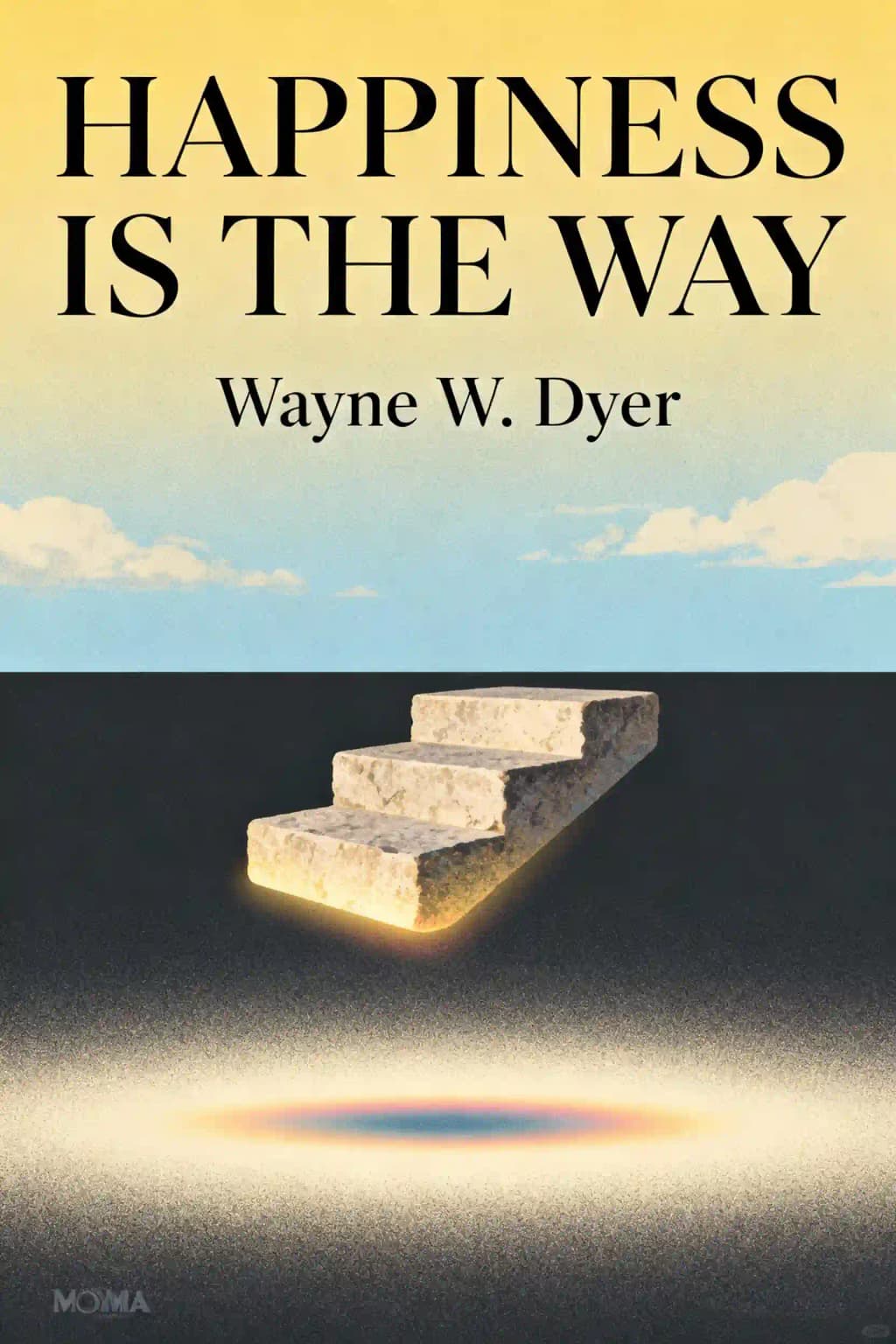
Wayne Dyer's "Happiness Is the Way" has transformed millions of lives with its radical yet simple premise: happiness isn't something we find externally but a state of being we cultivate from within. The book, compiled from Dyer's most impactful lectures and teachings, represents the culmination of wisdom from a man Oprah Winfrey called "one of the most influential spiritual teachers of our time." Since its publication, the book has sold over a million copies worldwide and continues to resonate with readers seeking authentic fulfillment. Celebrities from Ellen DeGeneres to Deepak Chopra have praised Dyer's accessible approach to spiritual growth. What makes this work particularly powerful is how it bridges Eastern philosophical concepts with practical Western applications, offering a roadmap for anyone ready to take responsibility for their own happiness.
第2章
Attitude: The Foundation of Everything
Happiness isn't something we find externally but something we are internally-a decision we make. Throughout my life studying human behavior, I've discovered that people mistakenly blame others for their feelings: "You hurt my feelings" or "The news depresses me." But happiness comes from taking responsibility for our perceptions and experiences. Like squeezing an orange always produces orange juice because that's what's inside, when life "squeezes" us, what comes out is what we already contain. No one can make you feel anything without your consent.
People generally fall into three categories: those living with pain and stress, those getting by but not reaching their potential, and "no-limit persons" who recognize their boundless capacity for living their best life. The no-limit person has no boundaries on their capacity for living and focuses on making life the best it can be. Unlike some who believe only a chosen few can reach enlightenment, anyone can achieve these heights of humanity.
The difference between self-defeating people and no-limit people isn't whether they face problems-we all do-but their attitude toward problems. Self-defeating people resist reality with "it shouldn't be raining" thinking, while no-limit people accept what is and find creative responses to any situation.
You get treated the way you teach people to treat you. If you don't like how someone treats you, examine how you've taught them to interact with you. Self-defeating people see reality but reject it, wishing things were different and blaming others. By learning to handle life's challenges without becoming a victim, you prepare yourself for any crisis. No blame is allowed for anything in your life.
The secret to getting almost anything in life-success, abundance, love-is counterintuitive: stop demanding it. Those desperately seeking love rarely find it. You meet people by being yourself, and love comes to you naturally. The same applies to money. All the wealth I've acquired came accidentally, not as a primary goal. I never wrote books thinking about sales-I wrote to please myself.
According to Abraham Maslow, the highest-level individuals have peak experiences as their purpose in life-being totally, completely involved in a moment to the point of transcendence. No-limit people can make any moment a peak experience. They speak the language of acceptance, appreciation, and love.
第3章
The Power of Choice in Creating Your Reality
Our attitudes and behaviors are choices, not predetermined traits. Many people blame their circumstances, genetics, birth order, or upbringing for their shortcomings, but ultimately, we are the sum total of our choices. Confidence doesn't precede action-it comes from it. When no-limit people fall, they get up and keep moving, while self-defeating people become immobilized by setbacks. The essence of self-confidence is doing.
Additionally, don't equate your self-worth with your achievements. You are not what you do-you're a human being, not a human doing. Your value comes from deciding you're worthwhile, not from external success.
Through simple logic, we can understand our power over emotions. Major premise: I can control my thoughts. Minor premise: My feelings come from my thoughts. Therefore, I can control my feelings. Emotions like guilt, worry, and fear are reactions to thoughts that we can change. Awakened people aren't emotionless, but they choose healthy reactions to circumstances.
Anger itself isn't problematic if it mobilizes positive action. I get angry about starvation, children dying from malnutrition, crime, and gun violence-but this anger motivates me to speak out, write, and work with young people. Anger becomes destructive when it immobilizes us, preventing us from functioning effectively.
Most people are externally motivated, allowing outside forces to determine their direction and blaming others for their problems. When down, they seek external solutions-alcohol, drugs, shopping, approval-rather than looking inward. Our media-saturated culture reinforces this externality, with children spending far more time with screens than in direct communication with parents.
The key is shifting from focusing on what we're against to what we're for-like working for peace rather than against terrorism. By reframing our thinking with positive, present-focused affirmations, we can move beyond negativity and see ourselves growing rather than fixing flaws.
I believe deeply in our power to choose and direct our own destiny. Growth-minded people look beyond nationalism to address human problems holistically, motivated by higher needs like truth, love, belonging, and dignity. These internally motivated individuals are innovators who don't blindly follow tradition but create new approaches.
第4章
Expectations Shape Your Reality
Our expectations shape our reality. When people tell me I'll be exhausted after speaking for hours, I reject this thinking. Many organize their expectations for negative outcomes-like those who lie awake calculating how little sleep they'll get, ensuring they'll feel terrible the next day. Your expectations determine your physical health too. Rather than embracing approaching illness ("Here comes that cold"), we can choose a different response: treating it as a mistake, taking extra care without dwelling on it.
I see myself as a young boy regardless of my physical age. We are not our bodies but our conscious awareness-souls with bodies, not bodies with souls. Every cell in my body has changed over time, yet I remember my experiences from decades ago. While our physical forms age, we don't have to "get older" mentally.
I choose to treat my body healthfully-eating less, avoiding sugar and salt, walking and running daily-not from fear of aging but from a higher state of self-acceptance. By maintaining positive thoughts, our bodies can remain remarkably capable. Even the wearing out of our bodies is largely an attitude; if we didn't prepare ourselves for decline, perhaps our bodies wouldn't have to deteriorate.
Medicine typically operates between points A (illness) and B (normal), focusing on eliminating symptoms. But what if we practiced between points B and C (maximum health potential)? How healthy could you possibly be? Could you run 50 miles without fatigue or climb 20 flights without breathing hard?
We should raise children thinking this way-modeling active lifestyles, not rewarding illness with special attention. When my children mention feeling sick, I respond with "You're too strong for that" rather than coddling them. I reinforce wellness instead of illness, rejecting outdated notions like "cold germs in the air" that I heard as a child.
Once you take responsibility for your life, you can succeed in almost any situation. People might call you "lucky" or say you have "perfect timing," but it's really about attitude-expecting things to go well. Everything boils down to your attitude and beliefs about a situation.
第5章
Discovering Your True Identity
While on a boat in Florida, I noticed the wake trailing behind us. I realized this wake, which quickly disappeared, was like our personal histories-everything we've experienced, believed, and been taught. Just as the wake doesn't drive the boat, your past doesn't drive your life. What drives your life is the present-moment energy you're generating. Hanging onto the idea that you must be as you've always been because of past experiences is as fruitless as believing the wake drives the boat.
You are not your name-it's just a label given to separate you from others. You are not your body-you're the owner or observer of your body. You are not your mind-you're the thinker of thoughts, the observer. You are not your occupation-role identification restricts you from your true higher self. You are not your relationships-you observe relationships but aren't defined by them. You are not your country, race, religion or other labels-you are something eternal, a Divine extension of God.
Every problem you experience exists in your mind, which means the solution must also be found there. The ancestor to every action is a thought, and what you think about expands. If your mind focuses on negativity, that's what grows in your life. You become what you think about all day long.
Two essential rules govern this: what you think about expands, and what you think about is already here. In the world of thought, everything conceivable can be created in form. That's why it's crucial not to clog your mind with negativity and instead focus on what you want to manifest.
To manifest your thoughts, you must be willing to do what it takes-not necessarily struggling or fighting, but being truly willing. I spent years in orphanages and foster homes as a child, choosing to make those experiences pleasant for myself and others. When my book "Your Erroneous Zones" was rejected by publishers with no marketing budget, I spent two years traveling across America, appearing on any local show that would have me, selling books myself.
Our culture often criticizes idealists, telling us to be "realistic" about our limitations. But as William Blake wrote, "If the doors of perception were cleansed everything would appear to man as it is, infinite." At the quantum level, everything is energy, and what you observe is what you create.
第6章
Following Your Inner Guidance System
Success, like happiness, is an inner concept-something that you are, not something you get. When you have success inside, you bring it to everything you do, rather than obtaining it from external achievements. True success comes from living your life as you choose, making every day miraculous, and following your own guidance rather than looking to others.
Other people's opinions have very little value by themselves-they're just judgments, not necessarily truth or your truth. What matters is what we do with those opinions. They can't hurt you or make you less than you are. Similarly, reputation is a meaningless concept, as it exists solely in others' minds. You have as many reputations as people who know you, and you have no control over what anyone decides to do with what you say or how they perceive you. What matters is your character, which is internal and always in your control.
Every negative experience contains hidden opportunities for empowerment. The seeds for solutions exist within problems themselves-the cure is always in the illness. Be grateful to those who upset you most, as they force you to examine yourself. It's what you don't face that controls you.
Setting boundaries is essential-if you can't say no within relationships, you'll eventually have to say no to the relationships themselves. Say no with love, dignity and respect, while remaining firm in your commitment to yourself. Self-love is fundamental-you can't give away what you don't have, and loving yourself has nothing to do with conceit.
The universal force of love is available to everyone regardless of circumstances. While traditional power structures flow top-down, networking operates horizontally through love-everyone gives power away rather than collecting it. In networking, you freely share ideas and help others without expectation, creating a win-win situation where benefits naturally return tenfold.
Your value doesn't come from accomplishments or winning-it comes from what you believe about yourself. When you measure worth by external achievements, you surrender control to others. You possess the ability to think anything you choose, and no one can take that away.
第7章
Embracing the Positive Mindset
The power of a positive mindset is illustrated by a friend diagnosed with cancer who was given 15 seconds by his doctor to decide his mental approach-whether to become a victim or fight the disease. By immediately choosing to defeat the cancer, he succeeded, demonstrating the tremendous capacity we all have within us to overcome challenges through our mindset.
Our brains have incredible potential-if reproduced as a computer, it would require land the size of Texas-yet most of us use only a fraction of this capacity. The highest-level individuals are "yaysayers" who embrace life enthusiastically rather than getting bogged down in negativity.
Self-defeating naysayers fear the unknown, avoid risks, and cling to the familiar. They're loaded with prejudices and reject new experiences out of fear. By contrast, no-limit yaysayers welcome the unknown and even seek it out. They don't require detailed plans, remain open-minded, and aren't intimidated by new challenges. While most people fall somewhere in the middle, the truly enlightened person will try new things even at age 90. Progress cannot happen if you always do things the same way-growth requires embracing the unfamiliar.
No-limit people operate from internal motivation rather than external validation. They don't dress to impress others or worry about fitting in-they make choices based on what makes sense for them. When internally motivated people arrive somewhere and find themselves dressed differently than others, they barely notice because they're not focused on appearances or comparisons.
Success comes from within-it's not something you find, but something that finds you when you're operating from the right mindset. If you believe things will work out, you'll see opportunities; if not, you'll only see obstacles.
第8章
Learning from Life's Greatest Teachers
Children exemplify the no-limit mindset by eagerly embracing opportunities without overthinking. Unlike their hesitant parents who focus on the cold temperature at the beach, children dive right in, enjoying themselves without reservation. This contrast illustrates how children instinctively know the power of a good attitude and positive expectations.
I emphasize taking responsibility for your life rather than blaming parents for childhood limitations. Even in difficult circumstances, some children figure out how to thrive. Having spent my childhood in foster homes and orphanages without knowing my father, I still created a fantastic life. It's never too late to have a happy childhood-if you missed experiences, you can have them now.
The best way to parent is by modeling enlightened behavior. Your children will learn from how you live, not what you say. When children misbehave, don't make their problems yours by becoming upset. You can provide guidance and set boundaries without sacrificing your own happiness. Don't reward disrespectful behavior by continuing to serve children who treat you poorly.
Failure should be viewed as motivation, not judgment. Like Thomas Edison who discovered 10,000 ways not to make a lightbulb, successful people are willing to fall down repeatedly and learn from each attempt. Failure is only negative when equated with self-worth. True self-worth comes from within-I enjoy audience approval but don't need it for validation.
Every second spent upset because of someone else's behavior is a moment you've surrendered control of your life. Instead, fill yourself with love and send it out into the world, understanding that some will accept it while others won't. The universe operates like a bank that pays the highest interest-send out $1,000 worth of love, and you'll receive back $1,300.
This makes integrity imperative-your words must consistently match your beliefs. Living authentically means embodying what you teach; you can't cheat on taxes while punishing children for dishonesty or smoke while warning about addiction. True enlightenment requires being exactly what you claim to be, with no distortion between what's in your heart and what comes out of your mouth.
第9章
Leading with Purpose and Love
Though my humanistic philosophy might seem incompatible with business, corporations understand that people are their most valuable asset. Companies increasingly offer not just exercise facilities but spaces for meditation and yoga, recognizing that workers with peaceful minds are more productive than those burdened by personal problems.
Leaders differ from followers in two crucial ways. First, leaders always see the big picture and their connection to the whole organization, while followers focus narrowly on their specific tasks. Second, leaders anticipate the long-range effects of actions-understanding how one employee's rudeness might cause a customer to avoid the company for years. True leadership extends beyond organizations to seeing how our behavior ripples throughout humanity.
Leaders trust their inner signals rather than just "playing the game." Self-defeating people live in a world of "would, could, should, might, maybe, and must," but no-limit individuals understand that you've done everything in life exactly as you were supposed to-the evidence being that you did it. You can never "should have" done anything differently in the past.
There's a management saying: "Don't send your ducks to eagle school." Problem-oriented "ducks" are everywhere, thinking in limited ways and resistant to change. I've encountered this mentality throughout my life-from the rigid concierge who refused breakfast after 9:30 despite my paying extra for service, to the airline employee who wouldn't put me on a nearby airport's flight because "the computer says they're different cities." Ducks hide behind rules, saying "there's nothing else I can do," while eagles find solutions.
Most parents want their children to be happy, fulfilled, and have purpose, yet our education system rarely teaches these essential life skills. Where are the courses on avoiding guilt, managing anxiety, eliminating approval-seeking, or living in the present? While schools claim to encourage self-development, they often shut down students who question authority or follow their intuition.
Henry David Thoreau wrote: "If one advances confidently in the direction of his dreams, and endeavors to live the life which he has imagined, he will meet with a success unexpected in common hours." This means when you work confidently toward what truly matters to you-not just following society's rules-success follows in unexpected ways.
第10章
Creating a Life of Meaning and Fulfillment
In Western culture, we define ourselves by artificial criteria: how much money we make, what possessions we have, what accolades we collect. We worship performance and achievement-contests, positions, awards, professional advancement. After living this way and achieving external rewards, many discover an emptiness to it all. When success is measured by what you get rather than how you serve others, it becomes obsession-winning once is never enough.
Instead of constantly looking outside for artificial definitions of success, what if we lived our lives as works of art? True masterpieces of humanity aren't measured by possessions or bank accounts, but by spiritual impact-like Jesus, Mohammed, Buddha, or Gandhi, who transformed nations through nonviolence and love.
You can't live purposefully in the future or past-only now, in this moment. We in the West struggle with the concept of "now," filling ourselves with worries about responsibilities and following rules. While being responsible is fine, it won't fill you with passion. Living in the now means allowing yourself to enjoy each moment rather than postponing gratification.
External motivations like money and awards can never truly give purpose-only internal motivations can: how you feel about yourself, how you're growing and experiencing the world. When focused internally, your life's mission finds you. Like happiness and success, purpose is something you are, not something you chase.
Learn to act as if what you want is already here. Fulfillment, like happiness, is an inner concept-not something you'll magically find once you achieve external goals. As Emerson said, "To finish the moment, to find the journey's end in every step of the road... is wisdom." Every step toward your goal deserves savoring.
I believe we all arrive with a mission and lessons to learn on our path to enlightenment. Some people gain thirty years of experience, while others repeat one year of experience thirty times. Some grow continuously while others remain stuck in patterns-the difference between yaysayers and naysayers. We often lock ourselves into decisions made by our younger selves. But if you're not happy or fulfilled in this moment, you always have the power to change.
第11章
Following Your Bliss: The Path to Authentic Living
If you're dissatisfied with your job, first change your attitude. No-limit people can make any situation work for them-just look at concentration camp survivors who found meaning in a blade of grass or ray of sunlight. If attitude adjustment isn't enough, take a risk and change your circumstances. Most disasters you envision exist only in your head.
I'm a classic example. I left a secure university position to write and speak, despite everyone telling me "the world needs least of all another self-help book." I wrote Your Erroneous Zones anyway, started on tiny radio stations, bought my own books when the publisher wouldn't reprint them, and personally delivered them to bookstores. After countless interviews and cross-country drives, The Tonight Show finally called. People called it luck, but they never saw the immense work behind this "overnight success." The irony? In my first year following my passion, I made more money than in the previous 35 years combined.
You must love what you do and do what you love. Your options are to take the risk and follow your bliss, or change your attitude about your current situation. You'll discover you can live with less as long as you have joy inside. Success cannot happen if you continue doing what you've always done just because you've always done it.
Stay a beginner as you move along your path. When you become an expert, you get clogged with what you know and the negativity that accompanies it-rejection and judgment-because you must deny other viewpoints to maintain yours. This blocks new experiences from finding you. Be wary of becoming an expert, as it limits you and prevents your purpose from finding you.
Is it practical to follow your bliss in a world demanding mortgage payments and bills? If you think abundance, abundance will rain into your life. Consider how addicted you are to your current lifestyle and expenses. Thoreau advised, "Simplicity, simplicity, simplicity!" You can return to simplicity by reducing external pressures or believing you can maintain your income level while pursuing your bliss.
Every problem you face exists only in your mind. If the problem is in your mind, then the solution must be there too-not outside yourself. Like looking for a key under a lamppost when you dropped it inside your house, seeking external solutions to internal problems is futile.
第12章
Cultivating Your Own Garden of Happiness
Wayne Dyer embraces his nonconformist identity, quoting E.E. Cummings: "To be nobody-but-yourself-in a world which is doing its best to make you everybody else-means to fight the hardest battle which any human being can fight; and never stop fighting." True freedom comes not from external validation but from being authentically yourself. Happiness is an inner concept that can't be found through external searching.
Awakened people look for solutions rather than problems. When confronted with a rude flight attendant, Dyer responded with empathy rather than anger, immediately defusing the situation by recognizing her behavior wasn't about him. People who refuse to be dragged into negativity make conflict nearly impossible. These enlightened individuals live in the present moment, free from worry and guilt, following their inner truth regardless of criticism.
As Voltaire concluded in "Candide," we must "cultivate our own garden"-focus on making your own life work rather than judging others'. Accept that "everything in the universe is exactly as it should be," then improve what you can without judgment.
In 1974, Dyer embarked on a personal quest that haunted him since childhood-searching for the father who abandoned him and his brothers. Standing at his father's grave, Dyer spent hours forgiving him for everything-the mistreatment of his mother and brothers. This act of forgiveness transformed his life completely, bringing clarity and focus. He immediately outlined "Your Erroneous Zones" afterward and never dreamed about his father again.
Forgiveness is the greatest motivator in the world. Whatever animosity or bitterness you harbor toward anyone becomes a poison worse than cancer that will never release you until you let it go. Love is both forgiving and "for giving"-a gift that asks nothing in return. To practice this, think about everyone with whom you have conflict and send them love.
The true test isn't loving those who are nice to you-it's loving those who've wronged you, being Christlike rather than merely Christian. When you send love outward, it returns in greater amounts, freeing you from the prison of resentment. We're often like prisoners holding onto bars while surrounded by open space-all we need to do is let go and walk free.