Kierkegaard's philosophical masterpiece presents life's ultimate dilemma: live aesthetically for pleasure or ethically with purpose? This 1843 work birthed existentialism, influencing Sartre and Camus. What choice will you make when confronted with existence's most haunting question?
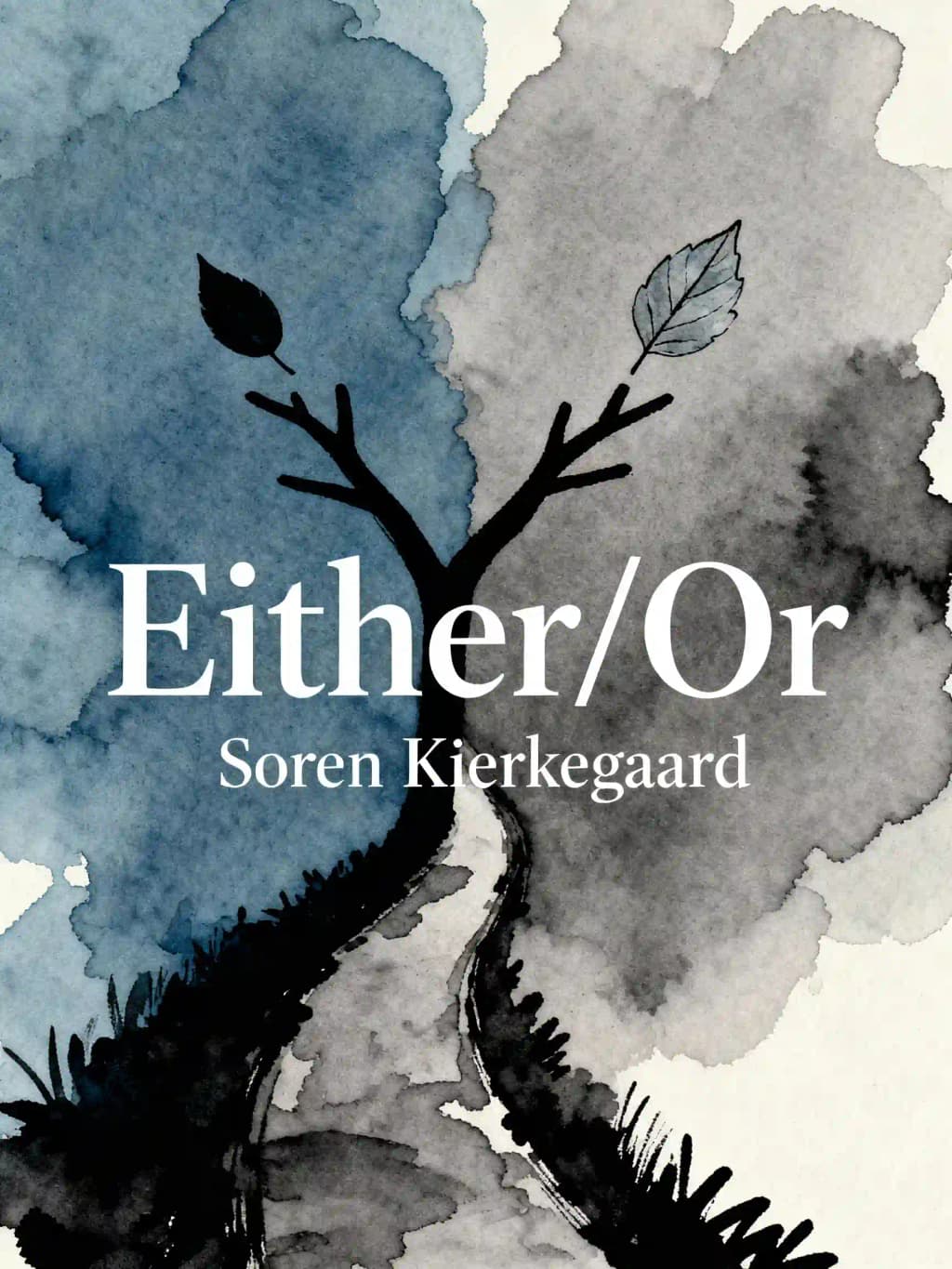
Søren Aabye Kierkegaard (1813–1855), the Danish philosopher and theologian often hailed as the father of existentialism, authored the seminal work Either/Or: A Fragment of Life, a foundational text in philosophical literature exploring themes of aesthetics, ethics, and existential choice.
A prolific writer and cultural critic, Kierkegaard’s pseudonym-laden works dissect human individuality, faith, and the tension between societal norms and personal authenticity. His academic rigor, evident in his doctoral dissertation On the Concept of Irony, and his personal struggles—including his fractured engagement to Regine Olsen—deeply informed his critiques of Hegelian philosophy and organized religion.
Known for penetrating psychological insight, Kierkegaard’s other influential works like Fear and Trembling, The Concept of Anxiety, and Concluding Unscientific Postscript further dissect existential responsibility and the leap to religious faith. His layered narratives, blending irony, metaphor, and paradox, reshaped modern thought and established frameworks for existentialist philosophy.
Over a century after his death, Kierkegaard’s writings remain cornerstones of Western philosophy, translated into dozens of languages and studied universally in theology and humanities curricula. Either/Or itself endures as a pivotal exploration of life’s stages, cementing his legacy as a visionary analyst of the human condition.
Either/Or explores two conflicting philosophies of life: the aesthetic (pleasure-seeking, impulsive, and fragmented) and the ethical (committed, duty-driven, and holistic). Through pseudonymous essays and letters, Kierkegaard contrasts fleeting sensual experiences with the fulfillment of moral responsibility, urging readers to consciously choose their path. The book’s structure mirrors this duality, with chaotic, artistic writings (by “A”) countered by structured ethical arguments (by Judge Vilhelm).
This book is ideal for readers interested in existential philosophy, moral decision-making, or 19th-century literature. Philosophy students, scholars of Kierkegaard’s works, and anyone grappling with questions of life’s purpose will find its exploration of choice, authenticity, and self-discovery compelling. Note that its dense, abstract style may challenge casual readers.
Yes—it’s a foundational text in existentialism and a masterclass in dialectical reasoning. While Kierkegaard’s prose demands patience, the book’s insights into human nature, freedom, and responsibility remain strikingly relevant. Its lack of a definitive “answer” invites reflection, making it rewarding for those willing to engage deeply with philosophical paradoxes.
The aesthete (symbolized by “A”) avoids commitment, seeking novelty and artistic stimulation, while the ethicist (Judge Vilhelm) argues for stability, integrity, and societal duty. Kierkegaard critiques the aesthetic life’s emptiness but acknowledges its allure, framing the ethical path as a leap toward wholeness through decisive action.
Immediacy defines the aesthete’s reliance on instinctual cravings—whether base (e.g., lust) or refined (e.g., artistic cultivation). Kierkegaard argues this leaves individuals trapped in repetition, blaming external forces for dissatisfaction. The ethical life breaks this cycle through introspection and accountability.
No—Kierkegaard intentionally leaves the debate open, urging readers to confront the tension themselves. Later works (like Stages on Life’s Way) introduce a third, religious stage, but Either/Or focuses on the futility of avoiding choice.
It introduces themes expanded in Fear and Trembling (faith’s paradoxes) and The Sickness Unto Death (despair). Unlike his overtly religious texts, Either/Or prioritizes secular philosophy, making it a gateway to his broader existential theology.
Some argue Kierkegaard’s dichotomy oversimplifies human experience, neglecting middle paths. Others note the ethical perspective’s Victorian-era rigidity, particularly its idealization of marriage. However, these critiques underscore the text’s role in sparking debate about individualism and societal norms.
In an age of distraction and choice paralysis, Kierkegaard’s demand for authentic commitment resonates deeply. The book’s critique of superficiality mirrors modern concerns about social media and consumerism, making it a timely guide for navigating existential uncertainty.
The aesthetic volume’s fragmented essays and aphorisms mimic a chaotic, pleasure-driven life, while the ethical section’s coherent letters symbolize order and purpose. This contrast reinforces Kierkegaard’s argument that how we structure our lives reflects our inner values.
These lines capture Kierkegaard’s emphasis on decisive action and the inevitability of regret in any unchosen path.
著者の声を通じて本を感じる
知識を魅力的で例が豊富な洞察に変換
キーアイデアを瞬時にキャプチャして素早く学習
楽しく魅力的な方法で本を楽しむ
All men are boring.
Boredom is the root of all evil.
The more you limit yourself, the more resourceful you become.
His life foams like champagne.
Always trying to find out how to sorrow.
『Kierkegaard's Writing, III, Part I』の核心的なアイデアを分かりやすいポイントに分解し、革新的なチームがどのように創造、協力、成長するかを理解します。
『Kierkegaard's Writing, III, Part I』を素早い記憶のヒントに凝縮し、率直さ、チームワーク、創造的な回復力の主要原則を強調します。

鮮やかなストーリーテリングを通じて『Kierkegaard's Writing, III, Part I』を体験し、イノベーションのレッスンを記憶に残り、応用できる瞬間に変えます。
何でも質問し、声を選び、本当にあなたに響く洞察を一緒に作り出しましょう。

"Instead of endless scrolling, I just hit play on BeFreed. It saves me so much time."
"I never knew where to start with nonfiction—BeFreed’s book lists turned into podcasts gave me a clear path."
"Perfect balance between learning and entertainment. Finished ‘Thinking, Fast and Slow’ on my commute this week."
"Crazy how much I learned while walking the dog. BeFreed = small habits → big gains."
"Reading used to feel like a chore. Now it’s just part of my lifestyle."
"Feels effortless compared to reading. I’ve finished 6 books this month already."
"BeFreed turned my guilty doomscrolling into something that feels productive and inspiring."
"BeFreed turned my commute into learning time. 20-min podcasts are perfect for finishing books I never had time for."
"BeFreed replaced my podcast queue. Imagine Spotify for books — that’s it. 🙌"
"It is great for me to learn something from the book without reading it."
"The themed book list podcasts help me connect ideas across authors—like a guided audio journey."
"Makes me feel smarter every time before going to work"

Kierkegaard's Writing, III, Part Iの要約をPDFまたはEPUBで無料でダウンロード。印刷やオフラインでいつでもお読みいただけます。
Have you ever felt torn between pursuing immediate pleasure and embracing lasting commitment? Sren Kierkegaard's revolutionary masterpiece "Either/Or" confronts us with perhaps life's most fundamental dilemma: should we live aesthetically-chasing novel experiences while avoiding responsibility-or ethically, finding meaning through deliberate choices and commitments? Published in 1843 under a pseudonym, this work shocked Danish society by challenging comfortable mediocrity. Through an ingenious literary device-presenting papers from two opposing perspectives-Kierkegaard doesn't merely explain philosophy; he forces us to experience the tension between these life paths. The aesthetic life promises freedom but delivers emptiness; the ethical life demands sacrifice but offers fulfillment. This nearly two-century-old text remains startlingly relevant today, influencing existentialist philosophers, psychologists studying identity formation, and even artists like David Bowie. In our age of endless options and shallow commitments, Kierkegaard's challenge feels more urgent than ever: Are you living authentically, or merely drifting?