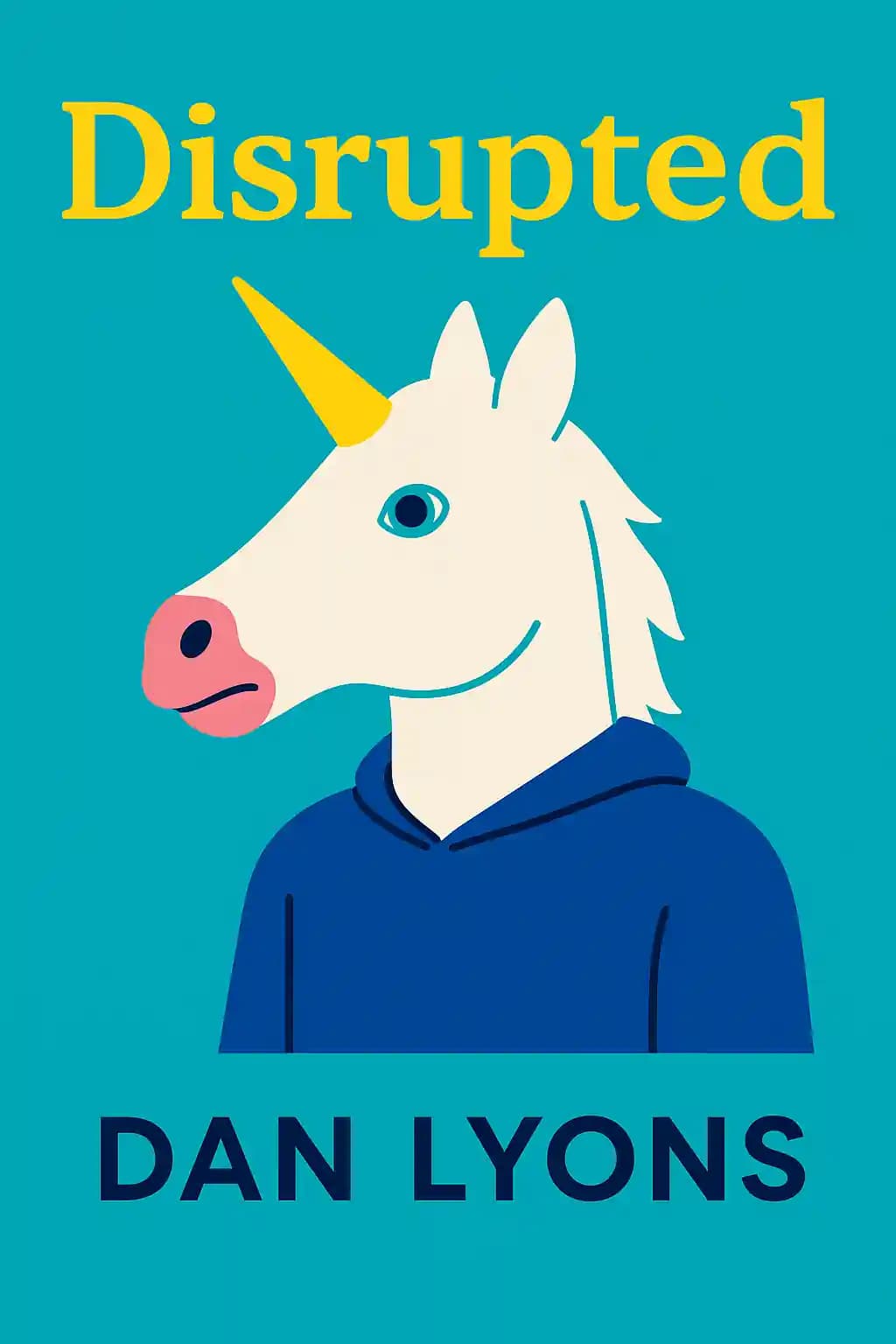
第1章
Silicon Valley's Midlife Crisis: Inside the Startup That Ate My Soul
Ever wondered what happens when a 52-year-old journalist with a skeptical eye and decades of experience infiltrates a youth-obsessed tech startup? Dan Lyons' "Disrupted" offers a scathing, hilarious, and ultimately disturbing answer. After being unceremoniously laid off from Newsweek in 2012, Lyons found himself in the bizarre position of joining HubSpot, a Boston-based marketing software company preparing for its IPO. What followed was a two-year odyssey into a world of candy walls, beer taps, and corporate doublespeak that would make George Orwell blush. The book became an instant sensation upon its 2016 release, resonating with older workers facing age discrimination and anyone questioning Silicon Valley's cult-like culture. Even more shocking, the memoir triggered an FBI investigation when HubSpot executives allegedly attempted illegal tactics to suppress its publication. Through Lyons' unflinching account, we get a rare insider's view of the tech industry's dark underbelly - where billion-dollar valuations meet playground aesthetics, and where experience is considered a liability rather than an asset.
第2章
Welcome to the Content Factory: A Midlife Plunge into Startup Absurdity
On my first day at HubSpot, I stood awkwardly in their renovated brick building in Cambridge, Massachusetts, feeling like I'd accidentally wandered onto the set of a children's television show. At 52, I was twice the age of most employees streaming past me in company-branded hoodies and "bro-wear." No one at reception knew who I was, despite the company publicly announcing my hiring. My boss "Cranium" was nowhere to be found, nor was his sidekick "Wingman."
The office resembled a Montessori preschool designed by someone who had never actually seen children. Bright orange walls. Beanbag chairs. Toys everywhere. There was even a "nap room" with a hammock. A candy wall offered free sugar hits to already hyperactive twenty-somethings. Dogs roamed freely. Nerf gun battles erupted randomly. The space featured standing desks, zero private offices (even for the CEO), and a mandatory seat rotation every three months-a "seating hack" to remind everyone that "change is constant."
My tour guide Zack, barely five years out of college, casually mentioned he ran the content team-meaning he was essentially my boss. He led me to the "content factory," a cramped room filled with twenty young women with identical shoulder-length hair who churned out blog posts with titles like "5 Ways to Make Your Landing Pages Awesome." When offered an orange bouncy ball instead of a chair, I awkwardly requested a real one, already feeling like I'd made a terrible mistake.
Why was I here? Nine months earlier, my life had seemed perfect. At 51, I had my dream job as Newsweek's technology editor, writing about fascinating subjects like fusion energy and artificial intelligence. Then one Friday morning, my editor Abby called with devastating news: my position was being eliminated. "I think they just want to hire younger people," she explained. "They can take your salary and hire five kids right out of college."
With two weeks' notice, no severance package, and the immediate loss of health insurance, I found myself in free fall. My wife Sasha had just left her teaching job due to chronic migraines. We had seven-year-old twins. We were suddenly a household with no income and no health insurance. I had become exactly what Newsweek had ironically described in its own cover story: "THE BEACHED WHITE MALE"-middle-aged men laid off during the recession, drifting through life like "castrated zombies."
Despite having covered technology since 1987 and achieving fame with my anonymous "Fake Steve Jobs" blog that attracted 1.5 million monthly readers, I was now facing the brutal reality of age discrimination in a shrinking industry. And so, desperate for stability, I had taken this marketing job at a hot tech startup-despite knowing absolutely nothing about marketing.
第3章
The Happy!! Awesome!! Startup Cult: Inside HubSpot's Orange Bubble
My first days at HubSpot were both amazing and hilarious-everything I imagined a tech company would be, but even more extreme. Our head trainer Dave, a wiry forty-something with a shaved head who played in a heavy metal band, preached with evangelical fervor that "HubSpot is leading a revolution" and "changing people's lives." He shared inspiring stories about customers like Brandon, a pool installer who became rich and transformed into a "rock star" motivational speaker after using HubSpot.
The reality was less glamorous-we were selling software that helped small businesses sell more stuff online, in the somewhat grubby world of online marketing. Yet HubSpot portrayed itself as noble, insisting our billions of automated emails weren't spam but "lovable marketing content." This Orwellian doublespeak fascinated me-we even had t-shirts that said "MAKE LOVE NOT SPAM."
HubSpot cultivated an exclusive cult-like atmosphere, claiming it was "harder to get into than Harvard" and recruiting primarily young, white, middle-class recent graduates who were easily influenced. New hires wore special HubSpot-branded rubber ID bracelets with transponders and were warned that many wouldn't survive the intensely competitive environment. People spoke of being "HubSpotty" and "bleeding orange" with religious devotion.
The company had its own language called "HubSpeak" with countless terms and acronyms stored on a corporate wiki. Terms like DRI (directly responsible individual), KPI (key performance indicator), SLA (service-level agreement), TOFU (top of funnel), MOFU (middle of funnel), SFTC (solve for the customer), and SMB (small and medium-size business) filled the air in endless meetings. This specialized jargon, along with the company's culture code created by co-founder Dharmesh Shah, formed part of what felt like landing on a remote island with its own rules, rituals, and reality.
The 128-slide PowerPoint "HubSpot Culture Code: Creating a Company We Love" defined what it meant to be "HubSpotty" through the HEART framework (humble, effective, adaptable, remarkable, transparent). Despite claiming "radical transparency," the company carefully controlled its image. The culture code introduced peculiar concepts like referring to firings as "graduations" and encouraging employees to "make magic" while exhibiting qualities like GSD ("get shit done").
HubSpotters constantly praised each other with excessive exclamation points and terms like "awesome," "crushing it," and "superstar," creating an atmosphere of relentless positivity that stood in stark contrast to the cynical, jargon-averse world of journalism I came from. As the oldest person in the training room, surrounded by fresh college graduates, I felt ridiculous and out of place. But I was transfixed by this bizarre corporate culture-it was like I'd stumbled into a real-life version of the over-the-top tech satire I used to write, a movie so bad it's good.
第4章
The Teddy Bear Management Philosophy: Corporate Infantilization
One July morning, our PR person Spinner enthusiastically asked the marketing department to promote an "awesome" LinkedIn article by Dharmesh, our co-founder. She provided pre-written "lazy tweets" we could automatically send from our personal accounts-a practice I recognized as "astroturfing," which seemed at odds with HubSpot's claims about authentic marketing.
When I actually read Dharmesh's article, I was stunned to discover his "innovative breakthrough" was bringing a teddy bear named Molly to meetings as a stand-in for customers. This practice, which he called "solving for the customer" (SFTC), involved placing the stuffed animal at the conference table during discussions.
The article included a photo of Molly sitting next to Cranium in a meeting. Despite my incredulity that grown adults considered this legitimate management rather than absurd theater, the LinkedIn comments praised it as brilliant innovation, with others vowing to adopt similar practices.
Even my colleague Zack, who had worked at Google, refused to criticize the teddy bear concept, dismissing it with "start-ups are eccentric." When I consulted friends outside HubSpot, Chuck warned me this was cult-like behavior, while Mike advised me to stay through the IPO for career reasons. Mike suggested HubSpot hired me as a publicity stunt and would likely fire me after going public.
Halloween at HubSpot further reinforced my sense of having entered a bizarre parallel universe. The entire company came to work in costumes, running around like children while work ground to a halt. HubSpotters were incredibly proud of this tradition, featuring Halloween photos on their website and in Dharmesh's Culture Code with the tagline "We dare to be different."
When my friend Rose, an executive VP of marketing for a major sports brand, visited that day, I showed her around our offices. She was shocked by the spectacle of actual adults racing around in costumes, whooping and shrieking. In the content factory, three women had dressed as the "mean girls" from the movie Mean Girls, complete with a "burn book" mocking coworkers-including a page about me with an unflattering photo. After seeing this childish workplace culture, Rose's parting advice was unequivocal: "You have to get out of here. This place will destroy your soul."
Though I knew Rose was right, I decided to wait until after winter to leave. I took advantage of HubSpot's work-from-home policy, going to the office only when absolutely necessary. When there, I isolated myself with headphones and earplugs, wandering the building aimlessly and speaking to no one. I slid into depression, swinging between anxiety and lethargy, sometimes unable to sleep without Ambien, other times sleeping eleven hours yet still exhausted.
第5章
We Need to Make the Blog a Lot More Dumberer: Content Marketing Reality
After three months at HubSpot, my role remained frustratingly undefined. Cranium, the CMO I thought I'd work with, barely acknowledged my existence beyond occasional hallway encounters. He managed his sixty-person department primarily through anonymous online surveys rather than direct interaction. With no guidance from Cranium, I was left taking direction from Wingman, who simply told me to "write about anything you want" for the blog.
Day-to-day, I dealt with Zack, whose enthusiasm was matched only by his constantly shifting priorities. When Zack asked me to write a memo critiquing the blog, I provided honest feedback, not realizing he would share it with Marcia, Jan, and Ashley-the women who ran the blog. This created immediate tension, as they'd been at HubSpot far longer than me and now viewed me as an arrogant newcomer criticizing their work.
I soon discovered the blog's true purpose wasn't quality journalism but lead generation. The blog team had a monthly quota of 14,000 leads, requiring about one million visitors. My articles, while generating traffic, didn't "convert well" into leads for the sales funnel. The blog targeted "Mary the Marketer," a fictional persona representing HubSpot's ideal customer-someone seeking basic marketing advice.
During a lunch meeting, Wingman informed me our "experiment with smarter content" had failed. We needed to make the blog even more basic than it already was-essentially dumbing it down further to generate more leads. As Wingman explained, if publishing the word "dogshit" repeatedly would generate leads, he'd do it. I realized with disappointment that HubSpot had hired a former Newsweek technology editor to produce content beneath my abilities and expertise.
Humiliated, I resigned myself to writing basic articles like "What Is CRM?" and "What Is CSS?" aimed at Marketing Mary's reading level. It was a far cry from interviewing Bill Gates or writing features on artificial intelligence. I proposed creating a separate high-end online magazine called Inbound that would target the audience Halligan wanted to reach without interfering with the lead-generation blog. Despite support from Tracy in brand and buzz, Wingman rejected my idea after a week.
I realized I was trapped in a middle-management quagmire. While top executives like Halligan might want change, middle managers like Cranium and Wingman, along with entrenched veterans like Marcia and Jan, resisted new ideas. They'd built the company their way and didn't welcome outsiders suggesting improvements.
第6章
Life in the Boiler Room: The Startup's Dark Underbelly
My new workspace was a telemarketing center that resembled a boiler room operation from the movies-dozens of young salespeople packed together in rows, barking identical scripts into headsets all day long. Despite HubSpot's marketing claims that their software eliminates the need for cold-calling, the company operated an aggressive call center where "business development representatives" (BDRs) earned just $35,000 plus bonuses to make hundreds of calls daily.
The irony wasn't lost on me: HubSpot preached "inbound" marketing while running an old-fashioned "outbound" call center. The noise was deafening-even noise-canceling headphones with earplugs underneath couldn't block it completely. This exile revealed HubSpot's split personality: Dharmesh's touchy-feely culture code versus Halligan's ruthless sales operation where the only rule was "make your numbers or get fired." The young salespeople worked under tremendous pressure, with software tracking their every move and monthly quotas that created a brutal hamster wheel existence where burnout was expected and accepted.
Sales reps operated under insane pressure with monthly quotas that reset their lives every thirty days. "That's why the sales reps are so young," one high-level rep explained. "People who are forty years old, who are married and have kids, they don't want to live like this." Halligan, a former salesman himself, accepted burnout as inevitable. The spider monkeys weren't hired for careers but to work a few brutal years before moving on.
While Dharmesh obsessed about HEART principles, Halligan focused on VORP (value over replacement player)-a ruthless metric designed to drive labor costs as low as possible. Despite the "delightion" rhetoric HubSpot presented publicly, the boiler room represented the company's true soul-where money got made through relentless pressure.
In October 2013, Halligan called an all-hands meeting to address slowing growth. HubSpot's sales grew over 80% in previous years but had dropped to 50%-still impressive but apparently insufficient. Halligan announced he was replacing Karl, one of his first hires who ran sales, and would personally take over the department until finding a replacement.
The problems extended beyond growth: high churn rates, low close rates compared to competitors like Zendesk, and plummeting morale. "We're going to make some hard calls," Halligan warned. "If you're not performing, we're going to put you on a plan"-essentially the first step toward termination.
第7章
The New Work: Employees as Disposable Widgets
I'd been naive about the tech industry. At HubSpot, I discovered that what I believed for 25 years was wrong. Unlike Apple, Microsoft, or Google, which began with brilliant inventions before adding sales teams, HubSpot started as a sales operation seeking a product. Their first hires were heads of sales and marketing, not engineers.
The tech industry isn't really about technology anymore. "You don't get rewarded for creating great technology," a veteran adviser explained. "It's all about the business model... getting big fast. Don't be profitable, just get big." That's HubSpot's strategy-unimpressive technology but impressive revenue growth that attracts venture capital.
HubSpot hired young people because they're cheap and can be packed densely into cavernous rooms. You give them free beer, foosball tables, and decorate like a kindergarten-frat house hybrid. You create a mythology making work seem meaningful, telling them they're special, on an important mission, and part of an exclusive team. You dangle the prospect of wealth while distributing it unevenly.
The tech industry has broken the social compact that once existed between companies and workers. Instead of lifetime employment with steady raises and pensions, workers are now "disposable widgets" plugged in for a year or two then discarded. LinkedIn's billionaire founder Reid Hoffman promotes this view in his book "The Alliance," arguing employees should see jobs as temporary "tours of duty."
This philosophy traces back to Netflix's influential culture code declaring "We're a team, not a family"-language HubSpot copied directly. While this arrangement might work for highly-paid athletes who retire young, it creates fear among ordinary workers who face replacement when someone cheaper comes along or they simply age past thirty-five.
Despite all the talk about "delightion" and "creating a company we love," HubSpot was astonishingly cruel. I repeatedly witnessed accomplished women in their mid-thirties (considered "old" at HubSpot) get suddenly fired by twenty-something managers with little or no warning.
Isabel, thirty-four with a one-year-old baby, was fired right after returning from medical leave. Denise, a four-and-a-half-year veteran, was told her job no longer existed while her department actively hired. During her final two weeks, Cranium completely ignored her existence. Paige, thirty-five, got fired during "Fearless Friday" (our feminist empowerment exercise), just weeks before her stock options would vest. Another woman was reportedly fired while pregnant with twins.
"The company can do whatever it wants," one manager told me. This is the New Work-exploitation with a smiley face, where everything from the crazy decor to the change-the-world rhetoric exists to drive down labor costs and maximize investor returns.
第8章
The Unicorn Protection Racket: Silicon Valley's Financial Shell Game
When HubSpot eventually published its financials for the IPO in August 2014, I discovered the company had accumulated over $100 million in losses in seven years and was borrowing against a credit line. Despite these financial troubles, HubSpot's party atmosphere continued unabated. "Monday was tequila tasting day. Today is a kayaking adventure starting at 2:30 followed by a pizza party," I wrote to a friend. "They just renovated the second floor and put in yet another kitchen, this one with beer and cider on tap. Expense is justified because 'recruiting.' They've raised $100m and I suspect have burned all or most of it."
Unlike the profitable tech companies of the past like Microsoft and Lotus, today's tech startups often lose enormous amounts of money for years while still making founders and investors rich. This business model emerged with Netscape's 1995 IPO, which went public despite being unprofitable-a watershed moment that flipped a switch in Silicon Valley.
The new formula became: grow fast, lose money, go public. Companies spend venture capital creating a "minimum viable product" then pour money into acquiring customers through marketing and hype. They essentially buy one-dollar bills and sell them for seventy-five cents, but it doesn't matter because investors focus only on revenue growth. Zynga, Groupon, and Twitter have collectively lost billions while maintaining high valuations.
The Valley is filled with "unicorns"-privately held companies supposedly worth billions. But as a Silicon Valley CEO explained to me, the investors in these late-stage startups are protected by "ratchets"-guarantees that if the company goes public at a lower valuation, they'll receive extra shares to make them whole. Some investors are even guaranteed 20% returns. The founders are also cashing out early by selling personal shares in private rounds. Meanwhile, employees with high-strike-price stock options will likely get nothing if the company goes public at a lower valuation than its private rounds.
Despite examining HubSpot's SEC filings, I was shocked anyone would invest in the company. The losses were enormous and growing faster than revenues. In 2013, HubSpot generated $77.6 million in revenue but lost $34.2 million, worse than 2012's $51.6 million revenue and $18.9 million loss. From 2009 through mid-2014, the company had generated $231 million in revenues but lost $118 million doing it-spending nearly $1.50 for every dollar of sales.
HubSpot was achieving revenue growth by spending increasingly on sales and marketing-$53 million in 2013 alone, about 68% of total revenues and more than three times what they spent on research and development. The company's assets had declined by 20% over eighteen months while liabilities more than doubled. They'd even borrowed $18 million against a line of credit, to be repaid from the IPO proceeds.
The prospectus contained a stark warning that HubSpot "might never become profitable." Investors weren't really investing; they were speculating, hoping someone else would eventually pay more for the shares.
第9章
If I Only Had a HEART: The Final Straw
About a month after the IPO, in November 2014, I received an offer from Gawker Media to write about Silicon Valley on their Valleywag blog. After months of playing anthropologist at HubSpot among increasingly resentful natives, I could finally return to my own tribe.
By coincidence, on the same day I expected to receive Gawker's official offer letter, I had my annual review with Trotsky. Despite considering skipping it, I decided to see what he had planned. The review took place in a tiny glass-walled room called "Dustin Pedroia" on the fourth floor-essentially a closet with two chairs and a small table.
Trotsky explained that HubSpot reviews graded employees in three categories: job performance, HEART, and VORP. In job performance, he gave me a three-essentially average. For HEART (humble, effective, adaptable, remarkable, and transparent), I received a two-below average. For VORP (value over replacement player), despite my high salary for secretarial work that an intern could do, he also gave me a two.
The most devastating part came next. Trotsky claimed he'd asked two colleagues for peer feedback about me, but they never responded despite multiple requests. "What do you think that says about you?" he asked. When I pressed for names, he reluctantly revealed one was Tracy, the VP of brand and buzz who sat near me and whom I considered a friend.
This genuinely hurt. I began to pour out my feelings, explaining how throughout my 25-year career I'd always made friends at work and moved upward, but at HubSpot I felt lonely and unwanted. Trotsky seized this vulnerability, telling me he'd spoken to someone from my past who described me as "smart but acerbic." He suggested my perception of having friends at previous jobs might not match reality-implying people had never actually liked me.
When I asked who had said this, he refused to tell me, adding with a grin, "Consider that my gift to you." I left the meeting numb, wondering if any of it was true or if he'd made it up to hurt me. As I stood in the lobby processing what had happened, Tracy herself appeared, greeting me cheerfully as if nothing was wrong. I hurried home and immediately called Gawker to accept their job offer.
第10章
The FBI Investigation: A Corporate Thriller's Unexpected Finale
Weeks after submitting my first draft manuscript to my publisher, events took a bizarre turn. On July 29, 2015, HubSpot issued a press release announcing Wingman's promotion to chief marketing officer-burying in the second paragraph the bombshell that Cranium (Mike Volpe) had been fired for violating the company's ethics code "in his attempts to procure" a manuscript of a book involving HubSpot. Furthermore, Trotsky (Joe Chernov) had resigned before the company could determine whether to terminate him for similar violations, while CEO Brian Halligan had been "appropriately sanctioned."
HubSpot's crisis management proved disastrous. PR expert Maura FitzGerald criticized their approach as "a lesson in what not to do," noting that both the crisis and its handling made HubSpot "look like an arrogant, cowboy culture." The company's press release attempted to bury bad news beneath a promotion announcement, making them appear sneaky. When Boston Globe reporter Curt Woodward tried to investigate, HubSpot's PR head Spinner had security remove him from the lobby.
I later heard that when Volpe was fired, HubSpot held an all-hands meeting where Halligan and Spinner were sobbing. A whistleblower may have reported the executives to the general counsel or board, though I couldn't confirm this. On October 9, 2015, the assistant U.S. attorney told my lawyer they wouldn't bring charges but wouldn't reveal what their investigation uncovered. The AUSA had previously mentioned they might find illegal activity but decide not to pursue the case.
Despite the scandal, all three executives emerged relatively unscathed. Chernov quickly landed a VP marketing job at a Cambridge startup. Halligan remained CEO and gave a keynote at the Inbound conference weeks later while still under board sanctions. Volpe briefly disappeared from social media but resurfaced on October 9-the same day we learned no charges would be filed-posting about the HubSpot IPO anniversary and later reinventing himself as a champion of diversity. Ironically, Wingman benefited most, rising from social media manager to C-level executive at a $2 billion company.
My journey wasn't what I expected when trying to reinvent myself as a marketer. I don't regret trying a new career or joining tech, but I do regret choosing HubSpot. I made about $60,000 from my stock options and unexpectedly found myself writing for Silicon Valley and this book. I wasn't prepared for the culture shock of Fearless Fridays and teddy bears at management meetings, nor did I anticipate working for bosses who might engage in potentially illegal activities targeting me.
Meanwhile, HubSpot's customers and employees remain devoted despite the scandal. In December 2015, HubSpot ranked fourth on Glassdoor's list of top places to work in America, ahead of even Facebook and Google. Many employees genuinely love the company and its perks. My experience was different-I saw age discrimination, groupthink, lack of diversity (euphemized as "culture fit"), poorly trained managers, and an organization out of control.
What concerns me most is that HubSpot holds private data for 15,000 customers and their customers too. Yet this is a company where executives allegedly invaded a former employee's privacy so seriously the FBI investigated. Like many tech companies-Uber, Lyft, Facebook-HubSpot has shown it can't be trusted with our data. But we have little choice but to use these services, and these companies won't invest in safeguards when their venture capital backers demand quick returns.