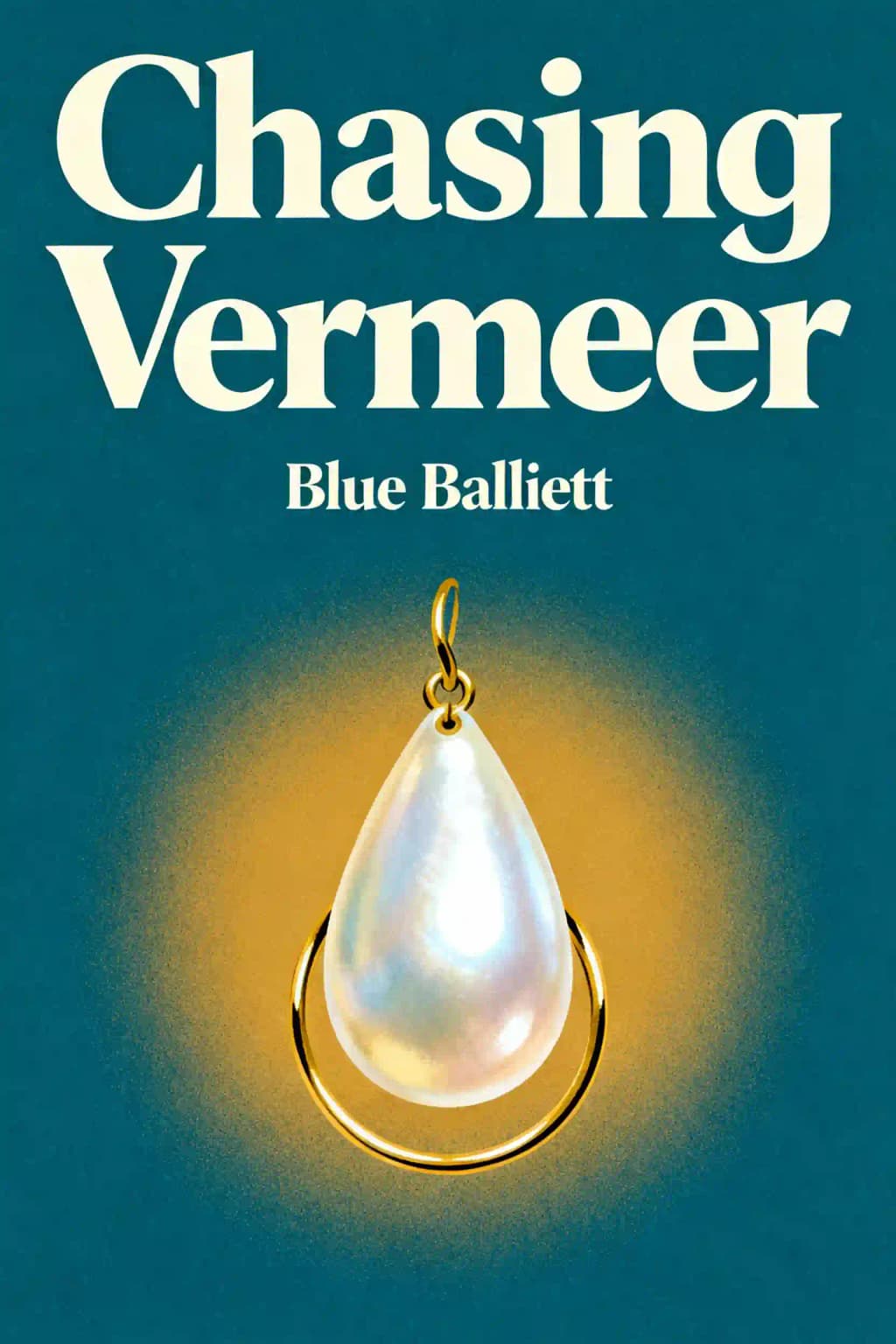
When art meets mystery: "Chasing Vermeer" turns two sixth-grade misfits into detectives hunting a stolen masterpiece. This Edgar Award-winning puzzle book, illustrated with hidden clues by Brett Helquist, challenges readers to see patterns where others see only coincidence.
Blue Balliett is the bestselling author of Chasing Vermeer and an award-winning writer of children's mystery novels.
Born in 1955 in New York City, she studied art history at Brown University and taught third grade at the University of Chicago Laboratory Schools before becoming a full-time author.
Her debut novel, Chasing Vermeer, blends her passion for art museums with a captivating mystery about two sixth-graders investigating the theft of a Johannes Vermeer painting. Published by Scholastic Press in 2004, the book won the Edgar Award for Best Juvenile Novel and the Agatha Award for Best Young Adult Novel.
Balliett continued the series with The Wright 3, The Calder Game, and Pieces and Players, alongside standalone mysteries like Hold Fast and Out of the Wild Night. Her books have achieved New York Times bestseller status and are celebrated for engaging young readers with art-inspired puzzles that encourage critical thinking about authenticity and truth.
Chasing Vermeer is a children's mystery novel about two eleven-year-old sixth graders, Petra Andalee and Calder Pillay, who team up to solve an international art scandal involving a stolen Johannes Vermeer painting titled "A Lady Writing". Set at the University School near Chicago, the story combines mathematical puzzles, pentominoes, hidden codes, and mysterious coincidences as the unlikely duo races to recover the priceless artwork and uncover the truth behind a centuries-old crime.
Blue Balliett is a former teacher at the University of Chicago's laboratory school who studied art history at Brown University and grew up surrounded by art in New York City. She wrote Chasing Vermeer while teaching full-time, inspired by her desire to create an art mystery for her students and explore how children connect coincidences that adults might miss. Balliett believes children often see things adults cannot and drew character inspiration from many students she knew throughout her teaching career.
Chasing Vermeer is ideal for middle-grade readers aged 9-13 who enjoy mystery novels, art, and puzzle-solving. The book particularly appeals to intellectually curious students who appreciate complex codes, mathematical patterns like pentominoes, and interactive storytelling with visual clues. Fans of The Westing Game, From the Mixed-Up Files of Mrs. Basil E. Frankweiler, and Lemony Snicket's illustrated adventures will find Chasing Vermeer engaging, as it combines mystery with educational elements about art history and problem-solving.
Chasing Vermeer is worth reading as a New York Times bestseller and award-winning novel that offers an engaging mystery experience with educational value. The book excels in characterization, lyrical writing, and teaching readers about Johannes Vermeer, art history, and teamwork through an interactive puzzle format with clues hidden in Brett Helquist's illustrations. However, some readers find the mystery relies too heavily on mystical coincidences and psychic connections rather than purely logical deduction, which may frustrate readers seeking a completely solvable puzzle.
Pentominoes are geometric puzzle pieces consisting of five connected squares that protagonist Calder Pillay uses as a problem-solving tool throughout Chasing Vermeer. These mathematical manipulatives serve as both a character trait and a clue-generating device, symbolizing how seemingly random pieces can come together to form complete solutions. Blue Balliett structured the entire mystery around pentomino logic, where clues appear randomly throughout the story but ultimately connect to solve the puzzle, mirroring how the puzzle pieces themselves work.
Petra Andalee and Calder Pillay are the two main characters in Chasing Vermeer—both intelligent, nerdy, and slightly unpopular eleven-year-old sixth graders at the University School in Chicago. Initially outcasts with unique interests, they discover unexpected connections like their shared love of blue M&Ms and pattern recognition, forming an unlikely friendship that becomes central to solving the Vermeer mystery. Petra experiences prophetic dreams about the stolen painting, while Calder relies on pentominoes and logical thinking, making them complementary detective partners.
The stolen artwork in Chasing Vermeer is "A Lady Writing" (also called "The Lady Writing"), a priceless painting by Dutch Golden Age master Johannes Vermeer. The thief sends anonymous letters threatening that lives will be in danger if authorities are contacted, claiming the theft aims to correct a centuries-old crime involving the artist. Petra and Calder ultimately discover the painting hidden in a wall within Delia Dell Hall, a historic building on their school grounds whose architectural details mirror those in Vermeer's paintings.
Critics of Chasing Vermeer argue that the mystery is ultimately unsolvable for readers because it relies too heavily on mystical coincidences, psychic dreams, and supernatural connections rather than logical clues. While the book presents itself as an interactive puzzle with clues hidden in illustrations, reviewers note too many red herrings and insufficient concrete evidence for readers to independently solve the case. The blending of realistic characters with mystical plot devices creates tonal inconsistency, leaving some readers feeling unsatisfied with the "cobbled together" resolution rather than experiencing an "Aha!" moment.
Chasing Vermeer and The Westing Game both feature young protagonists solving complex mysteries through pattern recognition and teamwork, with interactive elements inviting reader participation. However, reviewers note that while Chasing Vermeer aspires to The Westing Game's cleverness, it doesn't achieve the same level of logical puzzle satisfaction. The Westing Game relies on solvable clues and fair play mystery conventions, whereas Chasing Vermeer incorporates mystical elements and coincidences that make the mystery less purely deductive, leading some to consider it less successful as a puzzle novel.
Chasing Vermeer teaches children about Johannes Vermeer's life and artistic style, art history, and the world of museums and art authentication while developing critical thinking skills. The novel encourages readers to recognize patterns, decode messages, solve pentomino puzzles, and work collaboratively like Petra and Calder demonstrate throughout their investigation. Additionally, the book models how seemingly unrelated coincidences might connect meaningfully and shows how friendship can form between unlikely partners who share intellectual curiosity despite being social outcasts.
Chasing Vermeer is set in Hyde Park near the University of Chicago, specifically at the University School where Blue Balliett actually taught. The Chicago setting provides authentic detail since Balliett drew from her real teaching environment, and the historic architecture of buildings like Delia Dell Hall becomes integral to the mystery's solution. The school and surrounding neighborhood's intellectual atmosphere, with university connections and appreciation for art and learning, creates a believable context for two academically gifted sixth graders to pursue an international art investigation.
Brett Helquist, famous for illustrating Lemony Snicket's A Series of Unfortunate Events, created the illustrations for Chasing Vermeer. The artwork is not merely decorative but functions as an essential mystery-solving element, with hidden clues and codes embedded throughout the pictures that readers must decode alongside Petra and Calder. This interactive visual component makes Chasing Vermeer more than a traditional novel, transforming it into a multimedia puzzle experience where careful observation of illustrations provides crucial information for solving the Vermeer theft mystery.
著者の声を通じて本を感じる
知識を魅力的で例が豊富な洞察に変換
キーアイデアを瞬時にキャプチャして素早く学習
楽しく魅力的な方法で本を楽しむ
Something was up, and Petra felt it in her bones.
Everything had a secret meaning, if you searched hard enough.
Sometimes, the smallest things change everything.
art and reality begins to blur
『Chasing Vermeer』の核心的なアイデアを分かりやすいポイントに分解し、革新的なチームがどのように創造、協力、成長するかを理解します。
『Chasing Vermeer』を素早い記憶のヒントに凝縮し、率直さ、チームワーク、創造的な回復力の主要原則を強調します。

鮮やかなストーリーテリングを通じて『Chasing Vermeer』を体験し、イノベーションのレッスンを記憶に残り、応用できる瞬間に変えます。
何でも質問し、声を選び、本当にあなたに響く洞察を一緒に作り出しましょう。

"Instead of endless scrolling, I just hit play on BeFreed. It saves me so much time."
"I never knew where to start with nonfiction—BeFreed’s book lists turned into podcasts gave me a clear path."
"Perfect balance between learning and entertainment. Finished ‘Thinking, Fast and Slow’ on my commute this week."
"Crazy how much I learned while walking the dog. BeFreed = small habits → big gains."
"Reading used to feel like a chore. Now it’s just part of my lifestyle."
"Feels effortless compared to reading. I’ve finished 6 books this month already."
"BeFreed turned my guilty doomscrolling into something that feels productive and inspiring."
"BeFreed turned my commute into learning time. 20-min podcasts are perfect for finishing books I never had time for."
"BeFreed replaced my podcast queue. Imagine Spotify for books — that’s it. 🙌"
"It is great for me to learn something from the book without reading it."
"The themed book list podcasts help me connect ideas across authors—like a guided audio journey."
"Makes me feel smarter every time before going to work"

Chasing Vermeerの要約をPDFまたはEPUBで無料でダウンロード。印刷やオフラインでいつでもお読みいただけます。
What if a stolen masterpiece could communicate with you through dreams? In the shadowy corridors of Chicago's Hyde Park neighborhood, two unlikely sixth-grade detectives are about to discover that art isn't just something hanging on museum walls - it's alive, mysterious, and sometimes desperately trying to tell us something. When a priceless Vermeer painting vanishes, Petra Andalee and Calder Pillay find themselves drawn into a web of coincidences too perfect to be random. Strange letters appear, dreams reveal unseen paintings, and mathematical patterns emerge where none should exist. As they navigate this intellectual labyrinth, they'll discover that seeing isn't just looking - it's understanding the hidden connections that bind us all together across time and space. What begins as a classroom assignment becomes a dangerous adventure that will challenge everything they thought they knew about art, truth, and the boundaries between reality and imagination.