第1章
When Failure Becomes Your Greatest Asset
What if the very thing you fear most could become your superpower? Susan Kahn's "Bounce Back" arrives at a critical moment when workplace resilience has never been more essential. This transformative guide has become a favorite among executives at companies like Google and Facebook, who cite its practical approach to turning setbacks into springboards. The book's influence extends beyond corporate boardrooms-celebrities like Brene Brown have praised its honest approach to vulnerability, while academic institutions increasingly incorporate its frameworks into leadership curricula. In a world where 75% of workers report feeling overwhelmed by change, Kahn's psychology-based approach offers something rare: a pathway to not just survive workplace challenges but to emerge stronger because of them.
第2章
Embracing Failure as the Path to Growth
Failure has traditionally been viewed as something to avoid at all costs, with workplace cultures often demanding perfection. However, in our rapidly evolving Fourth Industrial Revolution-characterized by transformative technologies like IoT and AI-the ability to adapt through trial and error has become increasingly valuable. The concept of "failing fast" has emerged as a motto for embracing risk-taking and learning quickly.
Our hesitation to embrace failure is understandable. Throughout history, business failures were met with harsh treatment-from ancient Greeks forcing failed merchants to sit with baskets over their heads to public humiliation rituals in premodern Europe. Even today, entrepreneurs risk public shaming and harsh media coverage when ventures collapse. Yet those who fail and bounce back, like Richard Branson and J.K. Rowling, hold special public admiration, perhaps signaling a cultural shift in our relationship with failure.
Failure occurs in all industries and contexts. While Peter Drucker identified key reasons businesses fail-not addressing "what is our business?", persisting with failing strategies, or lacking interest in products-failures also stem from external disasters and personal setbacks. We face regular disappointments: missed opportunities, rejected pitches, failed products, and denied promotions.
The "fail fast" concept originates from systems design, where problems are immediately reported to prevent continued flawed operations. In business, it encourages bold action to quickly determine a strategy's viability before wasting years on doomed efforts. For individuals, failing fast means not stagnating in disappointment but reviewing mistakes, learning from them, and applying those lessons immediately.
When facing failure, Stoicism offers valuable perspective by encouraging us to consider what could be worse. Has anyone died? Have we disrupted world peace? The Stoic philosophy teaches that while external events are unpredictable and beyond our control, we can master our responses. One Stoic technique is to practice misfortune-imagining worst-case scenarios-which helps manage fear by revealing that most adversity is temporary.
Despite the prevalence of success stories, working life doesn't always reward the good, clever, and hardworking. When failure strikes-especially during already difficult times-self-compassion becomes essential. Rather than demanding a "thicker skin," we must acknowledge our vulnerability and that something meaningful has been lost. We should treat ourselves with the same gentleness we'd offer a cherished friend.
第3章
The Brain-Body Connection to Resilience
Our earliest relationships shape our nervous system, with research confirming strong links between brain development and emotional well-being. Though our emotional resilience foundations form in our first years, recent discoveries show brain function can develop and change throughout life. We're in an exciting era where different disciplines converge to help us understand emotional life more comprehensively.
Once thought fixed and destined for decline, we now know the brain can change itself without medication or physical intervention. This neuroplasticity has profound implications for resilience-helping people recover from strokes, improve memory, manage obsession, and handle trauma. The brain's remarkable ability to reorganize itself means we can rewire our responses to anxiety, obsession, and trauma, opening possibilities for fresh ways of thinking and working.
Carol Dweck's research on mindset psychological traits distinguishes between fixed and growth mindsets. Students who believed intelligence could improve through effort invested more time and achieved greater success. This concept extends beyond classrooms to workplace resilience-believing we can develop new skills and cope with setbacks makes us more likely to do so. This connects to brain plasticity, as neural networks can be established and strengthened with experience.
Taking care of our bodies is essential for producing the neurochemicals needed for balance, stress management, and well-being. Regular exercise, even gentle activities like walking five days weekly, stimulates endorphins that build mental resilience. A healthy diet, good sleep, moderate caffeine and alcohol intake, and proper hydration all contribute to our resilience capacity.
Sleep is nature's free reset button for our bodies and brains, yet industrialized nations face a sleep-loss epidemic. Without adequate sleep, our ability to perform complex tasks, remember information, and make sound decisions deteriorates significantly. Sleep deprivation weakens our emotional stability and resilience. Neuroscientist Matthew Walker argues we must reclaim our full night's sleep without shame to enhance our capacity for resilient behavior.
Despite Descartes' assertion that humans are primarily rational beings, our dual-system brain operates with both fast, emotional instincts and slow, deliberate calculation. Kahneman and Tversky's work showed how these systems function-the fast element allows immediate danger response while the slow element enables careful consideration. In workplaces, our instinctive thinking can make us defensive about relationships and processes, but also trigger destructive responses like anger or jealousy. The ability to engage "system-two thinking"-carefully reflecting on consequences before acting-becomes crucial in professional environments.
第4章
Understanding What Lies Beneath the Surface
We often imagine workplace interactions as straightforward, but human vulnerabilities are always present. By understanding what lies beneath the surface-the unconscious dimensions of thinking, feeling, and acting-we can better comprehend our fears and anxieties, ultimately strengthening our ability to bounce back from challenges.
What we observe in workplace interactions is rarely the complete picture. When a manager ignores a colleague's contribution or consistently favors one team member, unconscious motivations may be at play-perhaps envy of ideas or feeling threatened. When we're on the receiving end of such behavior, we often blame ourselves, questioning our capabilities and worth. Yet we reveal very little of ourselves in our interactions; most of who we are remains hidden below the surface.
The iceberg model illustrates how little of ourselves we consciously reveal in daily interactions-just the tip of the pyramid. Below the surface lies our subconscious, which we can access through careful examination, and deeper still, our unconscious, containing repressed memories from childhood. These buried experiences don't disappear but remain foundational to our revealed selves. When triggers in our current environment connect to early feelings of rejection or abandonment, we often unconsciously re-enact emotional responses from our past.
As humans, we fundamentally need to feel protected and safe-a basic psychological need established in our early relationships with caregivers. When we perceive threats to our safety, whether conscious or unconscious, physical or emotional, we experience anxiety. Psychological defences help us manage this anxiety, providing coping tools that are neither inherently good nor bad. They help us function in stressful jobs, meet deadlines, and manage teams.
We employ various defence mechanisms at work. Repression involves pushing difficult emotions into our unconscious so they no longer interfere with daily activities. Denial is refusing to admit the truth of something difficult. Rationalization or intellectualization involves explaining away disappointments through logical arguments or philosophical concepts. Sublimation transforms socially unacceptable impulses into acceptable actions-a mature defence mechanism for handling overwhelming emotions.
Splitting-the tendency to polarize-has become increasingly evident in 21st century workplaces and society. This defence mechanism divides thinking into rigid opposites: right/wrong, positive/negative, for/against. Such polarities isolate individuals, accelerate distance between groups, and impede our ability to navigate complexity.
Defence mechanisms protect us from feelings of guilt or anxiety when threatened. While natural and normal responses to workplace demands, they become problematic when used so frequently we become neurotic. Understanding our inner motivations helps us interact more productively at work and build resilience. Though defence mechanisms prevent unbearable feelings, they may stop us from facing important realities-like suppressing anger that could motivate necessary changes, or avoiding rejection that prevents pursuing desired promotions.
第5章
Navigating Change, Disruption and Loss
We live in an era of "always on transformation" driven by globalization, technology, and changing work patterns. While change can be energizing and transformative, offering opportunities for reinvention, it can also provoke anxiety and fear. Transformation often requires giving something up-efficiency may reduce team size, technology may limit personal connection. Even in jobs we love, obstacles will test our resilience and ability to improvise.
Change we choose differs fundamentally from change imposed upon us. When organizations we've shown loyalty to restructure or eliminate our roles, it can feel devastating. Traditional qualities like loyalty and conformity are often rewarded, yet flexibility and imagination prove more valuable during transitions. Our responses aren't binary-we can simultaneously feel excitement and anxiety about change, finding it both thrilling and terrifying.
While positive thinking is popular in resilience discourse, an alternative approach involves considering what might go wrong. Rather than being depressing, examining potential negative outcomes can be liberating and help prepare us for challenges, as the Stoics understood. Stoicism teaches us about the unpredictability of life and the importance of controlling ourselves rather than external circumstances. It favors logic over impulse and focuses on overcoming destructive emotions by worrying only about what we can control.
Psychoanalytic thought, like Stoicism, explores our relationship with mortality. The unbearable prospect of our finite existence can lead to delusion that we'll continue forever. In work contexts, this manifests as inability to recognize that leadership roles, projects, and even companies will eventually end. Markets are fragile, global uncertainty prevails, and organizations are not immortal.
Freud's 1917 essay distinguishes between mourning (normal response to loss) and melancholia (what we now call clinical depression). During mourning, a person realizes what's lost is truly gone and temporarily turns away from reality with dejection and loss of interest. Understanding this difference helps build resilience at work. When procedures change, some people experience normal mourning-they're sad or angry before eventually accepting and re-engaging. Others continue working as if nothing changed, unable to let go of comfortable established patterns.
While established practices and guidelines are important in work life, over-attachment to "the way things are done" creates stress when change occurs. Being perfectly organized for current methods can make adaptation extremely difficult. When routines change, predictability becomes a liability. New thinking requires openness to original ideas and creativity.
Work has transformed dramatically over centuries. Once, occupation was predetermined by birth and location, with generations following the same path. Now technology, culture and communication have created radical shifts in how we work. We operate in an "always on" digital culture with rapid change in virtually every environment, requiring constant adaptation and skill development.
Catharsis-purification or cleansing of emotions-can help build resilience. Naming fears about anticipated changes helps understand our deepest worries. Transforming cluttered thoughts into coherent stories helps process emotional responses. Jamie Pennebaker's research shows strong correlation between disclosure through writing and health benefits, supporting Freud's notion that processing emotions by writing or talking about them helps us literally "get it off our chests."
第6章
The Resilient Leader
Leadership requires balancing performance targets with the emotional needs of team members. Leaders must create trust, innovate, challenge, and remain accessible-all of which demands significant resilience. Similarly, "followers" need resilience to cope with situations where they have less knowledge or power, or when decisions are made without their full understanding.
While leadership development offers countless approaches-from transformational to charismatic to authoritative styles-true leadership doesn't require a formal position. We can inspire, influence, and guide from any stance in an organization, leading through example and character regardless of our official role. In today's climate of constant change and persistent challenges, resilience stands as perhaps the most crucial leadership quality.
Leaders play a vital role in managing the fears and anxieties of their teams by providing what psychologists call "containment"-creating a safe psychological space where people can explore ideas and step outside their comfort zones. When unexpected difficulties arise-losing contracts, key staff departures, or dramatic external changes-people look to leaders to make it safe to navigate uncharted waters.
Developing leadership resilience requires implementing boundaries and specific practices that protect both your effectiveness and wellbeing. Don't wait for major crises to build your resilience. Begin by managing smaller disappointments-when your idea isn't adopted in a meeting or when an executive forgets meeting you. By actively processing these minor setbacks and noticing your ability to survive them, you're exercising your resilience muscle.
The ancient wisdom to "know thyself" applies powerfully to leadership. As leaders, we must examine our leadership style, stress responses, and behavior during setbacks. Leadership positions bring both privilege and loss-you lose the freedom to speak casually or gossip with colleagues while gaining the responsibility of making sometimes unpopular decisions. Resilient leaders learn to quiet the negative internal voices that undermine self-belief.
Though it might sound soft, self-compassion is a robust skill that psychologists identify as a crucial source of resilience. Leadership positions can be isolating-your words carry more weight, and you'll inevitably face judgment, some fair and some unfair. Winnicott's concept of being "good enough" liberates leaders from perfectionism, allowing space for mistakes while preserving energy reserves for inevitable challenges.
Understanding how others perceive you is challenging but essential for leadership development. The persona we believe we project may differ significantly from how others experience us. You might be seen as critical, impatient, a poor listener, intimidating, or someone who rarely makes mistakes. Gaining this awareness requires actively seeking feedback, which can be uncomfortable but invaluable.
Leadership demands significant resilience, but those in non-leadership roles face challenges too. Organizations are no longer strictly hierarchical, with flatter structures and networks replacing traditional command-and-control leadership. "Followers" are essential to the leadership process and require their own resilience to cope with workplace demands. Importantly, even those in leadership positions often must interact with and follow other leaders. We all shift between leader and follower roles, making resilience important in both contexts.
第7章
Managing Conflict with Resilience
Conflict at work manifests in various ways-from colleagues who don't get along to tense atmospheres, heated exchanges, formal procedures, or subtle behaviors like avoiding events, taking sick leave, or ultimately leaving the organization. While not always obvious to outsiders, conflict represents significant tension for those involved.
Conflict is complex, experienced as a threat that triggers anxiety and fear. As it develops, consequences can spiral for individuals, colleagues, and organizations. People take sides, feel supported or unsupported, and both participants and witnesses suffer. These dynamics test resilience, making it important to understand conflict's nature and manifestations in the workplace.
The conflict triangle illustrates how conflict expresses through three interconnected elements: the issue itself (problem), the people involved, and the process (events leading up to and resulting from the problem). Changes in any element create different outcomes and disruption levels. Personal experience of conflict varies based on relationship history, conflict experience, pattern of disputes, current well-being, and resilience capacity.
Conflict and stress form a vicious circle-stress leads to conflict, and conflict causes stress. In a stressed state, we become more vulnerable and susceptible to perceived slights from colleagues. When faced with difficult workplace encounters, our brain triggers the fight-or-flight response, shutting down clear thinking just when we need it most. These brief encounters can occupy disproportionate headspace, disrupting our entire day and even our sleep as we ruminate far longer than the actual incident lasted.
Workplace bullying differs from normal conflict in that it involves sustained, repeated negative behavior over time with a one-way power imbalance. It's defined as harassing, offending, socially excluding someone, or negatively affecting their work tasks regularly over an extended period. Bullying impacts not only targets' psychological and physical well-being but also affects bystanders and the overall work environment.
While most people view conflict negatively, it's inevitable in any workplace. Research shows conflict-induced stress reduces productivity and increases turnover. Our response to conflict varies based on our psychological state-when resilient, we handle challenges from a secure base and are less likely to be thrown off course. People also have different tolerance levels for disagreement, from those requiring absolute agreement to those who welcome challenge as part of the creative process.
According to the UK's Advisory, Conciliation and Arbitration Service (ACAS), people typically respond to conflict in four ways: Fight (confrontational reactions like shouting or losing temper), Flight (avoiding the problem by turning a blind eye or walking away), Freeze (becoming unable to react or make decisions), and Face (approaching problems calmly and rationally with a planned approach). The last response-facing conflict-is most effective for building resilience, though many default to avoidance strategies that ultimately prolong or worsen situations.
While some suggest workplace conflict can benefit creativity and problem-solving, evidence for positive outcomes is limited, with negative effects generally outweighing benefits. However, conflict can serve as a barometer of organizational health by bringing hidden issues to light. Organizations presenting flawless images often harbor resentment and repressed anger beneath the surface. Acknowledging conflict as part of workplace dynamics allows for healthier development.
第8章
Finding Purpose to Fuel Resilience
As human beings, we seek direction and purpose. Purpose expresses our sense of resolve and identifies what we consider important enough to devote our time to. Since Max Weber's 1905 study on the Protestant work ethic, work has evolved from merely earning a living to becoming central to our identity and worth. Research by Adam Grant shows that meaningful work connects to happiness, productivity, and protection against burnout, while Stephen Covey suggests a personal mission statement becomes the DNA for every decision we make.
Beyond earning money for basic needs, understanding your deeper purpose for working is vital for resilience. Your approach and emotional connection to work impacts how you handle difficulties. The example of three teachers facing identical challenges demonstrates this: Teacher A (working purely for income after business failure), Teacher B (continuing a family tradition), and Teacher C (passionate about shaping compassionate citizens) will have vastly different resilience resources. The stronger your foundational "why," the more centered you remain during setbacks.
Purpose fuels resilience even in the darkest environments. Victor Frankl's Holocaust account demonstrates how maintaining purpose helped him survive death camps, teaching that while we can't always stop suffering, we can control our response to it. This aligns with cognitive behavioral therapist Windy Dryden's emphasis on personal responsibility-viewing hardships as opportunities for growth through purposeful meaning. Our negativity bias, once crucial for survival, now causes us to fixate on single workplace difficulties despite overall success. Purpose provides the counterweight to this tendency, giving us the strength to persevere through adversity and bounce back from disappointments.
When we clearly understand our "why," we develop greater resilience even during extreme challenges. Our purpose forms the innermost core of our resilience, surrounded by our work (the expression of purpose), with resilience as the outermost protective ring. This structure creates a foundation that helps us communicate needs, identify priorities, and explain our behaviors to others. Purpose becomes our centering "steel rod" that allows us to continue because we deeply care about what we're doing.
How we define ourselves directly connects to our sense of purpose. A receptionist might view their role as vital for client relationships or merely as answering phones; a trainee might see themselves as the organization's future or just the low-ranking worker doing menial tasks. Research shows that losing access to one's identity correlates with diminished resilience. The challenge often isn't the difficult event itself but how it conflicts with our self-perception.
Generational differences significantly impact work expectations and purpose. Baby boomers and Generation X typically expected traditional, certain career paths with long-term stability. In contrast, Millennials (Generation Y) and Generation Z have grown accustomed to work unpredictability. These younger generations enjoy greater freedom to pursue their dreams, unburdened by traditional expectations but lacking financial security. This context makes finding purpose at work particularly crucial for these later generations who must navigate more fluid career landscapes.
Psychologist Mihaly Csikszentmihalyi identified "flow" as that optimal state when we're utterly engaged and functioning at our best. Studying creative people who pursued meaningful work despite limited prospects for fame or fortune, he discovered that complete immersion in engaging processes leaves no attention for bodily needs or external problems. Work involving absorbing challenges with meaning creates flow states where we become resilient, absorbed, and experience meaningful reward.
Finding purpose isn't straightforward-many spend lifetimes searching for meaning. Ikigai, a Japanese concept meaning "a reason for being," offers a framework for finding purpose by answering four key questions: What do you love? What are you good at? What does the world need? What can you be paid for? This approach helps align personal values with professional goals, creating a fulfilling life where work becomes less of a drudge and more about satisfaction. Having this clear sense of purpose provides focus and stability when facing career crossroads, ultimately leading to greater mental and physical well-being.
第9章
The Journey Forward: Becoming Resilient
Developing resilience requires time and practice. When facing threats or upsets, pausing creates power-giving us time to adopt new responses and shift perspective beyond our initial reactions of hurt or anger. By reflecting on disappointments within context and acknowledging achievements, we can transform our thinking.
Building on Seligman's concept of learned helplessness (where dogs conditioned to believe they couldn't escape pain stopped trying even when escape became possible), we similarly limit ourselves at work. We may decide we're "not good delegators" or "can't handle sensitive matters" based on past struggles. The key transformation is moving from "I struggled with this before, therefore I cannot do it" to "I struggled with this in the past, but I am now able to think I can do it."
While supportive environments make risk-taking and creativity easier, we shouldn't delegate responsibility for our resilience solely to managers and leaders. Creating our own inner psychological space and shifting our internal locus of control allows us to face life events without falling into troubling behavioral patterns-achieving "autonomy of resilience." Rather than depending on others to create the right circumstances for us to flourish, we can take charge through self-care and attending to our needs.
When receiving feedback, we often engage in faulty thinking-hearing "your presentation was dull" as "YOU are dull" or interpreting "your report needs more work" as "I'M shallow." We should separate behavior from identity, seeing feedback as helpful rather than hurtful. Citing Eleanor Roosevelt's observation that no one can make you feel inferior without your consent, we can graciously accept others' perspectives while maintaining internal equilibrium.
Self-blame is destructive and should be redirected toward self-care-considering how to better nurture ourselves. Being well-rested helps manage work and home demands, with gratitude practices significantly improving wellbeing. True resilience requires self-awareness to recognize vulnerability and seek support when needed, whether by discussing workload with managers or seeking expert guidance for personal challenges.
Research into resilience initially focused on negative impacts of trauma, but Garmezy's work identified protective factors that help some people bounce back while others crumble. Those who are resilient follow an ABC pattern: they Accept their reality, Believe life has meaning, and have the ability to Change and improvise. This last quality, described as "ritualized ingenuity" or "bricolage," involves making something new from unrelated elements-like finding creative solutions when working with limited resources or in challenging circumstances.
People respond differently to challenges and adversity. What causes crisis in one person may barely affect another. Our resilience isn't static-it fluctuates across decades, years, months, even days. Gender differences also exist: research shows men who experience business failure tend to quickly start new ventures, while women may take more time, possibly affected by imposter syndrome. Age impacts resilience too, with youth bringing enthusiasm and fresh perspectives, while experience brings valuable lessons.
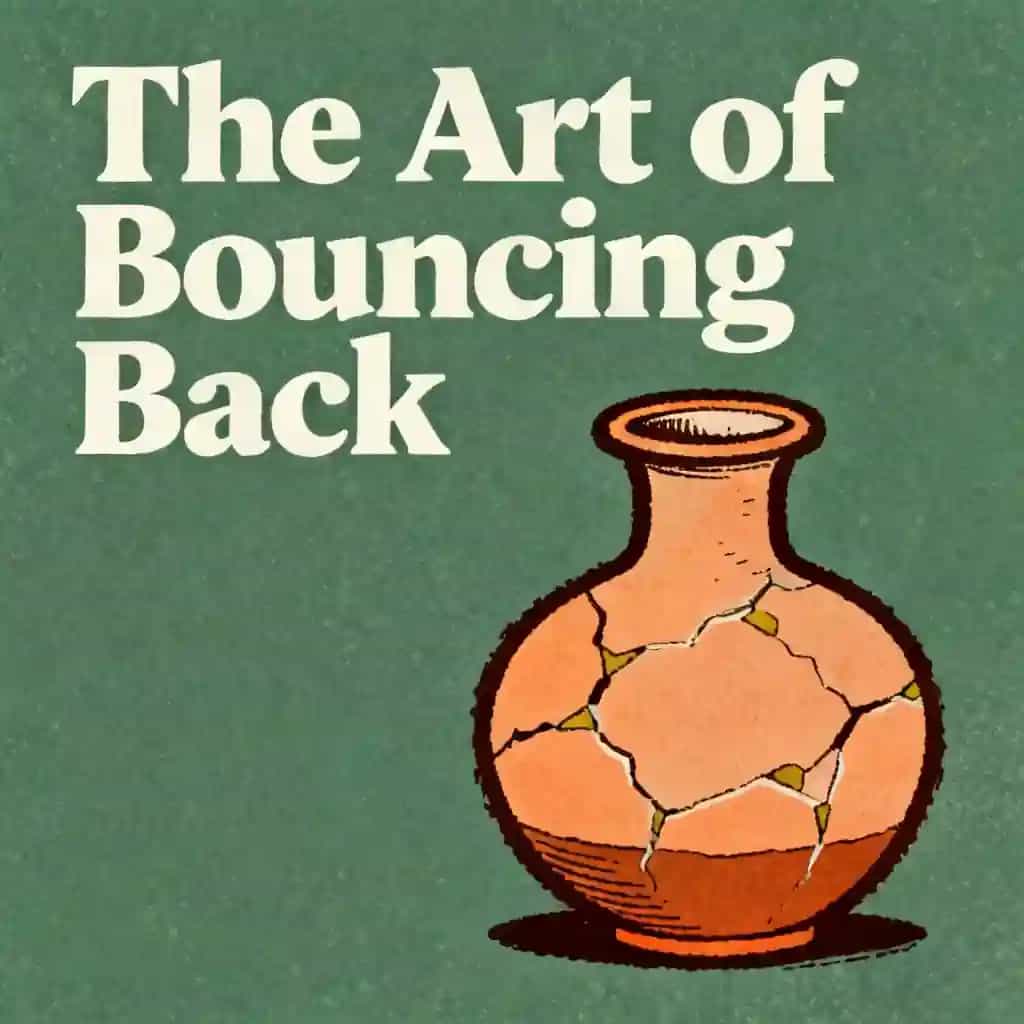
Some challenge the notion of "bouncing back," seeing it as regressive. After difficult experiences, we're never quite the same-we may appear unchanged, but our knowledge and experience are transformed, often for the better. Like the Japanese art of Kintsugi, which repairs broken pottery with precious metals to create something more beautiful, our scars and repairs become valuable parts of who we are. We don't just bounce back to our previous state-we bounce forward to "a new normal" with increased self-knowledge, understanding and strength.