第1章
The Untold Story of Britain's Black Past
The story of Black British history isn't a footnote or sidebar to the "main" British narrative-it's an essential, integral thread woven through the fabric of the nation's past.
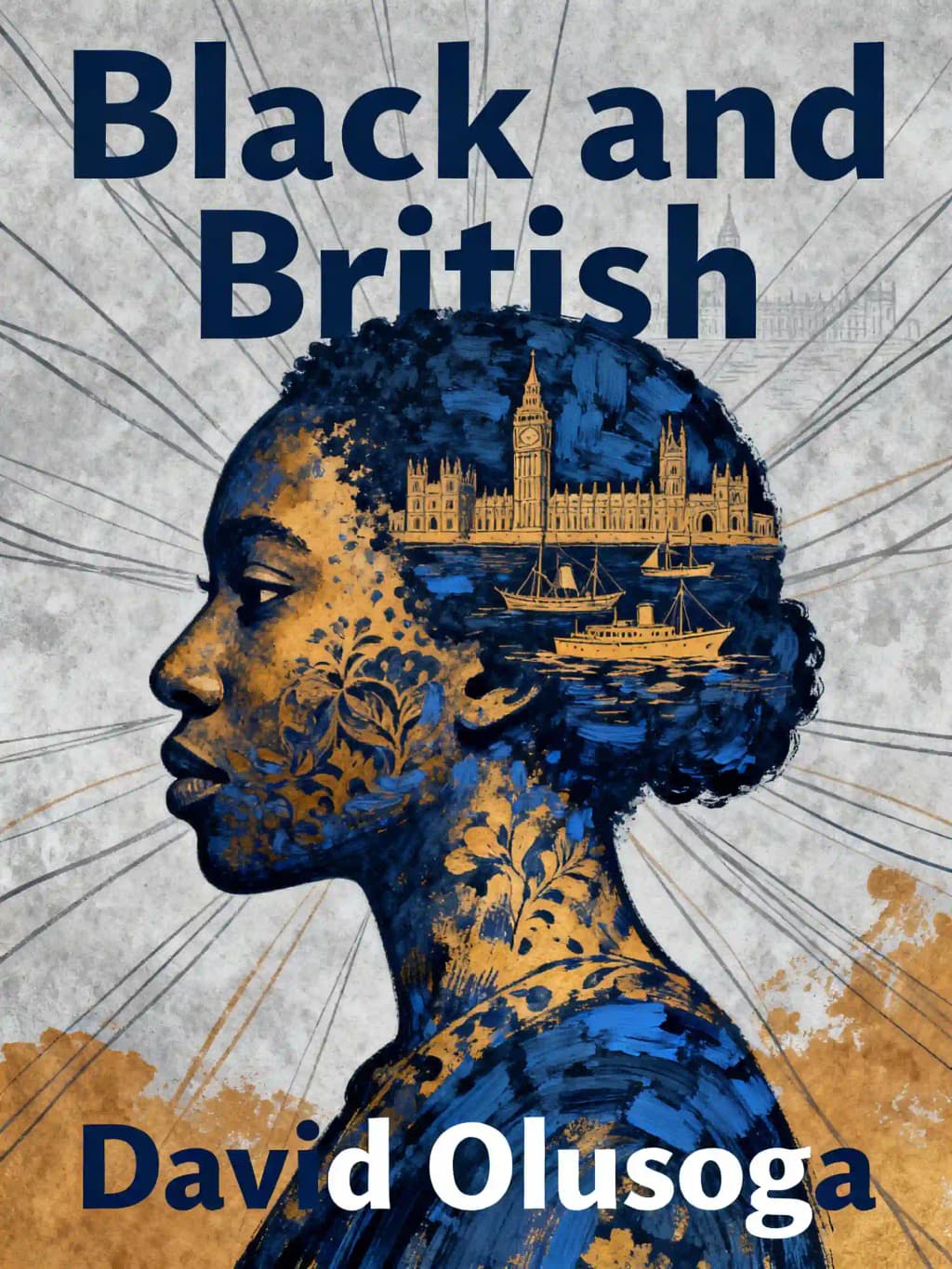
David Olusoga's "Black and British" arrives at a pivotal moment when Britain, like many nations, is reckoning with its colonial legacy and the multicultural society it has become.
This groundbreaking work has earned praise from figures ranging from Baroness Doreen Lawrence to novelist Zadie Smith, who called it "an essential rewriting of British history."
By meticulously documenting the Black presence in Britain from Roman times to the present, Olusoga doesn't just add color to a monochrome historical canvas-he fundamentally transforms our understanding of what it means to be British.
第2章
Tracing Britain's Forgotten African Connections
The first encounters between Britons and Africans occurred not during the age of empire or the slave trade, but nearly two millennia ago when Britain was merely a cold, distant province of Rome's multicultural empire.
Archaeological discoveries like the "Ivory Bangle Lady" found in York-a high-status mixed-race woman of North African descent who died in her early twenties during the third century AD-and the "Beachy Head Lady," a young African woman who lived in southeast England around AD 125-245, provide tangible evidence of this early presence.
Their careful burials and good physical condition suggest they weren't enslaved but held respected positions in Roman British society.
After Rome's fall in the fifth century, Britain was largely cut off from Africa for a millennium.
The rise of Islam created political, religious, and cultural barriers north of the Sahara.
Medieval Europeans' understanding of Africa came primarily through ancient writers like Homer, Herodotus, and Pliny, whose accounts mixed accurate observations with fantastic speculation.
The Hereford Cathedral's Mappa Mundi (c.1300) depicted Africa as home to monstrous races like the Blemmyes (people with faces on their chests).
When England finally entered the African trade in the 1530s, it was as traders rather than colonizers.
The relationship between Europeans and Africans during this period was fundamentally different from later colonial encounters.
African kingdoms like Oyo, Dahomey, Akan, and Benin had sophisticated administrative systems and military power that often made the sickly, inexperienced Europeans look unimpressive.
The Dutch trader Pieter de Marees noted in 1602 that Africans had clear understanding of their commodities' value and were "very ware in theyr bargenynge, and wyl not lose one sparke of golde of any value."
第3章
From Elizabethan 'Blackamoors' to Georgian Servants
The late 16th century marked a pivotal shift in Anglo-African relations with John Hawkins' pioneering of the English triangular slave trade.
In October 1562, he arrived in Sierra Leone where he "got into his possession, partly by the sword and partly by other means, 300 Negroes at the least," then sailed to Hispaniola to exchange them for "hides, ginger, sugars, and some pearls."
His profitable venture proved that English ships could break into the Spanish slave trade, attracting elite investors including Queen Elizabeth I herself.
As Britain's involvement in slavery grew, so did attempts to justify it.
The physical difference between Europeans and Africans, particularly skin color, posed profound challenges to sixteenth-century thinkers.
Having rejected environmental explanations for skin color, many turned to scripture, specifically the biblical story of Noah's sons.
The "Curse of Ham" became particularly significant-though neither race nor skin color is mentioned in Genesis, the story became racialized, with blackness viewed as the physical marker of this ancient curse.
This biblical interpretation would later be deployed as justification for slavery.
By the 18th century, Britain had become the dominant slave-trading nation in the North Atlantic.
The wealth generated transformed cities like Bristol, Liverpool, and Glasgow into boom towns of global commerce.
The Industrial Revolution-celebrated through heritage sites and museums-is typically remembered for coal, iron, and factory towns, while the cotton industry that employed 1.5 million people by Victoria's reign is divorced from its source material: cotton harvested by enslaved Africans in America.
第4章
The Somerset Case and the Path to Abolition
The economic transformation brought by slavery brought thousands of black people to Britain-some enslaved, some free-establishing a continuous black presence that continues unbroken to the present day.
These black Georgians became recognized symbols of Britain's new age of global commerce, prosperity and brutality.
Black Georgians were scattered throughout London rather than concentrated in distinct communities.
They worked as household servants, liveried coachmen, pageboys, army bandsmen, sailors, Thames bargemen, dockworkers, and tavern employees.
Some lived in desperate poverty alongside equally impoverished whites, forming partnerships, friendships and marriages across racial lines.
The forms of slavery practiced in Britain were racially based but more complex than the rigid plantation systems of the Americas.
Some enslaved people, particularly children sold to wealthy families, discovered the boundaries between slavery and service were less defined in Britain.
The most fortunate received education from their "owners" or were apprenticed to trades.
The remarkable social mobility achieved by famous black Georgians like Ignatius Sancho, Phillis Wheatley, Olaudah Equiano, Francis Barber and Bill Richmond resulted from both their exceptional talents and the educational opportunities provided by well-connected families.
When given access to education, some black servants demonstrated remarkable abilities.
Phillis Wheatley, who became a servant to the Wheatley family of Boston at age eight, mastered English with astonishing speed before learning French and Latin.
Her published neo-classical poetry was ecstatically received in Britain and parts of America.
第5章
The Province of Freedom and Sierra Leone
The legal status of slaves in Britain remained deeply ambiguous until the landmark Somerset case of 1772.
When James Somerset, a Virginia slave owned by Charles Stewart for twenty years, escaped after being brought to London, he was recaptured and chained aboard a ship bound for Jamaica.
Somerset's godparents secured a writ of habeas corpus from Lord Mansfield, and Granville Sharp assembled an impressive legal team to fight for his freedom.
After months of legal arguments, Mansfield finally ruled that the "power of a master over his slave" could only be permitted if recognized by the country's law.
His famous words-"It is so odious, that nothing can be suffered to support it, but positive law"-concluded with "the black must be discharged."
Though Mansfield attempted to limit the case's legal scope, his reluctant judgment had far-reaching consequences, emboldening abolitionists and enraging slave owners.
The abolition movement began as discontent among minority religious groups in the 1770s-80s and grew into a national movement that rejected a trade Britain had perfected.
In 1787, the Society for Effecting the Abolition of the Slave Trade was formally established by twelve men-nine Quakers and three Evangelical Anglicans.
The movement pioneered mass campaigning techniques, publishing thousands of pamphlets, gathering 1.5 million petition signatures (when Britain's population was just 12 million), and organizing boycotts of slave-produced goods.
Particularly powerful were the autobiographies of formerly enslaved people like Ottobah Cugoano and Olaudah Equiano, whose bestselling "Interesting Narrative" became a literary sensation of the late eighteenth century.
Together with other eighteenth-century black Britons, they formed the Sons of Africa, a group of formerly enslaved men who met to fight against slavery.
After decades of struggle, William Wilberforce's final bill to abolish the slave trade passed both houses, receiving Royal Assent on March 25, 1807.
The British slave trade, begun in the 1660s under Charles II, was "utterly abolished, prohibited and declared to be unlawful."
Between 1789-1807, while this political battle was fought, an estimated 767,000 Africans were transported to slavery in British ships.
第6章
Britain's Anti-Slavery Crusade
In the aftermath of the American Revolutionary War, approximately 3,000 black loyalists who had escaped American slavery during the conflict were settled in Nova Scotia.
These individuals had fought for or supported the British Crown in exchange for promises of freedom and land.
However, the reality in Nova Scotia proved harsh - despite explicit promises of 100-acre plots, most received marginal lands of poor quality or nothing at all.
They faced discrimination, harsh winters, and inadequate provisions, leading to widespread poverty and discontent among the settler community.
In 1790, Thomas Peters, a former slave from North Carolina and Revolutionary War veteran who had risen to become a leader among the black loyalists, embarked on a bold journey to London.
He carried with him a petition of grievances from 200 black loyalist families, documenting their dire conditions and broken promises.
His advocacy caught the attention of British abolitionists and the Sierra Leone Company, leading to an ambitious plan to resettle the Nova Scotian blacks in West Africa, in what would become known as the "Province of Freedom."
Fifteen ships, forming what became known as the Freedom Fleet, departed Halifax in January 1792.
The seven-week voyage across the Atlantic was treacherous, with passengers battling storms, disease, and uncertainty.
Upon arrival, the settlers faced the daunting task of building Freetown literally from the ground up.
They cleared dense elephant grass, constructed rudimentary shelters, and established a pioneering community that gathered beneath an enormous cotton silk tree - a living landmark that would become a powerful symbol of Sierra Leone's quest for freedom and democracy.
The first year proved especially challenging.
Malaria and other tropical diseases claimed nearly 200 lives, while conflicts with local Temne people and the Sierra Leone Company's strict regulations tested the settlers' resolve.
Despite these hardships, the settlement persevered, establishing schools, churches, and a distinctive Krio culture that blended African, American, and British influences.
Sierra Leone took on new significance after Britain's abolition of the slave trade in 1807, becoming the primary base for Britain's anti-slavery campaign in West Africa.
The Royal Navy's West Africa Squadron, operating from Freetown, intercepted slave ships along the coast.
Between 1808 and 1863, approximately 50,000 liberated Africans - known as "recaptives" - were settled in Freetown.
These individuals came from diverse ethnic backgrounds across West Africa, including Yoruba, Igbo, and Kongolese peoples, who had been destined for plantations in the Americas.
Their integration into Freetown society added new layers of cultural complexity to the settlement and contributed significantly to the development of modern Sierra Leone's multicultural identity.
第7章
Britain's Naval Campaign Against the Slave Trade
By the Civil War's eve, the four million enslaved Africans in America constituted the most valuable commodity in the American economy, with nearly half employed in cotton cultivation.
The South had grown so wealthy from cotton that by the 1860s it enjoyed the world's highest per capita income, surpassing even Britain's industrial heartlands.
The Deep South formed one half of a global, transatlantic industrial economy, with the Cotton Kingdom serving as the economic twin of Manchester-"Cottonopolis."
This economic partnership was so vital that Southern planters often boasted that "Cotton is King" and believed their monopoly on cotton production made them invulnerable to Northern aggression.
When war came in April 1861, Lincoln's government declared a blockade of all Southern ports, implementing what became known as the "Anaconda Plan" to strangle the Confederate economy.
By early 1862, Britain's cotton imports fell to half their pre-war levels, with American imports at just 4% of peacetime volume.
The impact was devastating - cotton prices soared from 6.5 pence per pound to 27.5 pence.
By October 1862, around 58% of Lancashire looms stood idle, and by year's end, 312,200 workers-70% of the labor force-were unemployed in what became known as the Lancashire Cotton Famine.
Relief committees were established across Britain, and mill workers, despite their own hardships, largely supported the Union cause.
Liverpool became the Confederate's most steadfast British ally during the Civil War, serving as the unofficial European headquarters for the Confederate government.
It was said more Confederate flags flew over the Mersey than the Mississippi.
The city's merchants, who had grown wealthy from the cotton trade, actively supported the Confederate cause by building blockade runners and privateers.
James Bulloch, the Confederate Navy's chief foreign agent, operated from Liverpool, successfully commissioning several warships including the infamous CSS Alabama.
However, the tide of British opinion turned decisively in late 1862 when Lincoln issued the Emancipation Proclamation.
After the proclamation, the war was understood in Britain as an armed struggle against slavery, and British anti-slavery fervor re-emerged.
Working-class Britons, despite their economic suffering, held massive pro-Union demonstrations.
Manchester workers sent a letter of support to Lincoln, who responded by thanking them for their "sublime Christian heroism."
Britain's cotton industry gradually adapted by sourcing cotton from India, Egypt, and Brazil, permanently altering global cotton trading patterns and diminishing the South's economic leverage.
第8章
Cotton, Civil War, and British Hypocrisy
In August 1884, the British and Foreign Anti-Slavery Society held what would be the last great anti-slavery gathering in British history.
Just three months later, the Berlin Conference began what would become known as the "Scramble for Africa."
Representatives of European powers gathered to establish rules for bringing Africa under their control, with no African representatives invited.
For Britain, this marked the transition from coastal anti-slavery imperialism to annexation and control of the interior.
The speed was breathtaking: in 1870, Africans ruled 90% of their continent; by 1900, Europeans controlled 90%.
Britain emerged victorious, with one in three Africans becoming British subjects-45 million people, more than Britain's entire population.
This conquest was enabled by new technologies: steam-powered gunboats navigated rivers into Africa's heart; quinine allowed Europeans to survive in previously deadly tropical regions; and Maxim machine guns and breech-loading rifles overwhelmed African armies still equipped with ancient muskets.
The expansion of the British Empire into Africa failed to deliver promised wealth but succeeded in offering spectacle.
It changed how Britons viewed the outside world, particularly the new peoples brought under British rule.
These observations were tainted by rapidly evolving forms of racism.
Older ideas placing races on a "scale of humanity" with whites at the top were given pseudoscientific backing through Social Darwinism and craniometry.
第9章
From Moral Mission to Imperial Scramble
The First World War brought thousands of Black colonial subjects to Britain as soldiers, sailors, and munitions workers.
When the war ended, racial tensions exploded in port cities like Liverpool, Cardiff, and London during the "Red Summer" of 1919.
White mobs attacked Black communities, with some victims being war veterans who had served Britain.
Charles Wootton, a young Black sailor, was chased through Liverpool's streets and drowned in the Queen's Dock while a crowd of thousands watched and cheered.
The racial tensions revealed a fundamental contradiction in British imperial identity.
White mobs viewed black people as foreigners with no legitimate claims to Britishness, attacking even veterans who had volunteered and risked their lives in service.
Colonial Secretary Lord Milner expressed concern about the riots' potential colonial impact: "These riots are serious enough from the point of view of the maintenance of order in this country, but they are even more serious in regard to their possible effect in the colonies."
During World War II, approximately 130,000 African American GIs were stationed in Britain-the largest Black population in British history until that point.
America sent a racially segregated army to Britain in 1942, reflecting the Jim Crow system of the American South.
The British public proved extraordinarily welcoming to the African American troops, though racial incidents occurred, particularly when white American soldiers attacked Black GIs who socialized with white British women.
第10章
The Long Road to Modern Multicultural Britain
The arrival of the Empire Windrush in 1948 with 492 West Indian passengers has become a symbolic moment in Black British history.
However, there were more Black people in Britain in 1944 (around 150,000, mostly African American GIs) than in 1948 (fewer than 20,000).
Britain's Black population likely didn't return to its 1944 peak until around 1958, after a decade of post-war immigration.
The post-war period saw increasing racial tensions, exemplified by the 1964 Smethwick election where Conservative candidate Peter Griffiths won using the slogan "If you want a nigger for a neighbour, vote Labour."
Though Labour Prime Minister Harold Wilson denounced Griffiths as a "parliamentary leper," both major parties adopted increasingly restrictive immigration policies.
Enoch Powell's infamous 1968 "Rivers of Blood" speech went beyond mere concerns about immigration numbers, asserting that Black and Asian people could never assimilate into British society regardless of birthplace.
Using racist language like "wide-grinning piccaninnies" to describe British-born children of West Indian origin, Powell claimed "The West Indian or Asian does not, by being born in England become an Englishman."
The 1980s saw Black communities increasingly asserting their rights through protest and resistance.
The 1981 New Cross house fire, where thirteen young Black people died, galvanized approximately 20,000 Black Londoners to march in protest.
The following month, the Metropolitan Police launched "Operation Swamp 81" in Brixton-an insensitively named initiative that ignited riots that spread to Birmingham, Manchester, and Liverpool.
第11章
A Shared History, A Shared Future
For Black Britons in the 1980s, reclaiming their lost history became crucial to establishing their sense of belonging and identity in British society.
The introduction of Black History Month, imported from America, served as a catalyst for uncovering a Black British past that had been largely buried in historical archives and public consciousness.
Historical figures emerged from obscurity - not just Olaudah Equiano in his cravat and scarlet coat, but others like Ignatius Sancho, the composer and writer who became the first known Black Briton to vote in a British election, and Mary Seacole, the Jamaican nurse who served British soldiers in the Crimean War.
The demographic landscape has shifted dramatically since those early efforts at historical recovery.
Today, Britain's black population stands at around 2 million (3% of the national total), with over a million concentrated in London alone.
The 2011 census revealed a significant demographic shift: between 2001-2011, the British African population doubled, reflecting new patterns of migration and settlement.
Communities from Nigeria, Ghana, Somalia, and other African nations have established vibrant cultural centers across British cities.
For the first time since the Atlantic slave trade era, most black Britons now trace their roots directly to Africa rather than the Caribbean or the Americas.
The commonly accepted "Windrush Myth" - which places the beginning of Black British history with the arrival of the Empire Windrush in 1948 - can obscure centuries of earlier presence and contribution.
Historical records show Black presence in Roman Britain, Tudor courts, Georgian London, and Victorian society.
Archaeological evidence, parish records, and historical documents reveal Black soldiers in medieval armies, sailors in Tudor navies, and merchants in Georgian trading houses.
This longer view challenges the notion that Black British history began with post-war immigration.
As Olusoga meticulously documents throughout his work, Black British history isn't an optional addendum or occasional splash of color in mainstream British history-it's fundamental and essential to understanding Britain's past.
Through centuries of marriages, cultural exchange, and shared experiences in both times of peace and conflict, Black British history has been woven into the very fabric of British society.
From the Black trumpeters in Henry VIII's court to the thousands of Black servicemen in both World Wars, these stories represent not just Black history, but British history in its fullest sense.
This integrated approach to understanding the past strengthens our comprehension of how modern British society evolved and continues to develop.