第4章
The Wizarding Family: Cast Relationships Behind the Scenes
Unlike Draco Malfoy's cold, brutal family, my real family was close-knit, loving, chaotic and supportive. But being Draco gave me a second family: my wizarding, death-eating family. While the Malfoys are toxic in the story, in real life my Malfoy family became almost as close as my blood relatives. There's a reason I still call Jason Isaacs "Dad."
Meeting Jason for the first time terrified me. Our first scene together was outside Borgin and Burkes during Chamber of Secrets. This charming man introduced himself as my father, immediately taking me under his wing and making me feel at ease. He offered tea, ran lines with me, and had everyone laughing with his stories. Then suddenly: "Quiet on set!" While I tensed up, Jason kept talking. "Roll cameras!" I took a breath; Jason didn't. "And... action!" Mid-punchline, he transformed completely, turning to me with pure hatred. Jason was gone. This was Lucius.
The transformation was disorienting. No acting was required for me to appear terrified. When they called "Cut!" Lucius dissolved and Jason returned, full of concern: "My darling boy, did I hurt you?" Jason's ability to instantly transform was unique-most adult actors had routines to get into character, but he could become Lucius at the snap of a finger. From day one, he treated me as an equal, offering career advice and encouragement without judgment.
Ralph Fiennes created an entirely different atmosphere. Despite the green dots on his face for VFX nose removal and sometimes seeing Voldemort casually drinking tea between takes, his presence was weighty. During the Battle of Hogwarts finale, which we spent weeks blocking, I walked toward Voldemort dozens of times. In one take, he made a slight arm movement that confused me-was he trying to hug me? I cautiously approached, and he gave me perhaps the most uninviting hug ever captured on film. It chilled me then and gives me goosebumps now. At the London premiere, the audience watched in shocked silence at this twisted moment. At the American premiere, bizarrely, the audience erupted in laughter!
Helen McCrory joined as my mother Narcissa in the sixth film. She was effortlessly cool-quietly rolling cigarettes with licorice papers, never speaking just to hear her own voice. Though she could look stern, she was soft-natured and generous with advice. Her transition into character wasn't dramatic like Jason's or Ralph's, but when she became Narcissa, something in her eyes revealed both Malfoy coldness and maternal softness.
Years after Potter ended, I was living in Venice Beach when Emma Watson came to visit. While I could blend in as a beach bum, Emma's celebrity status made our outing anything but normal. The moment we stepped outside, people recognized her, shouting her name and even chasing us along the boardwalk. We found temporary refuge under a lifeguard stand, reflecting on our journey from childhood adversaries to close friends.
Our relationship hadn't started well. During filming, a clear Gryffindor/Slytherin divide existed-Daniel, Emma and Rupert in one clique; Jamie, Josh and I in another. Rumors circulated about our relationship, which I denied despite there being more truth than I admitted. I wasn't in love with Emma, but I loved and admired her in a way I couldn't explain. We became kindred spirits who understood each other deeply.
第5章
The Masters of Magic: Learning from Acting Legends
We had two Dumbledores during the films. Sir Richard Harris played the role in the first two movies before his passing, when Sir Michael Gambon took over. I had minimal interaction with Harris, but he once took me aside outside the Great Hall, looked at me in a very Dumbledore-like way, and simply said: "You're good." Nothing more. I didn't fully appreciate then that I was receiving praise from a legend.
Michael Gambon was entirely different from Harris-more showman than wise elder, young at heart despite playing the old wizard. He could say almost anything and get away with it. Unlike the rest of us who were required to use studio drivers, Gambon would drive himself to work in his Audi R8 or Ferrari, parking inconveniently outside Door 5. I'd run from the makeup chair with peroxide and foil in my hair just to check out his car.
My most significant scene with him was atop the lightning-struck tower in Half-Blood Prince, where Draco has Dumbledore at wandpoint. I kept stumbling over one line despite thorough preparation. During a break, Gambon invited me for "a breath of fresh air"-our code for a cigarette. Outside, I apologized profusely for messing up. He deadpanned: "Dear boy, do you have any idea how much they pay me per day? At this rate, if you keep fucking it up, I'll have a new Ferrari by next week." Instantly, the pressure lifted.
Alan Rickman was another legend who initially terrified me. During Half-Blood Prince, after Snape kills Dumbledore, we filmed a scene where the Death Eaters flee through the Great Hall. Alan had insisted on extremely long, flowing robes that dragged behind him like a wedding train. Before a take, he warned us with his most intimidating Snape-like stare: "Don't... step... on... my... fucking... cloak." Despite my internal mantra not to step on the cloak, halfway through the Great Hall, I did exactly that. Alan's head jerked back with a strangled "Aaaargh!" I apologized profusely, but he said nothing.
In another instance of Alan's true character, he insisted that I be given a proper director's chair to match the height of the veteran actors. Despite my protests that my smaller chair was fine, he quietly but firmly demanded I be treated as an equal. That small kindness revealed volumes about the man.
Now that Alan, Richard Harris, John Hurt, Helen McCrory and others from the films have passed away, I find myself in a kind of purgatory-only as an adult do I truly understand their profound influence. Life has mirrored art-just as in Potter we played young wizards learning from brilliant masters, in reality we were raw child actors absorbing wisdom from Britain's finest.
第6章
Harry and Draco: Two Sides of the Same Coin
Nobody can truly understand what it was like to be Daniel Radcliffe-carrying more pressure than anyone else in the Potter project. While I could make typical teenage mistakes with minimal consequences, Daniel lived under relentless scrutiny, with paparazzi lurking around every corner and tabloids analyzing his every move. The weight of the entire franchise rested almost entirely on his shoulders, from age eleven onwards. Even a simple trip to get ice cream could become front-page news if he happened to spill any on his shirt.
I deeply respect how Daniel handled this pressure with remarkable grace and humility. Though we initially kept our distance-exchanging only British nods and brief greetings in the hallways of Leavesden Studios-we gradually became friendlier over the years. We found common ground bonding over cricket matches during lunch breaks, competing over obscure Simpsons trivia between takes, and sneaking cigarettes behind the studio warehouses (often joined by Michael Gambon as "Dumbledore" for what we jokingly called "a breath of fresh air"). These stolen moments of normalcy became precious reprieves from the intensity of filming.
As I got to know him better, I realized how remarkably similar we were at our core-both hyper-aware of our surroundings and emotionally sensitive to others' feelings and reactions. I believe if I'd been an only child like Daniel, raised with that singular focus of attention, I'd have ended up more like him-more measured, more diplomatic. And if he'd had my three older brothers' rough-and-tumble influence, he might have been more like me-more prone to testing boundaries. This symmetry fascinatingly mirrors the parallel paths of Harry and Draco in the stories.
Daniel's unwavering commitment to improving as an actor was truly inspiring to witness. Though none of us really knew what we were doing in those early films, stumbling through scenes with more enthusiasm than technique, he refused to cruise on auto-pilot. He worked tirelessly with acting coaches, studied his craft between films, and constantly pushed himself to deliver more nuanced performances. He had perhaps the hardest role of all-Harry needed to be the solid, reliable center around which all the more colorful characters could orbit, yet still draw the audience's eye and move them emotionally without resorting to scenery-chewing.
When Draco's character finally developed meaningful depth in Half-Blood Prince, Director David Yates challenged me to evoke just "one percent of empathy" for this boy who had no real choice in his path-dominated by his controlling father, coerced by ruthless Death Eaters, and terrified by Voldemort's presence in his home. Our bathroom crying scene (before Harry uses sectum sempra) became a crucial moment showcasing this development, though I credit the nuanced writing more than my own performance. The vulnerability in those scenes revealed the scared child beneath Draco's practiced sneer.
Draco's character arc reaches its pivotal moment at Malfoy Manor when he chooses not to identify the disfigured Harry-the boy who had no choice finally making one that could cost him everything. This crucial scene illustrates why I see Harry and Draco as two sides of the same coin: Harry, the product of a loving family willing to die protecting him; Draco, the product of a family that manipulates and bullies him into submission. Yet when finally free to make their own choices, they reach similar moral destinations, choosing what's right over what's easy.
第7章
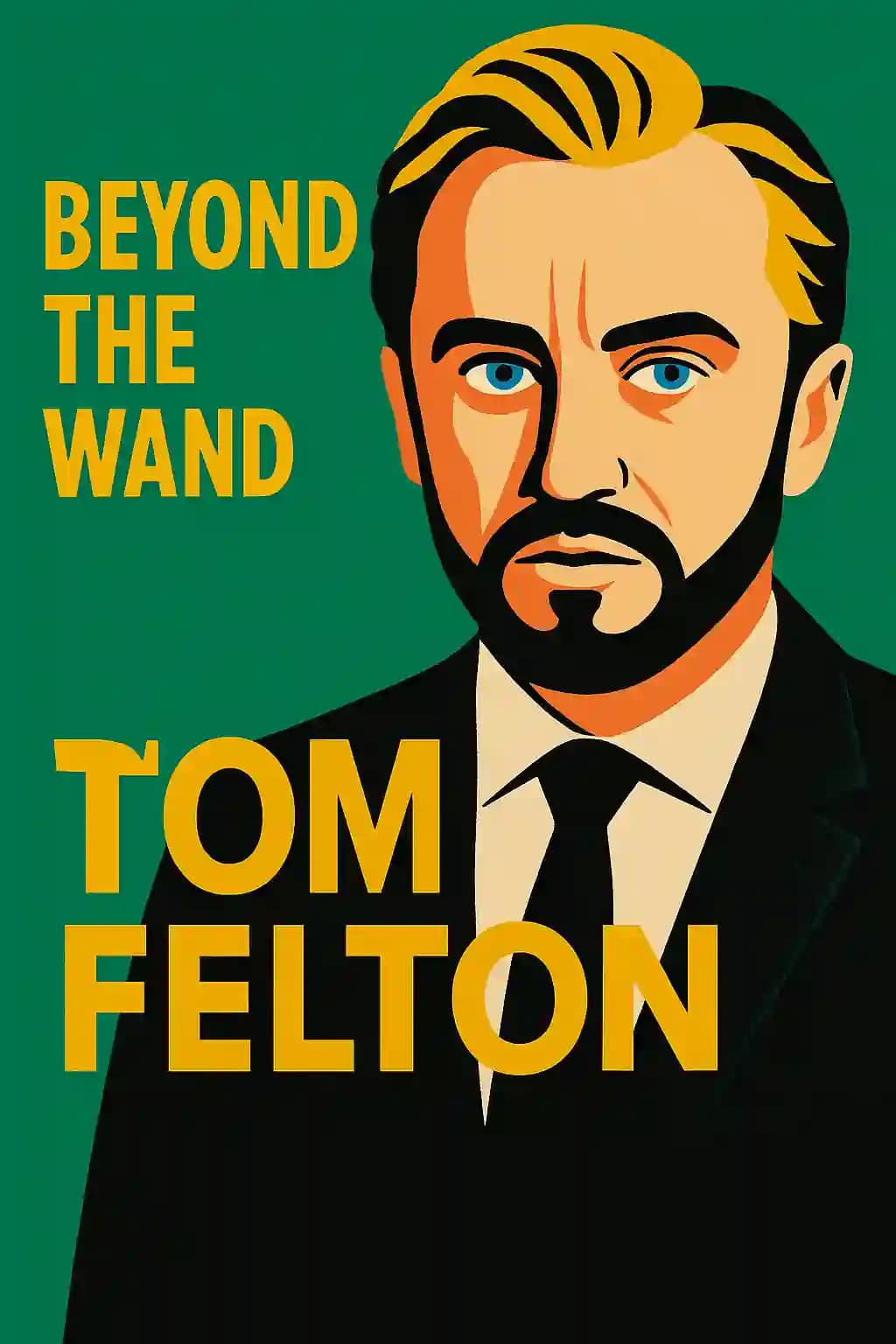
Beyond the Wand: Life After Potter
My final day filming Potter was emotional-a scene of Draco leaving the battle on a rubble-strewn bridge that never made the final cut. I managed to keep composed while saying goodbye to the crew, but once in the car, I bawled uncontrollably. Many of my closest friends were crew members, not just actors, and I was sad knowing life would move us apart.
Rise of the Planet of the Apes was a one-off success-the first and last time I'd be offered a major role without auditioning. Left to my own devices, I might have abandoned acting altogether for professional fishing. The harsh reality of Hollywood auditions quickly humbled me-from being ignored by bored casting directors to bombing with inconsistent American accents. Yet I developed a strange addiction to the adrenaline rush of the process.
LA transformed from a lonely place into a seductive bubble of privilege. Unlike in England where fame was met with sarcasm, Hollywood massaged my ego with effusive praise and VIP treatment. Designer clothes appeared for free, BMW lent me luxury cars, velvet ropes parted at exclusive clubs, and I was treated as a "bona-fide film star"-something I'd never experienced growing up with three older brothers who kept me firmly grounded.
Barney's Beanery became my sanctuary-an old dive bar plastered with decades of memorabilia where I could be myself among people who didn't care about Hollywood status. I transformed from someone who barely drank to regularly downing pints and whiskey before sunset. The drinking became a habit that affected my professionalism.
The night before my life changed forever, I spent the night drinking instead of resting for an important meeting. When I arrived at my managers' office, I found seven people waiting-Jade, my agents, lawyer, managers, and a strange bald man. It was an intervention. Despite my protests that I only had a few beers and occasional spliffs, they insisted I go immediately to rehab or lose their representation.
After a dramatic escape from rehab and ending my relationship with Jade, I faced the truth about my drinking. Though I didn't believe I needed rehabilitation, I recognized I'd been using alcohol to mask deeper issues. I promised myself to be more honest about my feelings and more conscious about my drinking. Eventually, I checked myself into a smaller, family-run rehab facility where I formed deep bonds with fellow patients, caring more about their problems than my own-the ultimate mental health tool.
第8章
The Magic That Remains: Finding Purpose and Gratitude
I've come full circle now, living in North London with my morning routine of walking my dog Willow through the quiet streets at dawn, making my childish ham and cheese sandwich (still cut diagonally, just as my mother did), and cycling to the West End for performances. This journey has taught me the profound power of storytelling-something I nearly dismissed as a young actor when auditioning for what seemed like a "ridiculous-sounding" story about a boy living under stairs. Looking back, my skepticism seems almost comical given how that story would transform my life.
Now I see how Harry Potter unified people worldwide in ways I never imagined possible. From Tokyo to Toronto, Sao Paulo to Sydney, the story resonates across cultures and languages. I'm carefully saving those books and films, preserving them like precious artifacts to share someday with my own little Muggles. That pivotal night in Malibu when I fled rehab, one of my "three kings" asked if I was rich. The question haunted me until I truly understood what he meant-true wealth isn't measured in Gringotts gold but comes from family, from helping others, from the ripple effect we have on those around us.
I've learned through hard experience that mental health struggles aren't signs of weakness, but rather common human experiences that deserve compassion and understanding. Talking about feelings isn't just essential-it's revolutionary in breaking down barriers of shame and isolation. Therapy shouldn't carry any more stigma than a dental check-up-it's simply time devoted to self-care, which is always time well spent. When numbness unexpectedly returned years later, like an unwelcome ghost from my past, I proactively sought help, finally accepting my predisposition to mood changes as part of who I am, not a flaw to hide.
The line between Tom Felton and Draco Malfoy isn't black and white but painted in countless shades of gray, each adding depth to both character and actor. My grandfather, in his wisdom, helped develop Draco's iconic sneer through detailed mirror practice sessions, teaching me to "imagine smiling about something terrible" while keeping it small and slimy-a technique I still use today. He encouraged me to channel my real-life frustrations as the youngest sibling, drawing from authentic memories of times my brothers called me "maggot" or "runt." These mirror sessions taught me something crucial about the craft of acting-the art of bringing elements from your own life and transforming them into something entirely different yet authentically true.
I've come to see myself as "a placeholder in people's memories," a living bridge transporting them to different times and places in their lives. Though fans sometimes react in unexpected ways-from spontaneous tears to crushing hugs-I try to remember their reactions reflect the deep importance these stories hold in their hearts. The Potter experience continues growing in popularity, magically connecting thirteen-year-olds with thirty-year-olds in a shared world that transcends generations. It's become a cultural touchstone, creating bonds between parents and children, bringing strangers together, and reminding us all that magic exists in the connections we forge with each other.
I'm profoundly grateful for the Potter films that gave me unprecedented opportunities, but I'm even prouder of the passionate fans keeping the wizarding world alive through their creativity and dedication. Each day, I remind myself how fortunate I am to have a life centered on love, family, and friendship-perhaps the greatest lesson from Harry Potter itself, and one that continues to shape my journey forward.