第1章
The Mahatma's Crucible: Gandhi's Lifelong Quest for Truth
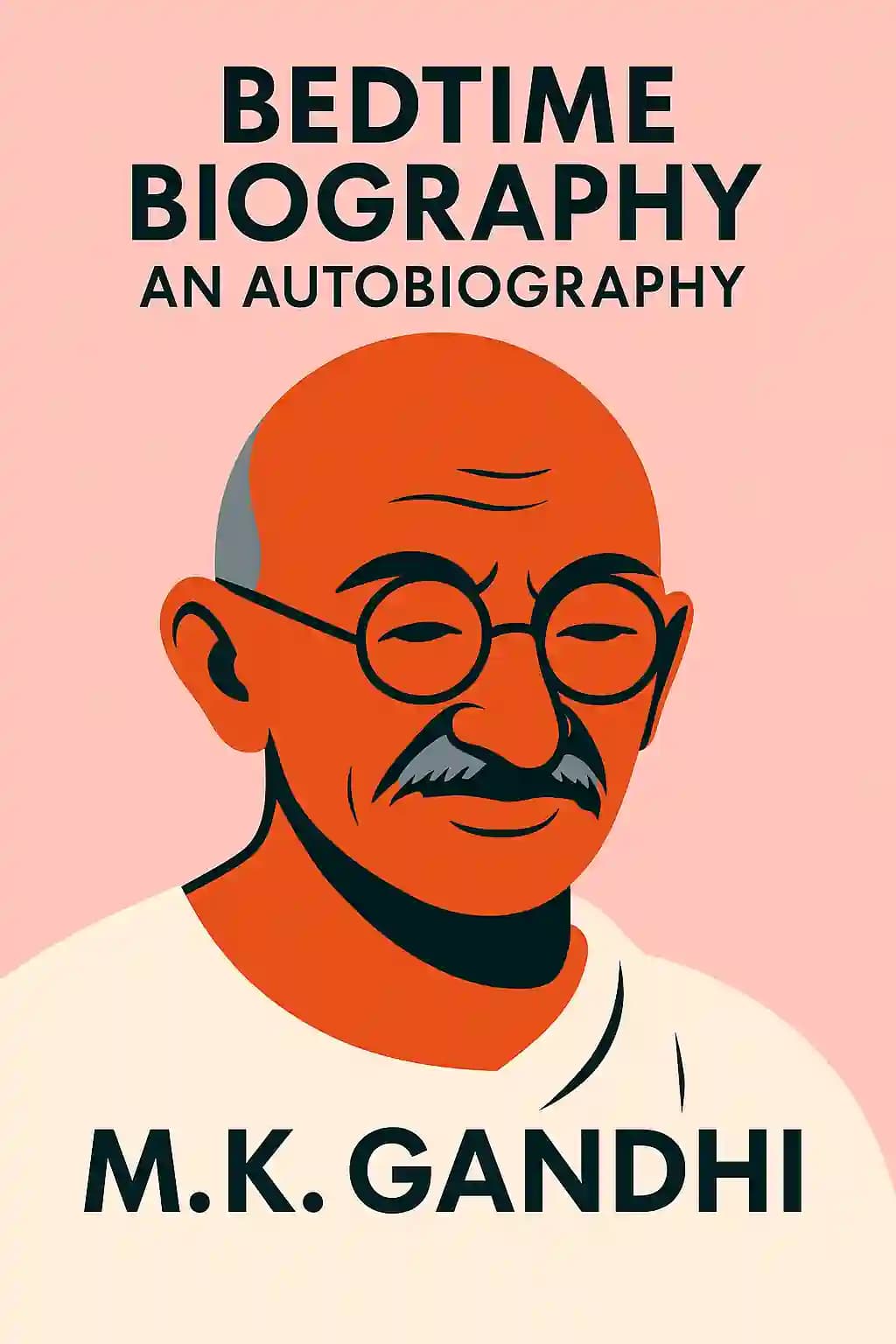
In a world where compromise seems inevitable, one man's relentless pursuit of truth stands as both challenge and inspiration. Mohandas K. Gandhi's autobiography isn't merely a historical account but a spiritual odyssey-each page revealing a soul determined to live by principles most consider impossible. "My experiments with truth," Gandhi called them, acknowledging the scientific nature of his approach to life's most profound questions. This remarkable text, translated by his trusted companion Mahadev Desai, has influenced generations of leaders from Martin Luther King Jr. to Nelson Mandela. Time magazine named Gandhi among the three most influential figures of the 20th century, and his autobiography continues to sell millions of copies worldwide, offering readers not just history but a roadmap for personal transformation. As we navigate our own moral dilemmas in an increasingly complex world, Gandhi's journey from shy lawyer to global icon reminds us that the greatest revolutions begin within.
第2章
Forged in Childhood: The Foundations of Character
Gandhi's earliest memories reveal how profoundly childhood experiences shape moral development. Born in 1869 to a family of the Bania caste in Porbandar, young Mohandas absorbed integrity from his father Karamchand, a principled prime minister who once famously saluted a Nawab with his left hand, explaining "The right hand is already pledged to Porbandar." From his deeply religious mother Putlibai, he witnessed the power of spiritual discipline as she maintained strict vows even during illness, waiting to see the sun before eating during religious observances.
Two childhood influences particularly shaped Gandhi's moral imagination. The story of Shravana's devotion to his blind parents instilled the value of filial duty, while the play Harishchandra-depicting a king who sacrificed everything for truth-captivated him so completely that he performed it countless times alone. "The ideal of truth has grown on me since then," Gandhi wrote, revealing how these early impressions planted seeds that would blossom throughout his life.
His academic performance was unremarkable, yet even as a schoolboy, his commitment to honesty stood out. When a school inspector attempted to prompt him to copy a spelling answer, the shy child refused despite pressure from his teacher's boot. This early stand for integrity foreshadowed the man who would later face down empires with the same quiet determination.
At thirteen, Gandhi was married to Kasturbai in an arranged triple wedding alongside his brothers-a practice he would later criticize despite acknowledging that "everything seemed right and proper to me then." The marriage quickly revealed his controlling tendencies as he jealously restricted his wife's movements, demanding her permission to go anywhere. "I wanted to make my wife an ideal wife," he confessed, recognizing years later how his "severities" stemmed from misguided love and possessiveness. These early struggles in his marriage would evolve into one of history's most remarkable partnerships as both Gandhi and Kasturbai grew together through decades of personal and political challenges.
第3章
Moral Awakening: Temptation, Transgression, and Truth
Gandhi's teenage years were marked by moral struggles that shaped his character through both failure and redemption. Under the influence of a rebellious friend, sixteen-year-old Gandhi began experimenting with meat-eating, convinced it would make Indians strong enough to overcome British rule. "The English are able to rule over us because they eat meat," his friend insisted, pointing to a popular schoolboy rhyme claiming meat-eaters grew "five cubits tall."
Despite his initial enthusiasm for this "reform," Gandhi's experiments with meat were haunted by guilt. After his first taste of goat meat by a riverside, he experienced nightmares of bleating goats. Though he developed a taste for meat dishes during subsequent secret meals, the deception required to hide his activities from his vegetarian parents tormented him. "The knowledge that I was lying to my mother and wife day after day gnawed at my very vitals," he confessed. Eventually, he resolved that deceiving his parents was worse than abstaining from meat, establishing a pattern of moral reasoning that would guide his later experiments.
More serious was his theft of gold from his brother's armlet to repay a debt. Overwhelmed by guilt, the fifteen-year-old Gandhi wrote a confession to his bedridden father, asking for punishment and promising never to steal again. Instead of anger, his father responded with tears that Gandhi described as "pearls of love" that "cleansed my heart" and "washed away my sin." This profound experience of forgiveness transformed their relationship and taught Gandhi a lesson in ahimsa (non-violence) that would later become central to his philosophy.
Perhaps his most painful moral failure came during his father's final illness. As a sixteen-year-old nursing his dying father, Gandhi would leave his bedside each night to be with his pregnant wife-violating religious prohibitions against marital relations during pregnancy. When his father died during one such absence, Gandhi was devastated: "I was weighed with shame and remorse," he wrote, believing that "animal passion had blinded me" and robbed him of being present for his father's final moments. The child born from these encounters lived only a few days-a consequence Gandhi believed was inevitable given his lustful state.
These youthful moral struggles reveal Gandhi not as a born saint but as a flawed human being whose greatness emerged from his willingness to confront his weaknesses and transform them through rigorous self-examination. His unflinching honesty about these failures makes his later moral achievements all the more remarkable and accessible.
第4章
South Africa: The Crucible of Transformation
Gandhi's twenty-one years in South Africa transformed him from an inexperienced lawyer into a formidable leader. Arriving in 1893 to handle a legal case, he immediately encountered the harsh reality of racial discrimination. At Maritzburg station, he was forcibly ejected from a first-class compartment despite holding a valid ticket, simply because he was "colored." Left shivering in the cold waiting room without his overcoat, Gandhi faced a pivotal decision: should he fight for his rights, return to India, or continue his journey? This moment of humiliation became a catalyst for his life's mission.
"I began to think of my duty," he wrote. "Should I fight for my rights or go back to India?" He decided the prejudice he faced was merely a symptom of a deeper disease that he must help root out. Further indignities followed-a stagecoach "leader" boxed his ears and tried to force him to sit on dirty sackcloth at his feet. When Gandhi refused this degradation, clinging desperately to the brass rails as the man beat him, some passengers intervened, saying, "Man, let him alone. He is right."
These experiences awakened Gandhi to the systemic injustice facing Indians in South Africa. He quickly connected with the Indian community, calling a meeting where he challenged merchants on truthfulness in business, emphasized sanitation improvements, and urged unity across religious and regional divisions. "I had been thinking of the problem all along," he wrote. "I saw that South African Indians were faced with political disfranchisement, economic ruin, and social degradation."
His legal practice flourished, but Gandhi found deeper satisfaction in humanitarian work. When plague broke out in a nearby gold mine, he and a small group of volunteers-including Dr. William Godfrey and four young Indians from his office-bravely nursed infected patients through the night. "That night was a memorable night," he recalled, describing how they managed the crisis until municipal authorities established a proper hospital camp.
The turning point in Gandhi's South African journey came during a train journey to Natal when he read John Ruskin's "Unto This Last." The book so completely captivated him that he couldn't sleep, arising at dawn determined to transform his life according to its principles: that individual good exists in collective welfare, that all honest work has equal value, and that agricultural and handicraft labor represent the life worth living. This epiphany led to the establishment of the Phoenix Settlement in 1904-a community where everyone labored equally and received the same modest allowance regardless of color or nationality.
By 1906, Gandhi had taken a vow of brahmacharya (celibacy), believing it necessary for one dedicated to public service. This self-purification became a preliminary to his development of Satyagraha-"truth-force" or "soul-force"-as a method of nonviolent resistance. When the Transvaal government passed discriminatory legislation against Indians, Gandhi led the community in peaceful resistance, willingly accepting imprisonment rather than submitting to unjust laws. "The spirit of Satyagraha rightly understood should make the people fear none and nothing but God," he explained, establishing principles that would later transform India's struggle for independence.
第5章
The Alchemy of Leadership: Transforming Suffering into Strength
Gandhi's approach to leadership emerged organically through three pivotal campaigns in India that revealed his extraordinary ability to transform collective suffering into moral and political power. The Champaran Satyagraha of 1917 marked his first major Indian initiative, responding to the plight of indigo farmers forced to grow the crop on portions of their land for European planters-the exploitative tinkathia system. When a determined farmer named Rajkumar Shukla literally "captured" Gandhi and brought him to Bihar, Gandhi knew nothing about indigo cultivation but immediately recognized the injustice.
Upon arrival in Motihari, authorities served Gandhi notice to leave Champaran. His refusal became India's first direct object-lesson in Civil Disobedience. "I have disregarded the order served upon me," he told the magistrate, "not for want of respect for lawful authority, but in obedience to the higher law of our being-the voice of conscience." The government, recognizing the potential for widespread unrest, withdrew the case and allowed his inquiry to proceed with official help.
Gandhi's methods revealed his genius for organization. He established a disciplined team of volunteers who meticulously recorded thousands of peasants' statements, cross-examining them for accuracy. Rather than politicizing the struggle, he focused on documenting facts and building relationships with both peasants and authorities. "The Champaran struggle was a proof of the fact that disinterested service of the people in any sphere ultimately helps the country politically," he observed. The inquiry led to abolition of the tinkathia system and refunds of unlawful exactions from planters.
In Ahmedabad, Gandhi mediated a labor dispute between mill workers and owners. When negotiations stalled, he advised workers to strike under strict conditions: no violence, no harassment of replacement workers, and earning bread through other honest labor during the strike. When the workers' resolve weakened after two weeks, Gandhi announced he would fast until they either reached a settlement or left the mills entirely. Though he later acknowledged this approach bordered on coercion rather than pure Satyagraha, his three-day fast succeeded in bringing the mill-owners to the negotiating table, ending the 21-day strike with a settlement.
The Kheda Satyagraha emerged from near-famine conditions when crops failed across the district. Despite government policy allowing suspension of revenue collection when yields fell below a certain threshold, officials refused to acknowledge the peasants' plight. After exhausting all peaceful means, Gandhi advised the Patidars to withhold payment until the government recognized their situation. As government pressure intensified through confiscation of cattle and property, Gandhi strengthened wavering hearts by advising them to remove crops from attached fields-leading to arrests that only galvanized the movement.
Though the campaign ended with a compromise that Gandhi found somewhat unsatisfactory, its indirect results were profound: "It awakened the peasants of Gujarat politically," he wrote, while revealing Vallabhbhai Patel's leadership potential and instilling in the Patidars awareness of their collective strength. Most importantly, it firmly established Satyagraha as an effective method for addressing grievances through disciplined, nonviolent resistance.
Through these campaigns, Gandhi demonstrated his remarkable ability to combine practical organization with moral vision, transforming ordinary people into agents of their own liberation through suffering accepted willingly rather than inflicted on others.
第6章
The Spinning Wheel Revolution: Gandhi's Economic Vision
While political resistance captured headlines, Gandhi's most revolutionary work may have been his economic vision centered on the humble spinning wheel. First described in his 1908 work "Hind Swaraj" as the solution to India's poverty, the spinning wheel (charkha) became both practical tool and powerful symbol in Gandhi's campaign for self-reliance.
When establishing the Satyagraha Ashram at Sabarmati, Gandhi introduced hand-looms with the goal of clothing community members entirely in hand-woven cloth from Indian yarn. This seemingly simple objective immediately connected them with the systemic problems facing India's textile industry: weavers' limited production, yarn supply difficulties, vulnerability to fraud, and growing indebtedness. Most critically, they discovered that fine cloth from weavers used foreign yarn, as Indian mills couldn't spin fine counts.
The search for spinning wheels proved surprisingly difficult. After extensive searching in Gujarat, a dedicated worker named Gangabehn finally discovered them in Vijapur, where people had relegated the wheels to their attics. With gentle encouragement and practical support-providing cotton slivers and guaranteeing yarn purchase-villagers gradually resumed spinning. Meanwhile, at the Ashram, Maganlal Gandhi improved the spinning wheel design, and they began manufacturing wheels and accessories.
The first Khadi (hand-spun, hand-woven cloth) cost 17 annas per yard-expensive but supported by friends committed to the principle of self-reliance. Gandhi recognized that the spinning wheel offered employment for "the semi-starved millions" of India, particularly women who could earn supplementary income while maintaining their household duties. "I have the conviction within me," he told skeptical mill-owners, "that the revival of hand-spinning and hand-weaving will make the largest contribution to the economic and the moral regeneration of India."
Mill-owners naturally questioned whether spinning wheels could compete with power machinery. Gandhi's response revealed his deeper understanding of economics: "Machinery has its place; it has come to stay. But it must not be allowed to displace necessary human labour." He saw the charkha not as a rejection of modernity but as appropriate technology that distributed economic power rather than concentrating it.
The Khadi movement faced practical challenges-the first cloth was rough and expensive compared to mill-made alternatives. Yet Gandhi persisted, understanding that economic independence was essential to political freedom. "Swaraj (self-rule) without Swadeshi (self-sufficiency) is a lifeless corpse," he declared. By reviving traditional skills and creating decentralized production, Gandhi offered an alternative to both colonial exploitation and centralized industrialization.
This economic vision extended beyond cloth production to a comprehensive philosophy of self-reliance and sustainable development. Gandhi challenged the Western model of industrialization that concentrated wealth and power while exploiting natural resources. Instead, he advocated production by the masses rather than mass production, with technology serving human needs rather than humans serving technological "progress."
Though often dismissed as impractical idealism, Gandhi's economic vision anticipated many contemporary concerns about sustainability, appropriate technology, and the human costs of unchecked industrialization. His insistence that true development must include moral and spiritual dimensions alongside material progress offers a powerful counterpoint to economic models focused solely on growth and consumption.
第7章
The Alchemy of Unity: Bridging Religious and Social Divides
Gandhi's most ambitious experiment was his attempt to forge unity across India's religious and social divides. Unlike many reformers who focused on one aspect of social change, Gandhi recognized that true liberation required addressing multiple forms of oppression simultaneously. His approach to Hindu-Muslim unity and untouchability revealed both his idealism and pragmatic understanding of human psychology.
From his earliest days in South Africa, Gandhi recognized the lack of genuine Hindu-Muslim unity as a fundamental obstacle to India's freedom. When the Khilafat movement emerged-Muslims protesting British policies affecting the Ottoman Caliphate-Gandhi saw an opportunity for Hindus and Muslims to work together against colonial rule. Despite criticism from Hindu nationalists, he threw his support behind the Muslims' cause, arguing that if their demands were just, Hindus should support them regardless of other differences.
At a Hindu-Muslim conference in Delhi, Gandhi insisted that Khilafat and cow protection issues should not be mixed or treated as a bargain. "I would not make the stopping of cow slaughter a condition precedent to Hindu-Muslim friendship," he declared, arguing that Muslims should consider ending the practice out of neighborly duty, not as a transaction. This principled approach earned respect from Muslim leaders like Maulana Abdul Bari, who suggested Muslims should voluntarily give up cow slaughter out of respect for Hindu sentiments.
Gandhi's approach to untouchability was equally revolutionary. When establishing the Satyagraha Ashram in Ahmedabad, he made clear to local supporters that he would admit worthy untouchables. This principle was soon tested when he welcomed an untouchable family-Dudabhai and Danibehn-despite resistance from some Ashram members, including his wife. When financial support abruptly ceased due to this decision, Gandhi remained resolute, telling his companions they would relocate to the untouchables' quarter if necessary.
His stance on untouchability stemmed from deep religious conviction rather than mere social reform. "I do not want to be reborn," he wrote. "But if I have to be reborn, I should be born an untouchable...so that I may share their sorrows, sufferings, and affronts levelled at them." He insisted that untouchability had no scriptural sanction in Hinduism and represented a corruption of religious principles.
Gandhi's experiments in unity extended to his Ashram communities, where he created microcosms of his ideal society. At Tolstoy Farm in South Africa, he encouraged everyone to observe religious practices-Hindu youngsters observing pradosha during Shravan while Muslim children kept Ramzan fasts. The Hindu and Parsi children didn't follow the Muslim fasting schedule exactly but supported their Muslim friends by preparing special meals for them at sunset.
These efforts at unity weren't merely theoretical but required constant practical negotiation. When teaching children from different backgrounds at Tolstoy Farm, Gandhi developed an educational approach that respected religious differences while emphasizing shared values. Rather than imposing uniformity, he sought unity through mutual respect and understanding-a principle he would later apply to his vision of an independent India.
Gandhi's approach to unity remains perhaps his most challenging legacy. He rejected both assimilationist models that erased difference and separatist approaches that hardened boundaries. Instead, he sought what we might now call unity in diversity-a genuine pluralism based on mutual respect and common humanity. "I do not want my house to be walled in on all sides and my windows to be stuffed," he famously said. "I want the cultures of all lands to be blown about my house as freely as possible."
第8章
The Inner Laboratory: Gandhi's Experiments with Self-Purification
While Gandhi's public campaigns captured global attention, his most rigorous experiments occurred in the laboratory of his own body and mind. His autobiography reveals an extraordinary commitment to self-purification through dietary restriction, sexual abstinence, and fasting-practices he considered essential for anyone dedicated to truth and nonviolence.
Gandhi's experiments with diet began for health reasons but evolved into spiritual discipline. After reading about vegetarianism in England, he moved beyond cultural tradition to ethical conviction, declaring, "The greatness of a nation and its moral progress can be judged by the way its animals are treated." His dietary experiments grew increasingly austere over time-progressing from vegetarianism to fruitarian diets, and eventually attempting to live on nuts and uncooked foods.
These restrictions weren't mere asceticism but part of his broader philosophy connecting physical discipline with spiritual growth. "A man of few wants and who practices non-violence can never be at a loss," he wrote. "The body was never meant to be a burden on the soul." By controlling his palate, Gandhi believed he was developing the self-mastery necessary for his public work.
His most challenging experiment was brahmacharya (celibacy), which he adopted in 1906 after careful consideration. Though married with four children, Gandhi concluded that family responsibilities limited his capacity for service. "I had not the necessary strength to keep the spring clean at its source," he confessed, "and therefore it became necessary to stop the outward flow." With his wife's consent, he took a lifelong vow of celibacy at age thirty-seven.
This decision transformed his marriage with Kasturbai into a spiritual partnership rather than a conventional relationship. Though he acknowledged the difficulty of this transition, Gandhi insisted that true brahmacharya required not just bodily restraint but "complete mental, verbal and physical control," including mastery over thoughts. "Even today I am far from claiming any finality or perfection in brahmacharya," he admitted, describing it as "walking on the sword's edge."
Fasting became another powerful tool in Gandhi's spiritual arsenal, serving multiple purposes throughout his life. Initially adopted for health and self-discipline, fasting evolved into a method of penance and political action. When he discovered moral lapses among Ashram residents, he imposed a seven-day fast upon himself, explaining, "I felt I should share the shame with them." This approach transformed anger into compassion and cleared "the atmosphere that had been rendered noxious."
Gandhi's most controversial self-purification experiment involved his "brahmacharya tests"-sleeping naked with young women to prove his conquest of sexual desire. Though these practices have understandably drawn criticism, they reveal his relentless drive to test his principles to their limits, regardless of conventional morality or public opinion.
Throughout these experiments, Gandhi maintained scientific detachment, carefully documenting results and acknowledging failures. "I claim no finality or infallibility about my conclusions," he wrote, comparing himself to a scientist conducting experiments with the material of his own life. This empirical approach to spirituality-testing ancient wisdom through personal experience rather than accepting it on authority-represents one of his most distinctive contributions to religious thought.
Gandhi's inner laboratory reveals a man determined to achieve consistency between private conduct and public principles. While his specific practices may seem extreme, his underlying conviction remains powerful: that social transformation requires personal transformation, and that those who would change the world must first change themselves.
第9章
The Unfinished Symphony: Gandhi's Ongoing Legacy
Gandhi concludes his autobiography in 1921, just as his leadership of India's independence movement was reaching its zenith. "My life from this point onward," he explains, "has been so public that there is hardly anything about it that people do not know." Yet this deliberate stopping point invites reflection on the unfinished nature of Gandhi's experiments with truth-both in his own life and in our world today.
The decades following 1921 would test Gandhi's principles in ways he couldn't have imagined when writing his autobiography. The Salt March of 1930, his imprisonment, negotiations with British authorities, conflicts with B.R. Ambedkar over untouchability, the trauma of Partition, and ultimately his assassination in 1948-all these experiences would further refine and challenge his understanding of truth and nonviolence.
Gandhi's final words in the autobiography reveal both humility and determination: "I am far from claiming any finality or infallibility about my conclusions," he writes, yet maintains absolute faith that "there is no God higher than Truth" and that "the only means for the realization of Truth is Ahimsa." This paradoxical combination of epistemological humility with moral certainty defines Gandhi's unique approach to life's fundamental questions.
His legacy continues to evolve through those who have adapted his methods to different contexts-from Martin Luther King Jr.'s civil rights movement to Cesar Chavez's farm workers' struggle, from Vaclav Havel's "power of the powerless" to Aung San Suu Kyi's democratic resistance (though her later actions raised questions about her commitment to Gandhian principles). Each of these movements represents not mere imitation but creative adaptation of Gandhi's core insights to new circumstances.
Contemporary challenges invite fresh applications of Gandhian principles. Climate change activism draws on his critique of unsustainable development and emphasis on simple living. Digital resistance movements echo his understanding of how moral force can overcome physical power. Efforts to overcome political polarization reflect his insistence that opponents be treated with respect rather than demonized.
Yet Gandhi's legacy remains contested. Critics from both right and left challenge his economic views, religious framework, and tactical decisions. Some question whether nonviolence can effectively confront systemic injustice or respond to existential threats. Others argue that his personal austerity sets an impossible standard for ordinary people seeking change.
Perhaps the most profound aspect of Gandhi's unfinished symphony is his insistence that truth must be lived rather than merely professed. "My life is my message," he famously said-a statement that challenges each person to align their actions with their deepest values. In a world of increasing performative virtue and decreasing personal accountability, Gandhi's integration of public advocacy with private discipline offers a powerful alternative.
As we face unprecedented global challenges, Gandhi's autobiography reminds us that transformation begins with individuals willing to experiment with truth in their own lives. His final prayer-"that God will grant me the strength and the courage to enable me to free myself from my attachments"-echoes across the decades as an invitation to continue the experiments he began, adapting his insights to our own circumstances while maintaining his unwavering commitment to truth and nonviolence.