第1章
The Dangerous Idea That Refuses to Die
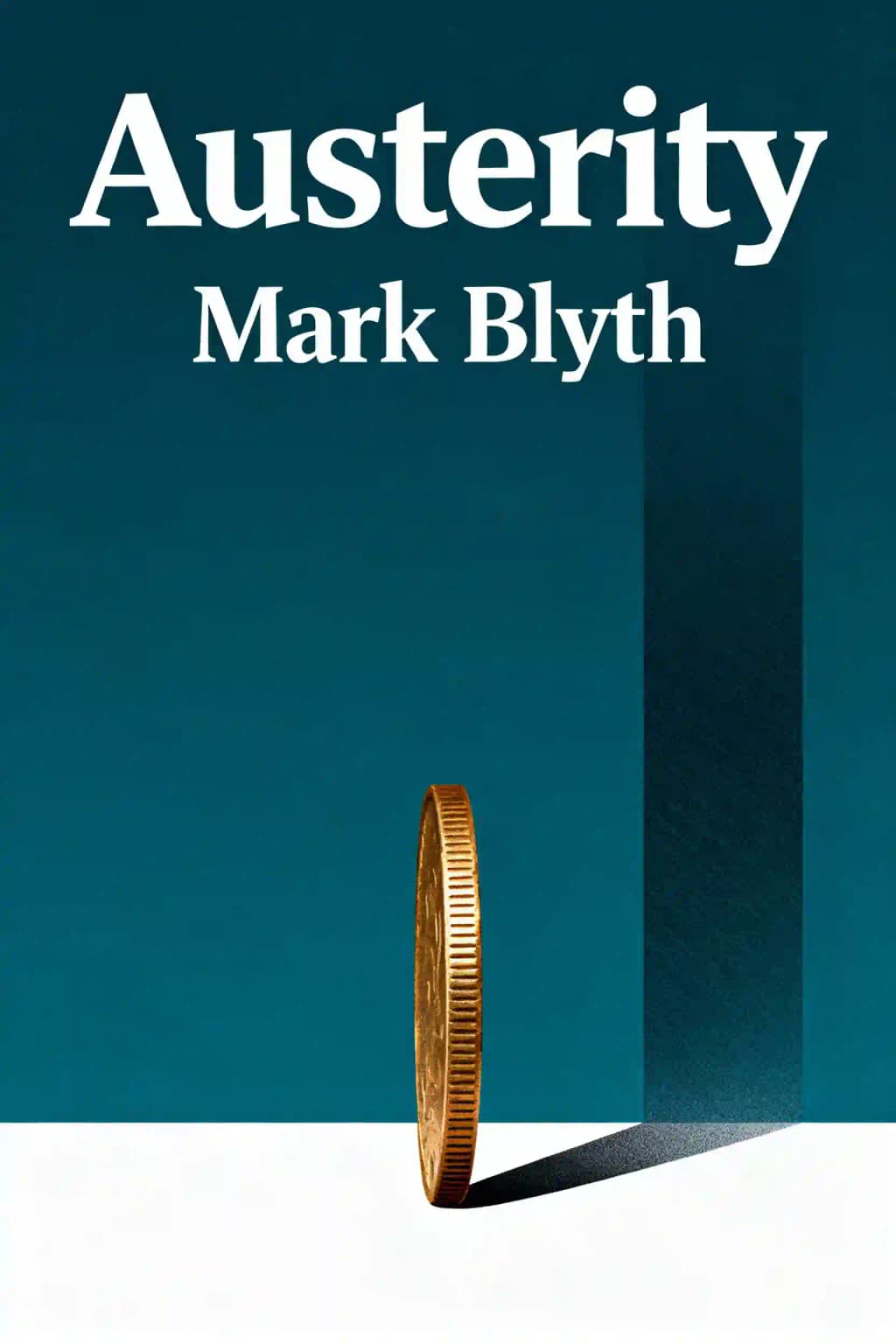
Ever wondered why, in the aftermath of the worst financial crisis since the Great Depression, governments worldwide chose to cut spending rather than stimulate their economies? Mark Blyth's "Austerity" provides the definitive answer to this puzzle. Born in working-class Scotland and raised by the British welfare state after his mother's early death, Blyth brings both academic rigor and personal passion to dismantling what he calls "the greatest bait and switch in modern history." The book has become required reading in economics departments globally and gained cult status among progressive policymakers. Even former Greek Finance Minister Yanis Varoufakis cited it as his intellectual north star during Greece's debt crisis negotiations. At its core, Blyth's work exposes how a banking crisis was cunningly repackaged as a sovereign debt crisis, forcing ordinary citizens to pay for the mistakes of financial elites.
第2章
Banking Crisis Disguised as Government Profligacy
The 2008 financial crisis and subsequent austerity policies represent one of history's most successful misdirection campaigns. What began as a massive private banking failure was rapidly reframed as a crisis of government spending, with devastating consequences for millions.
The timeline reveals this sleight of hand. Before 2008, few worried about national debts or deficits. Italy maintained debt at 105% of GDP in 2002 with little concern, yet the same figure in 2009 triggered alarm bells. What changed wasn't government behavior but the global financial meltdown that forced governments to absorb between $3-13 trillion in banking system bailouts.
This crisis originated not in government profligacy but in the shadow banking system, particularly the repo market where financial institutions borrowed and lent to each other using collateral. When housing prices declined in 2006, mortgage securities lost value, creating a collateral crisis. Banks like Bear Stearns and Lehman Brothers, leveraged at ratios of 30:1 or higher, couldn't withstand even small devaluations in their assets.
The financial sector had convinced itself that sophisticated risk models had eliminated the possibility of systemic failure. These models assumed a normal distribution of risk where extreme events become exponentially less likely at the tails. As Nassim Taleb argued, however, financial markets have "fat tails" - catastrophic events happen far more frequently than models predict. Banks were essentially playing Russian roulette, growing more confident with each successful "click" until catastrophe struck.
When governments stepped in to prevent complete collapse, they transferred massive private debt to public balance sheets. The financial crisis increased state debt across affected countries by 40-50 percent on average. Only 12 percent of this increase came from stimulus packages, while 35 percent represented direct bank bailout costs and half came from replacing lost tax revenues when financial sector receipts collapsed.
Yet remarkably, this banking crisis was rebranded as a sovereign debt crisis requiring government austerity as the solution. Among the European "PIIGS" (Portugal, Ireland, Italy, Greece, Spain), only Greece was genuinely profligate. Ireland and Spain had been model fiscal citizens before the crisis, with lower debt-to-GDP ratios than Germany. Their problems stemmed from property bubbles and banking failures, not government spending.
第3章
The Intellectual Foundations of a Dangerous Idea
Why does austerity persist despite repeatedly failing to deliver promised results? The answer lies in its deep intellectual roots within liberal economic thought, dating back to John Locke in the 17th century.
Locke established the philosophical foundation for private property and limited government, arguing that mixing labor with resources creates legitimate ownership. By naturalizing inequality and legitimizing private ownership, he created the intellectual foundation for separating state from market while limiting the state's ability to extract resources through taxation. This established what Blyth calls the liberal dilemma: the state is necessary but unwanted, especially when it comes to paying for it.
David Hume built on this foundation, placing merchant classes rather than the state at the center of economic life. His critique of public debt established arguments still repeated today: debt has no natural limit until interest rates become crushing; it's politically easier than taxation because costs are hidden; it diverts capital from productive industry; it eventually forces dependence on foreign creditors; and it ultimately leads to government impotence.
Adam Smith further developed these ideas, advocating "parsimony" (saving) as the driver of economic growth. For Smith, banking depends on confidence, but paper money alone doesn't create growth. The key is frugality becoming virtue while prodigality becomes vice. Smith feared government debt because it perverted this natural desire to save by offering merchants easy returns that undermined their incentive to invest productively.
These thinkers established austerity's intellectual foundation through their pathological fear of government debt. Smith transformed debt into a morality play where saving is virtue and spending is vice - a framing that persists today in how northern European "savers" view "profligate" southern Europeans, despite the impossibility of overborrowing without overlending.
第4章
Austerity's Devastating Historical Record
History offers a damning verdict on austerity. During the interwar period (1919-1939), countries that implemented austerity policies suffered catastrophic economic and political consequences.
America's "liquidationist" doctrine after the Wall Street crash transformed bank failures and minor deficits into a full depression. When President Hoover pivoted to austerity in 1931, raising taxes by $900 million to eliminate the deficit, unemployment reached 23% by 1932. Roosevelt's subsequent reflation reduced unemployment to 17% by 1936, but a premature return to austerity in 1937 caused another sharp recession.
Britain's restoration of pre-war parity immediately generated a million unemployed and a decade-long slump. Despite sacrificing the domestic economy to maintain sterling's value, Britain's debt increased rather than decreased, from 170% of GDP in 1930 to 190% by 1933.
Germany's austerity policies under Chancellor Heinrich Bruning implemented severe budget cuts by decree in 1930. The National Socialists, as the only party arguing against austerity, gained significant support, becoming the second-largest party with 18.3% of the vote. Ironically, austerity was "ruthlessly implemented by the left and so quickly abandoned by the right."
Japan's repeated deflation to maintain gold standard parity so angered their military that officers began assassinating financial elites. Prime Minister Hamaguchi was assassinated in 1930, and Finance Minister Takahashi was murdered in 1936 when he suggested cooling spending to control inflation. A decade of austerity had created Japan's worst depression and empowered "the wonderful folks that brought you Pearl Harbor."
Austerity didn't just fail economically - it helped destroy the world order. As Blyth starkly concludes, "That's the definition of a very dangerous idea."
第5章
The Modern Myth of Expansionary Austerity
Despite this dismal historical record, austerity experienced a surprising revival in the 1980s and 1990s through the concept of "expansionary fiscal contractions." Economists like Alberto Alesina, Francesco Silvia Ardagna, and Roberto Perotti claimed that cutting government spending could actually stimulate economic growth, particularly during downturns. This theory gained significant traction among policymakers and became influential in shaping economic policies across multiple countries.
Their research, based on a handful of cases from the 1980s-90s, claimed that successful fiscal adjustments require three key elements: substantial spending cuts rather than tax increases, wage moderation across both public and private sectors, and currency devaluation to boost export competitiveness. Ireland's adjustment in the late 1980s was repeatedly cited as the paradigmatic example, with Australia, Denmark and Sweden serving as supporting cases. The Irish case seemed particularly compelling because it showed significant deficit reduction alongside resumed economic growth, though critics later pointed out that this coincided with favorable external conditions including falling global interest rates and strong trading partner growth.
However, subsequent research has thoroughly dismantled these claims through multiple angles of analysis. Jayadev and Konczal's comprehensive examination revealed that of the twenty-six supposedly "expansionary" austerity episodes identified by Alesina and Ardagna, virtually none actually achieved the claimed trifecta of reducing deficits during economic slumps while simultaneously increasing growth rates and reducing debt-to-GDP ratios. In fact, countries that successfully consolidated were "growing steadily the year before the year of adjustment" - directly contradicting the central claim that austerity works during downturns. Their research showed that successful consolidations typically occurred during periods of economic expansion, not contraction.
The IMF's exhaustive reexamination proved particularly devastating to the expansionary austerity thesis. It found that the cyclically adjusted budget surplus metric used in original analyses had serious methodological flaws that systematically biased results to find positive cases while discounting negative ones. When alternative measures were employed, including more sophisticated methods of adjusting for the economic cycle, fiscal contractions proved to be exactly that - contractions with no offsetting gains. The IMF's research showed that austerity typically reduced GDP by about 0.5% within two years and increased unemployment by about 0.3 percentage points. The findings were even more negative when interest rates were already near zero, making monetary policy unable to offset fiscal tightening.
These revelations had profound implications for policy debates, particularly during the European sovereign debt crisis of 2010-2012, when many countries implemented austerity measures based partly on this discredited research. The real-world consequences of these policies - including deeper recessions and higher unemployment than initially forecast - served as a powerful practical refutation of the expansionary austerity hypothesis.
第6章
The German Question and Ordoliberalism
To understand Europe's embrace of austerity despite its failures, we must understand Germany's unique economic philosophy: ordoliberalism, which emerged from the ashes of the Weimar Republic and Nazi regime. This distinct economic framework, developed by scholars like Walter Eucken and Wilhelm Ropke, fundamentally shaped post-war German economic thought and eventually European economic governance.
Unlike Anglo-American liberals who primarily feared state power, ordoliberals identified private economic cartels as Germany's fundamental problem. They argued Germany's economic troubles stemmed from "the inability of the legal system to prevent the creation and misuse of private economic power." This recognition that concentrated private power posed as much threat as state power marked ordoliberalism's crucial departure from traditional liberalism. The experience of the Weimar Republic, where powerful industrial cartels had undermined democracy, deeply influenced this thinking.
Ordoliberals aimed to generate growth through enhancing competitiveness rather than consumption. By attacking concentration and cartels while maintaining price stability, they promoted "achievement competition" (Leistungswettbewerb) over "impediment competition" (Behinderungswettbewerb) - a supply-side restatement of Say's law where product quality creates demand. This approach emphasized strong legal frameworks, anti-trust regulations, and institutional guardrails to ensure fair market competition.
When Europe stagnated in the late 1970s, Germany recovered quickest through its export-oriented model and emphasis on price stability, making its economic approach increasingly attractive to other European states. Ordoliberal principles spread through multiple channels: currency pegs to the deutsche mark, incorporation into the European Central Bank's constitutional framework, and the EU Commission's robust competition policies. From the Maastricht convergence criteria to the Stability and Growth Pact to the fiscal compact treaty, European economic governance became increasingly rules-based, reflecting ordoliberal preferences for binding constraints on economic policy.
This historical evolution explains Germany's persistent resistance to Keynesian solutions during the Eurozone crisis. German policymakers follow ordoliberalism rather than Anglo-American neoliberalism, emphasizing state provision of framework conditions for markets, including comprehensive social safety nets (soziale Marktwirtschaft) and institutional support for small and medium enterprises (Mittelstand). However, they steadfastly prioritize budgetary discipline and financial stability enforced by a strong independent central bank, viewing fiscal restraint not as austerity but as essential prudence. This approach, deeply rooted in German historical experience, continues to shape European economic policy debates and institutional design.
The ordoliberal framework's influence extends beyond mere economic policy, embedding itself in German political culture through concepts like Ordnungspolitik (policy of order) and Stabilitatskultur (stability culture). These principles have become so fundamental to German economic thinking that they're often treated as common sense rather than specific theoretical choices, making dialogue with alternative economic approaches particularly challenging during crisis periods.
第7章
The Euro: A Monetary Doomsday Device
While the European Union has been an extraordinary political success - maintaining peace, spreading prosperity, and transforming dictatorships into democracies - its monetary project has been disastrous for most members except Germany.
Despite economists' warnings that the eurozone wasn't an optimal currency area, the euro was launched anyway. Rather than creating convergence, it produced dramatic divergence between European economies - except in bond yields. Before the euro, periphery countries like Greece and Italy had much higher borrowing costs than Germany. After introduction, their bond yields miraculously converged to near-German levels, despite these countries not fundamentally changing.
This convergence flooded periphery states with cheap money, swamping local funding markets and making them vulnerable to capital flight. Meanwhile, periphery consumers used this tsunami of cheap cash to buy German products, creating massive current account imbalances where Germany ran surpluses while almost everyone else ran deficits.
European banks executed what may be history's greatest moral hazard trade. As sovereign bond yields converged, banks swapped low-yield German debt for higher-yielding periphery debt, then turbocharged profits by operating at leverage ratios up to 40:1. They either genuinely believed the ECB had eliminated all risk or - more likely - recognized they could become so systemically important that they'd inevitably be bailed out if things went wrong.
These banks grew to dwarf their sovereign guarantors. While the top six US banks' combined assets equaled 61% of US GDP in 2008, European banks reached terrifying proportions: France's top three banks had assets totaling 316% of French GDP, Deutsche Bank alone represented 80% of German GDP while operating at 40:1 leverage, and the top four UK banks reached 394% of UK GDP.
When the crisis hit, these banks were literally "too big to bail" - no sovereign, even with its own printing press, could rescue institutions of this magnitude. Those who had surrendered their currencies to join the euro were in particularly dire straits.
第8章
The Austerity Trap: Why We Can't Escape It
The eurozone crisis represents a perfect economic trap, one that demonstrates the fundamental flaws in the currency union's design. With no ability to inflate away debt, devalue currency, or default without destroying the banking system, only internal deflation through austerity remains as an option. This limitation stems from the unique structure of the eurozone, where countries share a currency but lack the fiscal integration seen in other monetary unions like the United States.
When all countries cut spending simultaneously, they reduce each other's income streams, creating a vicious cycle where cuts lead to less growth, requiring even more cuts. This dynamic played out dramatically in countries like Greece, Portugal, and Ireland, where initial austerity measures led to GDP contractions of 25%, 7%, and 8% respectively. As Keynes noted in his "paradox of thrift," collective saving without spending shrinks the entire economy - a phenomenon that became painfully evident across Southern Europe.
European politicians face an impossible communication challenge. They can't publicly admit that a quarter of Spain needs to remain unemployed and the periphery must endure permanent recession just to save a decade-old currency. In Spain, youth unemployment reached a staggering 55%, while Greece saw similar numbers, creating a "lost generation" of young workers. The truth they can't speak is that the explosion of sovereign debt was a symptom, not a cause of the crisis. Core country banks, particularly in Germany and France, bought periphery sovereign debt, flooding those economies with cheap money to purchase core products, creating massive current account imbalances. By 2008, Greece's current account deficit had reached 15% of GDP, while Germany maintained a surplus of 6%.
The political reality is brutal and multifaceted: citizens must suffer unemployment to save banks that are too big to fail, thereby saving sovereigns who cannot save those banks themselves, thus preserving the euro. This creates a toxic triangle between banks, sovereigns, and the currency itself. The European Central Bank's limited mandate prevents it from acting as a true lender of last resort, while national governments lack the monetary tools to address their specific economic challenges. Countries like Italy and Portugal found themselves trapped between maintaining euro membership and implementing growth-killing austerity measures, with their citizens bearing the brunt of this impossible choice through reduced public services, higher taxes, and diminished economic opportunities.
第9章
Alternative Paths Forward
Iceland and Ireland provide stark contrasting approaches to handling banking crises, offering valuable lessons about crisis management. Ireland chose to guarantee its six major banks, creating the National Asset Management Agency (NAMA) to handle toxic assets, while implementing severe austerity measures despite unemployment reaching 15%. The Irish government slashed public sector wages by 15%, cut social welfare payments, and raised taxes - all while maintaining a controversial 12.5% corporate tax rate. While EU leaders praised Ireland as the "poster child" for austerity, this approach led to mass emigration, with over 300,000 people, mostly young professionals, leaving the country between 2008 and 2015.
Iceland took a radically different path, allowing its three largest banks - Kaupthing, Landsbanki, and Glitnir - to fail and actively prosecuting dozens of bankers responsible for the crisis. The country imposed capital controls, protected domestic depositors while letting foreign creditors take losses, and allowed its currency to devalue significantly. Despite experiencing an initial severe economic shock, Iceland's recovery was remarkably swift. By 2011, its unemployment rate had fallen to 7% compared to Ireland's 15%, and income inequality actually decreased during the crisis period.
The fundamental problem with austerity lies in its deeply unequal distribution of pain across society. When state spending is cut, the impacts cascade disproportionately through public services, healthcare, education, and social welfare programs that predominantly serve middle and lower-income populations. In the United States, this inequality has reached historic levels - the top 1% now captures 23.8% of national income, while the richest 400 Americans possess more wealth than the bottom 150 million combined. The bottom 50% of Americans own just 1.3% of the nation's wealth.
When austerity advocates claim "we have spent too much," they conveniently overlook how public funds were used to rescue financial institutions and protect wealthy asset holders during the crisis. The 2008 bailouts in the US alone committed over $700 billion through TARP, while the Federal Reserve provided trillions in emergency lending to banks. Expecting those at the bottom of the economic ladder to disproportionately pay for problems created by financial speculation at the top not only fails mathematically but fundamentally undermines the social contract that holds democratic societies together. This dynamic has directly contributed to rising polarization, populism, and nationalism across Western democracies. The result is an increasingly unstable society where, as history suggests, "the only possible movement is a violent one." Recent political upheavals in multiple countries demonstrate how economic inequality and austerity policies can fuel social instability and anti-democratic movements.
第10章
The Dangerous Idea That Won't Die
Austerity persists despite overwhelming evidence against it because it serves powerful interests. It allows elites to shift blame from banks to governments, transforming a private sector crisis into a morality play about public sector excess. This narrative conveniently ignores how the 2008 financial crisis originated in private sector speculation and risk-taking, instead focusing on government debt as the primary villain. The result has been a remarkable sleight of hand where taxpayers first bailed out banks, then were told they must tighten their belts due to resulting government deficits.
The euro's structural problems run deeper than commonly acknowledged. The currency union is trapped in a system lacking two crucial stabilizing mechanisms found in the United States: fiscal transfers between regions and labor mobility across borders. When Michigan struggles economically, federal spending automatically increases there while workers can easily relocate to Texas or California. In Europe, cross-border euro lending effectively functions like foreign currency borrowing, creating additional risks. Countries can't devalue their currency to regain competitiveness, yet also lack the cushioning mechanisms that make currency unions workable.
The fundamental problem isn't just institutional design flaws but the "epistemic hubris" behind the entire euro project. European planners attempted to control an uncertain future through rigid rules applied only to sovereigns, while ignoring private sector risks. The Maastricht criteria focused obsessively on government debt and deficit levels while paying little attention to private sector credit bubbles or banking system vulnerabilities. This represents a profound misunderstanding of how modern financial economies actually work.
By focusing exclusively on inflation rates, deficits and state debts, EU planners missed the growth of an unbailable banking system that would eventually threaten the entire project. European banks grew to multiple times their home countries' GDP, while operating across borders in ways that made effective regulation nearly impossible. The price being paid isn't just economic pain through austerity but potentially undermining the European political project itself, as evidenced by rising populism and euro-skepticism across the continent.
Austerity is a dangerous idea because it fails on multiple levels: it doesn't work in practice as shown by the devastating results in Greece, Spain and elsewhere; it forces the poor and middle class to pay for the mistakes of financial elites through cuts to public services and social programs; and it fundamentally ignores the fallacy of composition that defines our interconnected modern economy - when everyone cuts spending simultaneously, the result is a downward spiral of declining demand and growth. Until we recognize these fundamental truths and the way austerity serves as political cover for upward redistribution, we remain trapped in a cycle of self-defeating policies that threaten not just our economies, but our democracies as well.