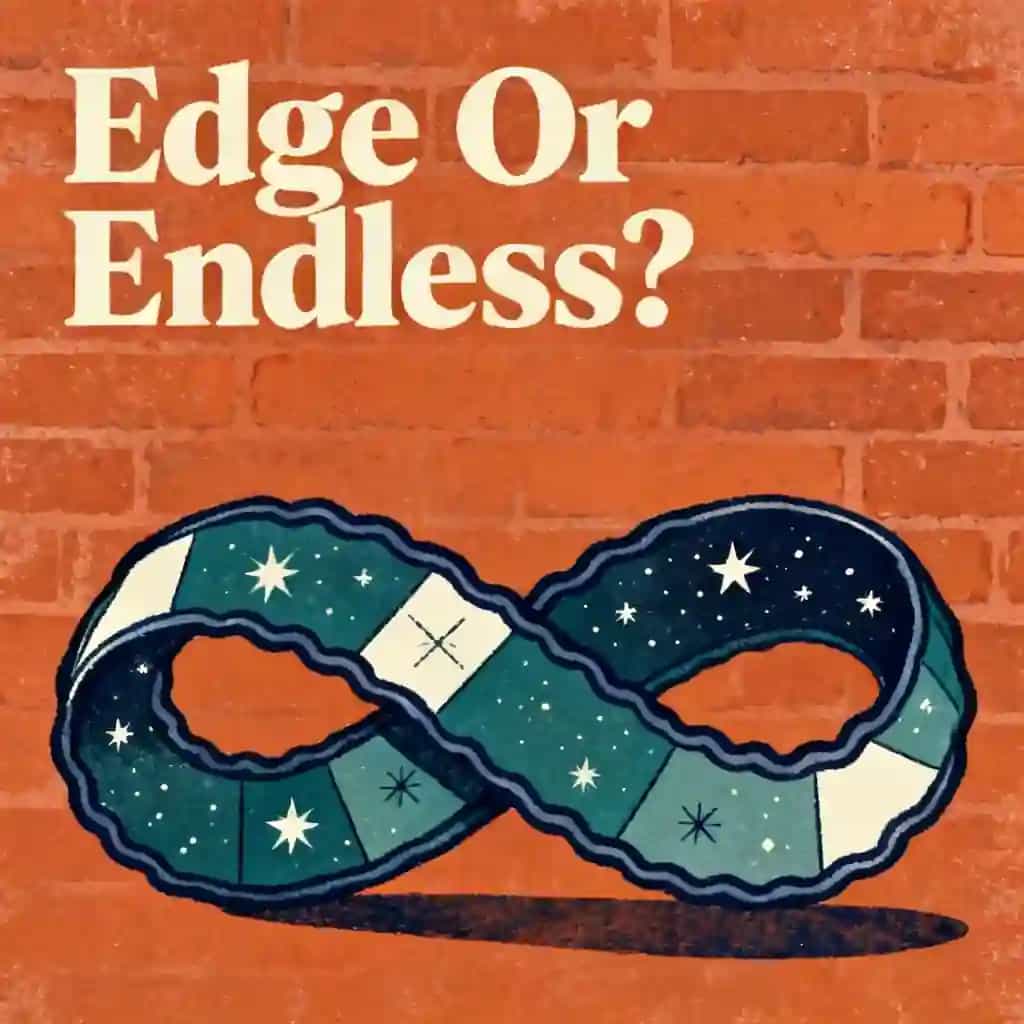
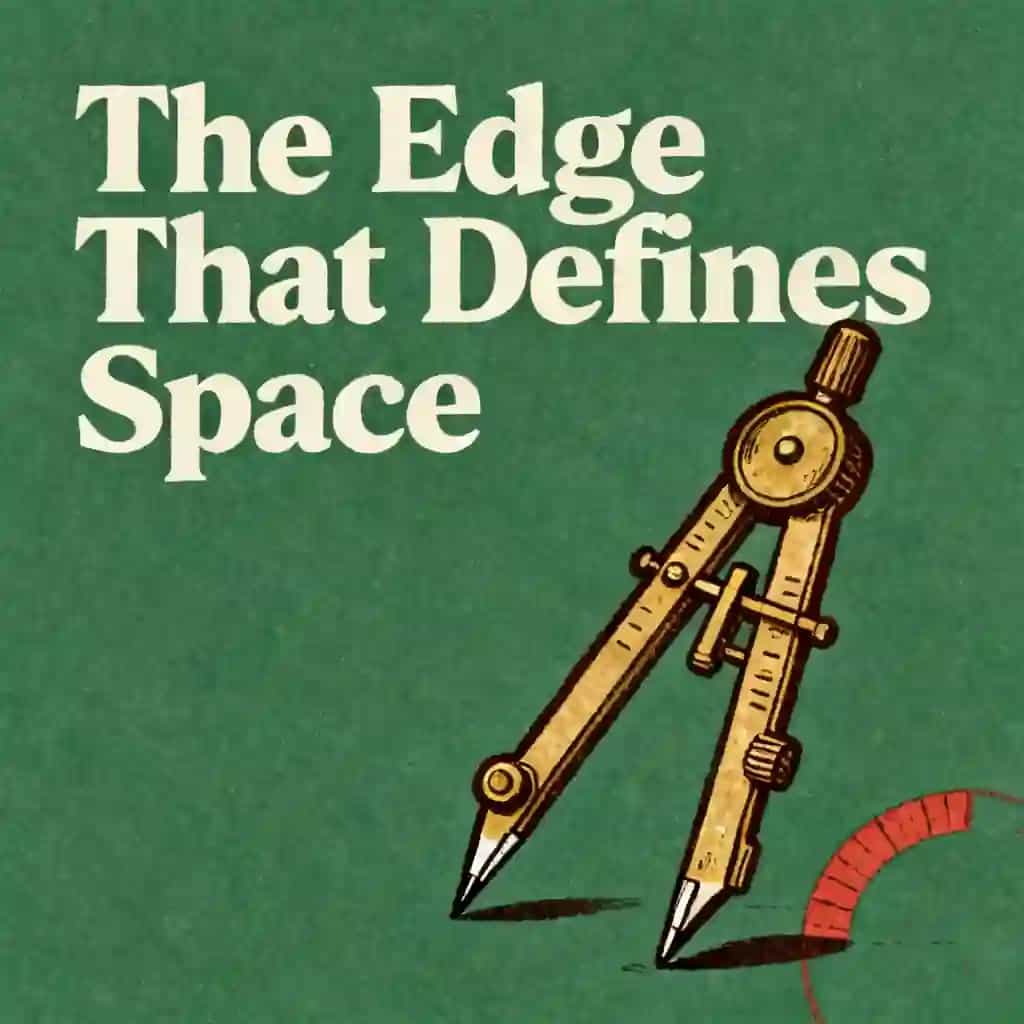
If you removed every atom from the universe, would space still exist? Explore the debate between spacetime as a physical stage versus a set of relations.

Spacetime isn't the container; it’s just the structural web of how things are connected. We’re basically trying to decide if the 'grid' is just a helpful map we drew or if the grid is the actual ground we’re standing on.
Cree par des anciens de Columbia University a San Francisco
"Instead of endless scrolling, I just hit play on BeFreed. It saves me so much time."
"I never knew where to start with nonfiction—BeFreed’s book lists turned into podcasts gave me a clear path."
"Perfect balance between learning and entertainment. Finished ‘Thinking, Fast and Slow’ on my commute this week."
"Crazy how much I learned while walking the dog. BeFreed = small habits → big gains."
"Reading used to feel like a chore. Now it’s just part of my lifestyle."
"Feels effortless compared to reading. I’ve finished 6 books this month already."
"BeFreed turned my guilty doomscrolling into something that feels productive and inspiring."
"BeFreed turned my commute into learning time. 20-min podcasts are perfect for finishing books I never had time for."
"BeFreed replaced my podcast queue. Imagine Spotify for books — that’s it. 🙌"
"It is great for me to learn something from the book without reading it."
"The themed book list podcasts help me connect ideas across authors—like a guided audio journey."
"Makes me feel smarter every time before going to work"
Cree par des anciens de Columbia University a San Francisco

Lena: You know, Miles, I was looking at my coffee cup this morning and wondering—if I took the cup away, and then the table, and eventually every single atom in the universe, would the empty space itself still be there? Like a giant, invisible container?
Miles: That is the classic "stage" view of the universe, Lena. It’s called substantivalism—the idea that spacetime is a real, independent substance that exists even if it's totally empty.
Lena: Right, it feels so intuitive! But then I read this radical alternative called relationalism, which suggests that space isn't a "thing" at all, but just a set of relations between objects. So, no objects, no space.
Miles: Exactly. It’s the ultimate "is spacetime the stage or the actors?" debate. It’s fascinating because how we answer that actually changes how we understand gravity and even the "flow" of time itself.
Lena: So let's dive into the "Hole Argument" and see if we can break down whether spacetime is a real substance or just a mathematical map.
Miles: So, to really get into this, we have to look at the math that Albert Einstein gave us back in 1915—general relativity. It’s the most successful theory of gravity we have, but it’s also the one that makes the "stage" idea really weird.
Lena: Because in general relativity, gravity isn't a force like magnetism—it's the actual curvature of spacetime. But if spacetime is just a "relation," how can a relation have a shape? How can a relation "curve"?
Miles: That is the million-dollar question! Substantivalists love this. They say, "Look, the Einstein field equations literally show the geometry of spacetime on one side and matter on the other. If geometry is doing something—like bending when a star is near it—it has to be a real thing, a substance."
Lena: It’s like saying you can’t have a bendy straw without the plastic. If there’s a bend, there’s a "stuff" that is bending.
Miles: Right! But here’s where it gets trippy. There’s this thing called diffeomorphism invariance. It’s a fancy term, but basically, it means that the laws of physics don't care how you label the points in space. You could slide all the events in the universe an inch to the left, or warp the coordinate grid like a piece of taffy, and the physical relations—the distances and the causal links—stay exactly the same.
Lena: Okay, so if I move the "actors" but keep their distance from each other the same, the "stage" shouldn't matter?
Miles: Exactly. And this led to the famous Hole Argument that John Earman and John Norton brought back into the spotlight. Imagine a region of spacetime—a "hole"—where there’s no matter. If spacetime is a substance, then sliding the gravitational field around inside that hole should create a different physical world, right? Because you’re putting the "field" on different "points" of the substance.
Lena: But the math says those two scenarios are identical. There’s no experiment you could ever do to tell them apart.
Miles: Precisely. So, if the "substance" of space has points that have their own identity—their own "thisness"—then physics becomes indeterminate. You’d have two different possible worlds that are observationally exactly the same.
Lena: And philosophers hate that! It feels like we’re over-counting. If we can't tell the difference, maybe the "points" don't actually exist. Maybe only the relationships between events are real.
Miles: That’s the relationalist breakthrough. If you throw away the idea that the points have an identity, the problem vanishes. Spacetime isn't the container; it’s just the structural web of how things are connected. But then you’re left with this ghost of a geometry that still somehow dictates how things move. It’s a wild tension, Lena. We’re basically trying to decide if the "grid" is just a helpful map we drew or if the grid is the actual ground we’re standing on.
Lena: It reminds me of those optical illusions where you can see the vase or the two faces. Depending on your ontological "lens," the same math looks like a solid stage or a shifting network of handshakes between atoms.
Miles: Spot on. And this isn't just academic. This choice—substance versus relation—actually ripples out into how we explain things like black holes and the very beginning of the universe. If there is no "substance," then a singularity isn't a "place" where the floor falls out—it's just a limit to our relational map.
Lena: Okay, Miles, let's test this relationalist view. If space is just the relations between matter, what happens in a total vacuum? I mean, if you have a region of the universe with absolutely zero matter—no atoms, no light, nothing—is there still gravity there?
Miles: That is a total "gotcha" for the relationalists, and it’s one of the coolest parts of general relativity. Einstein’s equations allow for what we call "vacuum solutions." You can have a universe that is completely empty of matter, but still has curvature. Still has gravitational waves rippling through it.
Lena: Wait, if there’s no matter to have "relations" with, what is curving? Doesn't that prove spacetime is a substance? I mean, a ripple needs a medium, right? You can't have a wave in a pond if there’s no water.
Miles: That’s the classic substantivalist argument! They say gravitational waves are "ripples in the fabric of spacetime." But relationalists like Benjamin Owino have a really clever comeback. They argue that the metric—the thing that describes the distance between points—isn't a property of a "substance" called space. Instead, the metric *is* the relational structure itself.
Lena: I’m not sure I follow. How can you have a structure with nothing in it?
Miles: Think of it like a set of rules or a "global consistency condition." Even if there’s no matter right *here*, the geometry in this empty spot is determined by the matter and energy everywhere else in the universe. It’s like a giant cosmic web where even the gaps are defined by the strands.
Lena: So the "vacuum" isn't empty space—it's just a part of the relationship where no "actors" happen to be standing at the moment?
Miles: Exactly. Curvature in a vacuum is just the metric field showing us the "potential" for relations. Owino argues that we only get into trouble when we treat the metric like it’s a material field—like electromagnetism. We want gravity to be "stuff" because we can see it doing things, but it might just be the "how" of the universe, not the "what."
Lena: It’s like the rules of a game. The rules aren't a physical object on the board, but they dictate exactly where the pieces can go.
Miles: That’s a great way to put it. And when you look at gravitational waves—those ripples we detected with LIGO a few years back—substantivalists see them as proof of a physical "fabric." But a relationalist would say, no, those waves are just shifting distances. When a wave passes through you, the "relation" between your head and your feet literally oscillates. You don't need a "fabric" for that; you just need the distance to change.
Lena: But that brings us to the energy problem. If a gravitational wave can knock over a building—which it theoretically could if it were strong enough—it must carry energy. And if it carries energy through a vacuum, doesn't that energy have to live *somewhere*?
Miles: You’ve hit the nail on the head! This is one of the biggest headaches in physics. In every other theory, energy is "local"—you can say exactly how much energy is in this tiny box. But in general relativity, you can’t localizing gravitational energy. There is no "density" of gravity at a single point.
Lena: No way. We can't say "there's ten Joules of gravity right here"?
Miles: Nope. The math literally won't let you. You can only define gravitational energy for a whole system, or by looking at the "global" picture. This "non-localizability" is a nightmare for substantivalists because if space is a substance, it should be able to hold energy at a specific spot. But for relationalists, it makes perfect sense! If gravity is just a set of relations, you can't have "half a relation" at a single point. A relation, by definition, involves more than one thing. It’s a global property of the web.
Lena: So the very fact that we can't find where the "gravity energy" is hiding might be a clue that we’re looking for a substance that isn't there.
Miles: Precisely. We’re looking for the water in the wave, but maybe the wave is just the way the fish are moving in relation to each other across the whole sea.
Lena: If we follow this relationalist path, it leads us to some pretty dark places—literally. I’m talking about singularities. Black holes. The Big Bang. We always hear that these are "places" where the laws of physics break down, right?
Miles: "Places" is the key word there. If you’re a substantivalist, a singularity is like a hole in the floor of the universe. It’s a point where the "stuff" of spacetime becomes infinitely curved, and the substance itself just... snaps.
Lena: Which sounds terrifying. It’s like the container itself has a leak.
Miles: Right! But relationalists see this very differently. If spacetime is just a representational scaffold—a map of relations—then a singularity isn't a physical "place" at all. It’s just the edge of the map. It’s the point where our current way of describing relations—the metric—simply ceases to work.
Lena: So it's not that the universe is broken; it's just that our "language" of space and time ran out of words?
Miles: Exactly. Think about the center of a black hole. We say the curvature becomes "infinite." But "infinite" in math often just means "this model no longer applies here." Relationalists argue that we only think singularities are physical "things" because we’ve reified the map. We’ve started believing the ink on the paper is the actual land.
Lena: That’s such a relief, honestly. It makes the universe feel less like it’s full of "glitches" and more like we just need a better map.
Miles: And this is where it gets really interesting for the future of physics. Most physicists agree that we need a theory of "Quantum Gravity" to explain what’s happening inside a black hole. And a lot of current research, like Loop Quantum Gravity, is leaning very heavily into the relationalist camp.
Lena: Because at the quantum level, everything is about interactions and probabilities, not solid objects sitting in a box.
Miles: Right. In some of these models, space isn't a background stage at all. Instead, you have these "quanta" of area and volume—tiny, discrete units of relationship. When enough of these units "link up" and become coherent, a smooth "space" emerges. It’s like how a digital photo looks smooth from a distance, but it’s really just a grid of discrete pixels.
Lena: So "space" is an emergent property? Like how "temperature" isn't a thing a single atom has, but it’s something a whole group of atoms has when they move together?
Miles: You’ve got it. This is the "Emergent Spacetime" idea. Space and time might just be the "coarse-grained" version of a much deeper, pre-geometric reality. Maybe the fundamental level of the universe is just information—pure relations—and "space" is just the user interface we use to make sense of it.
Lena: That blows my mind. It would mean that the "stage" isn't just invisible; it's a total illusion created by the "actors" interacting.
Miles: It changes everything. If space is emergent, then the "beginning" of the universe wasn't a "point in time"—it was the moment the relations became organized enough for "time" to even start making sense. We’re not moving *through* space; we’re part of the process that *is* space.
Lena: It’s like we’re the pixels and the image at the same time. But if space is emergent, what does that say about the "arrow of time"? Is time just another relation that emerges from the heap?
Miles: That’s the next frontier. If space is a "spectral image" of coherence, maybe time is just the "memory" of that coherence. It’s all about how information stays consistent as it changes.
Lena: Let’s pivot to something that feels very "solid" but is actually deeply mysterious when you think about it: inertia. You know, that feeling when a car slams on the brakes and your body wants to keep flying forward?
Miles: Oh, yeah. Classic Newton. "A body in motion stays in motion." We’re so used to it that we don't even think of it as something that needs an explanation. We just call it a property of matter.
Lena: But if we're being good "Socratic" explorers here, we have to ask: *Why*? Why does matter resist changes in motion? Does it have some internal "anchor" that is hooked into the substance of space?
Miles: This is where Ernst Mach comes in—the guy Einstein named "Mach's Principle" after. Mach had this radical idea: he said that your inertia—your resistance to acceleration—isn't an internal property at all. It’s actually caused by the gravitational pull of all the *other* matter in the entire universe.
Lena: Wait, so if I’m the only thing in a completely empty universe and I try to move, I wouldn't have any inertia? I wouldn't feel that "tug" when I speed up?
Miles: According to Mach, no! You only feel "mass" because you're being "tugged" on by all the stars and galaxies millions of light-years away. It’s a perfectly relational view. Inertia is just your relationship with the rest of the cosmic "actors."
Lena: That sounds so poetic, but is it true? Does general relativity actually work like that?
Miles: It’s a bit of a "yes and no." Einstein loved the idea, but his final equations don't quite get there. In general relativity, you can have a "test particle" in an empty universe that still has inertia because it’s moving along a "geodesic"—a natural path—defined by the metric.
Lena: So we’re back to the metric. If the metric is there, even without other matter, then inertia is still there.
Miles: Exactly. And for a substantivalist, that’s a win. They’d say, "See? The metric is part of the substance of spacetime. It’s the stage that tells the actor how hard it is to move." But the relationalist has a different angle. Benjamin Owino suggests that inertia is just the "coherence" of a matter field within the relational structure. It’s not that the "stage" is pushing back; it’s that for a field to exist at all, it has to follow the local rules of the geometric web.
Lena: It’s like trying to swim against a current. The current isn't a "thing" separate from the water; it *is* the water’s motion.
Miles: Right. And then there’s the Higgs field—that "molasses" that physicists say gives particles their mass. In modern physics, we say particles get mass by interacting with this universal field. It sounds like a new version of the "ether," doesn't it? A substance that permeates everything.
Lena: It really does! We keep trying to get rid of the "substance" and it just keeps coming back under new names. Whether it’s the "Metric," the "Higgs Field," or "Spacetime," we seem to need *something* to explain why the world has resistance and structure.
Miles: It’s a constant tug-of-war. We want the world to be simple—just things and their relationships. But every time we try to write the equations for those relationships, we find we need a "background" to make the math work. The big challenge for the next generation of physics is to see if we can derive inertia *entirely* from the relations, without needing a "stage" at all.
Lena: It’s the ultimate quest for a "background-independent" theory. A universe that truly pulls itself up by its own bootstraps, where everything—mass, space, time—is just a result of how the pieces fit together.
Miles: Exactly. And that leads us to the most stubborn "piece" of all: the cosmological constant. That tiny, weird number that seems to suggest that even "empty" space has a little bit of energy pushing everything apart.
Lena: Oh, the "Dark Energy" mystery. If that energy is "in" space, then space *must* be a substance, right? How can a "relation" have energy?
Miles: That is the "Vacuum Energy Paradox." If you use Quantum Field Theory to calculate how much energy is in the vacuum, you get a number that is 120 orders of magnitude too big. It’s the worst prediction in the history of science!
Lena: 120 orders of magnitude? That’s not even a "miss"—that’s like trying to throw a dart at a board and hitting a different galaxy.
Miles: It’s a total disaster. And relationalists argue that the reason we’re so far off is that we’re assuming the vacuum is a "substance" that can hold energy. If we stop treating space like a container and start treating the cosmological constant as just a "geometric parameter"—a rule for how the web expands—the paradox might just dissolve.
Lena: We've talked a lot about space, but we can't forget the other half of the "block"—Time. If general relativity gives us this four-dimensional "Block Universe" where the past, present, and future all coexist like a giant loaf of bread... then why does time feel so different from space?
Miles: You mean the "Arrow of Time"? The fact that I can move left or right in space, but I only ever move "forward" in time?
Lena: Exactly! In the math of general relativity, the equations are "time-symmetric." They work just as well backwards as they do forwards. But our *experience* is anything but symmetric. I’ve never seen a broken mug jump back onto a table and un-shatter itself.
Miles: That is a massive conceptual tension. If the "stage" of spacetime is a four-dimensional block, then "now" shouldn't be special. The Big Bang and the death of the sun are both just "there," at different coordinates.
Lena: So is our feeling of "becoming"—of things actually *happening*—just a massive psychological illusion? Einstein famously said that the distinction between past, present, and future is "only a stubbornly persistent illusion."
Miles: He really believed that. He saw the universe as a static, eternal structure. But a lot of modern thinkers, like Carlo Rovelli and Julian Barbour, are trying to reconcile the "Block" with the "Arrow." They suggest that while the fundamental equations might be symmetric, the *relations* between things aren't.
Lena: How so?
Miles: Think about entropy. The Second Law of Thermodynamics says that things tend to go from order to disorder. That’s what gives time its direction. It’s not that the "stage" is moving; it’s that the "actors" are getting more and more tangled and messy as they interact.
Lena: So time isn't a dimension we "travel through"—it's just a way of measuring the increase in messiness?
Miles: In a sense, yes! Some relationalist theories suggest that "time" is just a label we give to a sequence of snapshots of the universe. If you have a heap of "nows," you can order them by how much entropy they have. The "future" is just the direction of higher complexity.
Lena: But that still feels a bit cold. It doesn't capture the *feeling* of time passing. Is there a way to have a "relational" time that actually feels... well, like time?
Miles: There’s a beautiful idea in the "Emergent Spacetime" framework that sees time as "memory." Each "patch" of the universe seeks to maximize its variety—its distinctiveness—while staying coherent with its neighbors. The "past" is simply the set of relations that have already been "stabilized" into a consistent record.
Lena: Oh, I like that! So the past is the part of the web that’s already been woven, and the future is the part that’s still being negotiated?
Miles: Exactly. It makes time an irreversible process of "optimization." It’s not a background stage; it’s the actual growth of the network. And this might explain why we can't "time travel" in the way sci-fi movies suggest. You can't go "back" because the previous states of the network have been overwritten by the new, more complex ones.
Lena: It’s like trying to un-bake a cake. You can't just move the "cake actor" back to the "flour coordinate"—the flour has been fundamentally transformed.
Miles: Right. This "Emergentist" view of time helps bridge the gap between Einstein’s static block and our lived experience. It says that the block is a useful "god’s eye view," but the reality is a dynamic process of information processing.
Lena: It’s a much more "human" way of looking at physics. We’re not just shadows in a four-dimensional crystal; we’re part of the "ceaseless optimization" that keeps the universe moving.
Miles: And it ties back into the Quantum Gravity problem. If we can understand how time emerges from quantum relations, we might finally figure out why gravity behaves so weirdly at tiny scales. Maybe gravity is just the "tension" in the network as it tries to grow and stay coherent.
Lena: This has been an incredible journey through the "invisible fabric" of reality, Miles. But for our listeners who aren't planning on writing a thesis on tensor calculus tonight, how does this actually change how we think about our lives?
Miles: It’s funny, isn't it? We think "philosophy of physics" is about as far from "real life" as you can get, but the relationalist versus substantivalist debate is actually a great metaphor for how we view ourselves.
Lena: I was thinking the same thing! Are we "substances"—independent beings with a fixed "identity"—just sitting in a container called society? Or are we "relational"—defined entirely by our connections and interactions with everyone else?
Miles: That’s the "Practical Playbook" right there! If you take the relationalist lesson to heart, you realize that nothing exists in isolation. Just as a "point" in space has no identity without the metric field, a person has no identity without their relationships, their history, and their environment.
Lena: It’s a very "holistic" way of looking at things. It moves us away from that "lone wolf" substantivalist mindset. If the universe is a web of relations, then every "interaction" we have is actually a moment of "creating" the world.
Miles: Absolutely. And think about the "Arrow of Time" and entropy. We spend so much energy trying to fight disorder, but relationalism tells us that the "flow" of life is precisely that process of creating order out of complexity. Instead of seeing the "passing of time" as something to fear, we can see it as the "stabilization of coherence." Every choice we make is a new "stitch" in the cosmic web.
Lena: I also love the "Singularity" lesson. When we hit a "breakdown" in our lives—a moment where our "map" no longer works—it’s not that reality is over. It’s just that our current representation has reached its limit. We need a "New Physics" for our own lives.
Miles: That’s deep, Lena. "The singularity is not a place; it's a limit of our current understanding." Whenever we feel stuck, it’s usually because we’re treating our "map" of how life *should* go as if it’s the actual "substance" of life. If we can be "background-independent" in our own thinking, we become much more flexible.
Lena: And let's not forget the "Vacuum Energy" idea. Even when things feel "empty" or "stagnant," there’s still an underlying geometric potential. There’s still a "cosmological constant" of possibility pushing things forward, even when we can't see the "matter" of progress.
Miles: It’s a very high-energy way to live! The "actors" might change, and the "stage" might turn out to be a ghost, but the *relations*—the love, the work, the curiosity—those are the most real things in the universe.
Lena: So, the next time you look at the "empty" space between you and someone else, remember: it’s not a void. It’s a busy, vibrating field of relations that is literally holding the universe together.
Miles: You're not just "in" the world; you're helping "weave" it. And that is a much more exciting way to wake up in the morning.
Lena: As we wrap things up today, I’m left with this image of the universe not as a cold, empty container, but as a vibrant, interconnected tapestry. We started by asking if the "stage" would still be there if we took the "actors" away, and it seems the answer is far more interesting than a simple "yes" or "no."
Miles: It really is. We’ve seen how the "substantivalist" view of a solid stage is intuitive but runs into massive problems like the Hole Argument and the failure to quantize gravity. And we’ve seen how the "relationalist" view—where spacetime is just a web of handshakes between events—solves those paradoxes but forces us to rethink what "empty" space even means.
Lena: It’s a shift from "things" to "patterns." From "stuff" to "information." And whether space and time are fundamental or just "emergent" properties of a deeper quantum dance, it’s clear that our relationship with reality is much more intimate than we ever imagined.
Miles: I love that. We aren't just observers watching the play from the front row. We’re the ones on stage, and the very ground beneath our feet is made of the interactions we’re having right now.
Lena: It’s a lot to reflect on. Maybe the "Hole" in the universe isn't something to be filled, but a space for us to realize that we are the ones defining the grid.
Miles: Fascinating stuff. It makes you look at a simple coffee cup—and the space around it—in a completely different light.
Lena: It really does. I hope everyone listening takes a moment today to look at the "empty" space around them and wonder about the invisible relations that are making it all possible.
Miles: Thanks for going on this cosmic deep-dive with me, Lena. It’s been a blast.
Lena: Likewise, Miles. And thanks to all of you for listening and exploring these big questions with us. Take a moment to think about your own "relational web" today—how you’re connected to the people and the world around you. It turns out, that might be the most "fundamental" thing there is. Thank you for joining us on this journey through the philosophy of spacetime. Reflect on what you’ve learned, and perhaps you’ll see the "fabric" of your own world a little differently today.