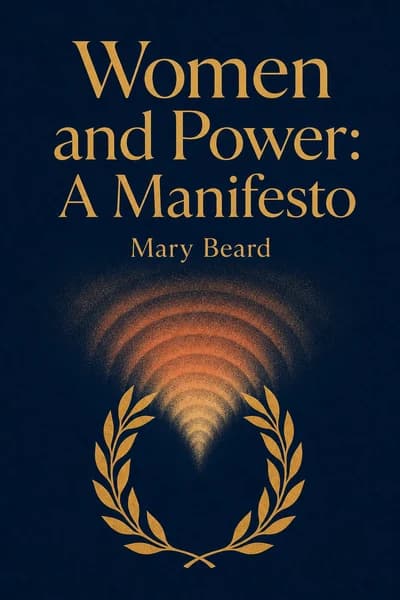
In "Women & Power," Cambridge professor Mary Beard exposes how women's voices have been silenced since ancient Greece. Released during #MeToo, this manifesto brilliantly connects Medusa myths to modern politics, challenging us to redefine power rather than force women into male structures.
Ressentez le livre à travers la voix de l'auteur
Transformez les connaissances en idées captivantes et riches en exemples
Capturez les idées clés en un éclair pour un apprentissage rapide
Profitez du livre de manière ludique et engageante
When Telemachus ordered his mother Penelope back to her quarters in Homer's Odyssey nearly three millennia ago, declaring "speech will be the business of men," he wasn't just having a family spat. He was articulating what would become the foundation of Western attitudes toward women's voices. This moment-the first documented silencing of a woman in Western literature-established a template that still shapes our world today. The Greek word Telemachus used, *muthos*, specifically referred to authoritative public speech. He wasn't merely asking for quiet; he was declaring that meaningful discourse belongs exclusively to men. Throughout classical antiquity, this exclusion wasn't subtle-it was deliberately paraded. Women who spoke publicly were characterized as unnatural, described as "androgynes" or "barking" rather than speaking. The Roman elite male was explicitly defined as "a good man, skilled in speaking." Even scientific treatises linked men's deeper voices to courage and women's higher pitches to cowardice. This wasn't just about custom-public speaking constituted the very definition of masculinity itself. When women did speak publicly, it was only in two narrow circumstances: as victims just before their deaths, or occasionally to defend specifically female interests. Even then, they were marked as exceptions that proved the rule. What makes this ancient history so disturbing isn't its distance from us, but its proximity. Our modern traditions of debate and rhetoric draw directly from these classical roots-and so do our prejudices.
Décomposez les idées clés de Women and Power en points faciles à comprendre pour découvrir comment les équipes innovantes créent, collaborent et grandissent.
Condensez Women and Power en indices de mémoire rapides mettant en évidence les principes clés de franchise, de travail d'équipe et de résilience créative.

Découvrez Women and Power à travers des récits vivants qui transforment les leçons d'innovation en moments mémorables et applicables.
Posez n'importe quelle question, choisissez la voix et co-créez des idées qui résonnent vraiment avec vous.

Cree par des anciens de Columbia University a San Francisco
"Instead of endless scrolling, I just hit play on BeFreed. It saves me so much time."
"I never knew where to start with nonfiction—BeFreed’s book lists turned into podcasts gave me a clear path."
"Perfect balance between learning and entertainment. Finished ‘Thinking, Fast and Slow’ on my commute this week."
"Crazy how much I learned while walking the dog. BeFreed = small habits → big gains."
"Reading used to feel like a chore. Now it’s just part of my lifestyle."
"Feels effortless compared to reading. I’ve finished 6 books this month already."
"BeFreed turned my guilty doomscrolling into something that feels productive and inspiring."
"BeFreed turned my commute into learning time. 20-min podcasts are perfect for finishing books I never had time for."
"BeFreed replaced my podcast queue. Imagine Spotify for books — that’s it. 🙌"
"It is great for me to learn something from the book without reading it."
"The themed book list podcasts help me connect ideas across authors—like a guided audio journey."
"Makes me feel smarter every time before going to work"
Cree par des anciens de Columbia University a San Francisco

Obtenez le resume de Women and Power en PDF ou EPUB gratuit. Imprimez-le ou lisez-le hors ligne a tout moment.