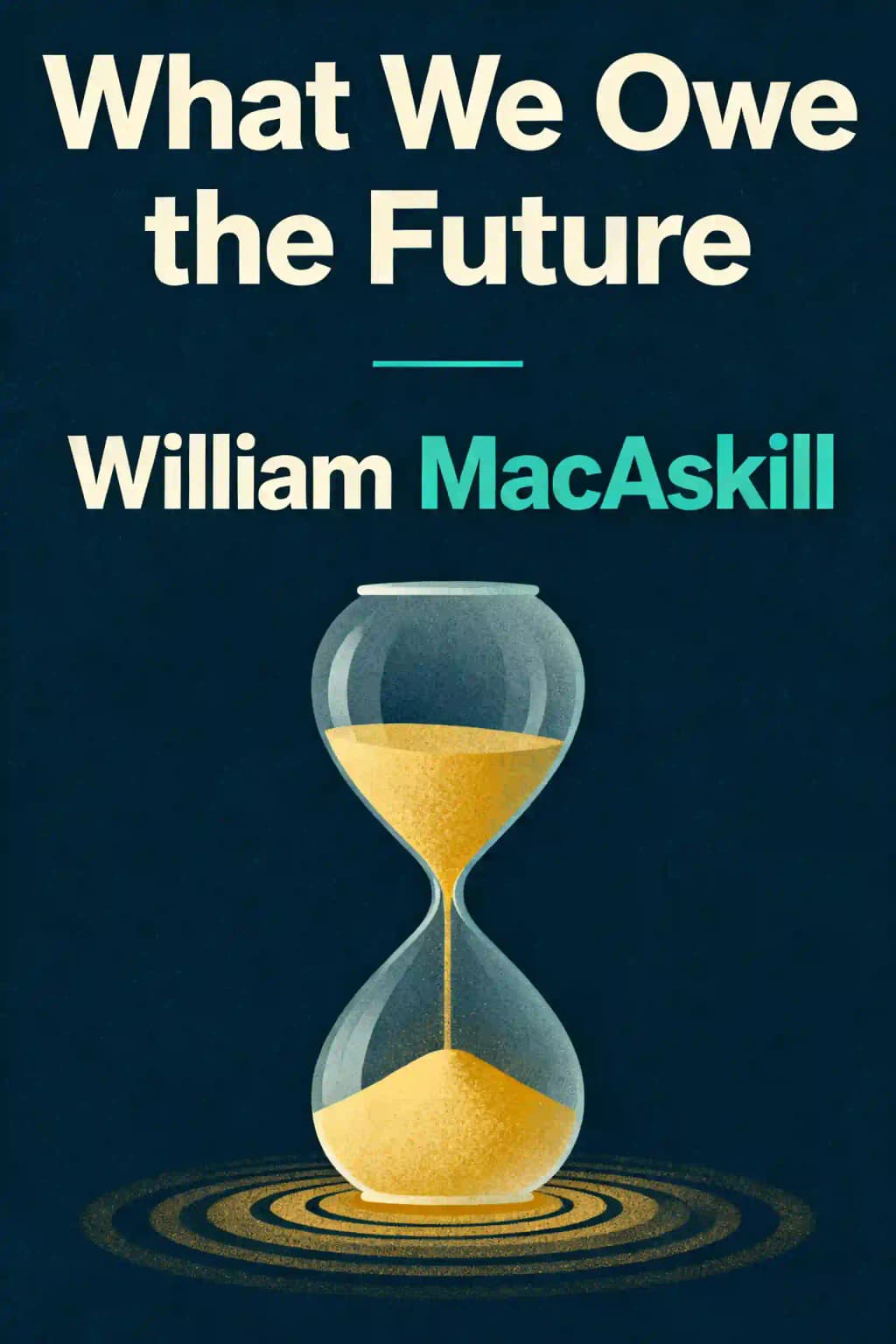
What We Owe the Future
Aperçu de What We Owe the Future
In "What We Owe the Future," MacAskill challenges us to consider humanity's entire timeline. Endorsed by Elon Musk and a New York Times bestseller, this radical perspective asks: What if your decisions today could impact billions of lives thousands of years from now?

Thèmes clés dans What We Owe the Future
- longtermism
- moral responsibility
- existential risk
- future generations
- value lock-in
Citations de What We Owe the Future
Civilization could plausibly last for millions, billions, or even trillions of years.
Future people count morally.
If we accept that future people matter, then we should accept that we should prioritize actions that improve the very long-run future.
The future could be radically better than the present.
We can affect the very long-run future.
Personnages de What We Owe the Future
- William MacAskillAuthor and philosopher who developed longtermism
- Benjamin LayQuaker activist who protested against slavery
- Anthony BenezetAbolitionist activist who spread Quaker ideals
- ThucydidesAncient historian who wrote to influence forever
À propos de l'auteur
À propos de l'auteur de What We Owe the Future
William MacAskill, author of What We Owe the Future, is a pioneering philosopher and co-founder of the effective altruism movement. An associate professor at the University of Oxford, he became the institution’s youngest philosophy professor upon his appointment.
His work centers on longtermism—the ethical imperative to safeguard humanity’s long-term potential—and moral decision-making under uncertainty. MacAskill’s expertise is rooted in founding nonprofits like Giving What We Can and 80,000 Hours, which have mobilized over $300 million toward high-impact causes.
His previous books, Doing Good Better and Moral Uncertainty, established him as a leading voice in evidence-based philanthropy and ethical theory. A frequent contributor to The New York Times and The Guardian, MacAskill’s TED Talk on effective altruism has reached millions globally.
Recognized in Forbes’ “30 Under 30” for social entrepreneurship, he bridges academic rigor with practical strategies for global good. What We Owe the Future became a New York Times bestseller, amplifying his call to prioritize future generations in today’s critical choices.
Telecharger le resume de What We Owe the Future
Obtenez le resume de What We Owe the Future en PDF ou EPUB gratuit. Imprimez-le ou lisez-le hors ligne a tout moment.
FAQ sur ce livre
What We Owe The Future argues for longtermism—the view that safeguarding humanity’s long-term potential is a critical moral priority. William MacAskill explores existential risks like AI, climate collapse, and pandemics, while advocating for actions to ensure civilization’s resilience, moral progress, and preparedness for a future dominated by digital minds.
This book is ideal for readers interested in ethics, philosophy, or global policy, particularly those concerned with humanity’s future trajectory. Policymakers, Effective Altruism advocates, and anyone seeking to understand how today’s choices impact tomorrow’s generations will find it transformative.
Widely praised for its optimistic yet practical tone, the book offers a compelling case for rethinking humanity’s responsibilities. Reviewers highlight its rigorous research, accessible writing, and ability to inspire actionable change, making it essential for those invested in shaping a better future.
Longtermism posits that positively influencing the distant future is a moral imperative. MacAskill argues that future generations could vastly outnumber us, so reducing existential risks and improving civilizational trajectories today could benefit trillions of potential lives.
Key risks include:
- Catastrophic climate change
- Unregulated AI development
- Pandemics and bioweapons
- Civilizational collapse without recovery mechanisms
- Moral backsliding halting societal progress
Using population ethics, he asserts that future lives are equally valuable to current ones. Historical examples—like ending slavery—illustrate how moral shifts can have long-lasting positive ripple effects, justifying proactive investments in humanity’s future.
Moral entrepreneurship refers to pioneering ethical innovations that reshape societal values. MacAskill cites movements like abolitionism and environmentalism as examples, urging readers to champion new norms that benefit future societies.
MacAskill warns that AI-driven digital consciousness could dominate the future, potentially outpacing human intelligence. He stresses the need to align these minds with humane values to prevent dystopian outcomes.
- Preserve resources (e.g., leaving coal reserves for post-collapse energy)
- Promote moral resilience to prevent backsliding
- Invest in AI safety research
- Reduce extinction risks through global cooperation
Some Effective Altruists argue it overemphasizes speculative risks while undervaluing near-term interventions. Others question whether longtermism neglects present-day marginalized communities, though MacAskill addresses these tensions in later chapters.
It draws parallels like 19th-century abolitionism to show how minority viewpoints can drive moral progress. The Glyptodon extinction illustrates irreversible consequences of short-term thinking, while coal’s role in post-collapse recovery underscores strategic resource preservation.
While his prior books focus on Effective Altruism’s principles, this title scales those ideas to a civilizational level, integrating philosophy with futurology. It’s broader in scope but retains his trademark blend of academic rigor and pragmatic optimism.