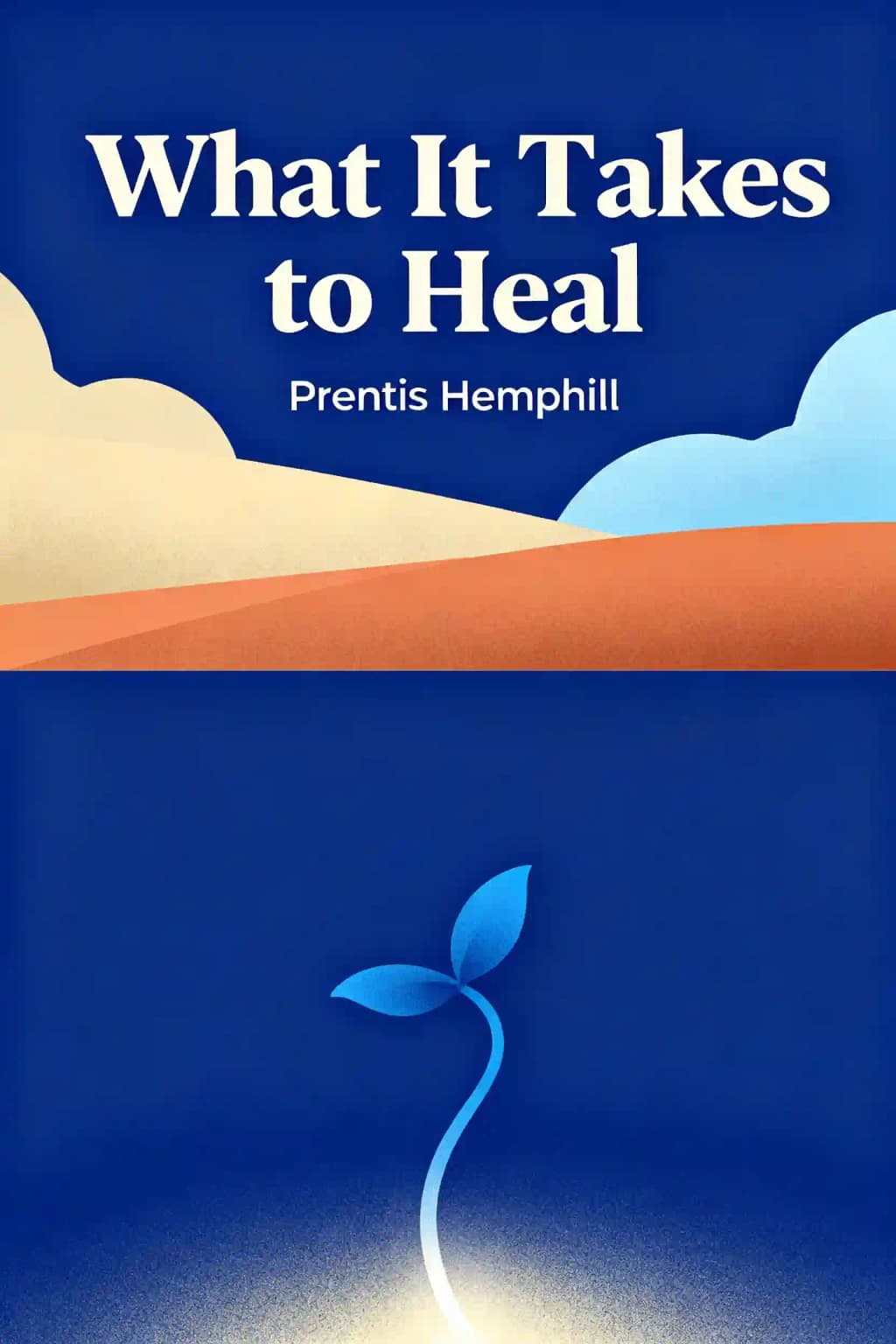
In "What It Takes to Heal," national bestseller Prentis Hemphill bridges personal transformation with social justice. Endorsed by "The Body Keeps the Score" author Bessel van der Kolk, this revolutionary guide asks: can embodied healing practices transform not just individuals, but our collective movements and communities?
Prentis Hemphill, author of What It Takes to Heal, is a celebrated embodiment practitioner, therapist, and social justice organizer whose work bridges personal and collective transformation. A founder of The Embodiment Institute and host of the acclaimed podcast Finding Our Way, Hemphill brings over a decade of experience in healing justice and somatics—a body-centered approach to trauma recovery.
Their groundbreaking contributions to anthologies like You Are Your Best Thing (edited by Tarana Burke and Brené Brown) and The Politics of Trauma inform this book’s exploration of communal healing, resilience, and reimagining power structures.
Hemphill’s expertise stems from roles such as Healing Justice Director for the Black Lives Matter Global Network and collaborations with organizations like Black Organizing for Leadership and Dignity. Their writing has appeared in The New York Times and Huffington Post, and they regularly speak on embodied leadership and systemic change.
What It Takes to Heal, published by Penguin Random House, distills Hemphill’s revolutionary framework for addressing intergenerational trauma through community-centered practices, solidifying their position as a visionary in modern healing justice movements. The book has been widely endorsed by leading voices in social justice and somatic therapy.
What It Takes to Heal by Prentis Hemphill explores how embodiment practices—awareness of bodily sensations and belief patterns—enable lasting personal and collective healing. It merges trauma recovery insights with social justice, arguing that community-centered healing can transform societal structures. Hemphill combines personal narratives, clinical examples, and activist experiences to advocate for courage, love, and systemic change.
This book is ideal for trauma survivors, therapists, social justice advocates, and anyone seeking tools to integrate personal growth with societal transformation. It resonates with readers interested in embodiment practices, collective care, and reimagining systems through a healing-centered lens.
Yes. Endorsed by thought leaders like Bessel van der Kolk, the book offers a timely framework for addressing modern crises through relational healing and systemic reimagining. Its blend of practical guidance and visionary ideas makes it valuable for both personal and professional growth.
Key concepts include:
Hemphill emphasizes that individual and societal transformation are interdependent.
Notable quotes include:
These lines underscore the book’s focus on connection and active compassion as catalysts for change.
While both address trauma, Hemphill’s work focuses more on community-based healing and systemic justice, whereas van der Kolk emphasizes neurobiological impacts. The books complement each other, offering individual and collective perspectives on recovery.
Some readers may find its systemic solutions challenging to implement without institutional support. However, Hemphill addresses this by providing practical steps for building healing-centered communities, even in oppressive structures.
Amid ongoing global crises, the book’s emphasis on resilience through connection aligns with 2025’s focus on mental health equity and social reform. Its ideas are particularly applicable to activists and organizations prioritizing intersectional healing.
Hemphill is a therapist, embodiment practitioner, and activist who co-founded the Black Lives Matter Los Angeles chapter. Their work bridges trauma therapy and social movements, collaborating with leaders like Tarana Burke and Brené Brown.
Healing justice, per Hemphill, is a framework that centers care and transformation in activism and institutions. It challenges systemic harm by prioritizing emotional, physical, and communal well-being alongside political change.
Courage involves confronting fear to pursue aligned action, while love is a transformative practice that affirms humanity. Together, they dismantle barriers to connection and fuel both personal and societal growth.
The book advises:
Hemphill also provides a free toolkit for deeper exploration.
Ressentez le livre à travers la voix de l'auteur
Transformez les connaissances en idées captivantes et riches en exemples
Capturez les idées clés en un éclair pour un apprentissage rapide
Profitez du livre de manière ludique et engageante
Boundaries are the distance at which I can love you and me simultaneously.
Healing begins not in our actions but in our dreams and imagination.
Trauma often steals our capacity for longing.
The visions we inherit can only recreate the world as it is.
Freedom exists in the gaps between things.
Décomposez les idées clés de What It Takes to Heal en points faciles à comprendre pour découvrir comment les équipes innovantes créent, collaborent et grandissent.
Condensez What It Takes to Heal en indices de mémoire rapides mettant en évidence les principes clés de franchise, de travail d'équipe et de résilience créative.

Découvrez What It Takes to Heal à travers des récits vivants qui transforment les leçons d'innovation en moments mémorables et applicables.
Posez n'importe quelle question, choisissez la voix et co-créez des idées qui résonnent vraiment avec vous.

Cree par des anciens de Columbia University a San Francisco
"Instead of endless scrolling, I just hit play on BeFreed. It saves me so much time."
"I never knew where to start with nonfiction—BeFreed’s book lists turned into podcasts gave me a clear path."
"Perfect balance between learning and entertainment. Finished ‘Thinking, Fast and Slow’ on my commute this week."
"Crazy how much I learned while walking the dog. BeFreed = small habits → big gains."
"Reading used to feel like a chore. Now it’s just part of my lifestyle."
"Feels effortless compared to reading. I’ve finished 6 books this month already."
"BeFreed turned my guilty doomscrolling into something that feels productive and inspiring."
"BeFreed turned my commute into learning time. 20-min podcasts are perfect for finishing books I never had time for."
"BeFreed replaced my podcast queue. Imagine Spotify for books — that’s it. 🙌"
"It is great for me to learn something from the book without reading it."
"The themed book list podcasts help me connect ideas across authors—like a guided audio journey."
"Makes me feel smarter every time before going to work"
Cree par des anciens de Columbia University a San Francisco

Obtenez le resume de What It Takes to Heal en PDF ou EPUB gratuit. Imprimez-le ou lisez-le hors ligne a tout moment.
What does it mean when you can't cry? Not because you're stoic or strong, but because somewhere deep in your body, the message was carved: *stop before I give you something to cry about.* This was the reality at age twenty-seven-a grown adult who'd forgotten how to let tears fall. The body had learned its lesson so well that even alone, even safe, the waterworks would shut down before a single drop could escape. So began an unusual experiment: a crying date. Hot tub, headphones, sad songs, and a repeated mantra: "I'm safe enough to feel what needs to come." Twenty minutes in, as Sade crooned "King of Sorrow," something shifted. The familiar tightening came-that impulse to swallow it all down-but this time, there was a conscious choice to relax the face, soften the chest, breathe. What followed wasn't pretty or Instagram-worthy. It was convulsive, shoulder-shaking, belly-deep sobbing. Years of suppressed hurt rushing through like a dam finally breaking. This moment reveals something revolutionary: healing doesn't happen in our heads. It happens in the tissues that remember, the muscles that hold, the tears that were never allowed to fall.