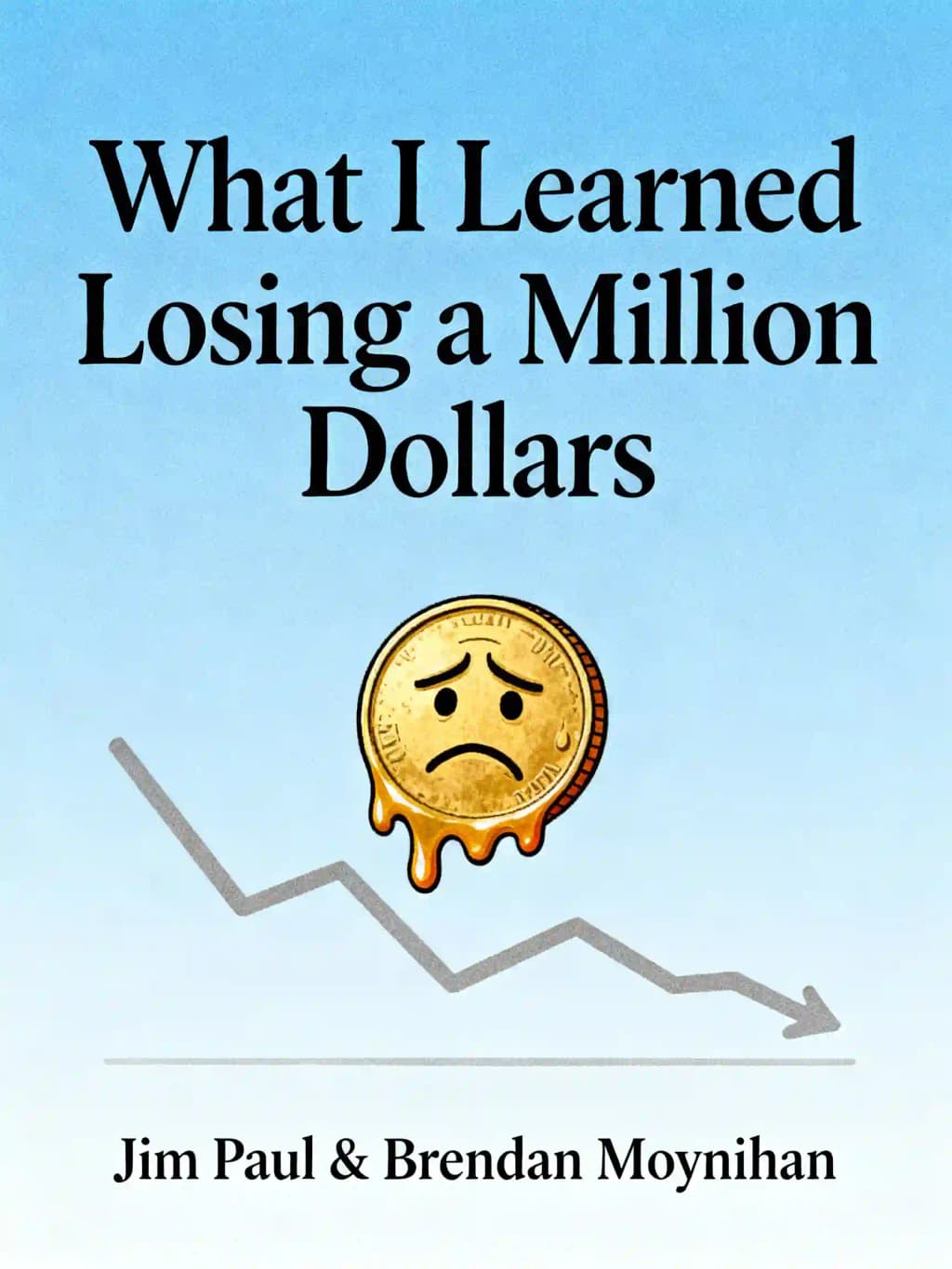
Jim Paul's cautionary tale of losing a million dollars teaches what most finance books don't - how not to lose money. This Axiom Award winner reveals why emotional control trumps strategy, making it required reading for traders who want lasting success.
Ressentez le livre à travers la voix de l'auteur
Transformez les connaissances en idées captivantes et riches en exemples
Capturez les idées clés en un éclair pour un apprentissage rapide
Profitez du livre de manière ludique et engageante
Jim Paul's journey from Kentucky caddy to Chicago trading titan-and his subsequent financial implosion-offers a masterclass in market psychology. At nine years old, Paul got his first taste of wealth caddying at Summit Hills Country Club. Watching members with their Cadillacs and country club lifestyles planted a seed: what mattered wasn't what you did, but how much you got paid doing it. This philosophy guided his unconventional path through college, military service, and eventually to the Chicago Mercantile Exchange, where his aggressive style and strategic networking propelled him to the inner circle of market power. By 1980, Paul had it all-handling 25% of daily lumber contracts, serving on the CME's Executive Committee, and earning hundreds of thousands annually. His success reinforced a dangerous belief: he was special, different, better than others. When the lumber market dried up in 1983, he pivoted to soybean oil spreads, building massive positions that initially paid off spectacularly. One day alone netted him $248,000-vindication of his self-perceived genius. Then the market turned. For months, Paul lost $20,000-$25,000 daily while rationalizing every drop. Sophisticated clients bailed out, but he held on, convinced the world would run out of bean oil and he'd make $10 million. By October, his positions had plummeted, and margin calls mounted. In just 75 days, he lost everything-money, exchange membership, job, and self-respect. What went wrong? He'd never actually been a trader-just a well-connected salesman who confused luck with skill.
Décomposez les idées clés de What I Learned Losing a Million Dollars en points faciles à comprendre pour découvrir comment les équipes innovantes créent, collaborent et grandissent.
Condensez What I Learned Losing a Million Dollars en indices de mémoire rapides mettant en évidence les principes clés de franchise, de travail d'équipe et de résilience créative.

Découvrez What I Learned Losing a Million Dollars à travers des récits vivants qui transforment les leçons d'innovation en moments mémorables et applicables.
Posez n'importe quelle question, choisissez la voix et co-créez des idées qui résonnent vraiment avec vous.

Cree par des anciens de Columbia University a San Francisco
"Instead of endless scrolling, I just hit play on BeFreed. It saves me so much time."
"I never knew where to start with nonfiction—BeFreed’s book lists turned into podcasts gave me a clear path."
"Perfect balance between learning and entertainment. Finished ‘Thinking, Fast and Slow’ on my commute this week."
"Crazy how much I learned while walking the dog. BeFreed = small habits → big gains."
"Reading used to feel like a chore. Now it’s just part of my lifestyle."
"Feels effortless compared to reading. I’ve finished 6 books this month already."
"BeFreed turned my guilty doomscrolling into something that feels productive and inspiring."
"BeFreed turned my commute into learning time. 20-min podcasts are perfect for finishing books I never had time for."
"BeFreed replaced my podcast queue. Imagine Spotify for books — that’s it. 🙌"
"It is great for me to learn something from the book without reading it."
"The themed book list podcasts help me connect ideas across authors—like a guided audio journey."
"Makes me feel smarter every time before going to work"
Cree par des anciens de Columbia University a San Francisco

Obtenez le resume de What I Learned Losing a Million Dollars en PDF ou EPUB gratuit. Imprimez-le ou lisez-le hors ligne a tout moment.