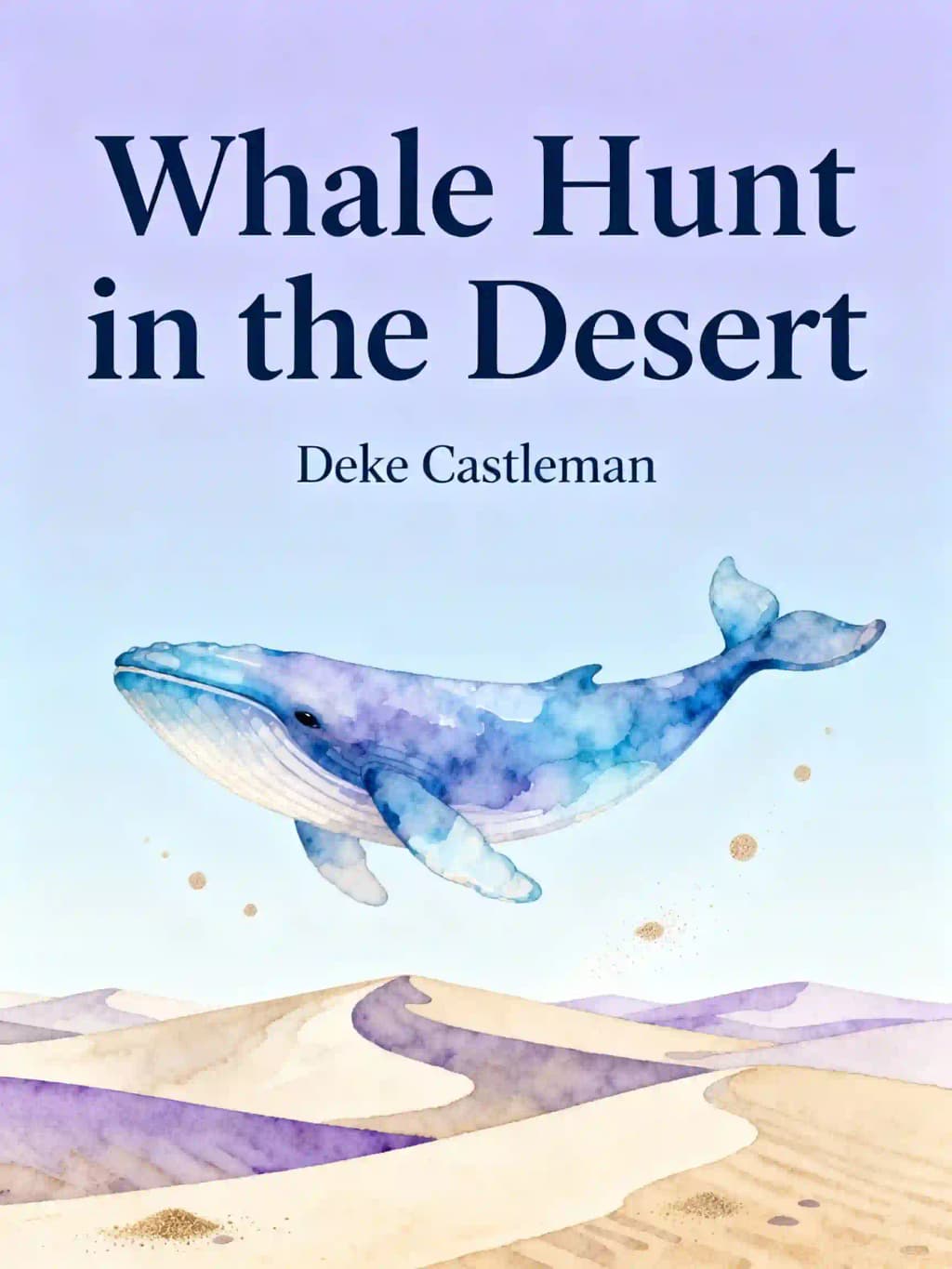
Step inside the secret world of Vegas "whales" - billionaire gamblers courted with private jets and million-dollar credit lines. Legendary superhost Steve Cyr's wild tactics reveal the Faustian pacts between casinos and their ultra-wealthy prey in this insider expose.
Deke Castleman, acclaimed author of Whale Hunt in the Desert: Secrets of a Vegas Superhost, is a seasoned authority on Las Vegas culture and high-stakes gambling.
A senior editor at Huntington Press since 1991, Castleman has spent decades dissecting casino operations and profiling industry insiders. His expertise stems from editing over 50 gambling-related books and co-authoring 200+ issues of The Las Vegas Advisor, a trusted newsletter for gaming enthusiasts.
Whale Hunt in the Desert, his definitive exposé on casino "whale hunting," blends meticulous research with insider access to figures like legendary host Steve Cyr, revealing the opulent yet cutthroat world of ultra-high rollers. Castleman’s other works include Vegas Golden Knights and multiple Nevada travel guides, cementing his status as a chronicler of Sin City’s allure.
The book, praised for its gritty narrative and industry revelations, remains a cornerstone resource for understanding casino economics and remains widely cited in gambling literature.
Whale Hunt in the Desert exposes the clandestine world of Las Vegas’ ultra-high-stakes gamblers (“whales”) and the casino hosts who lure them. Through the career of Steve Cyr, a legendary host, it reveals how casinos pamper whales with luxury perks to extract millions, while detailing the psychological and financial dynamics of these Faustian relationships.
This book suits gambling enthusiasts, Las Vegas culture buffs, and business readers interested in customer retention strategies. Its blend of investigative journalism and insider anecdotes appeals to anyone curious about the hidden mechanics of casino profitability or the extremes of wealth and risk-taking.
Yes, for its unrivaled insider perspective on high-stakes gambling. While some criticize its biographical focus on Steve Cyr, the book remains the definitive guide to casino-whale relationships, offering sharp insights into Las Vegas’s evolution and the art of “hosting.”
Casinos use personalized incentives like private jets, penthouse suites, and gambling credit lines. Hosts like Steve Cyr build emotional rapport, leveraging whales’ egos and addictions to keep them betting. The goal: maximize losses while ensuring whales feel like VIPs.
Steve Cyr is a famed Las Vegas casino host who pioneered aggressive whale-hunting tactics. The book tracks his rise from telemarketer to “superhost,” showcasing his methods for identifying, recruiting, and manipulating high rollers—a blend of charisma, psychological insight, and calculated generosity.
Some argue early chapters overly glorify Cyr’s biography at the expense of deeper gambling stories. However, the book’s later sections deliver compelling analyses of casino economics and whale psychology, balancing its uneven start.
The third edition highlights Vegas’s shift from gambling-centric resorts to entertainment hubs with nightclubs and day clubs. It also explores modern hosts’ roles in a landscape where non-gambling revenue rivals gaming profits.
A whale is a gambler who wagers millions annually. Unlike casual players, whales negotiate personalized comps (freebies) and credit terms. Their losses fund casino profits, making them targets of relentless hospitality and psychological manipulation.
The book examines how hosts balance ethical boundaries while exploiting whales’ addictions. Examples include offering alcohol to intoxicated players or extending credit to clearly bankrupt individuals—a tension between profit and responsibility.
Castleman’s 25-year career editing gambling guides and Las Vegas literature grounds the book in authority. His access to Cyr and industry insiders provides rare authenticity, blending journalistic rigor with vivid storytelling.
Whales trade massive financial risk for status and thrills, while casinos risk comps and credit for potential profits. Both sides chase mutually destructive gains, creating cycles of dependency and exploitation.
Unlike broader histories, it zooms in on the symbiotic host-whale dynamic. While Bringing Down the House focuses on card counters, Castleman’s work reveals how casinos “hunt” those they deem most profitable—a unique angle in gambling literature.
Ressentez le livre à travers la voix de l'auteur
Transformez les connaissances en idées captivantes et riches en exemples
Capturez les idées clés en un éclair pour un apprentissage rapide
Profitez du livre de manière ludique et engageante
The value is zero.
Don't get caught again.
Décomposez les idées clés de Whale Hunt in the Desert en points faciles à comprendre pour découvrir comment les équipes innovantes créent, collaborent et grandissent.
Découvrez Whale Hunt in the Desert à travers des récits vivants qui transforment les leçons d'innovation en moments mémorables et applicables.
Posez vos questions, choisissez votre style d’apprentissage et co-créez des idées qui vous correspondent vraiment.

Cree par des anciens de Columbia University a San Francisco
"Instead of endless scrolling, I just hit play on BeFreed. It saves me so much time."
"I never knew where to start with nonfiction—BeFreed’s book lists turned into podcasts gave me a clear path."
"Perfect balance between learning and entertainment. Finished ‘Thinking, Fast and Slow’ on my commute this week."
"Crazy how much I learned while walking the dog. BeFreed = small habits → big gains."
"Reading used to feel like a chore. Now it’s just part of my lifestyle."
"Feels effortless compared to reading. I’ve finished 6 books this month already."
"BeFreed turned my guilty doomscrolling into something that feels productive and inspiring."
"BeFreed turned my commute into learning time. 20-min podcasts are perfect for finishing books I never had time for."
"BeFreed replaced my podcast queue. Imagine Spotify for books — that’s it. 🙌"
"It is great for me to learn something from the book without reading it."
"The themed book list podcasts help me connect ideas across authors—like a guided audio journey."
"Makes me feel smarter every time before going to work"
Cree par des anciens de Columbia University a San Francisco

Obtenez le resume de Whale Hunt in the Desert en PDF ou EPUB gratuit. Imprimez-le ou lisez-le hors ligne a tout moment.
A gambler walks into a casino carrying $150,000 in his pocket, ready to bet it all on a single hand. Sounds like a fantasy? In Las Vegas, roughly 50 people worldwide do exactly this-and casinos deploy specialized hunters to track them down. These ultra-wealthy gamblers, known as "whales," represent the apex predators of the gambling world, and pursuing them requires a unique breed of casino host willing to break every rule in the book. Steve Cyr became the most legendary harpooner in this high-stakes hunt, revolutionizing how casinos pursue billion-dollar players through tactics so aggressive they'd make a used car salesman blush. His story reveals a hidden world where luxury becomes currency, addiction fuels empires, and the line between host and enabler blurs beyond recognition. This isn't just about gambling-it's about understanding the primal psychology of risk, the economics of desire, and how far people will go to capture lightning in a bottle.
Steve Cyr arrived in Las Vegas from Kansas and spotted what casinos missed: high rollers were treated terribly. Players dropping $100,000 waited in check-in lines and made their own reservations. At 22, Cyr talked his way into supervising the Desert Inn's VIP Services, staffing the lounge with attractive marketing secretaries who provided airport limos, personal greetings, and seamless coordination. Moving to Caesars Palace as a slot host, Cyr recognized slots generated massive profits while management dismissed players as "slot sluts." He offered premium suites to modest players, then proposed becoming a "cash host" working both slots and tables - targeting medium rollers everyone ignored. When mentor Guy Hudson brought him to the Hilton in March 1990, Cyr flew to Phoenix on his own dime to recruit Al Franco, who lost $164,000 at blackjack. This aggressive approach earned him a promotion to Director of Casino Support Services within his first week.
Cyr systematically demolished casino taboos. Mining the Hilton's neglected database, he identified 375 Southern California players who'd lost at least $10,000 but hadn't returned-then cold-called them. His telemarketing background proved invaluable as he bulldozed through secretaries with fabricated meetings. He broke sacred rules: calling players at home, pursuing widows of deceased gamblers, working Sundays when competitors rested. Suite allocation received similar treatment. While traditional hosts followed rigid criteria leaving luxury rooms empty, Cyr understood dynamic value: "It's nine p.m. and you haven't rented it? The value is zero." By Thursday afternoons, he'd offer Renaissance Suites for just $50,000 in action. His intelligence network was equally unorthodox-paying bellmen, limo drivers, and competitors' employees up to $10,000 monthly for player information. Cyr leveraged internal politics ruthlessly. After discovering he'd generated $1.4 million in profit while earning just $36,000-compared to veteran hosts making $125,000 with only $220,000 in profit-he threatened to quit and secured a raise. In suite meetings, he deliberately undersold and over-delivered, ensuring he'd always be the hero.
Elite hosts built specialized teams to expand their reach. Cyr's crew included Dan London, who dumpster-dove at Caesars World's San Francisco office to find 1,300 Northern California gamblers. Doug Bean leveraged Japanese language skills to access a Malaysian high roller who eventually lost nearly $1 million. Their telemarketing became legendary. They developed the "Round Table game" to critique calls and the "save my job" technique-pretending their employment depended on the player visiting. When players called wanting perks, Cyr created artificial scarcity, making them think he was working hard to secure fight tickets already on his desk. The team understood luxury economics. Casino-owned aircraft provided competitive advantage-the Hilton's Hawker could be dispatched quickly while NetJets might take 24 hours. Through these techniques, Cyr transformed casino marketing from passive waiting into aggressive pursuit.
Casino hosts walk a moral tightrope where friendship and exploitation blur. Cyr partied with clients while silently hoping "lose baby lose," since his career depended on their losses. Entrepreneur Gus Johnson exemplified this dynamic. After his girlfriend left, he ignored Cyr's bathroom warning and raised his limits from $500 to $10,000 minimums. Within one weekend, he lost his entire seven-figure bankroll, then chased losses until he was down $6 million in three months. Al Franco's story proved even more tragic. Cyr convinced Franco to visit the day before starting at the Hilton-he immediately lost $164,000. For two years, Cyr flew to Phoenix every Monday to fetch Franco, who gambled secretly, hiding his addiction from family and business partners. Franco lost $7 million across several casinos. One Monday, Franco miraculously won $1.5 million and wisely gave Cyr a $400,000 check with instructions never to return it. But when his luck turned, Franco cornered Cyr in a bathroom stall demanding it back. Despite knowing Franco was on tilt, Cyr returned it. By sunrise, Franco had lost everything plus another $500,000 in markers. Within six months, he declared bankruptcy. Only in the late '90s did Nevada mandate that casinos post gambling addiction hotlines.
Professional gamblers dismiss treatment programs, believing discipline alone separates them from pathological players. Billy Walters exemplifies this rare transition. Growing up poor in Kentucky, he gambled compulsively from age five. His epiphany came when he noticed casinos treated winners differently, prompting him to vow never to play without a mathematical edge. He became a founding member of the Computer Group, pioneering statistical sports betting, and built a real estate empire worth hundreds of millions. Only a few hundred professional gamblers worldwide make their living exclusively from gambling. The profession demands advanced mathematical ability, sophisticated bankroll management, iron discipline, and psychological fortitude to handle six-figure swings. For every Billy Walters who succeeds, thousands remain trapped, unable to develop the necessary sophistication and emotional control. Global whale migration shifts with economic tides. Mexican elites became the first international whales in the 1970s until the peso collapse. Las Vegas then targeted Middle Eastern oil money, followed by Japanese players in the 1980s. Today, though only 3% of Las Vegas visitors come from Asia, they account for $400-600 million in annual baccarat play. Chinese high-rollers face extraordinary challenges-making money in China's repressive environment, qualifying for US visas, circumventing currency export limits, and risking execution for corruption if caught gambling large sums abroad. Despite these obstacles, they continue flooding Vegas, particularly during Chinese New Year.
After nearly a decade at the Las Vegas Hilton, Cyr was terminated in 1999 - a forced career shift that proved fortunate. Going independent, he worked as a player representative for casinos like Barona and Atlantis, discovering greater freedom and earning potential. At Atlantis, he was introduced to "theoretical loss" commissions, allowing him to genuinely root for his players to win since his pay was based on total action rather than outcomes. The casino industry transformed dramatically during Cyr's career. Revenue streams shifted from 80% casino-generated to today's equal split between nightlife/restaurants, hotel/conventions, and gaming. The demographic changed radically - Cyr now hosts more $100,000 players under 35 than over, with tech entrepreneurs replacing the older generation. Now 50, Cyr represents six Las Vegas casinos while reinventing himself as a casino marketing consultant. He travels nationwide - particularly to Native American properties - charging high four to low five figures for consulting sessions. He lectures at Cornell and NYU's Stern School of Business, taking pride in shocking high-achieving students with his 2.3 GPA from UNLV and substantial earnings. Why do people gamble? Beyond casino marketing's pitch of casual recreation lies something more primal: risk-taking, an evolutionary trait embedded in human DNA. Modern gambling represents a residual hunting instinct repressed by urban society, with mega-rollers being apex predators. Steve Cyr's legacy as the ultimate harpooner remains intact - a testament to how hustle, innovation, and determination can transform an entire industry.