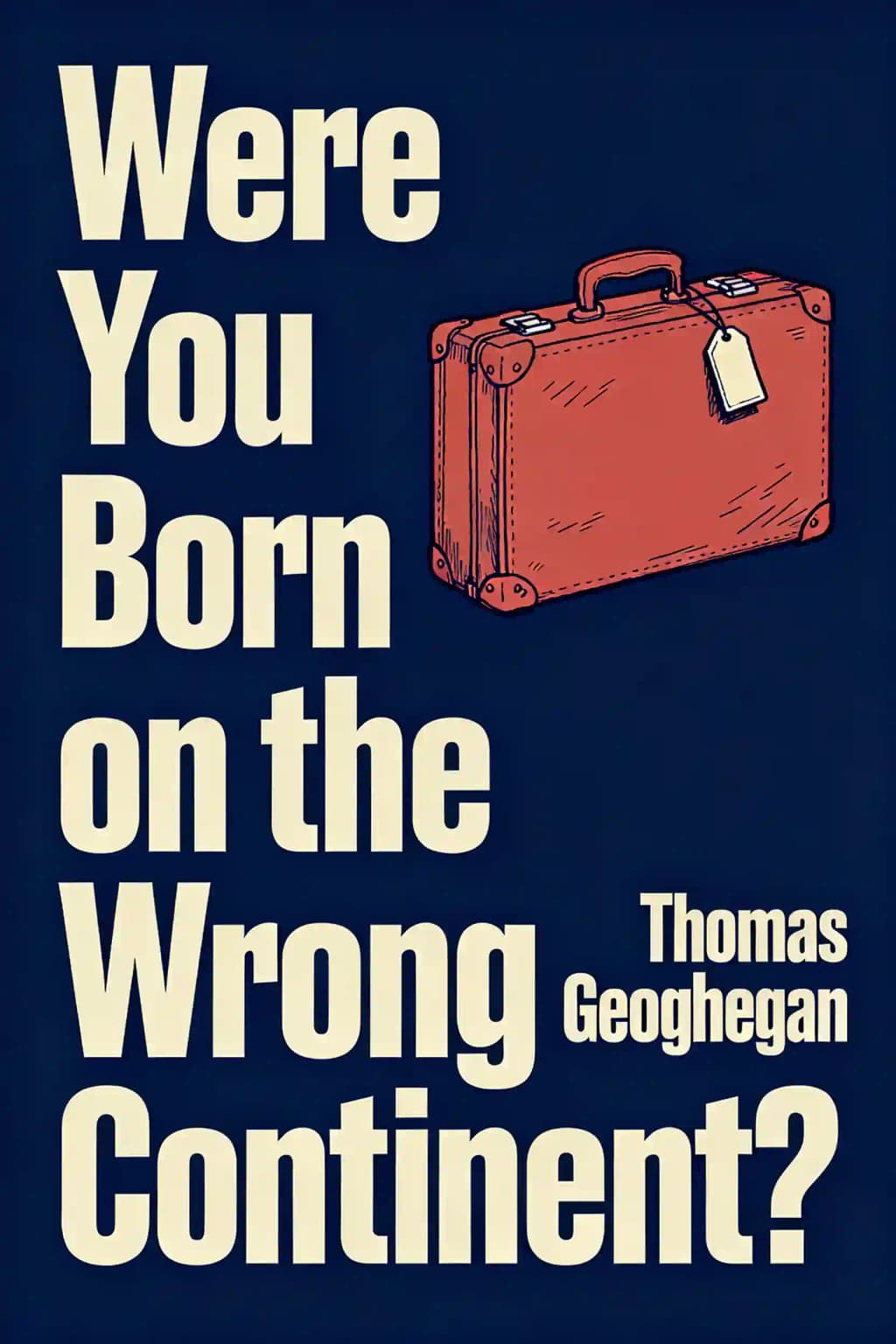
Were You Born on the Wrong Continent?
How the European Model Can Help You Get a Life
Aperçu de Were You Born on the Wrong Continent?
Could America's work-life balance be fundamentally wrong? Labor lawyer Thomas Geoghegan challenges American capitalism by revealing how Germany's economic model delivers higher living standards despite shorter work hours - sparking fierce debates among economists about what true prosperity means.

Thèmes clés dans Were You Born on the Wrong Continent?
- social democracy comparison
- labor rights advocacy
- middle class prosperity
- american exceptionalism critique
- work-life balance economics
Citations de Were You Born on the Wrong Continent?
America may claim to be for the middle class, but Europe is set up for the bourgeois.
Perhaps we should be working at jobs we consume rather than jobs that consume us.
So was I born on the wrong continent?
The European model demonstrates that productivity and profit don't have to come at the expense of quality of life.
The American system creates significant risks with devastating consequences.
Personnages de Were You Born on the Wrong Continent?
- Thomas GeogheganAuthor and labor lawyer
- Joseph StiglitzNobel Prize-winning economist
- Elizabeth WarrenU.S. politician and reader of the book
- KeynesEconomist whose predictions are discussed
À propos de l'auteur
À propos de l'auteur de Were You Born on the Wrong Continent?
Thomas Geoghegan, labor lawyer and acclaimed author of Were You Born on the Wrong Continent? How the European Model Can Help You Get a Life, combines decades of legal advocacy with incisive socio-economic analysis. A founding partner of Despres Schwartz and Geoghegan Ltd., he has represented unions and workers in landmark labor, civil rights, and public health cases since 1975.
His writing, including National Book Critics Circle Award finalist Which Side Are You On? and Only One Thing Can Save Us, exposes systemic inequities while advocating for labor reform and democratic renewal.
Geoghegan’s commentary has shaped national discourse through appearances on NPR, Nightline, and The Today Show, alongside contributions to The New York Times, Harper’s, and The Nation. His work blends firsthand legal experience with dry wit, offering pragmatic solutions to America’s labor and political challenges.
Were You Born on the Wrong Continent? reflects his comparative study of European social policies, arguing for equitable reforms. A Holtzbrinck Fellow at the American Academy in Berlin, Geoghegan’s books remain essential reading for understanding labor history and economic justice.
Telecharger le resume de Were You Born on the Wrong Continent?
Obtenez le resume de Were You Born on the Wrong Continent? en PDF ou EPUB gratuit. Imprimez-le ou lisez-le hors ligne a tout moment.
FAQ sur ce livre
Were You Born on the Wrong Continent? critiques American capitalism by advocating for Europe’s social democracy model, particularly Germany’s high-wage, worker-centric economy. Author Thomas Geoghegan contrasts Europe’s robust social safety nets—free education, universal healthcare, and subsidized childcare—with U.S. inequality, arguing that Europe better supports middle-class professionals through collective bargaining and public investment in key sectors like manufacturing.
This book suits policymakers, labor advocates, and readers interested in comparative economics. Geoghegan’s blend of personal anecdotes (e.g., encounters with subsidized artists in Paris) and data-driven analysis appeals to those exploring alternatives to U.S.-style capitalism, particularly Germany’s success in reducing unemployment through worker-friendly policies.
Geoghegan highlights five pillars of European social democracy: education, healthcare, retirement, childcare, and transportation. He praises Germany’s focus on high-end manufacturing over wage suppression, arguing this approach sustains living standards while maintaining global competitiveness. The book also critiques America’s “monolingual, provincial culture” for undervaluing these systems.
Germany avoids wage competition with low-cost economies by specializing in premium manufacturing (e.g., machinery, chemicals). Unlike the U.S., German unions collaborate with corporations and governments to ensure high wages, worker training, and job security. Geoghegan attributes Germany’s post-1990s unemployment drop to this “social democracy in action.”
Geoghegan argues the U.S. prioritizes corporate profits over public goods, leaving professionals to self-fund education, healthcare, and retirement. He contrasts this with Europe’s “joyful” quality of life, where state support allows careers in arts and sciences without financial precarity.
Yes. Geoghegan acknowledges struggles in Europe’s periphery (e.g., Greece, Ireland) but distinguishes them from core economies like Germany. He defends high taxes as investments in public infrastructure and rejects claims that union power stifles innovation, citing Germany’s export dominance.
German co-determination laws, which embed worker representatives in corporate boards, ensure labor interests shape economic decisions. Geoghegan contrasts this with U.S. union decline, arguing worker participation prevents exploitative practices and aligns corporate goals with societal well-being.
As a labor lawyer, Geoghegan draws on cases defending unions and pension rights. His courtroom experience informs critiques of U.S. labor law’s inadequacies and admiration for Europe’s legally enshrined worker protections.
He contrasts Europe’s multilingualism and subsidized arts with America’s “provincial” focus on consumerism. For example, he describes Parisian drummers funded by public grants and Germany’s thriving print media culture as evidence of Europe’s commitment to cultural enrichment.
Yes. Debates over healthcare, income inequality, and union resurgence in the U.S. mirror Geoghegan’s arguments. The book remains a touchstone for discussions on balancing free markets with social welfare—a key issue in post-pandemic policymaking.
Unlike his labor-focused Which Side Are You On?, this book blends memoir, economics, and travelogue. However, it shares his advocacy for collective bargaining and skepticism of unfettered capitalism, themes central to his writing career.
- “Europe is set up for the bourgeois; America’s a great place to buy kitty litter at Wal-Mart.”
- “The quicker we let go of ‘American exceptionalism,’ the sooner we can rebuild a fairer society.”
These lines underscore Geoghegan’s belief that Europe’s model offers blueprints for U.S. reform.