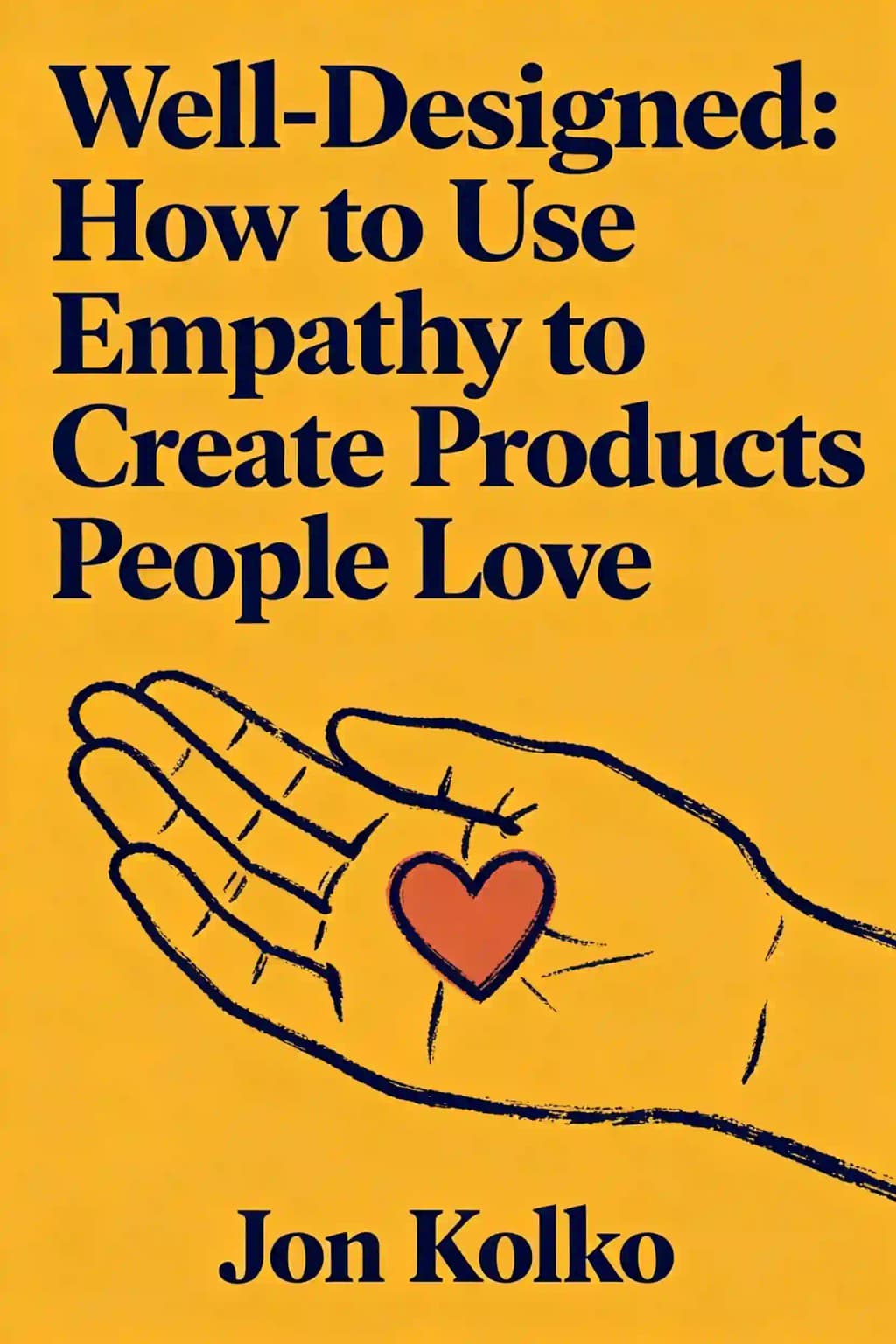
Well-Designed
How to Use Empathy to Create Products People Love
Aperçu de Well-Designed
In "Well-Designed," Jon Kolko reveals how empathy - not just data - creates products people genuinely love. This 2014 Harvard Business Review gem transformed how companies like Nest develop emotional connections with users, proving that understanding feelings drives innovation more powerfully than features alone.

Thèmes clés dans Well-Designed
- human-centered design
- empathy-driven innovation
- product-person fit
- emotional engagement
- design-led product management
Citations de Well-Designed
Design isn't merely about making things pretty.
We naturally personify products, especially digital ones.
Empathy isn't an innate trait...it's a skill.
Designers are typically optimistic about the future.
Markets may not be ready for certain products.
Personnages de Well-Designed
- Jon KolkoAuthor and expert in empathy-driven product design
À propos de l'auteur
À propos de l'auteur de Well-Designed
Jon Kolko, author of Well-Designed: How to Use Empathy to Create Products People Love, is a renowned designer, educator, and thought leader in interaction design and product innovation.
A Carnegie Mellon University graduate, Kolko’s career spans executive roles at frog design, Blackboard, and MyEdu, where he advocated for human-centered design in enterprise software. His expertise lies in bridging design thinking with business strategy, emphasizing empathy to create emotionally resonant products.
Kolko’s other influential works include Exposing the Magic of Design, a guide to design synthesis, and Wicked Problems: Problems Worth Solving, which tackles complex societal challenges through design. As founder of the Austin Center for Design, he educates future designers on social entrepreneurship.
Kolko’s frameworks are widely adopted by Fortune 500 companies like Ford and AT&T, and his writings remain required reading in design programs globally.
Telecharger le resume de Well-Designed
Obtenez le resume de Well-Designed en PDF ou EPUB gratuit. Imprimez-le ou lisez-le hors ligne a tout moment.
FAQ sur ce livre
Well-Designed by Jon Kolko argues that empathy-driven design is key to creating products users love. The book presents a four-step design-thinking framework: identifying product-market fit, uncovering behavioral insights through ethnographic research, synthesizing strategies, and refining details through visual storytelling. It emphasizes emotional value over mere functionality, using real-world examples to show how empathy transforms user experiences.
Product managers, designers, and marketers seeking to create emotionally resonant products will benefit most. Kolko’s practical advice on ethnographic research and iterative design is ideal for professionals looking to bridge user needs with business goals. The book also appeals to educators teaching human-centered design methodologies.
Yes—its blend of theory and actionable frameworks makes it valuable for anyone in product development. Readers praise its jargon-free approach and case studies from Kolko’s 15+ years in design. Critics note it leans heavily on product management contexts, but its empathy-focused lens remains widely applicable.
Jon Kolko is a designer, educator, and founder of Austin Center for Design. He’s held leadership roles at Frog Design, Blackboard, and Modernist Studio, working with clients like Ford and AT&T. A Carnegie Mellon graduate, he’s authored multiple books on design thinking and teaches practical empathy as a learned skill.
- Product-market fit: Identify user communities and unmet needs.
- Behavioral insights: Conduct ethnographic research to observe real-world behaviors.
- Strategy synthesis: Simplify complex data into actionable insights.
- Detail refinement: Use visual tools to polish user-facing elements.
Unlike traditional feature-focused propositions, Kolko’s emotional value proposition prioritizes how a product makes users feel. By aligning design with emotional outcomes (e.g., Nest’s thermostat creating trust through intuitive interfaces), products foster deeper engagement and loyalty.
Techniques include role-playing user scenarios, conducting observational fieldwork, and creating empathy maps to document emotional pain points. These methods help designers move beyond assumptions to authentically reflect user needs.
Nest is highlighted for its emotionally resonant thermostat design, which led to a $3.2B Google acquisition. Kolko also references firms using iterative storytelling to refine products, though specific examples are anonymized to focus on universal lessons.
While traditional design thinking emphasizes broad ideation, Kolko prioritizes granular emotional insights. His process leans heavily on ethnographic research and visual synthesis, arguing that empathy isn’t innate but a skill developed through structured practice.
Some reviewers argue the book lacks depth in technical execution and overly simplifies team dynamics. Others note its examples skew toward consumer tech, though Kolko’s frameworks are adaptable to other industries.
While Don Norman’s classic focuses on usability heuristics, Kolko emphasizes emotional engagement. Both advocate user-centered design, but Well-Designed offers more tactical steps for embedding empathy into corporate workflows.
As AI-driven products risk feeling impersonal, Kolko’s empathy-first approach helps maintain human-centric innovation. The book’s emphasis on ethnographic research remains critical for understanding nuanced user needs in rapidly evolving tech landscapes.