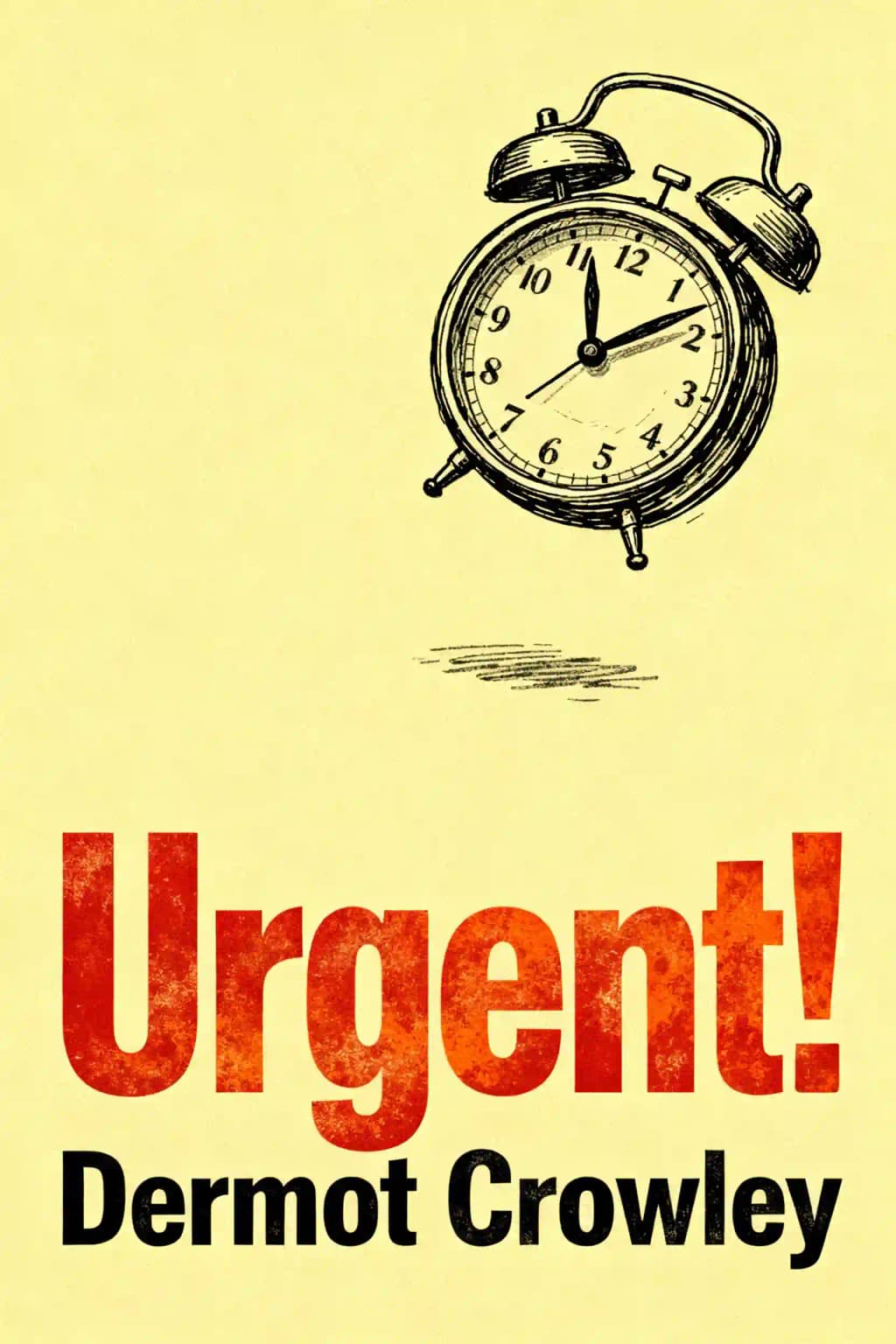
In "Urgent!", productivity expert Dermot Crowley reveals why 40% of Americans experience workday anxiety. Endorsed by thought leader Matt Church as "distinguishing between immediacy and true urgency," this game-changing playbook helps overwhelmed professionals reclaim focus in our notification-obsessed world.
Dermot Crowley, author of Urgent!, is a leading productivity expert and founder of Adapt Productivity, a Sydney-based training company he established in 2002.
With over 20 years of experience in corporate productivity coaching, Crowley specializes in strategies to combat reactive work habits and enhance proactive time management—core themes explored in his 2021 book. A bestselling author, he previously wrote Smart Work (2016) and Smart Teams (2018), which provide actionable frameworks for optimizing individual and collaborative efficiency using tools like Microsoft Outlook.
His methodologies are implemented by organizations worldwide, including Commonwealth Bank, and featured in his keynote speeches across Australia, London, and New York.
Crowley’s insights blend behavioral psychology with technology-driven solutions, positioning him as a trusted voice in modern workplace effectiveness. Smart Work has become a staple in productivity literature, praised for transforming how professionals manage priorities in email-saturated environments.
Urgent! by Dermot Crowley explores how modern productivity culture traps individuals in reactive urgency, harming mental health, relationships, and long-term effectiveness. It offers strategies like the Urgency Playbook to prioritize tasks, reduce stress, and reclaim control through proactive planning.
Professionals, managers, and anyone overwhelmed by constant deadlines will benefit. It’s ideal for teams struggling with burnout or poor time management, offering tools to balance urgent tasks with meaningful work.
Yes. Crowley combines research with actionable frameworks like the Eisenhower Matrix and proactive mindset principles. It’s praised for avoiding fluff and providing direct solutions to modern productivity challenges.
The book uses the Eisenhower Matrix (urgent/important quadrants) to categorize tasks:
Proactive work involves planning, prioritizing by impact, and minimizing last-minute urgency. Examples include setting clear deadlines, avoiding procrastination, and “measuring twice” before acting to reduce errors.
Fake urgency includes self-imposed panic (e.g., unchecked emails) or external pressures (e.g., unnecessary deadlines). Crowley advises auditing tasks to distinguish real priorities from manufactured crises.
Yes. The book advocates setting realistic deadlines, clarifying task importance, and modeling proactive behavior to prevent urgency overload. Example: Using shared calendars to visualize priorities.
Some may find its focus on self-discipline unrealistic for chaotic work environments. However, its emphasis on systemic planning addresses this by redesigning workflows, not just individual habits.
With remote work and AI-driven productivity tools increasing distraction, Crowley’s strategies help filter signal from noise. The urgency trap persists, making his frameworks timelier than ever.
While both address productivity, Urgent! focuses on systemic causes of overwhelm (e.g., urgency culture), whereas Eat That Frog! emphasizes tackling hard tasks first. They complement each other.
Though not a direct quote, Crowley’s principle to “measure twice, cut once” underscores avoiding rushed decisions that create avoidable urgency later.
Ressentez le livre à travers la voix de l'auteur
Transformez les connaissances en idées captivantes et riches en exemples
Capturez les idées clés en un éclair pour un apprentissage rapide
Profitez du livre de manière ludique et engageante
Failing to plan truly is planning to fail.
I am responsive, not reactive.
I prioritize by importance, not urgency.
Sometimes we need to work mindfully-slowing down to ultimately speed up.
Décomposez les idées clés de Urgent! en points faciles à comprendre pour découvrir comment les équipes innovantes créent, collaborent et grandissent.
Condensez Urgent! en indices de mémoire rapides mettant en évidence les principes clés de franchise, de travail d'équipe et de résilience créative.

Découvrez Urgent! à travers des récits vivants qui transforment les leçons d'innovation en moments mémorables et applicables.
Posez n'importe quelle question, choisissez la voix et co-créez des idées qui résonnent vraiment avec vous.

Cree par des anciens de Columbia University a San Francisco
"Instead of endless scrolling, I just hit play on BeFreed. It saves me so much time."
"I never knew where to start with nonfiction—BeFreed’s book lists turned into podcasts gave me a clear path."
"Perfect balance between learning and entertainment. Finished ‘Thinking, Fast and Slow’ on my commute this week."
"Crazy how much I learned while walking the dog. BeFreed = small habits → big gains."
"Reading used to feel like a chore. Now it’s just part of my lifestyle."
"Feels effortless compared to reading. I’ve finished 6 books this month already."
"BeFreed turned my guilty doomscrolling into something that feels productive and inspiring."
"BeFreed turned my commute into learning time. 20-min podcasts are perfect for finishing books I never had time for."
"BeFreed replaced my podcast queue. Imagine Spotify for books — that’s it. 🙌"
"It is great for me to learn something from the book without reading it."
"The themed book list podcasts help me connect ideas across authors—like a guided audio journey."
"Makes me feel smarter every time before going to work"
Cree par des anciens de Columbia University a San Francisco

Obtenez le resume de Urgent! en PDF ou EPUB gratuit. Imprimez-le ou lisez-le hors ligne a tout moment.
Imagine working like Dermot Crowley's father did in 1970s Ireland: arriving at 9, taking proper lunch breaks, and leaving at 5 with a clear desk. Unthinkable in today's always-on world, isn't it? We've fallen into what Crowley calls "the urgency trap" - a state where technology has fundamentally altered our relationship with time. Instant communication, global connectivity, and constant accessibility have created a workplace where everything feels urgent, even when it isn't. This isn't just annoying - it's destructive. When 40% of Americans report workplace anxiety and 86% of global leaders struggle to find thinking time, we're not just busy - we're broken. The solution isn't creating more urgency (as many leadership books suggest) but rather distinguishing between productive urgency that creates momentum and the unproductive kind that merely creates stress. The goal is reaching the "Goldilocks zone" of urgency - not too reactive, not too inactive - where our best work happens.
