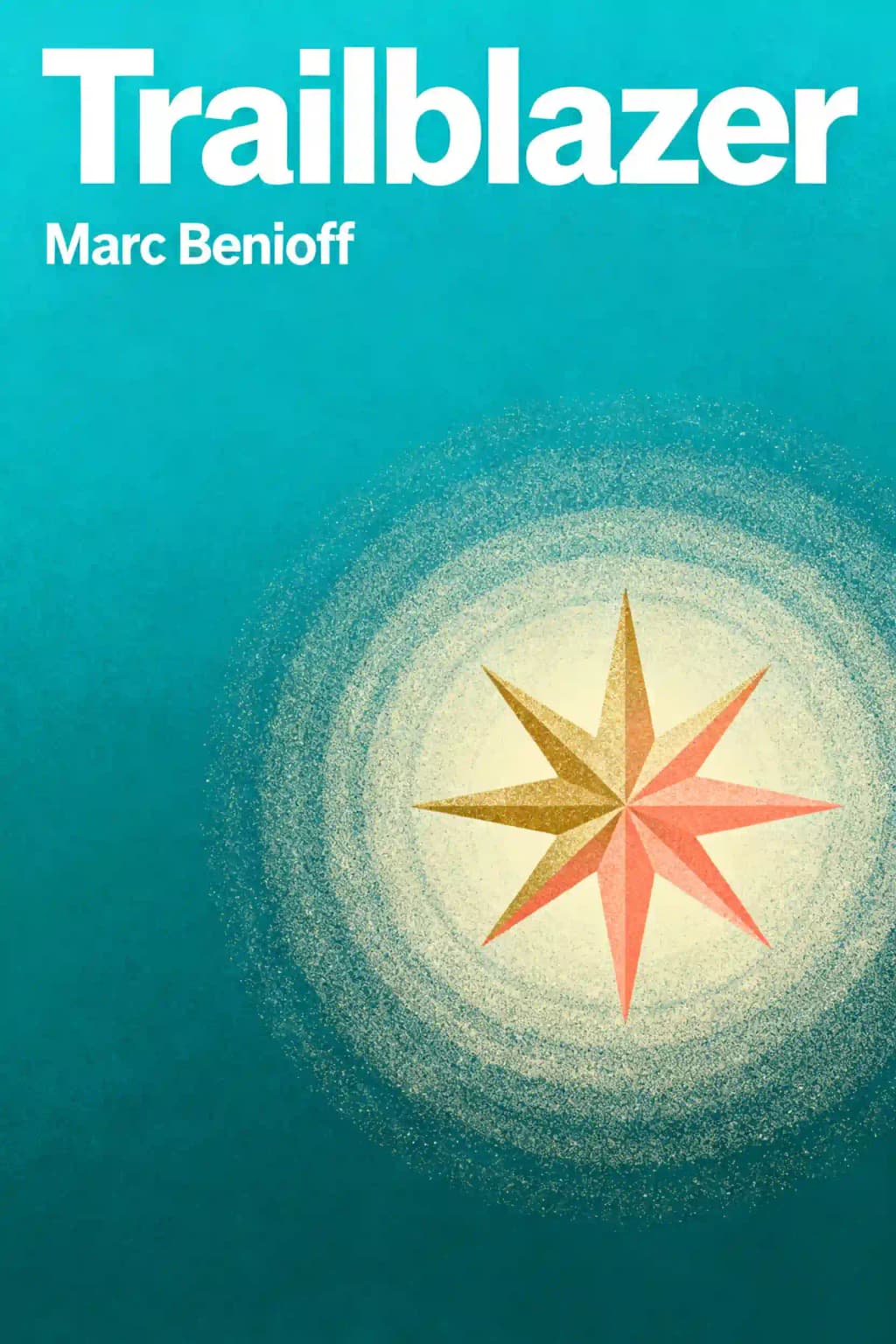
Salesforce CEO Marc Benioff's "Trailblazer" reveals how business can drive social change while achieving remarkable success. Endorsed by Richard Branson and Jane Goodall, this manifesto inspired 8,500+ companies to adopt the 1-1-1 philanthropy model. Can profit and purpose truly coexist?
Marc Russell Benioff is the founder and CEO of Salesforce, as well as the New York Times bestselling author of Trailblazer: The Power of Business as the Greatest Platform for Change.
A cloud computing pioneer and advocate for ethical capitalism, Benioff blends insights on corporate leadership with social responsibility themes drawn from his 25+ years building Salesforce into the world’s #1 CRM platform. His earlier book, Behind the Cloud (2009), chronicles Salesforce’s disruptive rise and remains a go-to case study for SaaS innovation.
Benioff chairs the World Economic Forum’s Center for the Fourth Industrial Revolution and co-founded the 1-1-1 philanthropic model, which has mobilized over $650 million in grants and 8 million employee volunteer hours. As owner of TIME magazine and a vocal advocate for stakeholder capitalism, he frequently contributes to global debates on tech ethics and climate action.
Trailblazer debuted at #3 on the Times bestseller list and is required reading in MBA programs at Wharton and Stanford.
Trailblazer explores how businesses can drive social change by aligning profit with purpose, using Salesforce’s core values—trust, customer success, innovation, and equality—as a blueprint. Marc Benioff argues that companies must prioritize stakeholder capitalism, where success hinges on benefiting employees, customers, communities, and shareholders equally. The book shares practical frameworks like the 1-1-1 philanthropy model and V2MOM strategy to build values-driven cultures.
This book is essential for business leaders, entrepreneurs, and CSR professionals seeking to integrate social responsibility into their operations. It also appeals to readers interested in stakeholder capitalism, corporate activism, or Salesforce’s growth journey. Benioff’s insights on balancing profit with purpose make it valuable for anyone navigating modern ethical business challenges.
Yes—ranked a New York Times bestseller, Trailblazer offers actionable strategies for building purpose-driven companies. Endorsed by Richard Branson and Jane Goodall, it blends personal anecdotes (e.g., Salesforce’s LGBTQ advocacy) with frameworks like customer success metrics and AI-driven innovation. Critics praise its focus on transparency and employee empowerment.
Benioff argues that customer success requires anticipating unspoken needs through deep listening. For example, Salesforce improved navigation speed by analyzing user behavior to create proactive client alerts. He emphasizes aligning technology (like AI) with long-term customer outcomes, not short-term fixes.
V2MOM (Vision, Values, Methods, Obstacles, Measures) is Salesforce’s planning tool for prioritizing goals transparently. Key principles include ranking objectives by impact, simplifying language, and publishing plans company-wide. This fosters alignment and accountability across teams.
Benioff highlights Salesforce’s Proposition C campaign to tax companies for homelessness solutions and its threat to divest from Indiana over anti-LGBTQ laws. He advocates using economic influence to drive policy changes, calling this “the new capitalism”.
Unlike traditional profit-focused guides, Trailblazer merges operational strategies (e.g., V2MOM) with social advocacy. It extends concepts from Ray Dalio’s Principles by emphasizing equality metrics and from Conscious Capitalism with actionable philanthropy models.
With AI transforming workplaces, Benioff’s focus on ethical innovation and employee upskilling remains critical. The book’s stakeholder-centric approach aligns with 2025 trends like ESG investing and Gen Z’s demand for purpose-driven brands.
Some argue Benioff’s model assumes resource access (e.g., Salesforce’s profit margins) that smaller businesses lack. Others question if stakeholder capitalism can scale without regulatory support—a gap the book doesn’t fully address.
The book advises embedding values into daily operations, like Salesforce’s Ohana culture (Hawaiian for “family”), which promotes inclusivity and feedback loops. Benioff also stresses measuring equality through pay audits and promotion rates.
Ressentez le livre à travers la voix de l'auteur
Transformez les connaissances en idées captivantes et riches en exemples
Capturez les idées clés en un éclair pour un apprentissage rapide
Profitez du livre de manière ludique et engageante
Doing well by doing good isn't just admirable-it's essential for business success.
Progress.
Employees had tested whether their CEO would stand on principle regardless of consequences.
People that care about culture and diversity.
A car should be like a trusted friend.
Décomposez les idées clés de Trailblazer en points faciles à comprendre pour découvrir comment les équipes innovantes créent, collaborent et grandissent.
Découvrez Trailblazer à travers des récits vivants qui transforment les leçons d'innovation en moments mémorables et applicables.
Posez vos questions, choisissez votre style d’apprentissage et co-créez des idées qui vous correspondent vraiment.

Cree par des anciens de Columbia University a San Francisco
"Instead of endless scrolling, I just hit play on BeFreed. It saves me so much time."
"I never knew where to start with nonfiction—BeFreed’s book lists turned into podcasts gave me a clear path."
"Perfect balance between learning and entertainment. Finished ‘Thinking, Fast and Slow’ on my commute this week."
"Crazy how much I learned while walking the dog. BeFreed = small habits → big gains."
"Reading used to feel like a chore. Now it’s just part of my lifestyle."
"Feels effortless compared to reading. I’ve finished 6 books this month already."
"BeFreed turned my guilty doomscrolling into something that feels productive and inspiring."
"BeFreed turned my commute into learning time. 20-min podcasts are perfect for finishing books I never had time for."
"BeFreed replaced my podcast queue. Imagine Spotify for books — that’s it. 🙌"
"It is great for me to learn something from the book without reading it."
"The themed book list podcasts help me connect ideas across authors—like a guided audio journey."
"Makes me feel smarter every time before going to work"
Cree par des anciens de Columbia University a San Francisco

Obtenez le resume de Trailblazer en PDF ou EPUB gratuit. Imprimez-le ou lisez-le hors ligne a tout moment.
When Marc Benioff found himself unable to get out of bed one summer morning in 1996, he was living what most would consider a dream life. As Oracle's youngest vice president with all the trappings of success - money, status, power - he nonetheless felt profoundly empty. This crisis led to a sabbatical in India where he encountered Amma, the "hugging saint," who offered him simple yet transformative wisdom: "In your quest to succeed and make money, don't forget to do something for others." This chance encounter planted the seed for what would become Salesforce, now a $120+ billion company that has fundamentally changed both the software industry and how businesses approach their role in society. At its core, "Trailblazer" delivers a revolutionary message: in today's world, doing well by doing good isn't just admirable - it's essential for business success.
Sunday drives with his father Russell through San Francisco profoundly shaped Benioff's business philosophy. Traveling between his father's six dress shops in their Buick station wagon, young Marc observed his father's meticulous approach - gathering sales data, moving popular merchandise strategically, and maintaining impeccable integrity. While Marc respected his father's dedication, he knew technology was his own calling, dismantling the family telephone at age four and writing his first program at fifteen. His father's principles became embedded in Salesforce's DNA. Russell's unwavering integrity and commitment to employees and customers left a lasting impression. Watching his father struggle with analog business operations inspired Salesforce's founding vision - cloud-based software that would free small business owners from administrative burdens. Meanwhile, his maternal grandfather Marvin Lewis, a prominent attorney and city supervisor, contributed Salesforce's ambitious spirit and commitment to the common good, inspiring the company's 1% pledge of product, equity, and employee time to nonprofits.
In 2015, Benioff faced a defining moment when Indiana passed legislation allowing discrimination against LGBTQ customers. When Scott McCorkle, CEO of Salesforce Marketing Cloud in Indianapolis, called about the issue, employees were demanding action. Though challenging a state government felt unfamiliar, Benioff tweeted that Salesforce would "dramatically reduce our investment in IN." Other business leaders joined, and within days Governor Pence signed a revised bill preventing discrimination. This stand became pivotal for Salesforce. Rather than hurting the business, it strengthened company culture and raised its profile. The Indiana situation proved that no single person controls a company's moral compass-if leadership won't act, employees will demand accountability. The following year, Sarah Franklin suggested calling their most advanced practitioners "trailblazers"-people who "want to learn, to better the world, aren't afraid to explore, crave innovation, enjoy solving problems and giving back." This mindset extends beyond technology to people with convictions who speak up against injustice and believe in building a better future.
When Toyota faced safety recalls affecting 8 million vehicles in 2010, CEO Akio Toyoda admitted they had "pursued growth over the speed at which we were able to develop our people and organization." His humble apology - bowing before reporters and taking personal responsibility - demonstrated commitment to restore trust. This resonated with Benioff, who had established Salesforce's first international office in Japan. Though less recognizable than Google or Facebook, Salesforce has prioritized transparency. From inception, the company asked customers to trust them with sensitive data stored in "the cloud" - a radical concept in 1999. During a 2005 management offsite when their site went down, Parker Harris suggested: "Let's tell everyone exactly what's happening in real time." Despite executive concerns about showing vulnerabilities, they created trust.salesforce.com, providing real-time information on system performance and issues. The 2018 Edelman Trust Barometer showed 70% of respondents identified building trust as a CEO's primary responsibility, even ahead of producing quality products, rising to 76% by 2019. In today's business landscape, vulnerability isn't weakness - it builds competitive advantage.
In 2013, Benioff received an urgent call that Salesforce was about to lose their biggest customer, Merrill Lynch. Their financial advisers found the software slow and unintuitive, with simple tasks requiring multiple clicks and long wait times. Benioff tasked Simon Mulcahy with a "Get Well" program. Visiting Merrill Lynch offices nationwide, Simon discovered the issue went beyond software glitches. When he focused on understanding broader challenges, he learned advisers needed smarter "tasks" that could trigger proactive client alerts and guide them to useful market data. This philosophy of addressing deeper needs evolved into Dreamforce, their annual gathering that's grown from 1,000 attendees in 2003 to 170,000 participants from 90 countries. Today's Dreamforce celebrates customers, with 2,700+ educational sessions largely led by customers themselves - creating a virtuous circle where successful users encourage others to join the community.
In summer 2015, Benioff launched a companywide AI initiative with Salesforce's top engineers, targeting Dreamforce 2016. The vision was using AI to find patterns in massive datasets beyond human detection, ultimately improving everything they did. Albert Einstein was Benioff's first great role model, admired for his genius, moral conviction, and childlike wonder. Steve Jobs became another influence after they met during Benioff's 1984 Apple internship. When seeking Jobs' advice in 2003, Benioff received three key insights: "project the future," secure a major account to grow "10x in twenty-four months," and build an "application ecosystem." The AI initiative was aptly named "Einstein" for "the world's smartest CRM." A small engineering team worked intensively in a Palo Alto lab, introducing Salesforce Einstein at Dreamforce 2016. They enhanced their AI capabilities through strategic talent acquisition. What distinguishes their approach is connecting innovation consistently to purpose - creating technology that solves real human problems rather than innovating for its own sake.
In late 2018, Benioff confronted San Francisco's homelessness crisis-7,500 individuals and 1,200 families homeless in a city of innovation and wealth. The contrast between the Salesforce Tower and suffering on the streets was unsustainable. Despite years of charitable work, the problem worsened, requiring systemic change through consistent funding that only businesses could provide. Benioff supported Proposition C, a ballot measure applying a 0.5% tax to the city's largest businesses to generate $300 million annually for homeless services. Despite opposition from most tech CEOs, he campaigned vigorously, viewing community protection as essential to business success. When Twitter CEO Jack Dorsey opposed it, Benioff challenged his contributions to homeless initiatives. The measure passed with 61% support. While Klaus Schwab describes our current "Fourth Industrial Revolution" of technological transformation, Benioff envisions a Fifth Industrial Revolution focused on harnessing progress for common good. Today's workers seek purpose, requiring businesses to ask not just "Are we doing well?" but "Are we doing good?" Being a trailblazer means taking the long view-not just five years but fifty or a hundred-and creating a better world for future generations. In an era of eroding trust, businesses have both the opportunity and responsibility to become platforms for positive change.