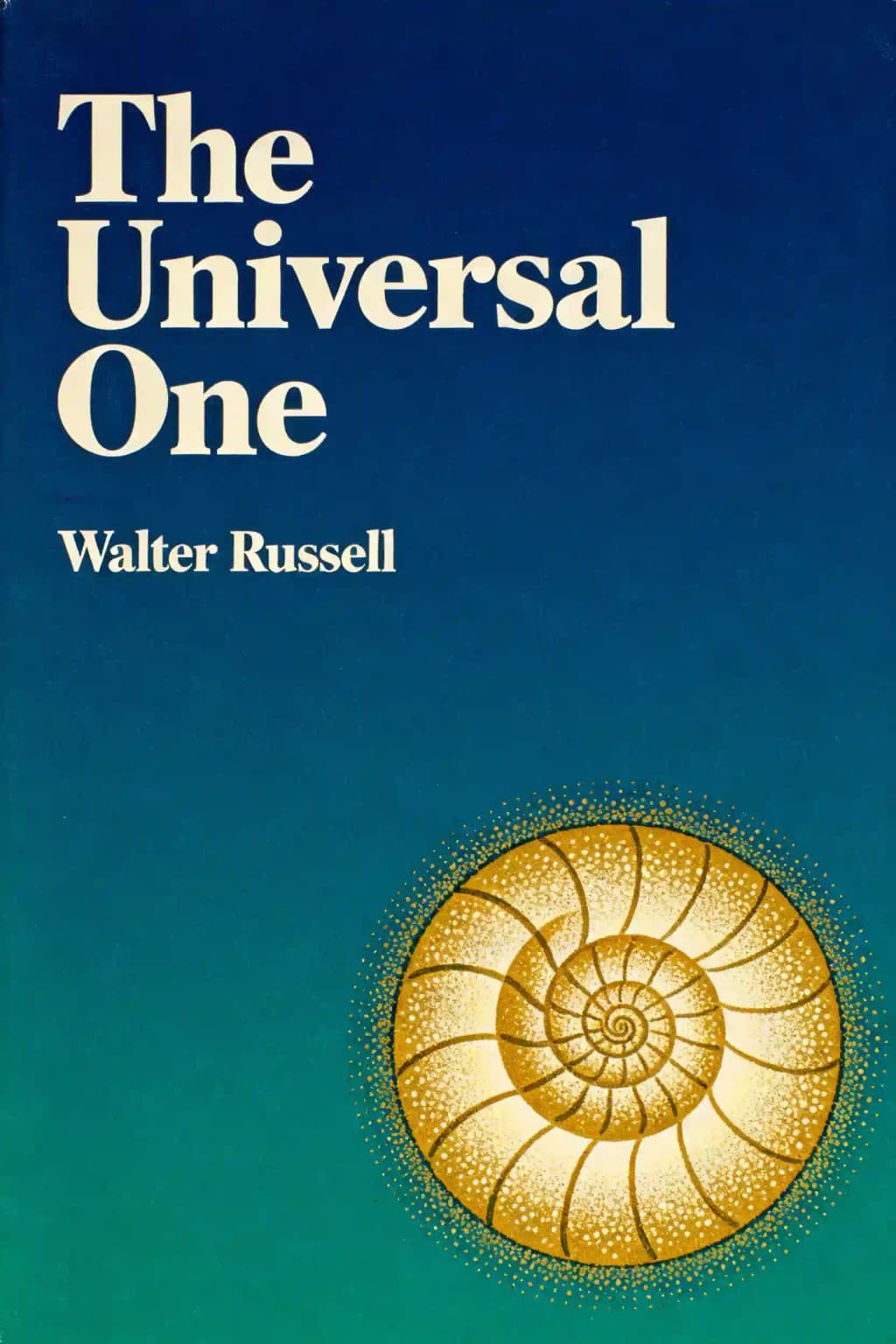
Walter Russell's cosmic masterpiece reveals how consciousness shapes the universe, challenging conventional physics. When Nikola Tesla read it, he famously warned Russell to "hide his cosmogony for a thousand years." What profound truth did Tesla recognize that still captivates scientists and mystics alike?
Walter Bowman Russell (1871–1963) was the author of The Universal One and a visionary natural philosopher, painter, sculptor, and architect often called "the modern Leonardo da Vinci." Born in Boston, Massachusetts, Russell was a self-taught polymath who never attended high school yet became a leading voice in cosmology and unified field theory.
His book explores themes of Mind-centered cosmology, the nature of light and matter, and the interconnectedness of all existence—concepts he claimed to understand through a profound 39-day illumination experience in 1921.
Russell's scientific insights gained credibility when he accurately predicted the discovery of Deuterium, Tritium, Neptunium, and Plutonium, earning him an honorary doctorate from the American Academy of Sciences in 1941. He later expanded his cosmological theories in The Secret of Light (1947) and A New Concept of the Universe. Russell also lectured on rhythmic interchange principles to IBM executives for 12 years and co-founded the Twilight Club, influencing major service organizations.
The Universal One remains a century ahead of its time, attracting readers exploring consciousness, metaphysics, and alternative science.
The Universal One by Walter Russell is a philosophical and scientific treatise explaining his cosmology of a Mind-centered electric universe. Published in 1927, the book presents Russell's theory that all matter, energy, and spirit are manifestations of one universal substance—light—in varying states of motion, controlled by thinking Mind. It explores universal oneness, rhythmic creation cycles, and humanity's divine potential through understanding cosmic laws.
Walter Russell was an American polymath born in 1871—accomplished as a painter, sculptor, architect, and natural philosopher. He wrote The Universal One following his profound 39-day cosmic illumination experience in 1921, during which he received revelations about the universe's fundamental structure. Russell sought to unite spiritual cause with scientific observable effects, explaining God's processes in constructing the universe and revealing the possibility of elemental transmutation.
The Universal One appeals to spiritual seekers, alternative science enthusiasts, and philosophers exploring consciousness and cosmology. This book suits readers interested in metaphysical explanations of reality, unified theories connecting mind and matter, and those questioning mainstream scientific paradigms. It's particularly valuable for students of Russell science, consciousness researchers, and anyone examining the relationship between spiritual principles and physical phenomena in the universe.
The Universal One is worth reading for those interested in visionary cosmology and metaphysical science, though it requires an open mind. Russell's ideas were revolutionary—he predicted elements like Deuterium and Plutonium before their discovery, earning recognition from the American Academy of Sciences. However, his theories diverge significantly from mainstream physics. The book is lavishly illustrated and considered a century ahead of its time, appealing to readers exploring alternative scientific paradigms.
The Universal One teaches that everything in existence is an expression of one universal Mind, making separateness an illusion. Walter Russell explains that God, Mind, the universe, light, and matter are not separate entities but unified manifestations of one unchanging cause. This philosophy asserts that all things are interconnected—"nothing is of itself alone"—and understanding this unity in measurable exactness removes human limitations within universal boundaries.
In The Universal One, Walter Russell defines light as the one universal substance—the body of Mind in action. All matter is crystallized light in varying states of motion, while energy represents the force of thinking Mind. Russell revolutionary proposes that matter doesn't possess inherent properties like attraction or repulsion; these qualities belong to motion imposed upon substance. Visible and invisible light forms the foundation of all physical reality.
According to The Universal One, the universal Mind is the sole creative cause behind all motion, form, and phenomena in existence. Walter Russell explains that thinking Mind generates the only force in the universe, causing all effects through dynamic action. The inner Mind operates in higher octaves of light enabling true comprehension, while the outer mind perceives only illusions. God's thinking creates continuous rhythmic cycles of integration and disintegration.
The Universal One contains profound quotes expressing cosmic unity.
The Universal One presents creation as a continuous rhythmic process, not a one-time event. Walter Russell describes evolution through endless cycles of integrating and disintegrating one universal substance, with no true beginning or end—everything "always was and always will be." The sex principle divides one force into opposites (electricity and magnetism), enabling form expression and reproduction. Creation and dissolution represent two aspects governed by periodic pulsations of thinking Mind.
In The Universal One, Walter Russell presents revolutionary concepts of electricity and magnetism as sex opposites of light—apparent divisions of one universal force. These opposing principles enable the universe to express dimensional form from dimensionless concepts. Rather than separate forces, they represent complementary aspects of the same substance in motion, creating rhythmic balanced interchange. This electro-magnetic pulsation governs all creation cycles, generating and radiating matter through periodic waves.
The Universal One was Walter Russell's first expression of his cosmology, which he later refined in The Secret of Light (1947) and A New Concept of the Universe. While The Universal One establishes foundational principles about Mind-centered reality and light as universal substance, Russell worked twenty more years developing clearer explanations after scientists initially rejected his 1927 theories. The later books present more accessible language while maintaining core concepts about rhythmic balanced interchange and universal oneness.
The Universal One teaches that by understanding universal laws governing creation, humanity can access greater knowledge, power, and cosmic harmony. Walter Russell emphasizes human omnipotence through comprehending our divine nature and connection to universal Mind. The book provides philosophical guidance for living aligned with cosmic principles, suggesting that recognizing our unity with all existence removes artificial limitations. Russell believed mastering these concepts enables humanity to manifest higher potentials and work knowingly with God's creative processes.
Ressentez le livre à travers la voix de l'auteur
Transformez les connaissances en idées captivantes et riches en exemples
Capturez les idées clés en un éclair pour un apprentissage rapide
Profitez du livre de manière ludique et engageante
Mind isn't something separate from the universe; it is the universe itself.
All matter, whether organic or inorganic, is living, evolving matter.
All separation is illusion.
Life isn't something that inhabits matter - it is matter.
The universe isn't infinite in the sense of boundless extension but finite in its cause-effect relationships.
Décomposez les idées clés de On Liberty en points faciles à comprendre pour découvrir comment les équipes innovantes créent, collaborent et grandissent.
Condensez On Liberty en indices de mémoire rapides mettant en évidence les principes clés de franchise, de travail d'équipe et de résilience créative.

Découvrez On Liberty à travers des récits vivants qui transforment les leçons d'innovation en moments mémorables et applicables.
Posez n'importe quelle question, choisissez la voix et co-créez des idées qui résonnent vraiment avec vous.

Cree par des anciens de Columbia University a San Francisco
"Instead of endless scrolling, I just hit play on BeFreed. It saves me so much time."
"I never knew where to start with nonfiction—BeFreed’s book lists turned into podcasts gave me a clear path."
"Perfect balance between learning and entertainment. Finished ‘Thinking, Fast and Slow’ on my commute this week."
"Crazy how much I learned while walking the dog. BeFreed = small habits → big gains."
"Reading used to feel like a chore. Now it’s just part of my lifestyle."
"Feels effortless compared to reading. I’ve finished 6 books this month already."
"BeFreed turned my guilty doomscrolling into something that feels productive and inspiring."
"BeFreed turned my commute into learning time. 20-min podcasts are perfect for finishing books I never had time for."
"BeFreed replaced my podcast queue. Imagine Spotify for books — that’s it. 🙌"
"It is great for me to learn something from the book without reading it."
"The themed book list podcasts help me connect ideas across authors—like a guided audio journey."
"Makes me feel smarter every time before going to work"
Cree par des anciens de Columbia University a San Francisco

Obtenez le resume de On Liberty en PDF ou EPUB gratuit. Imprimez-le ou lisez-le hors ligne a tout moment.
Have you ever considered that everything-from the stars in distant galaxies to your own thoughts-might be made of exactly the same substance? This isn't some new age fantasy but the foundation of Walter Russell's revolutionary cosmology. The universe isn't a collection of separate objects but a unified field of Mind substance expressing itself through rhythmic thinking processes. Everything we perceive as matter, energy, or space is simply this one substance in various states of motion. Think of it like water transforming between ice, liquid, and vapor. The molecular composition remains unchanged while the form and properties shift dramatically. Similarly, what we perceive as solid matter is actually light-not just visible light but the entire spectrum of electromagnetic radiation-condensed into patterns that create the illusion of solidity. This explains why seemingly solid matter can be converted to energy and back again, as demonstrated by nuclear processes. When you look at another person or a distant star, you're not seeing something separate from yourself but different expressions of the same universal substance. This understanding dissolves the illusion of separation that causes so much suffering and conflict. We're not isolated entities navigating through an external world but individualized expressions of one infinite Mind, temporarily manifesting in countless forms while remaining eternally unified at our source.