Chapitre 1
A Journey Through Darkness and Light: Finding Freedom on the Rails
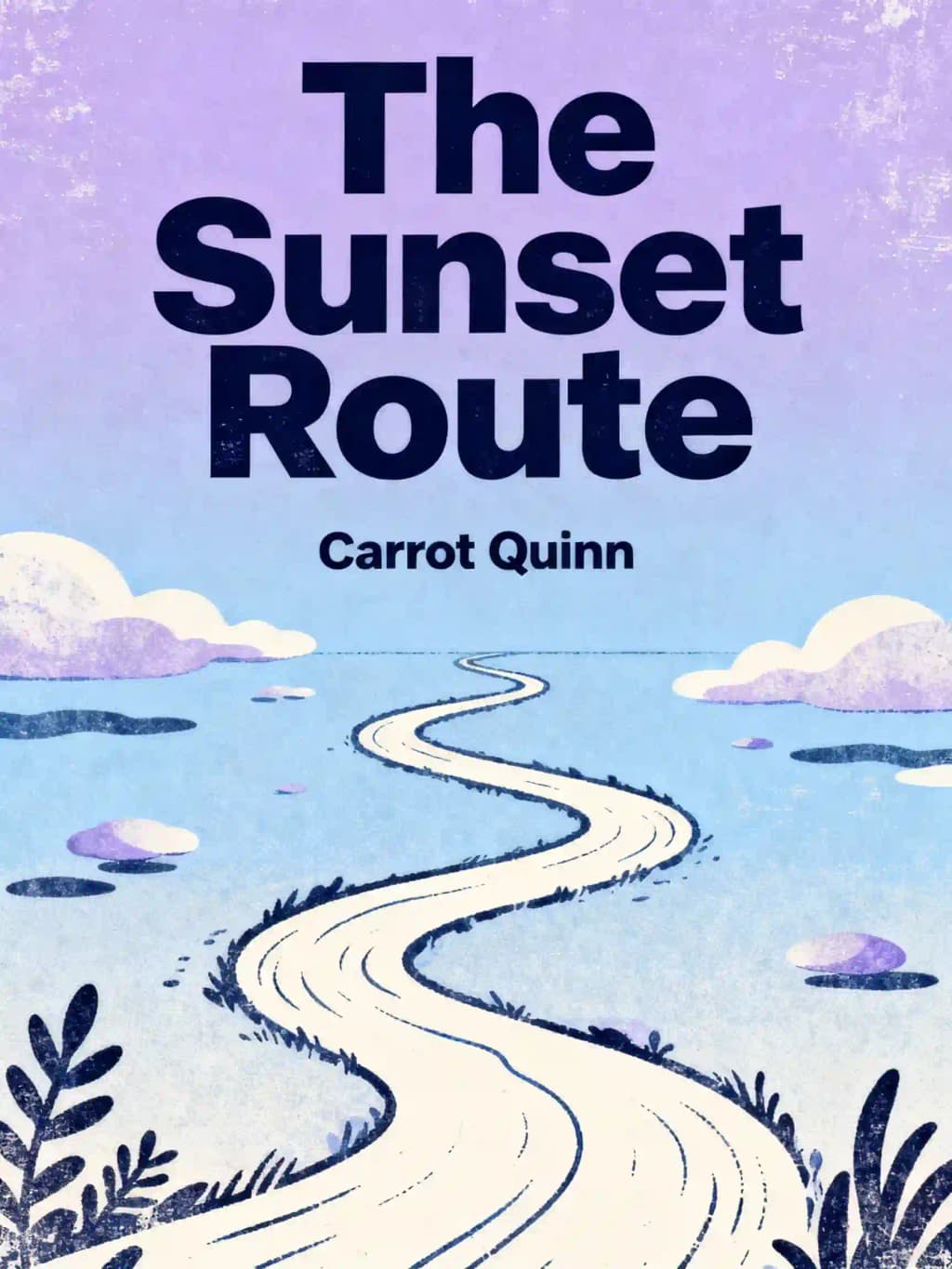
The Sunset Route is a raw, unflinching memoir that has captivated readers since its 2021 release, earning praise from critics and a devoted following among those seeking stories of resilience and self-discovery. Carrot Quinn's narrative of escaping childhood trauma through freight train adventures has been celebrated by NPR as "a testament to human endurance" and featured on numerous best-of lists. The book resonates particularly with millennials who came of age during economic uncertainty, offering a window into alternative lifestyles and the search for authentic connection in a fractured world. Even celebrities like Phoebe Bridgers have cited it as inspiration for their own artistic explorations of trauma and healing. Beyond its literary merits, The Sunset Route has sparked important conversations about mental health, homelessness, and the hidden epidemic of childhood neglect in America.
Chapitre 2
The Shadows of Childhood: Surviving a Mother's Mental Illness
Growing up in Anchorage, Alaska with a schizophrenic mother named Barbara created a childhood defined by hunger, fear, and confusion. At six years old, Quinn learned never to answer the ringing phone while her mother, cigarettes trembling in her hands, told stories of their past life in the Chugach Mountains and her conversations with the Virgin Mary. After her parents' divorce, Quinn and her brother Jordan lived briefly in foster homes before returning to their mother's custody, where poverty became their constant companion.
Barbara cycled between manic productivity and crushing depression, sometimes forgetting to maintain their food stamps. The children would search empty cupboards for anything edible, and when Quinn cried from hunger pains, Barbara would slap her. Their apartment became a place of both physical and emotional deprivation, where Barbara increasingly lost touch with reality, eventually telling her children that she wasn't just speaking to the Virgin Mary-she was the Virgin Mary reincarnated.
The isolation of this existence was profound. Quinn describes being too small to carry a gallon of milk or open pickle jars, walking to school in the dark under freezing Chinook winds, staying up late reading library books, sleeping with all lights on, and neglecting to brush her teeth with no one to remind her. In the forest behind their apartment, she found solace in the snow-making caves, tunnels, and finding shelter under a spruce tree whose boughs created a sanctuary where she felt safe and held, experiencing the love of nature that was absent at home.
As Quinn grew older, she discovered a book on schizophrenia at the public library that helped her understand her mother's condition. Reading about the illness brought waves of terror and embarrassment as she recognized Barbara's symptoms. The case studies revealed people trapped in parallel realities of suffering, unreachable by loved ones. This knowledge, while devastating, provided a framework for understanding the chaos of her home life.
The relationship with her brother Jordan became crucial for survival-he was the only other witness to their mother's instability, the only person who truly understood what their life was like. When Jordan eventually ran away and was taken into custody, Quinn felt the overwhelming weight of being truly alone, "learning that there is no bottom to how alone a person can feel."
Chapitre 3
Escape Routes: Finding Freedom in Movement
At twenty years old, Quinn discovered freight train hopping-a dangerous yet liberating way to traverse America that would become her pathway to freedom. Her first journey began with her friend Sami as they embarked from Portland toward Texas, crouching in dark railcars wrapped in plastic tarps against the bitter cold as their train thundered through Oregon's Cascade Mountains. Despite losing her sleeping bag when it was sucked through a hole in the railcar floor and enduring freezing temperatures, Quinn found something exhilarating about this dangerous journey: "I feel more alive than I do in the city where I'm weighed down by fear and shame. Out here in the wilderness, I feel expansive and free, even as I struggle to survive the freezing night."
The rhythmic thrumming of the tracks became a song that melded with her heartbeat, and even the cold reminded her of her childhood in Alaska-but this time, she was in control. As they traveled through the California desert, the landscape transformed around them, and Quinn experienced a profound sense of agency she had never known before. When they finally reached Los Angeles, dehydrated and hungry, they found a taqueria where Quinn gulped down water and devoured a burrito, savoring the simple pleasure of having her basic needs met on her own terms.
This initial journey sparked what would become years of train-hopping adventures across America. Quinn describes how these experiences taught her resilience and self-reliance: improvising meals from canned beans, playing cards to pass time, managing bathroom needs over the side of moving trains, and sleeping under the stars. Each journey presented its own challenges-from avoiding rail cops to enduring extreme weather-but also offered unparalleled freedom and connection to the landscape.
The physical hardships of train hopping-the cold, the hunger, the discomfort-were balanced by moments of transcendent beauty: watching sunrise from metal ledges, seeing wild horses in New Mexico, crossing the Mississippi bayou "like a ship, surrounded by trees rising from still swamp waters." These experiences provided Quinn with a sense of purpose and belonging that had been absent in her childhood.
Chapitre 4
Creating Family: The Search for Connection
Throughout her journey, Quinn forms deep bonds with fellow travelers who become the chosen family she never had. Her friendship with Willow proves particularly transformative. After attending a protest in Washington D.C., Quinn adopts the name "Carrot" and seeks out Willow, whose zine about freight trains had captivated her. In Willow's communal house, she learns about traveling light and living outside the system-including shoplifting techniques that Willow frames as "liberating" food rather than stealing it.
Willow's colorful room filled with stolen art supplies organized by color and drawings scattered across the floor becomes a symbol of creative possibility. As the daughter of a New York City painter, Willow "moves through the world without making herself small, constantly asking questions with visible curiosity." This approach to life inspires Quinn to embrace her own curiosity and creativity.
Later, Quinn meets Finch while dumpster diving for flowers at Trader Joe's. In Finch's nearly empty bedroom with just a futon and a few books, they read aloud from "Pilgrim at Tinker Creek" as they lie close under a comforter, rain falling outside. Finch, who grew up Mormon in rural Utah before being kicked out at fourteen for coming out, shares her past struggles with heroin and her new life in Portland. Their connection grows as they pick blackberries by the Willamette River "until our hands are purple and bloodied."
The Wych Elm house in Portland becomes another important community-a creative commune where nine people live in improvised spaces, avoiding traditional employment and instead preparing for what they believe will be civilization's collapse by learning earth-based skills. They collect books on beekeeping and fermentation, tan animal hides, and create zines on DIY skills. Though Quinn sometimes feels like an impostor in this world, the desire for belonging drives her forward.
Perhaps the most significant relationship forms with Tara, whom Quinn meets in Alaska. Tara lives in a cabin without electricity or running water in the Alaskan interior-a one-room structure with honey-colored spruce siding and cheery green window trim. Inside, the walls have yellowed from wood smoke, and a small thermopile on the woodstove generates just enough electricity to charge a phone. Despite having just met, Tara feels like family to Quinn. They spend their days hauling rounds of wood from the forest on sleds tied to their hips and their nights reading Annie Dillard by candlelight.
In this land outside of time, the heavy questions that haunted Quinn in Portland seem irrelevant. She wonders if her ghosts can find her in this wild place, and if she and Tara might discover answers to "the riddles that are stuck like thorns into the darkest parts of our hearts."
Chapitre 5
Confronting the Past: The Search for Parents
At twenty years old, Quinn decides to find her father, discovering through a people-finder website that he lives in Anchorage, Alaska-shockingly, just a mile from their old low-income apartment. This revelation leaves her stunned, wondering how he could have been so close while they were starving and never reached out. With her boyfriend Joe, she hitchhikes to Alaska, a journey that takes them through the Pacific Northwest's humid summer heat, across the Canadian border into British Columbia's mountains and forgotten towns.
When they finally reach her father's house-one in a row of identical condos with an American flag and potted pansies-the meeting proves deeply disappointing. The man who answers looks like "no one in particular, just an average, soft-featured man" who responds with an odd smile: "I figured you'd show up eventually. Why don't you come inside?" Their conversation is stilted and awkward, his smile fixed, his eyes flat. When Quinn mentions he never paid child support despite living nearby, he simply says he gave up his parental rights.
Years later, Quinn searches for her homeless mother in Anchorage, whom she hadn't seen since leaving Alaska as a teenager. At a drop-in center, she finds someone who recognizes Barbara but hasn't seen her in five years. Later, in a homeless camp behind Loussac Library where Quinn had hidden as a child, a woman tells her she'd seen her mother just two days earlier at Walmart. The revelation that her mother is still alive washes over her "like the gentle forest light."
Quinn visits their old apartment complex, finding everything smaller than in her memories, wondering about the dirty children playing there now-did they dream of escape as she once had? The corridor still smells of Smarties candies, a scent so familiar it feels like home. Though she misses seeing Barbara before flying back, she resolves to return in winter, hoping to prevent her mother from freezing to death alone. After running from the pain for so long, she's finally ready to face it.
Chapitre 6
The Healing Power of Nature
Throughout Quinn's journey, nature emerges as a consistent source of healing and grounding. From her childhood sanctuary beneath the spruce tree behind her apartment to her adult adventures hiking through Death Valley, the natural world provides what human relationships often cannot: unconditional acceptance and a sense of belonging.
In Alaska, working with Tara, Quinn finds peace in the rhythm of hauling wood from the forest on sleds tied to their hips and splitting logs with a maul on the stump outside the cabin. Though March brings bright sun, the daily low is still fifteen below zero-yet there's comfort in this harsh environment, a simplicity that allows Quinn to focus on immediate needs rather than the emotional complexities that plague her elsewhere.
The cabin itself becomes a sanctuary-its honey-colored spruce siding with cheery green window trim, walls yellowed from wood smoke, and the small thermopile on the woodstove generating just enough electricity to charge a phone. At night, Quinn sleeps in the top bunk under a stained quilt that smells "comfortingly of unwashed feathers." Each morning, the window facing the slough sparkles with frost as she pees in the snow and gathers more for melting, peeling paper-like bark from the birch trees with reddened hands.
Later, after discovering long-distance hiking, Quinn finds even deeper peace in becoming "rangy, wild, and interwoven with the very fabric of the mountains." During a 135-mile hike from Death Valley's Badwater Basin to Mount Whitney, she pushes through exhaustion as they climb nine thousand feet in ten miles. The physics of light-both particle and wave-reminds her how multiple realities can exist simultaneously. As they reach the mountain summit, she feels a hollow fatigue but also a profound connection to the landscape.
Nature provides not just physical challenges but philosophical insights. Quinn contemplates reincarnation, imagining future lives with her grandmother and mother as trees or birds. She realizes that multiple truths can coexist: childhood memories with her grandparents, Tara's father playing piano in Alaska, her brother watching desert sunsets in Afghanistan, and herself on this mountain-"as clean and empty as the wind."
Chapitre 7
The Economics of Survival: Living Outside the System
Quinn's memoir offers a profound exploration into alternative economies and survival strategies outside conventional society. After escaping her childhood poverty, she discovers various ways to sustain herself without traditional employment, developing a complex web of survival strategies that challenge mainstream economic assumptions. These include sophisticated approaches to dumpster diving, calculated shoplifting, strategic participation in medical studies, carefully timed seasonal work, and intricate community-based resource sharing systems that operate on principles of mutual aid rather than monetary exchange.
In the Wych Elm house in Portland, nine residents create a microcosm of anti-capitalist living. They actively reject traditional employment, viewing it not just as undesirable but as "a sort of death" within a civilization they believe is rapidly approaching collapse. Instead, they work in strategic bursts at seasonal jobs - sugar beet harvests in late autumn, marijuana trimming during harvest season, and occasional craft fairs where they sell homemade goods. Their preparation for societal collapse is methodical and comprehensive: they maintain extensive libraries of practical knowledge, focusing on sustainable skills like beekeeping, advanced fermentation techniques, traditional hide tanning, and permaculture. Their zine production becomes a way to both document and distribute this accumulated knowledge, creating an informal educational network among like-minded communities.
Willow emerges as Quinn's mentor in survival strategies, teaching her sophisticated techniques for "liberating" resources from chain stores. The lessons go beyond simple theft, incorporating complex social observations about how appearance and privilege operate in retail spaces. "People only see what they're expecting to see," Willow explains, detailing how white privilege, clean appearance, and markers of middle-class status create a shield of invisibility. She teaches Quinn specific techniques: how to remove different types of security tags, optimal times for "shopping," and how to blend seamlessly with paying customers.
In Greensboro, Quinn refines her survival strategies further. Her participation in medical studies becomes a calculated risk - enduring the physical discomfort of untested medications in exchange for the freedom to pursue her art. She develops an expertise in dumpster diving, learning the disposal schedules of different stores and how to identify valuable discards. The community she builds turns even waste into celebration - collecting discarded birthday cakes from bakery dumpsters and transforming them into midnight art projects, hurling them at passing trains in explosive displays of defiant joy.
These survival strategies represent more than just economic alternatives; they form a comprehensive critique of conventional systems. Quinn's experiences reveal how traditional economic structures systematically exclude those without generational wealth or family support networks. Her detailed accounts of these alternative economies demonstrate both their necessity and their complexity - they're not romantic choices but sophisticated adaptations to systemic failure, existing in carefully navigated legal and ethical gray areas that require both skill and community to sustain.
Chapitre 8
The Body as Battlefield: Hunger, Harm, and Healing
Throughout Quinn's narrative, the body emerges as a site of both trauma and potential healing. From childhood hunger to adolescent disordered eating to adult physical challenges, her relationship with her body evolves dramatically over time.
As a child, hunger was a constant companion. Quinn describes searching empty cupboards for anything edible and crying from hunger pains, only to be slapped by her mother. At school, she would devour her corn dog, green beans, and cobbler-"the first food I've had all day"-and eye other kids' lunches, still hungry. Finding a rain-soaked Oreo in the grass, she would carefully eat it, "imagining it dropped by someone wealthy enough to discard such treasures."
In adolescence, this relationship with food becomes further complicated as Quinn develops disordered eating, allowing herself only one bean burrito at lunch while obsessively comparing herself to impossibly thin dELiA*s catalog models. Standing before mirrors, she would suck in her stomach but still feel "grotesque when my body makes any shape at all." She develops compulsive behaviors-counting calories, touching her hair constantly, plucking pubic hair and eyelashes, picking at the acne on her arms until they scar.
The transition to Portland marks a turning point. Quinn sells her car after it's broken into and begins walking everywhere, her spirit expanding with each step. She buys a vintage cruiser for thirty-five dollars and discovers the freedom of cycling through Portland's neighborhoods. Her eating disorder begins to fade as she finds herself hungry from exercise and distracted by new experiences. She gains twenty pounds, develops muscles from cycling, and no longer cares about being thin.
The physical challenges of train hopping and hiking push her body in new ways-enduring cold, hunger, thirst, and exhaustion. Yet these experiences also reconnect her with her body's strength and resilience. During her Death Valley hike, Quinn forces herself awake at 5 AM with "Eye of the Tiger" and instant coffee as they face 9,000 more feet of climbing. Despite exhaustion making her stop repeatedly, she somehow keeps going, marking time with snack breaks and the increasing pain in her Achilles tendons.
Through these physical journeys, Quinn reclaims her body as a source of power rather than shame or vulnerability. The same body that once felt like a liability becomes the vehicle for her freedom and self-discovery.
Chapitre 9
Finding Forgiveness: Reconciling with the Past
The journey toward forgiveness-of others and herself-forms the emotional core of Quinn's memoir. After years of running from her past, she gradually finds ways to integrate her traumatic childhood experiences into a coherent sense of self, allowing her to move forward with greater wholeness.
A pivotal moment comes at fourteen when Barbara is strangling Quinn in the hallway of their apartment. Quinn had come home hungry to find no food, and when her mother was unreachable, lost in her illness, Quinn screamed at her. As Barbara's fingers dig into her neck, time slows enough for quiet realizations to float across Quinn's mind. Despite her illness making her frail, her grip is strong. Quinn punches her mother in the face-the first time she's ever fought back. Barbara pulls away in horror, and in this moment, the balance shifts: "my mother will never hurt me again, and neither will anyone else."
This act of self-defense marks the beginning of Quinn's journey toward self-protection and eventually self-forgiveness. In the weeks that follow, as Barbara deteriorates further, Quinn cries for "the young woman she once was," showing early signs of compassion for her mother despite the harm she caused.
Years later, when Quinn searches for her mother in Anchorage, this compassion has deepened. Despite the trauma of their relationship, she wants to prevent Barbara from "freezing to death alone" in the Alaskan winter. After running from the pain for so long, she's finally ready to face it-a crucial step in her healing process.
The relationship with her brother Jordan also evolves toward forgiveness. After a phone call where Jordan, who went AWOL from the Marines rather than go to war, apologizes for how he treated her as teenagers, saying he respects her freedom and the choices she's made, Quinn feels "a sense of freedom and certainty." His words "unclenched something in my heart," allowing her to recognize her own freedom and agency.
By the end of her narrative, during her Death Valley hike, Quinn contemplates multiple truths coexisting: childhood memories with her grandparents, Tara's father playing piano in Alaska, her brother watching desert sunsets in Afghanistan, and herself on the mountain. This ability to hold contradictory experiences-both the trauma and the beauty, the pain and the healing-represents the ultimate form of forgiveness, not erasing the past but integrating it into a more complex understanding of herself and her relationships.
Chapitre 10
The Sunset Route: Finding Home in Movement
Quinn's memoir ultimately celebrates the paradoxical discovery of home not in a fixed location but in constant movement. The "Sunset Route"-a freight train line that runs through the American Southwest-becomes a metaphor for her life journey, where freedom is found not in arrival but in the courage to keep moving forward.
After years of train hopping, hitchhiking, and temporary living situations, Quinn discovers long-distance hiking six years before the memoir's conclusion. Having walked 10,000 miles since then, she finds peace in becoming "rangy, wild, and interwoven with the very fabric of the mountains." This form of movement-purposeful, challenging, and connecting her deeply with the natural world-represents the culmination of her search for belonging.
What began as desperate escape gradually transforms into intentional exploration. The same restlessness that once drove her from painful situations becomes a source of strength and identity. As she writes during one train journey: "After days of train sleep, I become a new person, the world infused with candy-colored possibility."
Quinn's story challenges conventional notions of home and healing. Rather than finding resolution through stability or permanent relationships, she discovers that for some people-particularly those whose early experiences of "home" were traumatic-movement itself can be the most honest form of belonging. The open road, the freight train, the hiking trail-these become spaces where she can fully inhabit herself without the constraints of others' expectations or the weight of painful memories.
In the final scenes of her Death Valley hike, as Quinn reaches the mountain summit feeling "hollow fatigue," she contemplates multiple realities coexisting simultaneously. This ability to hold contradictions-to be both rooted and rootless, connected and independent, wounded and healing-represents the true freedom she has been seeking all along. On the mountain, she feels "as clean and empty as the wind," suggesting that emptiness itself can be a form of fullness when it represents the space to define oneself on one's own terms.
The sunset route leads not to a final destination but to the ongoing journey of self-discovery-a path illuminated by the fading light of past traumas and the promise of new beginnings on the horizon.