Chapitre 1
Dreams Wrapped in Red Brick: A Journey Through Mango Street
The House on Mango Street has quietly transformed American literature since its 1984 publication, becoming required reading in schools nationwide. Sandra Cisneros created this slim volume of vignettes while living in a rundown Chicago apartment, crafting what Edwidge Danticat calls "timeless poetry and song with yearning and love." The novel's unique structure-neither fully prose nor poetry-has influenced countless writers who recognized themselves in Esperanza's voice for the first time. Beyond critical acclaim, the book has achieved rare cultural resonance: Oprah Winfrey named it a must-read, Lin-Manuel Miranda cited it as an inspiration, and it's been translated into over 20 languages. Through Esperanza's eyes, we experience universal themes of identity, belonging, and the power of storytelling, all woven through the specific lens of a young Latina girl's coming-of-age in Chicago-proving that the most personal stories often become the most universal.
Chapitre 2
Houses Real and Imagined: The Search for Home
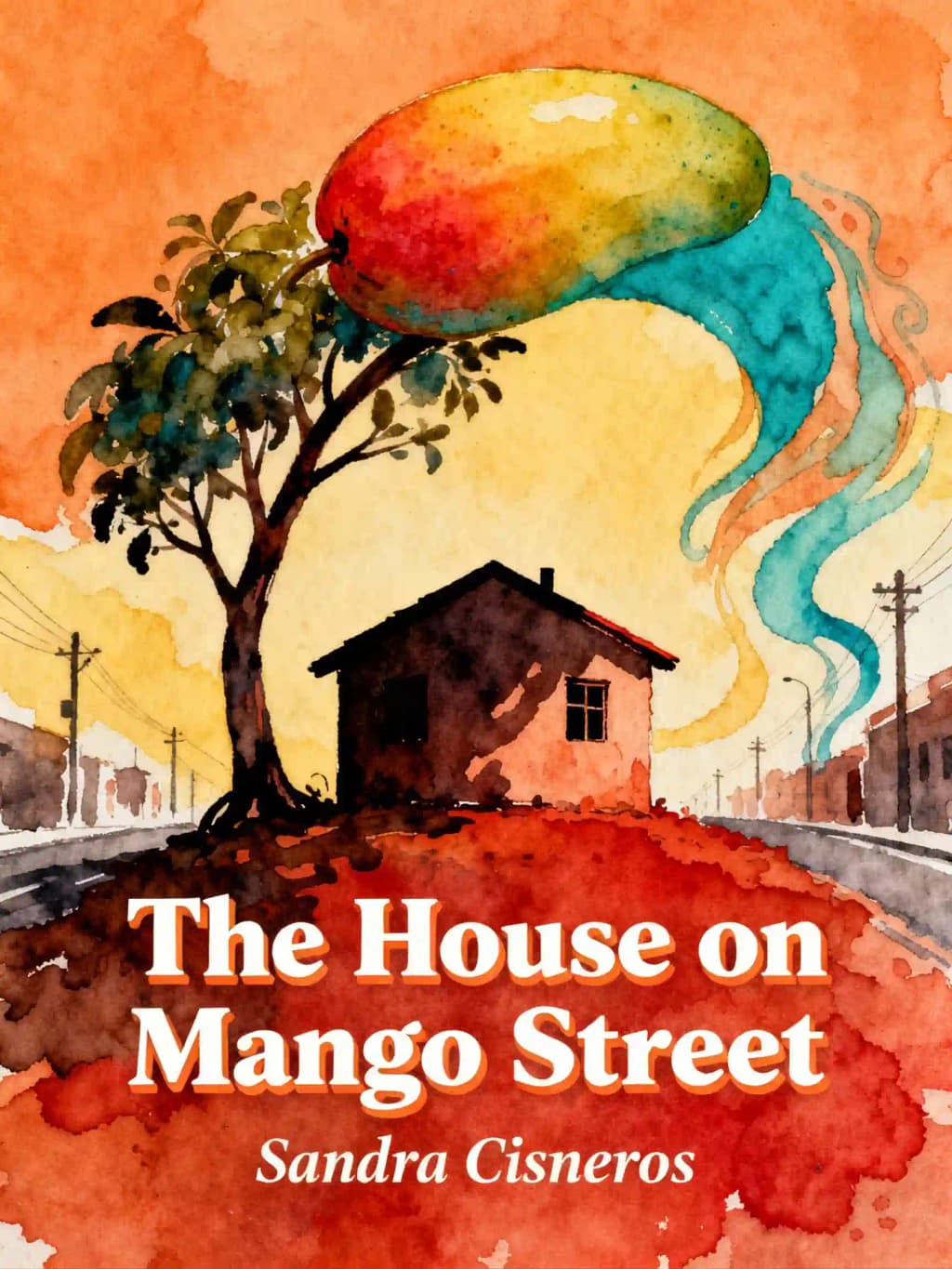
We didn't always live on Mango Street. Before that was Loomis, Keeler, Paulina-a string of temporary addresses marking the family's nomadic existence, each move driven by broken pipes, rising rents, or the endless search for something better. The house on Mango Street represents both achievement and disappointment: it's finally theirs, free from landlords' demands and shared yards, but nothing like the dream house Esperanza's parents promised. Small and red with tight steps, tiny windows, and crumbling bricks, it stands as a physical manifestation of compromise. The stairs lean like angry eyebrows, the front door swells in the rain, and the windows are so small they seem to squint.
For Esperanza, houses are never just buildings-they're symbols of identity and possibility, repositories of dreams and markers of social status. The memory of a nun from school spotting her playing outside their old apartment haunts her: "Where do you live?" When Esperanza pointed to their third-floor apartment with peeling paint and barred windows, the nun's dismissive "You live there?" made her feel like nothing. That moment crystallized her determination to someday have a house she could point to without shame, a house that would command respect rather than pity.
Though her mother calls their situation "temporary," softening the reality with promises of someday, Esperanza knows better: "But I know how these things go." She's seen too many temporary situations become permanent, too many dreams defer to necessity. The gap between the house they have and the house they dream of represents the larger gap between immigrant aspirations and American reality. While her parents might see Mango Street as progress, measuring it against what they left behind, Esperanza sees it as another compromise, another place that doesn't match her vision of home.
This tension between gratitude and disappointment runs throughout the narrative, coloring every description of physical space. When Esperanza visits the houses on the hill where her father works as a gardener, she feels both longing and shame: "One day I'll own my own house, but I won't forget who I am or where I came from." Her promise to let "bums" stay in her attic reveals her compassion and her determination to bridge worlds rather than abandon one for another. She imagines a house that would embrace both her origins and her aspirations, a space where past and future could coexist.
The search for home becomes both literal and metaphorical-a physical space and a state of belonging. "Not a flat. Not an apartment in back. Not a man's house. Not a daddy's," Esperanza dreams, "A house all my own." This vision of independence represents more than property ownership; it's about claiming space in the world, about the right to belong somewhere on her own terms. Her ideal house would have running water and pipes that work, but more importantly, it would have space for her stories, her memories, and her future.
Chapitre 3
Family Portraits: Ties That Bind and Break
Family in The House on Mango Street exists as both sanctuary and constraint. Esperanza's descriptions of her family members reveal intimate connections through small, sensory details. Her mother's hair-"sweet to put your nose into when she is holding you"-becomes a symbol of safety and comfort. The way she sleeps next to her mother at night, listening to rain and Papa's snoring, creates a cocoon of security.
Yet family also means responsibility. As the oldest child, Esperanza must look after her younger sister Nenny: "She can't play with the Vargas kids or she'll turn out just like them." This obligation creates resentment-"I am a red balloon, a balloon tied to an anchor"-while simultaneously revealing Esperanza's protective instincts.
Throughout the neighborhood, we see families shaped by absence and struggle. Rosa Vargas's children run wild after their father abandons them, becoming increasingly dangerous and neglected until tragedy strikes with Angel Vargas's fatal fall. Alicia, whose mother has died, inherits "the rolling pin and the sleepiness" as she struggles to maintain her household while pursuing education. Minerva, barely older than Esperanza, already has two children and an abusive husband who repeatedly leaves and returns.
The patriarchal structure of these families emerges as both cultural tradition and source of trauma. Sally's father beats her "like if I was an animal" out of fear she'll bring shame like his sisters did. Rafaela's husband locks her inside when he goes out playing dominoes because she's "too beautiful" and might run away. These men wield control through violence and confinement, perpetuating cycles that began before them.
Papa, by contrast, appears as a complex figure-hardworking yet limited by circumstance. When he cries after learning of his father's death, Esperanza witnesses his vulnerability: "I hold my Papa in my arms. I hold and hold and hold him." This moment of role reversal reveals both her compassion and her growing awareness of adult frailty.
These family portraits collectively illustrate how bonds of blood create obligations that can either nurture or constrain-sometimes simultaneously. The challenge for Esperanza becomes determining which ties to honor and which to transcend in her quest for self-determination.
Chapitre 4
Language and Identity: Finding Voice Between Worlds
Language serves as both bridge and barrier throughout the narrative, weaving a complex tapestry of cultural identity and belonging. Esperanza's name itself becomes a site of cultural negotiation: "In English my name means hope. In Spanish it means too many letters." This duality reflects her position between worlds, where translation never captures the full meaning or emotional resonance of either language. The name she inherits from her great-grandmother carries weight and history, yet becomes transformed and sometimes diminished in its crossing between cultures.
The pronunciation of her name changes depending on who speaks it-harsh and foreign in English classrooms, musical and flowing in Spanish households. This linguistic difference represents the broader cultural divide Esperanza navigates daily, where each pronunciation carries its own set of expectations and assumptions. Her fantasy of renaming herself "Zeze the X" reveals her desire for an identity that transcends these boundaries, something uniquely her own that cannot be mispronounced or misunderstood. This imagined name becomes a symbol of self-determination and resistance against the limitations of both cultures.
For others in the neighborhood, language limitations create profound vulnerability and isolation. Mamacita, who knows only eight English words, remains trapped in her apartment like a bird in a cage, crying "No speak English" when her young son begins singing a Pepsi commercial. Her linguistic isolation becomes physical isolation, as she clings desperately to Spanish radio and memories of her pink house in Mexico. The commercialization of American culture, represented by the Pepsi jingle, becomes a threat to her cultural identity and connection to home.
Esperanza's bilingualism gives her both power and responsibility in her community. Unlike Mamacita or Geraldo (who dies anonymously after a hit-and-run because he "didn't speak English" and couldn't communicate his identity or needs), she can navigate both worlds with increasing confidence. Her mother proudly declares she "speaks two languages," positioning this ability as cultural capital and a tool for advancement. Yet Esperanza recognizes that true empowerment comes not just from speaking languages but from finding one's own voice within them, from crafting an authentic identity that honors both worlds without being limited by either.
Writing emerges as Esperanza's path to authentic self-expression and liberation. When Aunt Lupe tells her, "You just remember to keep writing, Esperanza. It will keep you free," she offers a prophecy that shapes Esperanza's understanding of her own potential and purpose. Through storytelling, Esperanza can transform experience into meaning, pain into purpose, and confusion into clarity. "I put it down on paper and then the ghost does not ache so much," she explains, revealing writing as both documentation and healing, a way to process the complexities of her dual identity and the struggles of her community.
This linguistic journey culminates in Esperanza's determination to tell stories that honor her community while transcending its limitations-to speak in a voice that is uniquely hers yet connected to her roots on Mango Street. Her evolution as a writer becomes inseparable from her development of identity, as she learns to weave English and Spanish, past and present, tradition and innovation into a narrative voice that bridges worlds while creating something entirely new.
Chapitre 5
Coming of Age: The Painful Awakening
Esperanza's journey from childhood to adolescence unfolds through a series of awakenings-some beautiful, others brutal. We witness her first awareness of how others perceive her, her emerging sexuality, and her growing understanding of womanhood's complexities in her community.
The girls' discovery of high-heeled shoes marks a pivotal moment in this transition. When they try on the dancing shoes-red, yellow, and blue-their skinny legs suddenly become "good to look at," attracting unwanted male attention. A drunk man offers Rachel a dollar for a kiss, teaching them that female beauty carries both power and danger. They hide the shoes afterward, suddenly "tired of being beautiful."
This lesson continues through Esperanza's observations of other women. Sally, with her "eyes like Egypt" and makeup, seems sophisticated but trades sexual favors for protection from her abusive father. Marin stands under the streetlight at night, waiting for someone to change her life. These women use their sexuality as currency in a world that offers them few other resources.
Esperanza's own sexual awakening comes with violence rather than tenderness. At a carnival, while waiting for Sally, she's assaulted by a group of boys: "Sally, you lied... It wasn't what you said at all." The stark contrast between romantic expectations-"all the books and magazines, everything that told it wrong"-and the reality of violation leaves her disillusioned and angry.
Yet Esperanza also witnesses alternative models of womanhood. Alicia studies at the university despite her father's insistence that "a woman's place is sleeping so she can wake up early with the tortilla star." The three sisters who appear mysteriously recognize something special in Esperanza, telling her she will "go very far." These figures offer glimpses of possibility beyond the limited roles she sees around her.
Throughout these experiences, Esperanza develops a fierce determination not to become "tame like the others who lay their necks on the threshold waiting for the ball and chain." She admires women in movies who are "beautiful and cruel," who maintain their power by refusing to surrender it. Her quiet rebellion begins with simple acts-leaving the table without pushing in her chair, "the way a man does."
This coming-of-age narrative avoids easy resolution, instead showing the messy, contradictory process of becoming. Esperanza neither fully rejects nor embraces the models of womanhood available to her-she observes, questions, and gradually begins to imagine alternatives.
Chapitre 6
Neighbors and Community: The Tapestry of Mango Street
Mango Street comes alive through its cast of characters-each vignette adding another thread to the neighborhood's complex tapestry. These neighbors form a community bound by proximity, shared struggles, and cultural connections, even as individual stories reveal profound isolation.
The neighborhood functions as both protection and prison. When outsiders enter, they come "with their mean eyes looking for bad," afraid because they don't know "all the boys who are day-old bread." Within its boundaries, however, residents understand each other's stories: "That's Davey the Baby's brother... that's Rosa's Eddie V., and that's Fat Boy, though he's not fat anymore."
Yet this familiarity doesn't always translate to care. When Rosa Vargas's children run wild after their father's abandonment, the community initially tries to help but eventually gives up: "No one looked out for them. They moved through the neighborhood like hungry dogs."
The characters inhabiting Mango Street represent various responses to marginalization. Meme Ortiz with his bilingual dog adapts playfully to straddling two cultures. Ruthie, who lives with her mother despite having her own house somewhere else, exists in a perpetual state of temporary displacement. Earl, the jukebox repairman, creates a nocturnal life separate from the community, bringing mysterious women who may or may not be his wife into his basement apartment.
Some neighbors offer Esperanza glimpses of possibility. Alicia, who takes two trains and a bus to attend university, shows that education might provide escape. The three sisters who appear during a wake recognize Esperanza's potential: "When you leave you must remember to come back for the others." Others serve as cautionary tales-Sally marries before eighth grade to escape her father's abuse, only to find herself trapped by a controlling husband.
Throughout these encounters, Esperanza remains both participant and observer, connected to her community yet increasingly aware of her desire to transcend it. This tension culminates in her conversation with Alicia on Edna's steps. When Alicia insists, "Like it or not you are Mango Street," Esperanza responds with both rejection and responsibility: "Not me. Not until somebody makes it better." When asked who will make it better, her laughter reveals her emerging understanding that this task might fall to her.
Chapitre 7
The Female Experience: Constraints and Resistance
The women of Mango Street navigate a world of limited options and patriarchal control, their stories collectively forming a powerful portrait of female experience. From young girls to grandmothers, these women demonstrate various strategies for survival and resistance within confining circumstances.
Physical confinement serves as a literal manifestation of women's restricted freedom. Rafaela's husband locks her in their apartment when he goes out because she's "too beautiful to be left alone." She leans out the window, lowering a shopping bag on a clothesline so neighborhood children can buy her coconut or papaya juice-her small taste of the tropical drinks served at the dance hall where she longs to go "before she gets old."
Sally's father keeps her under similarly strict control, afraid she'll run away like his sisters who "made the family ashamed." His fear manifests as violence: "He just forgot he was her father between the buckle and the belt." Sally eventually escapes through early marriage, only to find herself in another form of confinement with a husband who forbids her from looking out the window or using the telephone.
For other women, confinement is economic or social rather than physical. Esperanza's mother laments her abandoned potential: "I could've been somebody, you know?" Though talented and intelligent-she speaks two languages, can sing opera, fix televisions, and draw-she quit school because she "didn't have nice clothes" and now warns Esperanza not to become "a fool" like Madame Butterfly, dependent on a man who might leave.
Against these constraints, women develop various forms of resistance. Alicia defies expectations by attending university despite her father's insistence that "a woman's place is sleeping so she can wake up early with the tortilla star." Marin stands under the streetlight at night, wearing dark nylons and Avon lipstick, dreaming of a downtown job and a man who might marry her into a better life.
Esperanza observes these strategies critically, gradually developing her own response to the limited options she sees. She admires movie heroines who are "beautiful and cruel," who drive men crazy but refuse to surrender their power. She rejects becoming "tame like the others who lay their necks on the threshold waiting for the ball and chain."
Writing emerges as Esperanza's unique form of resistance. Through storytelling, she can transform experience, preserve memory, and imagine alternatives: "I put it down on paper and then the ghost does not ache so much." This creative power offers a path beyond the physical and social constraints that limit other women in her community.
Chapitre 8
Dreams and Disappointments: The Space Between
Throughout The House on Mango Street, dreams collide with reality, creating a poignant space where characters navigate between aspiration and limitation. These dreams-of better houses, education, romance, escape-reveal both the human capacity for hope and the structural barriers that often thwart it.
The gap between expectation and reality appears immediately in the description of the family's house on Mango Street. After years of moving and promises of a real house, the reality proves disappointing: "But the house on Mango Street is not the way they told it at all." This physical structure becomes a metaphor for the broader immigrant experience-the distance between American dreams and American realities.
For many characters, dreams function as necessary survival mechanisms. Mamacita clings to memories of her pink house in Mexico while trapped in an apartment she refuses to leave. Marin stands under the streetlight dreaming of a downtown job and a husband who might change her life. Ruthie claims she's just visiting her mother temporarily, though she never returns to the house she says she has outside the city.
Some dreams are interrupted by violence or necessity. Esperanza's mother abandoned her artistic aspirations: "I could've been somebody, you know?" Sally's romantic fantasies lead her to an early marriage that becomes another form of confinement. Alicia studies despite exhaustion because she doesn't want to spend her life "in a factory or behind a rolling pin."
Esperanza's own dreams evolve throughout the narrative. Her initial desire for a house "like the ones on TV" transforms into something more complex-"Not a man's house. Not a daddy's. A house all my own." This dream represents not just physical space but autonomy and creative freedom: "Only a house quiet as snow, a space for myself to go, clean as paper before the poem."
The three sisters who mysteriously appear recognize Esperanza's potential to realize her dreams while warning her of accompanying responsibility: "When you leave you must remember to come back for the others." This counsel transforms Esperanza's individual aspiration into a communal vision-success not just for herself but for those "who cannot out."
This tension between individual dreams and community responsibility culminates in Esperanza's declaration: "They will not know I have gone away to come back. For the ones I left behind. For the ones who cannot out." Her dream of escape becomes simultaneously a dream of return and transformation-not abandonment but a more complex commitment to both personal growth and community uplift.
Chapitre 9
The Power of Storytelling: Writing as Salvation
At its core, The House on Mango Street is a book about writing itself-about how storytelling transforms experience, preserves memory, and creates possibility. Through Esperanza's developing voice, we witness the power of narrative to both document reality and transcend it.
Esperanza's earliest understanding of storytelling comes through observation. She notices how her father tells stories about a house they'll have someday, stories she recognizes as both beautiful and untrue. She watches her mother sing like Madame Butterfly while cooking oatmeal, then suddenly warn against becoming "a fool" like that character. These family narratives reveal how stories can both sustain hope and mask disappointment.
Her own storytelling begins as a private practice: "I like to tell stories. I tell them inside my head." She creates narratives for everyday actions-"And so she trudged up the wooden stairs, her sad brown shoes taking her to the house she never liked"-transforming mundane experience into meaningful narrative. This internal storytelling provides a way to process and understand her world.
Aunt Lupe recognizes Esperanza's gift, encouraging her to continue writing even as her own body fails: "You just remember to keep writing, Esperanza. It will keep you free." This advice positions writing as both liberation and preservation-a way to escape limitations while honoring what might otherwise be forgotten.
Throughout the book, Esperanza documents the stories of those around her-Marin waiting under the streetlight, Minerva writing poems on tiny folded papers after her children sleep, Geraldo dying anonymously after a hit-and-run. These narratives might otherwise disappear, but through Esperanza's telling, they become part of a larger tapestry of experience.
Writing also allows Esperanza to transform pain: "I put it down on paper and then the ghost does not ache so much." After traumatic experiences like her assault at the carnival, storytelling offers a way to process what happened and reclaim agency. The very structure of the book-fragmented vignettes that circle back to central themes-mimics how memory works, how we make sense of experience through narrative.
By the conclusion, writing has become Esperanza's path forward: "One day I will pack my bags of books and paper and say goodbye to Mango Street." Yet this departure isn't abandonment but transformation-using stories to bridge worlds: "They will not know I have gone away to come back. For the ones I left behind. For the ones who cannot out."
Through Esperanza's journey, Cisneros demonstrates how storytelling can be the ultimate act of resistance and remembrance-a way to honor where we come from while imagining where we might go.