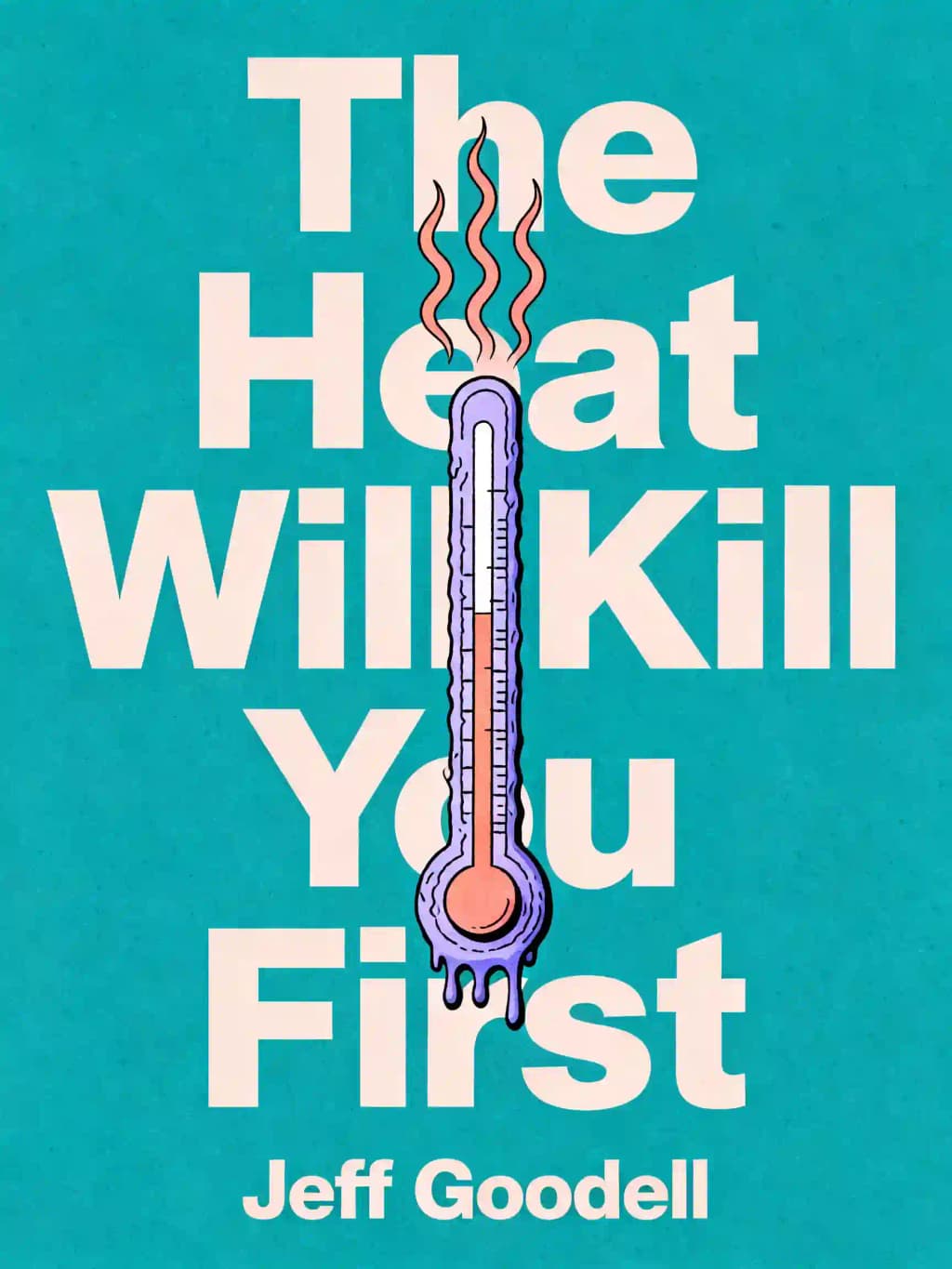
In "The Heat Will Kill You First," Jeff Goodell delivers a chilling wake-up call about our scorching planet. This NYT bestseller reveals how heat waves silently killed 72,000 Europeans in 2003 while the wealthy escape and the vulnerable suffer. What temperature will finally force us to act?
Jeff Goodell, bestselling author of The Heat Will Kill You First: Life and Death on a Scorched Planet, is an award-winning journalist and leading voice on climate change. A contributing editor at Rolling Stone for nearly three decades, Goodell has built his career investigating environmental crises, energy politics, and their human impacts.
His deeply researched nonfiction works, including The Water Will Come (a New York Times Critics’ Top Book) and Big Coal, blend scientific rigor with narratives about societal vulnerability.
Goodell’s climate reporting has taken him from sinking coastal cities to geoengineering labs, earning appearances on NPR, MSNBC, and The Oprah Winfrey Show. A Senior Fellow at the Atlantic Council, he translates complex science into urgent stories, informed by interviews with policymakers and frontline communities.
The Heat Will Kill You First became an instant New York Times bestseller and was named one of 2023’s best books by NPR and The Economist, cementing his reputation for exposing climate threats with clarity and moral force.
The Heat Will Kill You First examines extreme heat as climate change’s deadliest consequence, blending science, journalism, and human stories. Jeff Goodell explores how rising temperatures disrupt ecosystems, exacerbate inequality, and threaten survival through events like lethal heatwaves and collapsing Arctic ice. The book frames heat as a transformative force, urging systemic adaptation and equity-driven solutions.
Climate advocates, policymakers, and readers seeking actionable insights into heat-related risks will find this book essential. It’s particularly relevant for those interested in environmental justice, urban planning, or public health, as it highlights vulnerable populations and adaptive strategies.
Yes—Goodell’s gripping narrative combines rigorous research with vivid storytelling, earning praise as “one of the most eloquent and terrifying climate books.” It’s a New York Times bestseller lauded for making complex science accessible and emphasizing heat’s immediate human toll.
While The Water Will Come focused on sea-level rise’s slow creep, this book underscores heat’s rapid, visceral impacts. Both emphasize climate justice, but Heat prioritizes urgency, framing temperature spikes as a present-day emergency rather than a distant threat.
Goodell advocates for heat-resistant city design (e.g., green roofs), worker protections, and renaming heatwaves (like hurricanes) to boost public awareness. He stresses that solutions must center marginalized communities, who face the gravest risks.
Some reviewers argue the book could delve deeper into renewable energy’s role in mitigating heat. Others note its dystopian tone might overwhelm readers, though many praise its unflinching urgency as a necessary wake-up call.
Goodell details how temperatures above 104°F (40°C) denature proteins, cause organ failure, and trigger “heat tsunamis” in the bloodstream. He emphasizes that humidity exacerbates these effects, making survival impossible without rapid cooling.
The book links heat-driven crop failures and uninhabitable zones to rising displacement, particularly in the Global South. Goodell critiques border policies that criminalize climate refugees instead of addressing root causes.
With record-breaking temperatures now occurring annually, the book’s warnings about unprepared infrastructure and health systems remain critical. Its focus on equity aligns with growing advocacy for climate reparations and worker safeguards.
Ressentez le livre à travers la voix de l'auteur
Transformez les connaissances en idées captivantes et riches en exemples
Capturez les idées clés en un éclair pour un apprentissage rapide
Profitez du livre de manière ludique et engageante
Wealth buys coolness, while poverty can be a death sentence.
Adaptation has limits, especially for the vulnerable.
Heat isn't just uncomfortable-it's an extinction-level threat.
Proper hydration can delay heat exhaustion but cannot prevent heatstroke.
We've been lulled into believing technology has tamed nature's forces.
Décomposez les idées clés de Heat Will Kill You First en points faciles à comprendre pour découvrir comment les équipes innovantes créent, collaborent et grandissent.
Condensez Heat Will Kill You First en indices de mémoire rapides mettant en évidence les principes clés de franchise, de travail d'équipe et de résilience créative.

Découvrez Heat Will Kill You First à travers des récits vivants qui transforment les leçons d'innovation en moments mémorables et applicables.
Posez n'importe quelle question, choisissez la voix et co-créez des idées qui résonnent vraiment avec vous.

Cree par des anciens de Columbia University a San Francisco
"Instead of endless scrolling, I just hit play on BeFreed. It saves me so much time."
"I never knew where to start with nonfiction—BeFreed’s book lists turned into podcasts gave me a clear path."
"Perfect balance between learning and entertainment. Finished ‘Thinking, Fast and Slow’ on my commute this week."
"Crazy how much I learned while walking the dog. BeFreed = small habits → big gains."
"Reading used to feel like a chore. Now it’s just part of my lifestyle."
"Feels effortless compared to reading. I’ve finished 6 books this month already."
"BeFreed turned my guilty doomscrolling into something that feels productive and inspiring."
"BeFreed turned my commute into learning time. 20-min podcasts are perfect for finishing books I never had time for."
"BeFreed replaced my podcast queue. Imagine Spotify for books — that’s it. 🙌"
"It is great for me to learn something from the book without reading it."
"The themed book list podcasts help me connect ideas across authors—like a guided audio journey."
"Makes me feel smarter every time before going to work"
Cree par des anciens de Columbia University a San Francisco

Obtenez le resume de Heat Will Kill You First en PDF ou EPUB gratuit. Imprimez-le ou lisez-le hors ligne a tout moment.
On a summer day in 2021, a family set out for what should have been an easy hike in California's Sierra Nevada foothills. Jonathan Gerrish, Ellen Chung, their one-year-old daughter Miju, and their dog Oski never came home. Search teams found them the next morning-all four dead on a remote trail. No signs of foul play, no visible injuries. Just a family that had walked into the heat and never walked out. The culprit was invisible, odorless, and utterly merciless: extreme heat. Their final text message, sent at 11:56 a.m., read: "No water or ver heating with baby." What killed them wasn't a lack of preparation or poor judgment-it was our collective failure to grasp that we're living on a fundamentally different planet than the one we evolved to inhabit. Heat doesn't just make us uncomfortable anymore. It kills. And it's getting deadlier every year. Your body is essentially a heat machine that must maintain an internal temperature around 98 degrees. When you step into scorching weather, an elegant system kicks in: blood rushes to your skin, sweat glands activate, and evaporation cools you down. But this system has hard limits. At a wet bulb temperature of 95 degrees-a measure combining heat and humidity-even a perfectly healthy person sitting in the shade will eventually die. There's a common myth that proper hydration prevents heatstroke. It doesn't. Water delays heat exhaustion, but it cannot prevent your core temperature from climbing to lethal levels. When your body reaches 105 degrees, seizures begin. At 107, your cell membranes start melting. Your kidneys collapse, your muscles disintegrate, your intestines develop holes that leak toxins into your bloodstream, and your blood begins clotting uncontrollably. This is what happened to the Gerrish family on that shadeless trail where ground temperatures reached 109 degrees. Each member faced unique vulnerabilities: Oski couldn't sweat, baby Miju's sweat glands weren't fully developed, Jonathan carried extra weight, and Ellen-despite being fit-simply couldn't escape the physics of overheating. Heat doesn't discriminate based on good intentions.