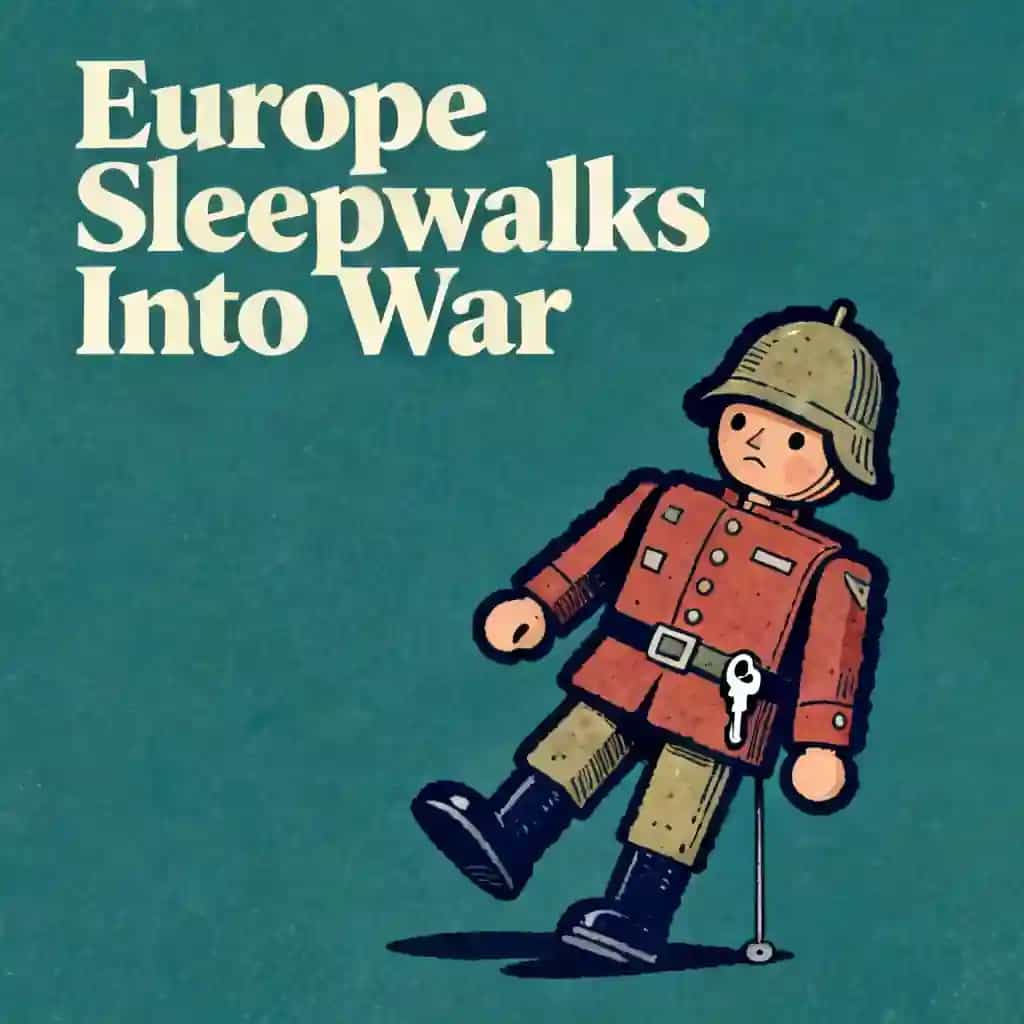
In August 1914, miscalculation ignited global catastrophe. "The Guns of August" - the Pulitzer-winning masterpiece JFK credited with preventing nuclear war during the Cuban Missile Crisis - reveals how diplomatic blunders cascade into bloodshed. What catastrophic mistakes are today's leaders repeating?
Barbara Wertheim Tuchman (1912–1989) was a Pulitzer Prize-winning historian renowned for her narrative mastery of 20th-century conflicts. Her landmark work The Guns of August (1962), examining the critical first month of World War I, exemplifies her signature approach of weaving geopolitical analysis with vivid human drama.
Educated at Radcliffe College and a former journalist for The Nation, Tuchman earned dual Pulitzers—for The Guns of August and Stilwell and the American Experience in China—and influenced global leaders like President John F. Kennedy during the Cuban Missile Crisis. Her books, including The Proud Tower and A Distant Mirror, remain classics of accessible scholarship.
Robert Kinloch Massie (1929–2019) was a Pulitzer-winning biographer acclaimed for transforming Russian imperial history into compelling narratives. He contributed the foreword to this edition of The Guns of August, bridging his expertise in World War I naval history—explored in Dreadnought and Castles of Steel—with Tuchman’s ground-level analysis.
A Rhodes Scholar and former journalist for Newsweek and The Saturday Evening Post, Massie’s Nicholas and Alexandra sold 4.5 million copies and inspired an Oscar-winning film, while Peter the Great earned him the 1981 Pulitzer. His final work, Catherine the Great, solidified his legacy.
"The Guns of August" by Barbara W. Tuchman is a Pulitzer Prize-winning narrative history of the first month of World War I (August 1914). It chronicles how European powers stumbled into catastrophic conflict through diplomatic miscalculations, rigid military plans like Germany’s Schlieffen Plan, and leadership failures. The book details pivotal events—from Germany’s invasion of Belgium to the Battle of the Marne—that set the stage for trench warfare.
History enthusiasts, students of military strategy, and political science readers will find this essential. Tuchman’s vivid prose dissects how leadership decisions can escalate crises—making it crucial for those analyzing conflict prevention or 20th-century geopolitics. Its lessons on diplomatic failures remain relevant for policymakers and educators.
Absolutely. Tuchman’s masterpiece blends rigorous scholarship with gripping storytelling, offering timeless insights into how small miscalculations trigger global disasters. Its influence on President Kennedy during the Cuban Missile Crisis underscores its enduring value for understanding crisis management.
The book redefined popular history by arguing that August 1914’s rigid war plans and leadership failures doomed Europe to protracted war. Kennedy cited it to resist military escalation during the Cuban Missile Crisis, highlighting its real-world impact. Its Pulitzer Prize cemented its status as a seminal WWI analysis.
Tuchman examines:
President Kennedy applied Tuchman’s lessons during the Cuban Missile Crisis, rejecting generals’ push for airstrikes. He explicitly referenced the book to avoid repeating 1914’s "cycle of escalation," opting for naval blockades and diplomacy instead.
Critics note:
Tuchman depicts Tannenberg (August 1914) as a German tactical triumph against Russia, but a strategic error. Diverting troops east weakened Germany’s western advance, contributing to the Marne stalemate. She highlights command disarray and poor Russian logistics.
She attributes it to:
King Edward VII’s 1910 funeral introduces Europe’s tense alliances. Monarchs present—including Kaiser Wilhelm II—embodied the rivalries that later fueled war. Tuchman foreshadows conflict through their uneasy interactions.
The German cruiser Goeben’s escape to Constantinople drew the Ottoman Empire into the war. Tuchman calls this a "ruinous domino effect": Churchill deemed it a pivotal error that extended the war’s scope and carnage.
Unlike comprehensive surveys (e.g., Keegan), Tuchman’s micro-focus on August 1914 uses narrative drama to humanize strategic blunders. It prioritizes contingency over inevitability—arguing alternate decisions could have averted war.
Ressentez le livre à travers la voix de l'auteur
Transformez les connaissances en idées captivantes et riches en exemples
Capturez les idées clés en un éclair pour un apprentissage rapide
Profitez du livre de manière ludique et engageante
Military necessity trumped all other considerations.
The French Army henceforth admits no law but the offensive.
It is better to lose a province than split the forces.
The heart of France lies between Brussels and Paris.
Never speak of it; think of it always.
Décomposez les idées clés de The Guns of August en points faciles à comprendre pour découvrir comment les équipes innovantes créent, collaborent et grandissent.
Condensez The Guns of August en indices de mémoire rapides mettant en évidence les principes clés de franchise, de travail d'équipe et de résilience créative.

Découvrez The Guns of August à travers des récits vivants qui transforment les leçons d'innovation en moments mémorables et applicables.
Posez n'importe quelle question, choisissez la voix et co-créez des idées qui résonnent vraiment avec vous.

Cree par des anciens de Columbia University a San Francisco
"Instead of endless scrolling, I just hit play on BeFreed. It saves me so much time."
"I never knew where to start with nonfiction—BeFreed’s book lists turned into podcasts gave me a clear path."
"Perfect balance between learning and entertainment. Finished ‘Thinking, Fast and Slow’ on my commute this week."
"Crazy how much I learned while walking the dog. BeFreed = small habits → big gains."
"Reading used to feel like a chore. Now it’s just part of my lifestyle."
"Feels effortless compared to reading. I’ve finished 6 books this month already."
"BeFreed turned my guilty doomscrolling into something that feels productive and inspiring."
"BeFreed turned my commute into learning time. 20-min podcasts are perfect for finishing books I never had time for."
"BeFreed replaced my podcast queue. Imagine Spotify for books — that’s it. 🙌"
"It is great for me to learn something from the book without reading it."
"The themed book list podcasts help me connect ideas across authors—like a guided audio journey."
"Makes me feel smarter every time before going to work"
Cree par des anciens de Columbia University a San Francisco

Obtenez le resume de The Guns of August en PDF ou EPUB gratuit. Imprimez-le ou lisez-le hors ligne a tout moment.
Edward VII's funeral in May 1910 marked the last gathering of Europe's royalty before the world changed forever. Nine kings rode through London's streets, led by the new King George V flanked by his cousin Kaiser Wilhelm II. Behind them followed heirs apparent, royal highnesses, and queens in an unprecedented assembly of European power. The Kaiser, astride a gray horse in a British Field Marshal's uniform, harbored conflicted emotions - nostalgia for his English relations mixed with satisfaction at Edward's death, whom he had venomously called "Satan" for diplomatically isolating Germany. Among the procession rode Belgium's unassuming King Albert I and the ill-fated Archduke Franz Ferdinand, whose assassination would spark the coming war. Edward's diplomatic achievements had transformed Britain's "splendid isolation" into new alliances with France and Russia, creating the Triple Entente that would prove crucial in the coming conflict. Meanwhile, Germany under Kaiser Wilhelm pursued aggressive naval expansion that directly challenged British maritime supremacy, ignoring Bismarck's warning to remain content with continental power. The German leadership suffered from a profound psychological complex - a terrible need for recognition on the world stage. When other nations naturally formed defensive alliances in response, Germany's cry of "Einkreisung!" (Encirclement!) became a self-fulfilling prophecy driving Europe toward catastrophe.